Families, Caregivers, Children, and Changing Life Roles
Who cares and what it costs, caregiver assessment and backup, children in the household, and role loss.
PublishedNailathalaGipatikPepalwal:ReferencesMga SanggunianMga TinubdanReng Reperensya:3Audience: Registered social workers in dialysis units, hospital medical social work departments, and kidney transplant programs · medical social workers rotating into kidney care · navigation and support staff on the orientation pathRead timeOras ng pagbasaOras sa pagbasaOras ning pamamasa:
This module is study material for social workers and navigation staff in kidney care. It explains the reasoning behind social work decisions; it is not a facility procedure, legal advice, a benefits ruling, or a mental health diagnosis. Rules, assistance programs, and amounts change: confirm them against the current issuance and your facility’s approved policy. Medical treatment belongs to the nephrologist, benefits to PhilHealth, donation ethics to the ethics committee, and psychiatric diagnosis to the mental health team. Every case, name, and identifier is fictional.
Learning objectives
After this module you should be able to
Describe what caregiving for a person on dialysis involves and what the evidence says about caregivers’ quality of life.
Assess a caregiver’s tasks, capacity, strain, and backup in a separate conversation.
Build a written caregiver plan with shared tasks and a named backup before strain becomes collapse.
Recognize children and adolescents carrying adult caregiving roles, and protect their schooling and safety.
Support a person whose roles as worker, parent, or provider have changed, without treating the loss as illness.
Classroom 1 hSkills lab 1 hSupervised placement 1 h
Pre-testBefore you read, answer the 5 self-assessment questions and note your score. After the module, select New set of questions and compare. The difference is what you learned; the questions you still miss are what to reread.
Start here
The big picture, in plain words
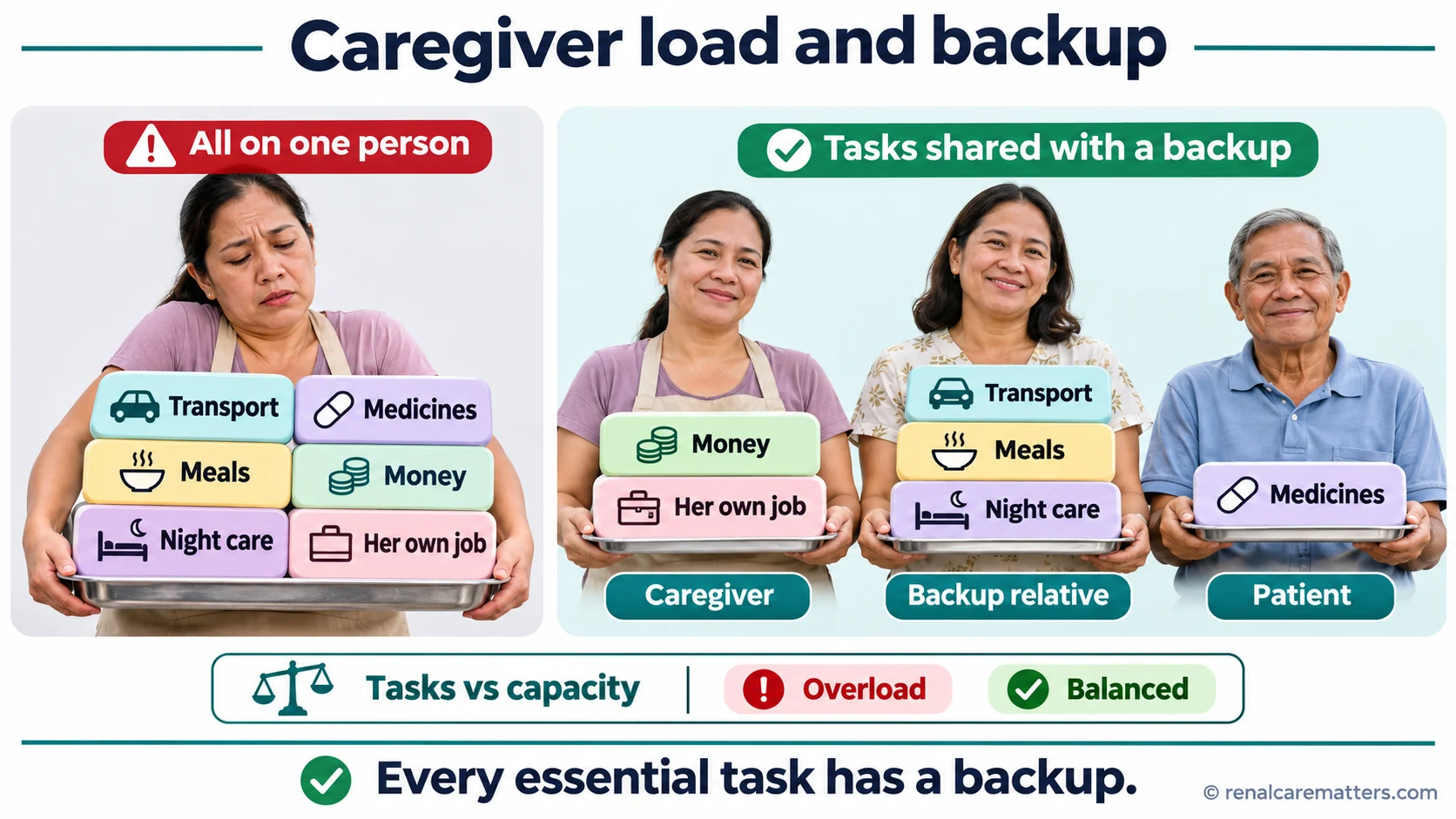
In plain wordsA family caring for someone on dialysis is like a bamboo raft: many poles tied together, each carrying part of the load. When one pole carries everything (usually a wife, a daughter, or a mother), the raft tilts. It does not sink all at once. It tilts slowly, until one day that pole snaps.
Figure 1. Caregiver load. List the tasks, the person's capacity, and the backup before strain becomes collapse.
The picture has a limit. Bamboo does not tell you when it is about to break. Caregivers often do not either. Many feel it is their duty, or that complaining would betray the person they love. They come to the unit three times a week, sit in the waiting area for four hours, and say “Okay lang po” when asked. The person on dialysis is the patient; the caregiver is usually invisible to the team until they collapse, fall ill, or stop coming.
Your job in this module is to make caregivers visible: to assess them in their own right, to spread the load before it breaks someone, to notice children who have become caregivers, and to help the whole family adjust to changed roles. The evidence is clear that caregiving costs something. A systematic review of 61 studies with 5,367 caregivers in 21 countries found that most caregivers were female spouses, and that their quality of life was poorer than the general population’s and similar to that of caregivers for other chronic diseases; most studies were cross-sectional and of generally poor quality.1 Caregivers of people choosing conservative kidney management carry a similar burden.2
Figure 2 · Key terms for this module
CaregiverA family member or friend who gives unpaid help with daily life, treatment, or money.
Caregiver strainThe physical, emotional, social, and financial cost of caregiving.
Backup caregiverA named second person who takes over tasks when the main caregiver cannot.
Young carerA child or adolescent who takes on caregiving tasks usually done by adults.
RespitePlanned time off for a caregiver while someone else takes over.
Role changeA shift in a person’s place in the family, such as from provider to dependent.
Opening case · fictional
Case: Aling Nena is exhausted
Saturday, 11:30 a.m. Mrs. Nena Dizon, 55, has brought her husband Romeo to every dialysis session for three years. You first met him in Module 10. Today, while he is on the machine, she asks to speak to you alone. She starts crying before she sits down.
She gave up her market stall eight months ago. She sleeps four hours a night because he wakes with itching and worry. She manages his eleven medicines, cooks separately for him, and handles all the money. Her blood pressure was high at her own check-up, but she has not gone back. Their daughter, Ella, 15, now cooks for her two younger brothers and has missed school twice this month to bring her father to dialysis when Nena was sick.
“I cannot complain,” she says. “He is the one who is sick. But I do not know how long I can do this.”
Before reading on, decide:
How do you assess Aling Nena as a person in her own right?
What would a caregiver plan for this family include?
What do you do about Ella?
Keep your answers in mind. The lesson gives you what you need, and the case review near the end shows one sound response.
Lesson · part 1
Making the load visible
Caregiving for someone on dialysis is a long list of tasks: transport three times a week, waiting through sessions, medicines, special cooking, money and paperwork, night care, emotional support, and often lost income. Most of it is invisible to the team, which sees only the person in the chair.
Area
Typical tasks
What it costs the caregiver
Transport and waiting
3 trips and about 12 hours of waiting a week
Work, sleep, own health appointments
Medicines and diet
Sorting many medicines; separate cooking
Time, worry about mistakes
Money and paperwork
Benefit and assistance applications, bills
Queues, debt, conflict
Night and emotional care
Itch, breathlessness, fear, low mood
Sleep loss, exhaustion, sadness
Household roles
Taking over the patient’s former roles
Lost income, isolation, role overload
Caregivers are often patients too. A caregiver who skips her own check-ups, sleeps four hours, and has stopped seeing friends is at risk of becoming ill herself, which would leave the household with two people needing care.
RememberCount the caregiver’s tasks and hours. The team sees the patient; you must see the person beside the chair.
Lesson · part 2
A separate conversation
Assess the caregiver in a separate, private conversation, with the patient’s knowledge. Caregivers rarely speak freely in front of the person they care for. Ask four things: what they do (tasks), what they can manage (capacity), what it is costing them (strain), and who could share it (backup).
Figure 3 · A caregiver conversation
Tasks“Walk me through a dialysis day and a non-dialysis day. What do you do?”
Capacity“What can you keep doing, and what is getting too much?”
Strain“How are you sleeping? Your own health? Your work? Your mood?” Screen for distress and ask about safety if signals appear.
Backup“Who else could do any of this, even one task, one day a week?”
Their own goal“What would make the biggest difference for you?”
Caregiver strain can be measured with published scales; some are copyrighted and need permission to use, so this course does not reproduce one. A structured conversation covering the four areas is enough to plan. If the caregiver shows signs of depression or says anything suggesting thoughts of self-harm, the screening and safety steps of Modules 10 and 11 apply to them as much as to any patient.
What helps? A 2026 systematic review of interventions for caregivers of people with chronic kidney disease found 13 studies (education, mindfulness, relaxation, peer mentoring, and others); a meta-analysis of five education and skills-training programs showed reduced caregiver burden, but certainty was low and the studies varied widely.3 That supports offering practical education and skills, and being honest that the evidence is thin.
RememberSee the caregiver alone. Ask about tasks, capacity, strain, backup, and their own goal.
Lesson · part 3
Spread the load before it breaks
A caregiver plan turns the conversation into shared tasks. Write it with the caregiver and, with consent, the wider family.
Task
Main person
Backup
Help available
Transport Monday, Wednesday, Friday
Wife
Brother-in-law on Wednesdays
Shared ride with another patient (Module 9)
Medicines
Wife
Patient himself with a picture chart
Pharmacist simplifies timing; nurse teaches
Night itch and sleep
Wife
—
Nephrologist reviews itch; sleep plan
Assistance paperwork
Wife
Eldest niece
Social worker prepares documents
Caregiver’s own check-up
Wife
—
Booked on a non-dialysis day
Two parts of the plan protect against collapse. A named backup for every essential task, so that one person’s illness does not mean a missed session. And protected time for the caregiver: her own health appointments, some sleep, some contact with friends or church. Respite can be as simple as a relative sitting with the patient one morning a week.
Ask the patient how he wants to contribute. People on dialysis are rarely helpless; many can take back a task (sorting their own medicines, managing one bill) and feel better for it.
RememberEvery essential task has a backup. Every caregiver has protected time for their own health.
Lesson · part 4
Young carers and lost roles
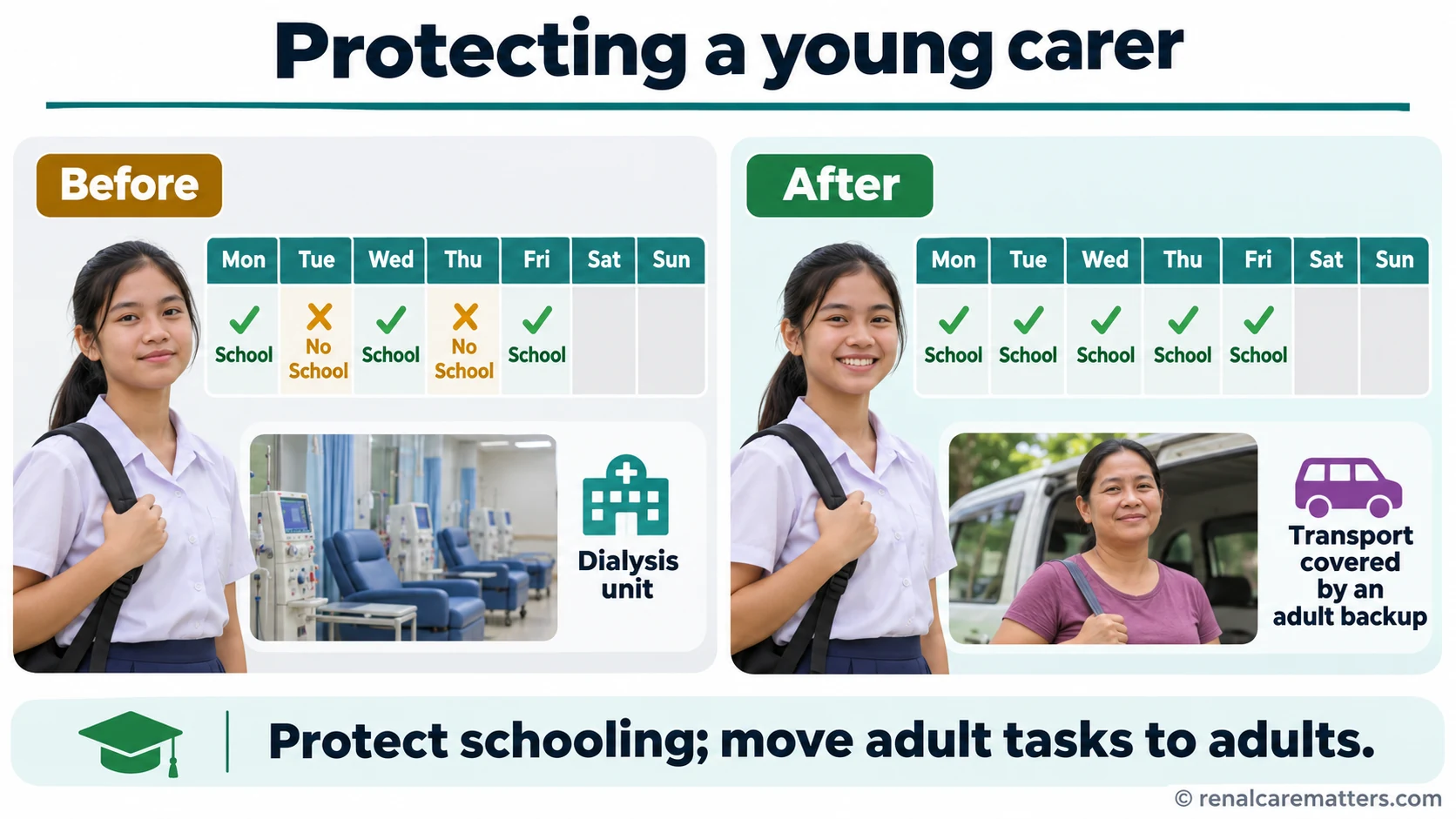
When a parent is on dialysis, children often take on adult work: cooking, caring for siblings, bringing the parent to dialysis, managing medicines. Some of this builds responsibility. Too much costs them their schooling, friendships, and childhood, and it is often hidden because the family is proud of them.
Figure 4. A child’s schooling is not a backup plan.
Warning sign
What you do
Missing school to bring a parent to dialysis
Change the transport plan so no school days are lost
Doing night care for a parent
Move night tasks to adults; ask the nephrologist about the symptoms
Signs of distress or falling grades
With the family’s agreement, involve the school guidance counselor
A child left without adult care
Child protection comes first (Module 11)
Adults lose roles too. A man who was the family’s provider may now feel he is a burden; a grandmother who ran the household may now be told what to eat. Grief over lost roles is normal, not a disorder. Help the person name what they have lost, find roles they can still hold (adviser, teacher, keeper of family stories, the one who manages the budget), and watch for depression if the grief deepens (Module 10).
RememberProtect children’s schooling and childhood. Help adults find roles they can still hold.
On the floor · The budget keeper
A former bank teller on dialysis tells social worker Ms. Pia Aquino he feels useless since his wife took over everything.
With both of them, she suggests he take back the household budget and the assistance tracking. A month later his wife has an afternoon free each week, and he says he feels “like the head of the house again.”
Giving a task back can lift two people at once.
Illustrative scenario. Names and details are invented.
On the floor
Real situations: problems and solutions
These are fictional but typical. For each one, cover the answer, decide what you would do, then compare. Where a step depends on local rules, your unit’s procedure and your supervisor’s direction come first.
“Okay lang po”
What you see
A caregiver always says she is fine, but has stopped going to church and her own check-ups.
What is likely going on
Hidden strain.
What to do
Ask for a private conversation about her own health and backup.
Why it matters
Caregivers rarely volunteer their limits.
The 15-year-old cook
What you see
A teenager cooks for three siblings and brings her father to dialysis.
What is likely going on
A young carer whose schooling is at risk.
What to do
Plan adult backup for dialysis days and, with the family, involve the school guidance counselor.
Why it matters
A child’s schooling is not a backup plan.
The provider who feels useless
What you see
A former breadwinner says he is now “just a burden.”
What is likely going on
Role loss, possibly depression.
What to do
Help him find roles he can still hold; screen for depression.
Why it matters
A meaningful role can lift both patient and caregiver.
Field notes
Ask every caregiver: who would do this if you were sick tomorrow?
Book caregivers’ own check-ups on non-dialysis days.
Case review
Back to the case: Aling Nena is exhausted
Assessing Aling Nena. Thank her for trusting you, and make it clear she is entitled to help in her own right. Cover tasks (everything: transport, waiting, eleven medicines, cooking, money), capacity (what she can keep doing), strain (four hours’ sleep, no market income, untreated high blood pressure, crying), and backup (who else is in the family). Screen her mood with the two Patient Health Questionnaire-2 (PHQ-2) questions and, if positive, the Patient Health Questionnaire-9 (PHQ-9) with item 9, as you would for any patient. Ask what would make the biggest difference to her.
The caregiver plan. A backup for transport (a relative, a shared ride); a simpler medicine schedule from the pharmacist and nurse, with Romeo taking part; his itch and sleep raised with the nephrologist, since his nights are her nights; her own blood pressure check booked on a non-dialysis day; and assistance for the lost income (Module 8). Include Romeo: what can he take back?
Ella. No more school days lost to dialysis transport; the backup plan covers those days. Check whether she has too much at home, and, with the family’s agreement, involve her school guidance counselor. Watch for distress. Her pride in helping is real; so is her right to be fifteen.
Skills lab · with your preceptor
Skills checklist: A caregiver conversation and plan
With a simulated caregiver, hold a private conversation and build a caregiver plan while your supervisor observes. Your preceptor rates each step as satisfactory, needs practice, or not observed. Steps marked Critical must all be satisfactory before sign-off. This checklist supports supervised learning; your unit’s own procedure and competency form are the authority. A printable version of every checklist is on the trainer page.
Arranges a private conversation with the caregiver with the patient’s knowledge.
Asks about tasks, capacity, strain, backup, and the caregiver’s own goal.
CriticalScreens the caregiver for distress and asks about safety when signals appear.
Writes a plan with a named backup for every essential task.
Protects time for the caregiver’s own health appointments.
CriticalIdentifies a child carrying adult caregiving tasks and plans to protect schooling.
Involves the patient in taking back tasks where possible.
Placement activity. Hold one supervised caregiver conversation (with consent) and write the caregiver plan in your facility’s approved record.
Self-assessment
Check your understanding
Each visit draws 5 questions at random from this module’s 10-question bank. Choose the single best answer for each, then select Check answers; an explanation appears under the best answer. Select New set of questions for a different mix. A good target is 4 of 5 on two different sets. Nothing you select is sent anywhere; scoring happens in your browser.
Gilbertson, E. L., Krishnasamy, R., Foote, C., Kennard, A. L., Jardine, M. J., & Gray, N. A. (2019). Burden of care and quality of life among caregivers for adults receiving maintenance dialysis: A systematic review. American Journal of Kidney Diseases, 73(3), 332–343. https://doi.org/10.1053/j.ajkd.2018.09.006
Walavalkar, A., Craswell, A., & Gray, N. A. (2022). Experiences of caregivers of patients with conservatively managed kidney failure: A mixed methods systematic review. Canadian Journal of Kidney Health and Disease, 9, 20543581221089080. https://doi.org/10.1177/20543581221089080
Gillespie, K. M., Purtell, L., Finderup, J., Schjerning, N., & Bonner, A. (2026). Interventions to reduce burden among informal caregivers of people with chronic kidney disease: Systematic review and meta-analysis. Journal of Renal Care, 52(2), e70063. https://doi.org/10.1111/jorc.70063
Educational material for social workers and navigation staff in kidney care. Completing it is an Academy learning record only. It is not a Professional Regulation Commission (PRC) license, a specialty credential, CPD units, or DOH or PhilHealth recognition, and it does not authorize anyone to practice beyond their own registration.