Describing instead of labeling, the spirit and skills of motivational interviewing, barrier-specific problem solving, and when to stop pushing.
PublishedNailathalaGipatikPepalwal:ReferencesMga SanggunianMga TinubdanReng Reperensya:4Audience: Registered social workers in dialysis units, hospital medical social work departments, and kidney transplant programs · medical social workers rotating into kidney care · navigation and support staff on the orientation pathRead timeOras ng pagbasaOras sa pagbasaOras ning pamamasa:
This module is study material for social workers and navigation staff in kidney care. It explains the reasoning behind social work decisions; it is not a facility procedure, legal advice, a benefits ruling, or a mental health diagnosis. Rules, assistance programs, and amounts change: confirm them against the current issuance and your facility’s approved policy. Medical treatment belongs to the nephrologist, benefits to PhilHealth, donation ethics to the ethics committee, and psychiatric diagnosis to the mental health team. Every case, name, and identifier is fictional.
Learning objectives
After this module you should be able to
Replace the label “nonadherent” with a factual description and a search for the barrier behind the behavior.
Use the spirit of motivational interviewing (partnership, acceptance, compassion, evocation) and its four core skills (OARS).
Recognize change talk and sustain talk, and respond in a way that strengthens the person’s own reasons.
Match the response to the barrier: practical, knowledge, belief, mood, or relationship.
Recognize when pushing becomes pressure, and respect an informed choice you disagree with.
Classroom 1 hSkills lab 1 hSupervised placement 1 h
Pre-testBefore you read, answer the 5 self-assessment questions and note your score. After the module, select New set of questions and compare. The difference is what you learned; the questions you still miss are what to reread.
Start here
The big picture, in plain words
In plain wordsTrying to talk someone into change is like pushing a carabao. The harder you push, the harder it leans back. Walk beside it, find out where it wants to go, and it may walk with you.
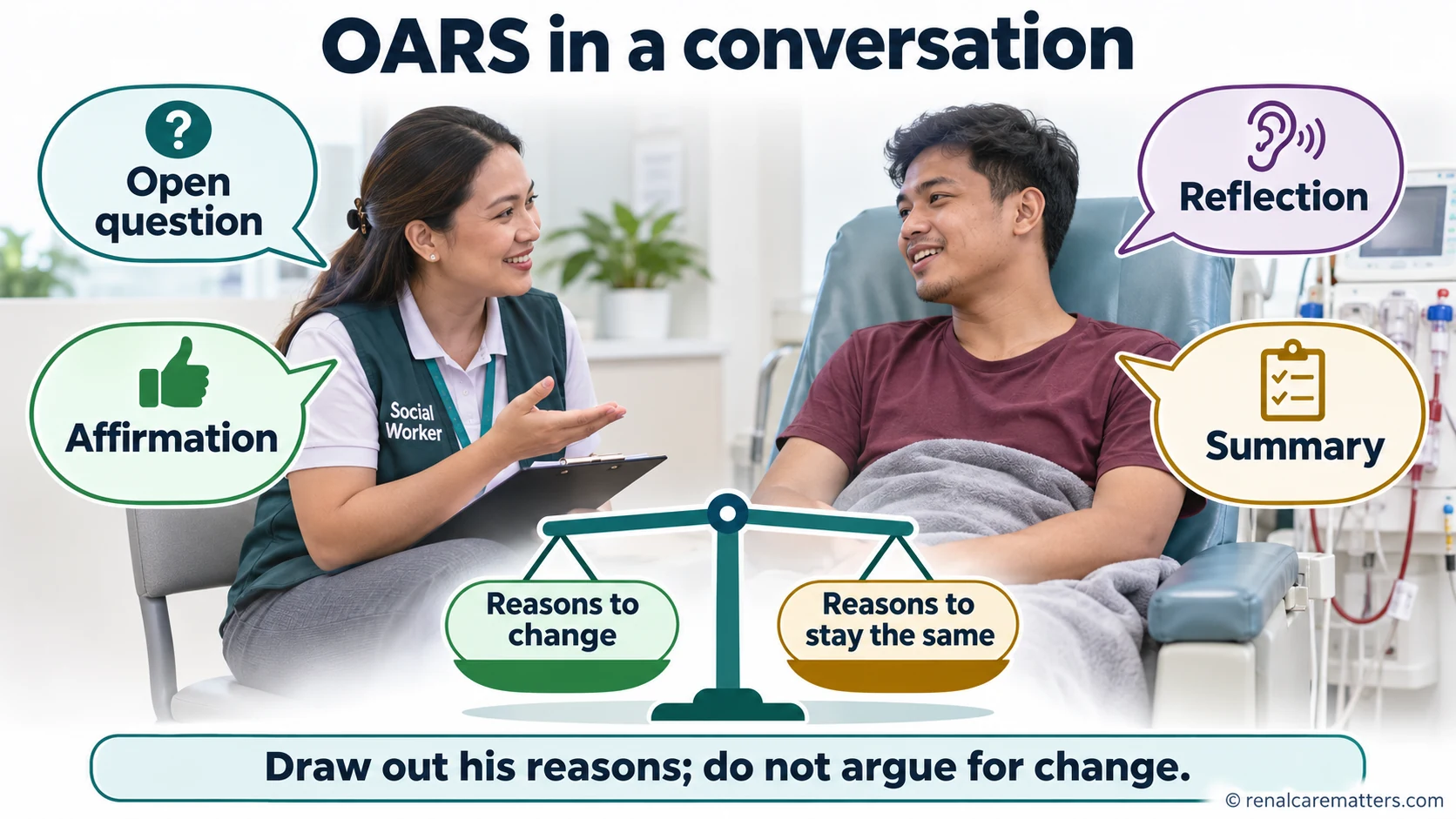
Figure 1. Motivational conversation. Draw out the person's own reasons; do not argue for change on their behalf.
The picture has a limit. A carabao has no reasons to tell you. A person who leaves dialysis at hour two, drinks three liters on a hot day, or skips binders has reasons, and they are usually good reasons from where they stand: a job, a child to fetch, cramps that frighten them, a belief that the binders damage the stomach, or simple exhaustion. Until you know the reason, any advice is a guess.
Your job in this module is to have conversations that uncover the reason and strengthen the person’s own motivation, without lecturing or shaming. Motivational interviewing (a collaborative conversation style for strengthening a person’s own motivation for change) has been tested in small trials in hemodialysis. In one randomized trial of 60 patients at a single center, four sessions improved measured adherence over usual care, but quality of life scores did not differ between groups.1 The trial was small and the outcome was adherence, not survival or hospital stays. It supports the approach as reasonable, not proven to change hard outcomes.
Figure 2 · Key terms for this module
Motivational interviewingA collaborative conversation style that strengthens a person’s own motivation and commitment to change.
OARSOpen questions, affirmations, reflections, and summaries: the four core skills.
Change talkWhat the person says in favor of change (“I want to see my son finish school”).
Sustain talkWhat the person says in favor of staying the same (“I cannot lose a day’s pay”).
Righting reflexThe helper’s urge to correct and advise, which usually provokes resistance.
BarrierThe specific reason a person does not or cannot follow a plan.
Opening case · fictional
Case: The man who leaves at hour two
Friday, 9:00 a.m. Mr. Christian Ocampo, 33, a motorcycle mechanic on hemodialysis for eight months, has signed out against advice at hour two of his four-hour session five times this month. The charge nurse has warned him twice. The referral note says: “Uncooperative. Counsel re: compliance.”
You meet him in the waiting area before his session. He is guarded. “Let me guess. You are going to tell me I will die. Everybody tells me that.”
When you ask what the last part of his session is like, he says the cramps in his legs are “like being stabbed” and he would rather leave than scream in front of everyone. He also says his shop opens at noon and he loses customers if he is late.
Before reading on, decide:
How do you open the conversation after “You are going to tell me I will die”?
What barriers has he named, and whose job is each?
What would a motivational response to “I lose customers if I am late” sound like?
Keep your answers in mind. The lesson gives you what you need, and the case review near the end shows one sound response.
Lesson · part 1
Behavior has a reason
“Nonadherent,” “uncooperative,” and “noncompliant” describe the team’s frustration, not the person. They also hide the reason, which is the only thing that leads to a solution. Write what happened, how often, and what the person says about why (Module 5).
Missed and shortened sessions are clinically important. In the international Dialysis Outcomes and Practice Patterns Study (DOPPS) cohort, skipping one or more sessions a month was associated with higher mortality (relative risk 1.30) and more hospital admissions.2 These are associations; people who skip differ in many ways from those who do not. But the reasons people give are rarely mysterious: transport, money, work, symptoms during dialysis, mood, and family demands appear again and again.3,4
Type of barrier
Example
Response
Owner
Practical
Shop opens at noon; fare; childcare
Schedule change, transport, a plan
Social worker, head nurse
Physical symptom
Cramps, low blood pressure, nausea in the last hour
Clinical review of the prescription and fluid gains
Nurse and nephrologist
Knowledge
Does not know why the full four hours matter
Plain explanation with teach-back (Module 2)
Nurse, social worker
Belief
“Binders destroy the stomach”
Explore the belief; involve the clinician
Nephrologist, pharmacist
Mood
Hopelessness, “what’s the point”
Screen and support (Module 10)
Social worker, mental health team
Relationship
Conflict with staff, shame in front of others
Repair; privacy; a different approach
Unit head, social worker
RememberEvery “nonadherent” behavior has a reason. Find it, name its type, and send it to its owner.
Lesson · part 2
Walk beside, do not push
Motivational interviewing rests on a spirit, not a script: partnership (you work with the person, not on them), acceptance (you respect their autonomy and worth), compassion (you act in their interest), and evocation (the reasons for change come from them, not from you).
The four core skills are OARS:
Skill
What it is
Example
Open questions
Questions that invite a story
“What is the last hour of your session like for you?”
Affirmations
Genuine recognition of strengths and effort
“You have kept your shop going through eight months of dialysis. That takes real determination.”
Reflections
Saying back what you heard, sometimes with its meaning
“The cramps are so bad you would rather leave than be seen in that pain.”
Summaries
Gathering what was said, especially the person’s own reasons
“So you want to keep your shop and your health, and right now the cramps and the noon opening are making that hard.”
The biggest obstacle is your own righting reflex: the urge to correct, warn, and advise. When a person says “You are going to tell me I will die,” the reflex is to say exactly that. Resist it. Agree with what is true (“You have heard that a lot”), and ask about their experience instead.
RememberAsk, affirm, reflect, summarize. Let the reasons for change come from the person.
Lesson · part 3
What to strengthen
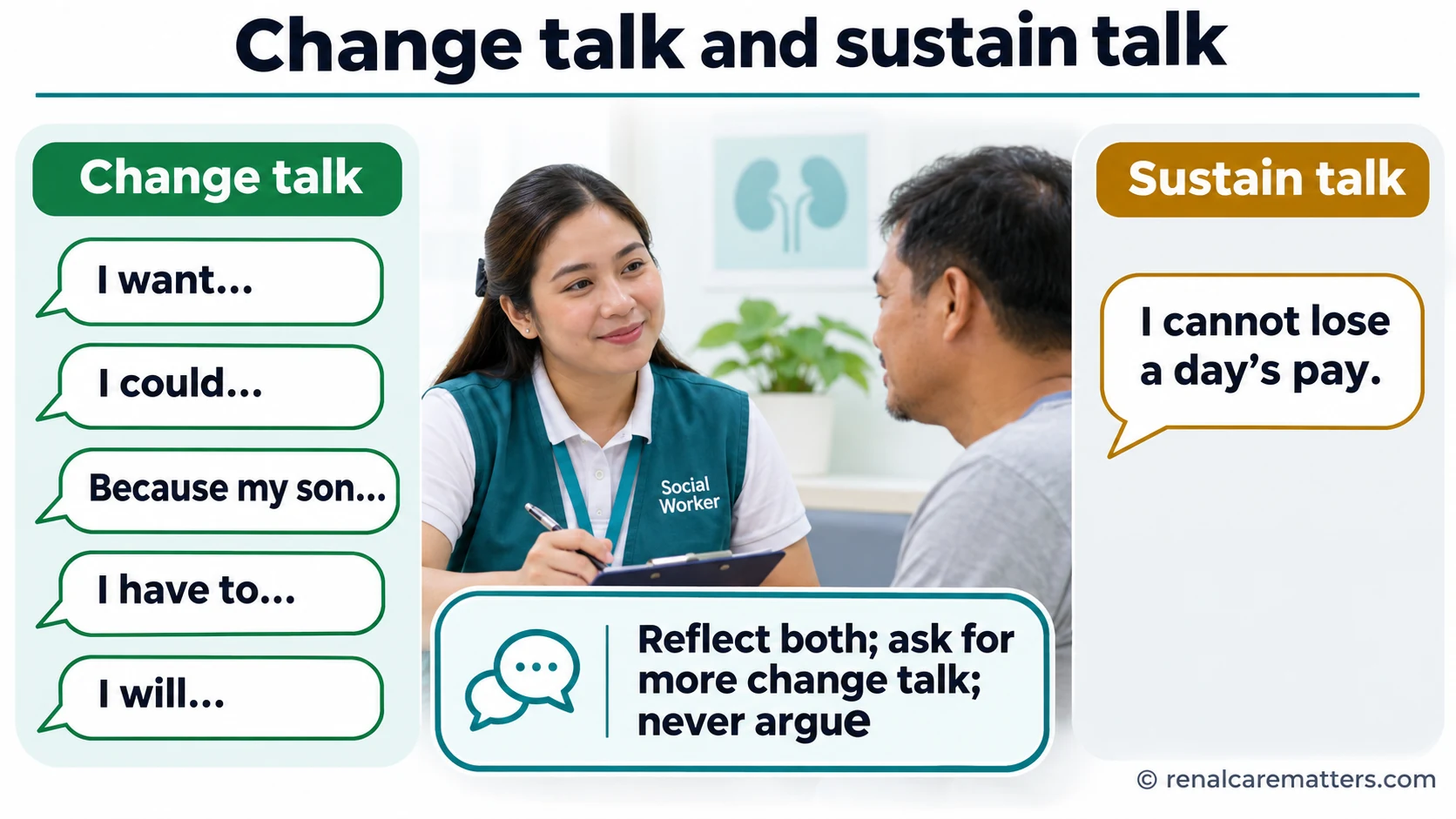
Listen for two kinds of talk. Change talk is anything the person says in favor of change: desire (“I want…”), ability (“I could…”), reasons (“because my son…”), need (“I have to…”), and commitment (“I will…”). Sustain talk is the opposite: reasons to stay the same. Both are normal; ambivalence is the usual state of anyone facing a hard change.
Figure 3. Strengthen change talk; reflect sustain talk without arguing.
Respond more to change talk than to sustain talk. Reflect it, ask for more (“What else?”), and summarize it. When you hear sustain talk, reflect it without arguing; arguing makes people defend the status quo.
He says
Unhelpful reply
Motivational reply
“I lose customers if I am late.”
“Your health is more important than customers.”
“Your shop is how you support your family. You need both the shop and the dialysis to work.”
“I want to be around for my daughter.”
“Then stay the full four hours.”
“Your daughter is a big reason you keep going. Tell me more about her.”
“Maybe I could stay longer if the cramps stopped.”
“Good, so you will stay.”
“So if the cramps were handled, staying would feel possible. Shall we ask the doctor about them today?”
RememberReflect and draw out change talk. Reflect sustain talk without arguing.
Lesson · part 4
Respecting an informed choice
Once the barriers are named, the plan almost writes itself. Physical symptoms go to the clinicians: cramps in the last hour may reflect how much fluid must be removed and how fast, which the nurse and nephrologist can review. Practical barriers come to you: a later shift, a different day, a plan for the shop. Knowledge gaps go to plain explanation with teach-back.
There is a point where encouragement becomes pressure. If a person who understands the risks makes an informed choice you disagree with, such as shorter sessions or a decision not to pursue transplant, your role changes. Make sure they understood, make sure the nephrologist knows, record the decision and the information given, and keep the relationship open. People change their minds when they feel respected, rarely when they feel cornered.
Support
Pressure
“What would make it possible for you to stay the full time?”
“If you leave again, we will report you.”
“The doctor wants you to know the risks. Can I explain what we know?”
“You are killing yourself.”
“It is your decision. I will make sure the team knows what you decided and why.”
Asking the family to “make him stay”
RememberSolve barrier by barrier. When an informed adult chooses differently, respect it, record it, and keep the door open.
On the floor · The 1:00 p.m. shift
A young mother leaves dialysis early twice a week to fetch her son from school. Social worker Mr. Joel Fernandez does not lecture her. He asks the head nurse about a later shift.
She moves to the 1:00 p.m. shift on two days; her sister fetches the boy on the third. She stays the full four hours from the next week.
The barrier was a school bell, not a lack of motivation.
Illustrative scenario. Names and details are invented.
On the floor
Real situations: problems and solutions
These are fictional but typical. For each one, cover the answer, decide what you would do, then compare. Where a step depends on local rules, your unit’s procedure and your supervisor’s direction come first.
“Pasaway”
What you see
Staff call a patient “pasaway” (stubborn) for leaving early.
What is likely going on
A label covering a reason nobody has asked about.
What to do
Ask what the last hour is like; look for symptoms, work, or family demands.
Why it matters
Labels end curiosity; questions start solutions.
The binder myth
What you see
A patient believes phosphate binders “destroy the stomach.”
What is likely going on
A belief formed from experience or hearsay.
What to do
Explore where the belief came from and bring the clinician in to address it.
Why it matters
Beliefs change through respect, not ridicule.
The weekend drinker
What you see
A patient gains five kilograms every weekend at family gatherings.
What is likely going on
Social pressure and thirst, not indifference.
What to do
Use a motivational conversation and involve the dietitian.
Why it matters
Plans that respect family life last longer than prohibitions.
Field notes
Count your reflections and your advice in one conversation a week; aim for more reflections.
Rewrite every labeling referral note you receive in descriptive language.
Case review
Back to the case: The man who leaves at hour two
The opening. Agree with what is true and step away from the lecture: “You have heard that a lot, and I am not here to say it again. I want to understand what the session is like for you.” Then an open question: “What happens in the last part of your session?”
The barriers. Two clear ones. Cramps “like being stabbed” and the shame of being seen in pain: a physical symptom, owned by the nurse and nephrologist, who can review his fluid gains, the rate of fluid removal, and his prescription. The noon shop opening: a practical barrier, owned by you and the head nurse, perhaps solved by an earlier start or a different shift. Tell the nurse and nephrologist about the cramps today; they may be the main reason he leaves.
A motivational response. “Your shop is how you support your family, and every late opening costs you customers. You need both the shop and the dialysis to work.” Then ask: “If the cramps were dealt with and the schedule fit your shop, what would the full four hours be like?” Rewrite the referral note: “Leaves at hour two because of severe leg cramps and a noon work start; referred to nephrologist for cramps; shift change requested.”
Skills lab · with your preceptor
Skills checklist: A motivational conversation about a barrier
With a simulated patient who leaves sessions early, hold a motivational conversation while your supervisor observes and counts OARS. Your preceptor rates each step as satisfactory, needs practice, or not observed. Steps marked Critical must all be satisfactory before sign-off. This checklist supports supervised learning; your unit’s own procedure and competency form are the authority. A printable version of every checklist is on the trainer page.
Opens without lecturing and resists the righting reflex.
Uses open questions, affirmations, reflections, and a summary (at least one of each).
Recognizes and reflects change talk; reflects sustain talk without arguing.
Identifies each barrier by type and names its owner.
CriticalRoutes a physical symptom reported during dialysis to the nurse and nephrologist the same day.
Rewrites a labeling referral note in descriptive language.
CriticalRespects an informed choice, records it, and informs the nephrologist without pressuring.
Placement activity. Record (with consent) or transcribe one of your conversations about a treatment barrier. Count your open questions, reflections, and advice-giving with your supervisor.
Self-assessment
Check your understanding
Each visit draws 5 questions at random from this module’s 10-question bank. Choose the single best answer for each, then select Check answers; an explanation appears under the best answer. Select New set of questions for a different mix. A good target is 4 of 5 on two different sets. Nothing you select is sent anywhere; scoring happens in your browser.
Ok, E., & Kutlu, Y. (2021). The effect of motivational interviewing on adherence to treatment and quality of life in chronic hemodialysis patients: A randomized controlled trial. Clinical Nursing Research, 30(3), 322–333. https://doi.org/10.1177/1054773820974158
Saran, R., Bragg-Gresham, J. L., Rayner, H. C., Goodkin, D. A., Keen, M. L., Van Dijk, P. C., Kurokawa, K., Piera, L., Saito, A., Fukuhara, S., Young, E. W., Held, P. J., & Port, F. K. (2003). Nonadherence in hemodialysis: Associations with mortality, hospitalization, and practice patterns in the DOPPS. Kidney International, 64(1), 254–262. https://doi.org/10.1046/j.1523-1755.2003.00064.x
Chan, K. E., Thadhani, R. I., & Maddux, F. W. (2014). Adherence barriers to chronic dialysis in the United States. Journal of the American Society of Nephrology, 25(11), 2642–2648. https://doi.org/10.1681/ASN.2013111160
Al Salmi, I., Larkina, M., Wang, M., Subramanian, L., Morgenstern, H., Jacobson, S. H., Hakim, R., Tentori, F., Saran, R., Akiba, T., Tomilina, N. A., Port, F. K., Robinson, B. M., & Pisoni, R. L. (2018). Missed hemodialysis treatments: International variation, predictors, and outcomes in the Dialysis Outcomes and Practice Patterns Study (DOPPS). American Journal of Kidney Diseases, 72(5), 634–643. https://doi.org/10.1053/j.ajkd.2018.04.019
Educational material for social workers and navigation staff in kidney care. Completing it is an Academy learning record only. It is not a Professional Regulation Commission (PRC) license, a specialty credential, CPD units, or DOH or PhilHealth recognition, and it does not authorize anyone to practice beyond their own registration.