Immediate Safety, Safeguarding, Violence, and Exploitation
Asking directly about suicide, the safety pathway, abuse and exploitation of older adults, and violence in the home.
PublishedNailathalaGipatikPepalwal:ReferencesMga SanggunianMga TinubdanReng Reperensya:3Audience: Registered social workers in dialysis units, hospital medical social work departments, and kidney transplant programs · medical social workers rotating into kidney care · navigation and support staff on the orientation pathRead timeOras ng pagbasaOras sa pagbasaOras ning pamamasa:
This module is study material for social workers and navigation staff in kidney care. It explains the reasoning behind social work decisions; it is not a facility procedure, legal advice, a benefits ruling, or a mental health diagnosis. Rules, assistance programs, and amounts change: confirm them against the current issuance and your facility’s approved policy. Medical treatment belongs to the nephrologist, benefits to PhilHealth, donation ethics to the ethics committee, and psychiatric diagnosis to the mental health team. Every case, name, and identifier is fictional.
Learning objectives
After this module you should be able to
Ask directly and calmly about thoughts of suicide or self-harm, and explain why asking does not increase risk.
Follow the safety pathway: stay with the person, involve the attending physician and the crisis route, hand over in person, and document.
Recognize signs of abuse, neglect, and financial exploitation of older adults and people dependent on others for care.
Respond to disclosures of intimate partner violence or harm to a child with privacy, safety planning, and the correct reporting route.
Distinguish immediate danger from urgent access problems and from routine support, and act at the right speed for each.
Classroom 1 hSkills lab 1 hSupervised placement 1 h
Pre-testBefore you read, answer the 5 self-assessment questions and note your score. After the module, select New set of questions and compare. The difference is what you learned; the questions you still miss are what to reread.
Start here
The big picture, in plain words
In plain wordsSafety work is like a fire drill. You do not wait for smoke to decide where the exits are, who calls whom, and who stays with the people who cannot walk. When the alarm sounds, nobody should be inventing the plan.
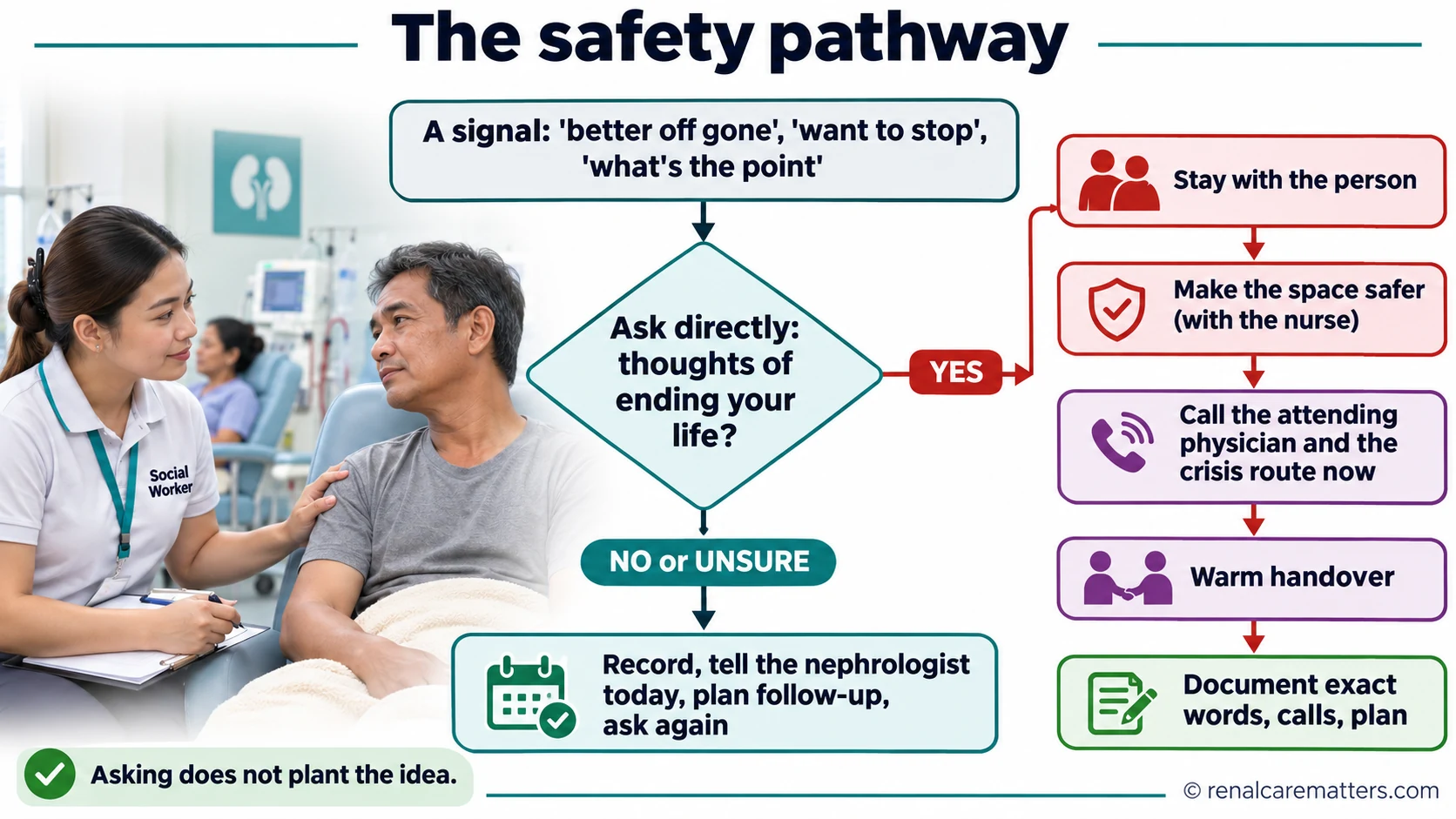
Figure 1. The safety pathway. Ask directly, never leave a person at immediate risk alone, and hand over in person.
The picture has a limit. A fire alarm is loud and unmistakable. Danger in a dialysis unit is usually quiet: a passing remark that life is not worth it, a bruise explained too quickly, a pension card held by a nephew, a wife who flinches when her husband speaks. Most of these signals come to you mixed into ordinary conversations about fares and forms. The skill is to hear them, to ask the next question directly, and to act at the right speed.
Your job in this module is to know the drill before you need it: how to ask, what to do in the first minutes, whom to call, and how to protect people who are being harmed by those closest to them. Every unit needs its own written pathway with current local contacts; this module teaches the reasoning behind it.
Figure 2 · Key terms for this module
Safety pathwayThe unit’s written steps when someone may be at immediate risk of harming themselves or others.
Means restrictionReducing access to the means of self-harm (medicines, sharp objects, rope) as part of keeping someone safe.
SafeguardingProtecting people who cannot fully protect themselves from abuse, neglect, or exploitation.
Financial exploitationMisuse of an older or dependent person’s money, pension, or property by someone they trust.
Safety planningWorking out with a person at risk of violence how to stay safe, whom to call, and where to go.
Warm handoverIntroducing the person to the next helper in person or by a live call, not by a slip of paper.
Opening case · fictional
Case: The bruise and the missing pension
Wednesday, 2:15 p.m. The nurse asks you to see Mrs. Remedios Garcia, 78, a retired public school teacher on hemodialysis for four years. She has a large bruise on her upper arm and says she “bumped the cabinet.” She has lost 4 kilograms in two months.
Her nephew, Mr. Jerome Garcia, 35, who brings her to dialysis and lives with her, waits outside. In a private conversation she says quietly that he “keeps her ATM card to help her,” that she has not seen her pension slip in months, and that there is often no food in the house. She begs you not to make trouble: “He is the only one I have. If he leaves, who will bring me here?”
Before you can answer, she adds, “Sometimes I think it would be easier to just stop coming and sleep.”
Before reading on, decide:
What do you do first, and in what words?
How do you respond to the signs of abuse and exploitation while respecting her wishes?
Whom do you involve, and what do you document?
Keep your answers in mind. The lesson gives you what you need, and the case review near the end shows one sound response.
Lesson · part 1
It does not plant the idea
When someone says anything that could mean thoughts of death or self-harm (“it would be easier to sleep,” “my family would be better off,” “I do not see the point”), ask directly, in plain words: “When you say that, are you having thoughts of ending your life?” Then: “Have you thought about how? Have you done anything to prepare?”
Many workers fear that asking will plant the idea. A review of the published studies found none that showed a significant increase in suicidal thoughts among people asked about them; acknowledging and talking about suicide may reduce rather than increase such thoughts.1 The review was narrative and the studies varied, but the direction is consistent, and the alternative, not asking, leaves risk invisible.
People on dialysis carry particular risks. In a study of everyone who started dialysis in the United States from 1995 to 2000, the suicide rate was 1.84 times that of the general population after standardization; older age, male sex, alcohol or drug dependence, and a recent psychiatric admission were independent predictors.2 Suicide remained rare in absolute terms. The data are older and from one country; they cannot tell you who in your unit is at risk, which is why you ask every person who gives you a signal.
They say
You ask next
“I am tired of all this.”
“Tired in what way? Sometimes people who feel this way think about not living. Has that happened to you?”
“I want to stop dialysis.”
“Tell me more. Is that about the treatment, or are you having thoughts of ending your life?” (Both may be true; both go to the nephrologist.)
“My family would be better off without me.”
“Are you thinking of ending your life?”
RememberAsk directly about suicide. Asking does not plant the idea; silence hides the risk.
Lesson · part 2
The first minutes
If the person says yes, or you cannot tell, follow the unit’s written safety pathway. Its exact contacts are local; its logic is the same everywhere.
Figure 3 · The safety pathway
StayDo not leave the person alone. Ask a colleague to stay if you must make a call.
Make the space saferWith the nurse, remove or secure medicines, sharps, cords, or other means nearby.
Call nowThe attending physician or nephrologist on duty, and the unit’s crisis route (hospital psychiatry, emergency room, or crisis line).
Hand over warmlyIntroduce the person to the next helper in person or by a live call.
Involve supportsWith the person’s knowledge, contact the family member or friend they trust, unless that person is a source of harm.
DocumentTheir exact words, your questions and their answers, who you called and when, and the plan.
Post the crisis contacts where every staff member can see them, and check them every quarter. The National Center for Mental Health (NCMH) runs a national crisis hotline; confirm its current numbers from its official listing and post them in your unit.
Wanting to stop dialysis is not the same as being suicidal. A person who can decide may choose to stop a burdensome treatment; that is a medical and ethical conversation led by the nephrologist (Module 16). But the two can overlap, and depression can drive the request. When in doubt, follow the safety pathway first and let the clinicians sort out the rest.
Stop and callAny statement of intent or a plan to end one’s life, or any self-harm: stay with the person and call the attending physician and crisis route now. Never send them home alone to “think about it.”
RememberStay, make it safer, call, hand over warmly, involve safe supports, document.
Lesson · part 3
When the helper is the harm
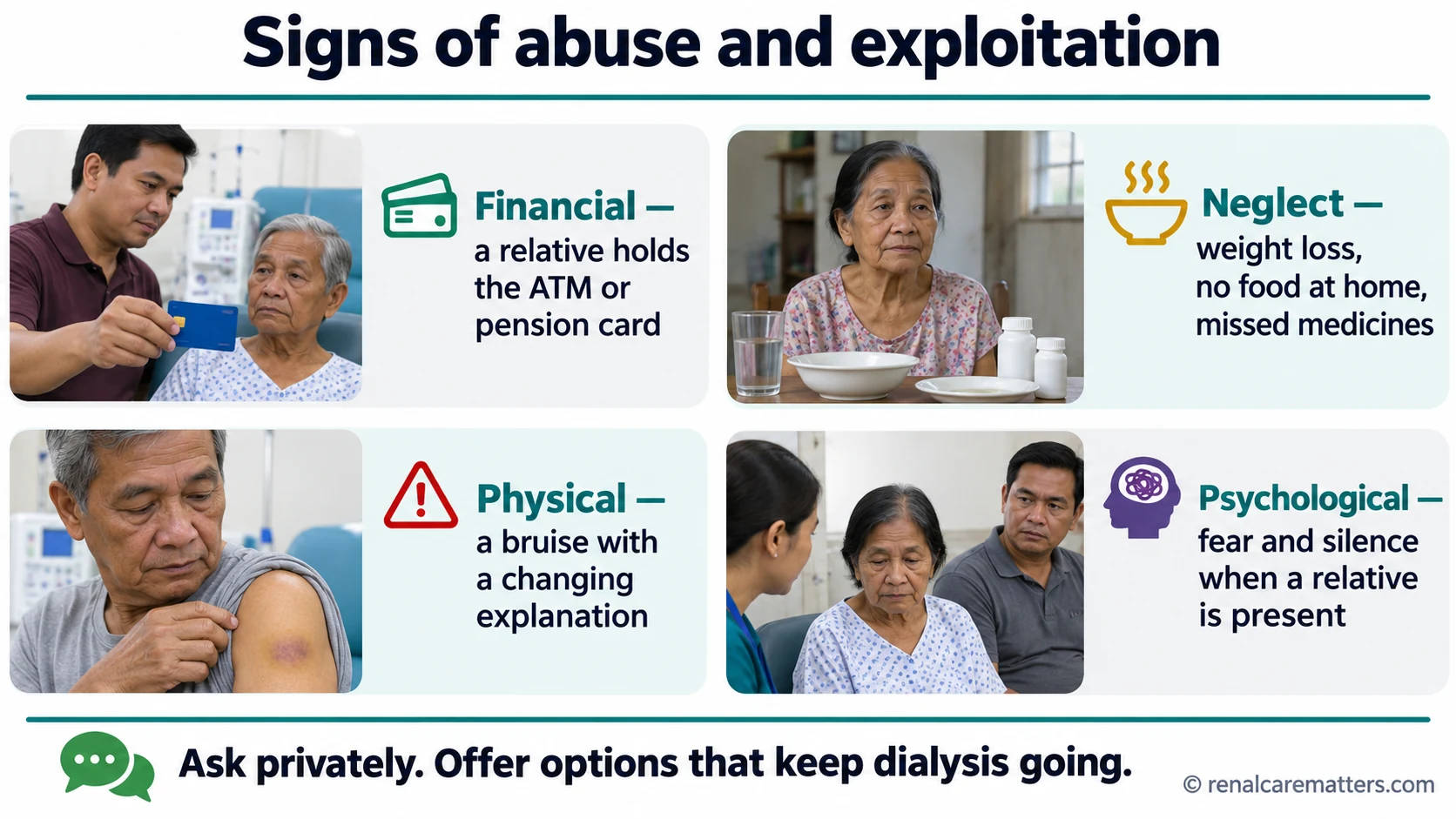
People on dialysis depend on others for transport, money, food, and care. That dependence makes them vulnerable to abuse by the people they rely on. A systematic review of 52 studies in 28 countries estimated that about one in six adults aged 60 or over experienced some form of abuse in the past year (pooled 15.7%), most often psychological (11.6%) and financial (6.8%), then neglect (4.2%) and physical abuse (2.6%).3 Studies from low- and middle-income countries were few, so treat the numbers as a signal that abuse is common, not a local rate.
A relative holds the ATM or pension card; the person cannot say where their money goes; unpaid bills despite income
Neglect
Weight loss, missed medicines, no food at home, poor hygiene, missed sessions blamed on “no one free”
Physical abuse
Unexplained bruises, especially on arms and in patterns; explanations that change
Psychological abuse
Fear of a relative, silence when they are present, being called a burden
An adult who can decide has the right to make choices about their own life, including staying with a relative who harms them. That right does not end your work. Talk with them privately, describe what you are seeing, offer options that reduce harm without forcing a break (a bank arrangement, a second trusted person, food support, a different companion on dialysis days), and keep seeing them. Discuss every case with your supervisor and follow your facility’s safeguarding procedure. Where a person cannot decide, or a child is at risk, protective duties apply.
RememberDependence creates vulnerability. Ask privately about money, food, and fear, and offer options that reduce harm without abandoning the person.
Lesson · part 4
Privacy, planning, reporting
Disclosures of violence from a partner or harm to a child come at unexpected moments: during a benefit interview, at the chair, in a corridor. Respond the same way each time: believe the person, thank them for telling you, make sure you are in a private place, and ask about immediate safety.
Situation
What you do
A woman discloses violence by her partner
Privacy; immediate safety; safety planning (where she can go, whom she can call); information on the women’s and children’s protection desk at the barangay or police and the protection available under the law against violence against women and their children (VAWC); respect her pace
A child in the household is being harmed or neglected
Children’s safety comes first; follow your facility’s child protection procedure and reporting duties; involve your supervisor the same day
A patient is being harmed by a caregiver who is also their only transport
Plan safety and dialysis together: an alternative companion before any confrontation
Violence happens in the unit
Staff safety and patient safety; the unit head and security; incident report
Reporting duties and protective procedures are set by law and by your facility, and they differ for adults and children. Learn your facility’s procedure before you need it, with the names and numbers of the people who receive reports.
RememberBelieve, thank, make it private, ask about immediate safety, plan, and follow your facility’s reporting duties. Children’s safety comes first.
On the floor · The different companion
A patient tells social worker Ms. Liza Ramos that her husband hits her, and that he is the one who brings her to dialysis.
Before anything else, Ms. Ramos works with her on how to get to dialysis without him: a neighbor on two days, a shared ride on the third. Only then do they plan what she wants to do next.
Safety plans in kidney care have to keep the treatment going, or the plan itself becomes a danger.
Illustrative scenario. Names and details are invented.
On the floor
Real situations: problems and solutions
These are fictional but typical. For each one, cover the answer, decide what you would do, then compare. Where a step depends on local rules, your unit’s procedure and your supervisor’s direction come first.
“Pagod na ako”
What you see
A man says “I am tired of everything” while waiting for his session.
What is likely going on
Exhaustion, a wish to stop dialysis, or thoughts of suicide.
What to do
Ask directly what he means, including about ending his life.
Why it matters
You cannot tell which without asking.
The pension card
What you see
An older woman says her grandson “keeps her card for safekeeping.”
Ask privately whether she can see her money and whether she wants a change.
Why it matters
Financial abuse is common and often hidden by family loyalty.
The new bruise
What you see
A patient has a new bruise and an explanation that changes.
What is likely going on
Possible abuse.
What to do
Ask privately, document what is seen and said, and follow the safeguarding procedure with your supervisor.
Why it matters
Changing explanations are a recognized warning sign.
Field notes
Check every number on your safety pathway each quarter.
Never promise secrecy before you know what someone will tell you.
Case review
Back to the case: The bruise and the missing pension
First. Her last sentence comes before the pension. Ask directly, gently: “Nanay, when you say it would be easier to stop coming and sleep, are you having thoughts of ending your life?” Then ask about a plan and preparations. Stay with her. Whatever she answers, tell the attending nephrologist today. If she has thoughts of ending her life, follow the safety pathway now; if she means stopping dialysis, the nephrologist leads that conversation, with depression assessed first.
Abuse and exploitation. Thank her for telling you. Describe what you see: the bruise, the weight loss, no food, a pension she cannot see. Respect her fear that her nephew will leave. Offer options that reduce harm without forcing a break: food support today, a dietitian review for the weight loss, a visit to the bank or pension office with her to see her statements, a second trusted person to share transport. Ask whether there is any other relative or friend she trusts.
Involve and document. Your supervisor today, under the facility’s safeguarding procedure; the nephrologist for the weight loss and mood. Document her exact words, the bruise as described by the nurse, the disclosures, your questions and her answers, whom you called, and the plan. Do not confront the nephew before a safety plan is in place and her transport is secured.
Skills lab · with your preceptor
Skills checklist: Asking about suicide and responding to a disclosure
In two role-plays, ask about suicide and respond to a disclosure of exploitation while your supervisor observes. Your preceptor rates each step as satisfactory, needs practice, or not observed. Steps marked Critical must all be satisfactory before sign-off. This checklist supports supervised learning; your unit’s own procedure and competency form are the authority. A printable version of every checklist is on the trainer page.
CriticalRecognizes an indirect statement as a possible suicide signal and asks directly in plain words.
Asks about a plan and preparations without lecturing.
CriticalStays with the person and calls the attending physician and crisis route on any positive answer.
Explains why asking does not increase risk, if a colleague objects.
Asks privately about money, food, and fear when signs of exploitation appear.
CriticalOffers harm-reducing options that keep dialysis going, and involves the supervisor the same day.
Documents exact words, questions, answers, calls, and the plan.
Placement activity. Find your facility’s safety pathway and safeguarding procedure. List every contact on them and check each number is current.
Self-assessment
Check your understanding
Each visit draws 5 questions at random from this module’s 10-question bank. Choose the single best answer for each, then select Check answers; an explanation appears under the best answer. Select New set of questions for a different mix. A good target is 4 of 5 on two different sets. Nothing you select is sent anywhere; scoring happens in your browser.
Dazzi, T., Gribble, R., Wessely, S., & Fear, N. T. (2014). Does asking about suicide and related behaviours induce suicidal ideation? What is the evidence? Psychological Medicine, 44(16), 3361–3363. https://doi.org/10.1017/S0033291714001299
Kurella, M., Kimmel, P. L., Young, B. S., & Chertow, G. M. (2005). Suicide in the United States end-stage renal disease program. Journal of the American Society of Nephrology, 16(3), 774–781. https://doi.org/10.1681/ASN.2004070550
Yon, Y., Mikton, C. R., Gassoumis, Z. D., & Wilber, K. H. (2017). Elder abuse prevalence in community settings: A systematic review and meta-analysis. The Lancet Global Health, 5(2), e147–e156. https://doi.org/10.1016/S2214-109X(17)30006-2
Educational material for social workers and navigation staff in kidney care. Completing it is an Academy learning record only. It is not a Professional Regulation Commission (PRC) license, a specialty credential, CPD units, or DOH or PhilHealth recognition, and it does not authorize anyone to practice beyond their own registration.