Distress, Depression, Anxiety, and Stepped Support
How common distress is, screening honestly, what helps and how well, and stepped care with referral.
PublishedNailathalaGipatikPepalwal:ReferencesMga SanggunianMga TinubdanReng Reperensya:10Audience: Registered social workers in dialysis units, hospital medical social work departments, and kidney transplant programs · medical social workers rotating into kidney care · navigation and support staff on the orientation pathRead timeOras ng pagbasaOras sa pagbasaOras ning pamamasa:
This module is study material for social workers and navigation staff in kidney care. It explains the reasoning behind social work decisions; it is not a facility procedure, legal advice, a benefits ruling, or a mental health diagnosis. Rules, assistance programs, and amounts change: confirm them against the current issuance and your facility’s approved policy. Medical treatment belongs to the nephrologist, benefits to PhilHealth, donation ethics to the ethics committee, and psychiatric diagnosis to the mental health team. Every case, name, and identifier is fictional.
Learning objectives
After this module you should be able to
State how common depression is among people on dialysis, and why rating scales give higher numbers than clinical interviews.
Screen in two steps (the two PHQ-2 questions, then the PHQ-9) and interpret the score in light of symptoms that kidney failure also causes.
Describe what the evidence shows for talking therapies, exercise, and antidepressants in dialysis, and how strong it is.
Match support to need using stepped care, from listening and practical help to referral to the mental health team.
Keep the safety question (PHQ-9 item 9) open at every step, and act on any positive answer.
Classroom 1 hSkills lab 1 hSupervised placement 1 h
Pre-testBefore you read, answer the 5 self-assessment questions and note your score. After the module, select New set of questions and compare. The difference is what you learned; the questions you still miss are what to reread.
Start here
The big picture, in plain words
In plain wordsDistress in kidney failure is like water in the hull of a boat. A little is normal on any voyage and you bail it out with ordinary effort: a good conversation, a solved fare problem, a friend in the next chair. When the water keeps rising despite bailing, something has opened below the waterline, and the crew needs help from someone with the right tools.
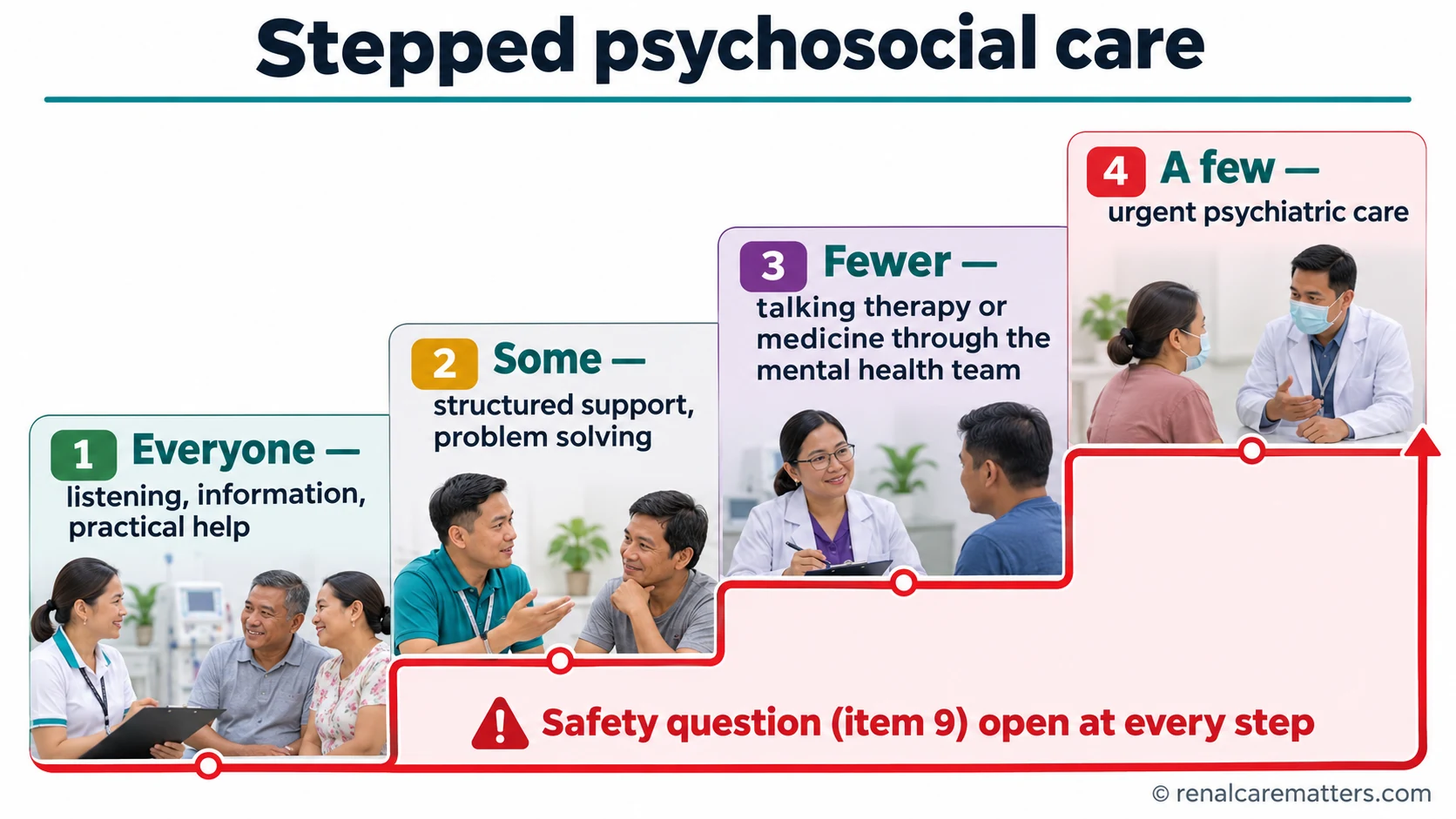
Figure 1. Stepped psychosocial care. Match the help to the need, and keep the safety question open at every step.
The picture has a limit. In a boat, water is water. In kidney failure, the body itself produces some of what looks like depression: uremia, anemia, poor sleep from itch or breathlessness, and medicines can cause tiredness, poor appetite, and poor concentration. Grief over lost work and roles is normal and is not an illness. And sometimes what looks like low mood is a clear-eyed view of a hard situation. So your task is not to decide who is “depressed.” It is to notice, to screen honestly, to support, and to make sure the people who can diagnose and treat get involved when the water keeps rising.
Depression matters because it is common, because people suffer from it, and because it travels with other harms. By clinical interview, about one in five people on dialysis has depression; rating scales give higher numbers.1 The Dialysis Outcomes and Practice Patterns Study (DOPPS) cohort linked depressive symptoms to missed treatments.2 Suicide is rare in absolute terms but more frequent than in the general population.3
Figure 2 · Key terms for this module
DepressionPersistent low mood or loss of interest, with changes in sleep, appetite, energy, or thinking, for at least two weeks; diagnosed by a clinician.
DistressEmotional suffering of any kind; common and often a normal response to loss.
PHQ-2The first two questions of the PHQ-9 (interest and mood), used as a quick first screen.
PHQ-9Nine questions on the past two weeks, each scored 0 to 3, total 0 to 27. A screen, not a diagnosis.
Item 9The PHQ-9 question about thoughts of being better off dead or of self-harm. Any positive answer starts the safety pathway.
Stepped careMatching the intensity of support to the level of need, and stepping up when needed.
Opening case · fictional
Case: Mang Romeo’s PHQ-9 of 16
Monday, 10:00 a.m., hour one of his session. Mr. Romeo Dizon, 58, on hemodialysis for three years, tells the nurse he “does not see the point anymore” and wants to talk to someone. He missed last Wednesday’s session.
You sit with him. He describes weeks of waking at 3:00 a.m. with worry, no appetite, and no interest in the chess games he used to play with other patients. His wife, Aling Nena, stopped selling at the market to bring him to dialysis, and the household income has halved. He feels he has become a burden.
With his agreement you complete the PHQ-9 together. His item scores are: interest 2, mood 2, sleep 3, energy 3, appetite 2, feeling a failure 2, concentration 1, slowness 1, item 9 (thoughts of being better off dead or self-harm) 0.
Before reading on, decide:
What is his total, and what does it mean and not mean?
What would you say to the attending nephrologist, and what would you offer him?
What else do you notice that needs attention?
Keep your answers in mind. The lesson gives you what you need, and the case review near the end shows one sound response.
Lesson · part 1
Numbers and overlap
Palmer and colleagues pooled 249 study populations with 55,982 participants. By clinical interview, depression affected 22.8% of patients on dialysis; by rating scales, 39.3%. The authors concluded that scales may overestimate depression in dialysis.1 Both figures come from observational studies of varying quality. The gap between them is the overlap problem: kidney failure itself causes many symptoms the scales count.
Symptom
Also caused by
Leans toward depression when…
Tiredness, low energy
Anemia, uremia, post-dialysis fatigue
It comes with loss of interest and hopelessness
Poor sleep
Itch, restless legs, breathlessness, pain
The person wakes early with worry or sadness
Poor appetite
Uremia, nausea, diet restrictions
Food stops giving any pleasure at all
Poor concentration
Uremia, medicines, sleep loss
It comes with guilt and feeling a failure
Anxiety is common too: worry about money, the next session, needles, the future. It often travels with depression and responds to the same practical and talking support.
RememberMany symptoms of kidney failure look like depression. Loss of interest, low mood, guilt, and hopelessness are the parts the kidneys do not explain.
Lesson · part 2
Two steps, and item 9 every time
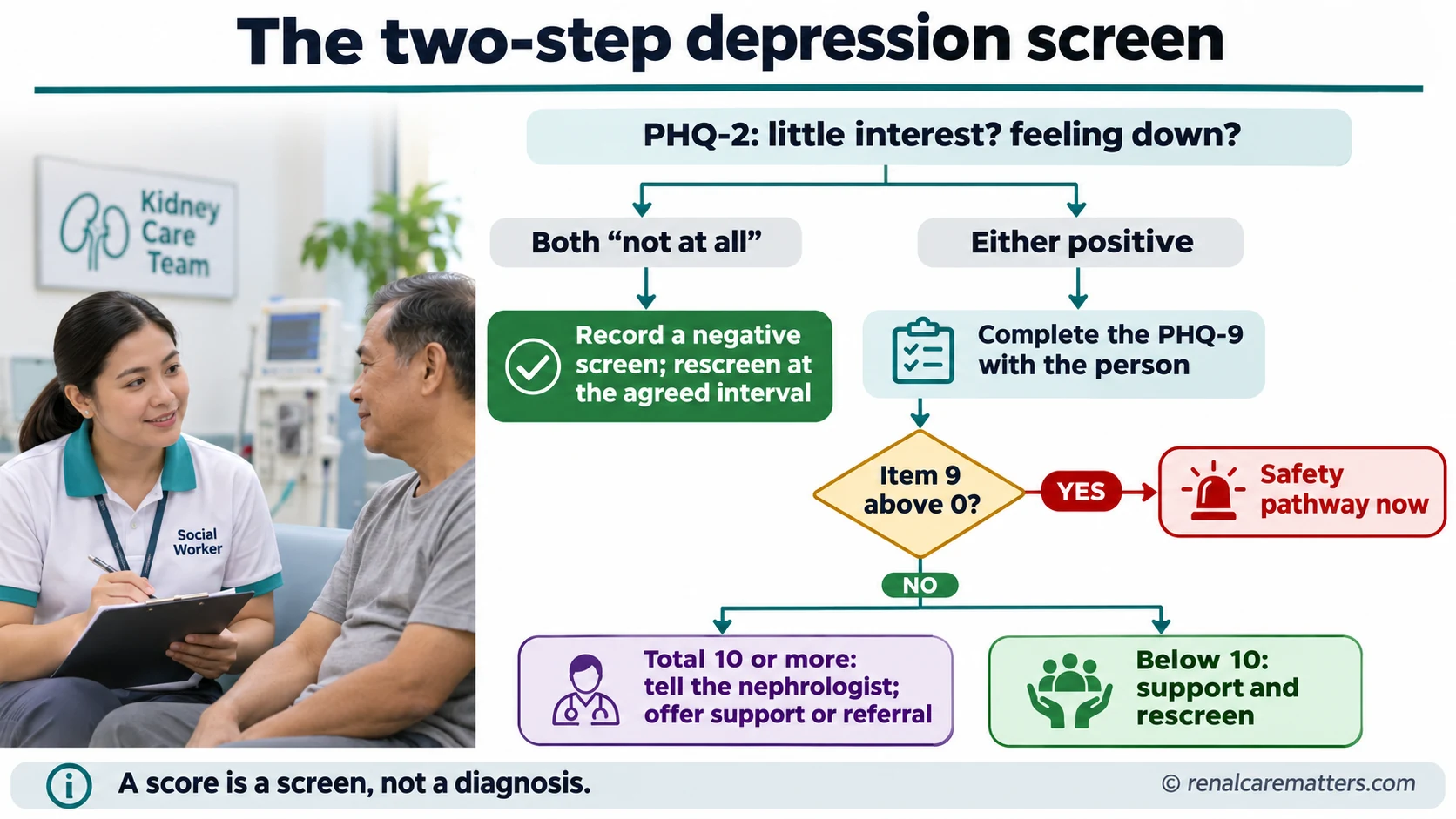
Screen in two steps. First the two questions of the Patient Health Questionnaire-2 (PHQ-2): over the last two weeks, how often have you been bothered by little interest or pleasure in doing things, and by feeling down, depressed, or hopeless? If either answer is positive, complete the full Patient Health Questionnaire-9 (PHQ-9) with the person.
Figure 3. Two questions first, the full PHQ-9 if either is positive, and item 9 every time.
The PHQ-9 was validated in 6,000 primary care and obstetric patients: a score of 10 or more had sensitivity and specificity of 88% for major depression, and scores of 5, 10, 15, and 20 marked mild, moderate, moderately severe, and severe.4 In 62 patients on dialysis compared with a structured psychiatric interview, a score of 10 or more had sensitivity 92%, specificity 92%, positive predictive value 71%, and negative predictive value 98%.5 The dialysis study was small and single-center. A negative screen is reassuring; a positive screen means “look closer”: about three in ten positives did not have depression on interview.
PHQ-9 total
Band (primary care)
Dialysis caveat
What you do
0–4
Minimal
—
Record; rescreen at the agreed interval
5–9
Mild
Points may come from uremic symptoms
Support, practical help, rescreen in a month
10–14
Moderate
Check which items carry the score
Tell the nephrologist; offer structured support or referral
15–19
Moderately severe
Usually more than kidney symptoms
Tell the nephrologist today; referral to the mental health team
20–27
Severe
—
Same day: nephrologist and urgent mental health review
Item 9 any answer above 0
—
—
Safety pathway now, whatever the total (Module 11)
The bands come from primary care.4 The dialysis caveat is reasoning from shared symptoms, not a tested correction. The site’s PHQ-9 calculator adds the items. A score is never a diagnosis; diagnosis belongs to the mental health clinician.
Worked example, illustrative. PHQ-9 total = sum of nine items, each 0 to 3.4 Interest 2 + mood 2 + sleep 3 + energy 3 + appetite 2 + feeling a failure 2 + concentration 1 + slowness 1 + item 9 0 = 16. Above the dialysis-validated cutoff of 10.5 Sleep, energy, and appetite (8 of the 16 points) overlap uremic symptoms; interest, mood, and feeling a failure (6 points) do not. What the number tells you: depression is likely enough to report and refer. What it does not tell you: the diagnosis, the cause, or the treatment.
RememberAsk item 9 in person, every time, whatever the total. A positive answer starts the safety pathway now.
Lesson · part 3
Talking, moving, medicine
Know the evidence well enough to offer options honestly and to answer “Will it help?”
Figure 4 · What the studies tested and found
Talking therapy (CBT)A Cochrane review of psychosocial interventions in dialysis found that cognitive behavioral therapy (CBT) probably improves depressive symptoms (Beck Depression Inventory, 4 studies, 230 participants, mean difference −6.10 points) and quality of life, with moderate-certainty evidence.6
CounselingCounseling may slightly reduce depressive symptoms (3 studies, 99 participants, mean difference −3.84 points); low-certainty evidence.6
ExerciseExercise may reduce major depression (3 studies, 108 participants, risk ratio 0.47); low certainty.6
Chairside CBT trialA randomized crossover trial of 65 patients at two centers found benefit from CBT delivered during dialysis.7
Sertraline versus CBT (ASCEND)120 patients, 41 United States units, 12 weeks, open label. Clinician-rated scores were modestly lower with sertraline, with more side effects; there was no placebo group.8
Antidepressant versus placeboFew, small trials; benefit in dialysis is uncertain.9,10
All these outcomes are rating-scale scores, surrogates for how a person feels and functions. None of these studies was designed to show an effect on survival, hospital stays, or suicide. What they do support is that talking therapies, counseling, and exercise are reasonable to offer and that medicine is an option for the mental health team and nephrologist to weigh. Medicine decisions are never yours: you refer, support, and follow up.
Much of what you do every day also counts. Solving the fare problem, arranging a caregiver’s rest, reconnecting a man with his chess partner: practical help reduces the load that feeds distress, even though trials rarely measure it.
RememberOffer what has evidence (talking therapy, counseling, exercise) and refer for medicine decisions. Say honestly that the trials measured symptoms, not survival.
Lesson · part 4
Match the help to the need
Stepped care means everyone gets the basics, and help steps up as need rises. It also means you step back down when things improve.
Step
Who
What you offer
1 Everyone
All patients
Listening, information, practical help with barriers, screening at agreed intervals
2 Some
Mild to moderate distress
Structured support: problem solving, behavioral activation (planning small pleasant activities), peer support, exercise with the team’s agreement
3 Fewer
Moderate to severe depression or anxiety
Referral to a psychologist or psychiatrist for assessment and therapy or medicine; you keep following up
4 A few
Severe, or any safety risk
Urgent psychiatric review through the attending physician and the crisis route (Module 11)
A referral to mental health is a referral like any other (Module 6): it is not done when sent. Many people decline or never attend. In ASCEND, a structured engagement interview did not raise treatment uptake (66% against 64%).8 Patients decide for their own reasons. Your role is to make the offer, record the answer, keep the door open, and screen again.
RememberEveryone gets step 1. Step up when need rises, follow every referral to an outcome, and step down when things improve.
On the floor · The chess table
Social worker Mr. Luis Bautista notices that three men on the Tuesday-Thursday-Saturday shift used to play chess in the waiting area before a renovation removed the table.
He asks the unit head for a small table in the waiting area. Two of the men tell him a month later that the mornings are “less heavy.”
Not every intervention needs a referral form. Some just need a table.
Illustrative scenario. Names and details are invented.
On the floor
Real situations: problems and solutions
These are fictional but typical. For each one, cover the answer, decide what you would do, then compare. Where a step depends on local rules, your unit’s procedure and your supervisor’s direction come first.
The chess player who stopped
What you see
A patient who used to play chess in the waiting area now sits alone.
What is likely going on
Loss of interest, a core sign of depression.
What to do
Screen with the PHQ-2 and, if positive, the PHQ-9 with item 9.
Why it matters
Loss of interest is the part of depression the kidneys do not explain.
Score 12, all sleep
What you see
A PHQ-9 of 12 comes almost entirely from sleep, energy, and appetite.
What is likely going on
Uremic or other physical symptoms may be driving the score.
What to do
Report to the nephrologist for physical causes and rescreen; do not label it depression.
Why it matters
A score is a reason to look closer, not a diagnosis.
The declined referral
What you see
A patient declines referral to psychiatry.
What is likely going on
Stigma, cost, or a reasonable preference.
What to do
Respect it, offer supportive steps, and rescreen at the agreed interval.
Why it matters
The door you keep open is the one people come back through.
Field notes
Ask item 9 in person every time, whatever the total.
Keep the crisis route and mental health referral contacts on one card at your desk.
Case review
Back to the case: Mang Romeo’s PHQ-9 of 16
The total. 2 + 2 + 3 + 3 + 2 + 2 + 1 + 1 + 0 = 16, the pattern of the worked example. That is above the dialysis-validated cutoff of 10, so depression is likely enough to report and refer. Sleep, energy, and appetite (8 points) may partly reflect kidney failure; interest, mood, and feeling a failure (6 points) do not. Item 9 is 0, so no safety pathway today, but you asked it in person and you will ask again. The score is not a diagnosis.
To the nephrologist. Situation: “Mr. Romeo Dizon, 58, said he does not see the point anymore; PHQ-9 16, item 9 zero.” Background: “Weeks of early waking with worry, poor appetite, missed Wednesday. Wife stopped work; income halved.” Request: “Please review possible physical causes of the sleep and appetite changes, and agree a referral to the mental health team.” Offer Mr. Dizon a choice of next steps: structured support with you, a referral for talking therapy or a psychiatric assessment, and practical help with the money.
What else. “Does not see the point” can also mean thoughts of stopping dialysis; ask what he means, and if he wants to stop, the nephrologist leads that conversation (Module 16). The missed session and the income loss are access problems (Modules 8 and 9). Aling Nena, who gave up her work, needs her own conversation about how she is coping (Module 13).
Skills lab · with your preceptor
Skills checklist: A two-step screen with the safety question
In a role-play with a simulated patient in the dialysis chair, screen for depression and agree next steps while your supervisor observes. Your preceptor rates each step as satisfactory, needs practice, or not observed. Steps marked Critical must all be satisfactory before sign-off. This checklist supports supervised learning; your unit’s own procedure and competency form are the authority. A printable version of every checklist is on the trainer page.
Sets a private moment at the chair and asks the two PHQ-2 questions.
Completes the PHQ-9 with the person and computes the total correctly.
CriticalAsks item 9 in person in plain words, whatever the total.
Interprets the score with the dialysis caveat and states that it is not a diagnosis.
CriticalStarts the safety pathway on any positive item 9 answer.
Explains the options and the strength of their evidence without promising a cure.
Reports to the attending nephrologist in Situation, Background, Assessment, Recommendation (SBAR) and follows the mental health referral to an outcome.
Placement activity. With supervision, screen three patients (with consent) using the two-step approach and discuss each result with your supervisor.
Self-assessment
Check your understanding
Each visit draws 5 questions at random from this module’s 10-question bank. Choose the single best answer for each, then select Check answers; an explanation appears under the best answer. Select New set of questions for a different mix. A good target is 4 of 5 on two different sets. Nothing you select is sent anywhere; scoring happens in your browser.
Palmer, S., Vecchio, M., Craig, J. C., Tonelli, M., Johnson, D. W., Nicolucci, A., Pellegrini, F., Saglimbene, V., Logroscino, G., Fishbane, S., & Strippoli, G. F. M. (2013). Prevalence of depression in chronic kidney disease: Systematic review and meta-analysis of observational studies. Kidney International, 84(1), 179–191. https://doi.org/10.1038/ki.2013.77
Al Salmi, I., Larkina, M., Wang, M., Subramanian, L., Morgenstern, H., Jacobson, S. H., Hakim, R., Tentori, F., Saran, R., Akiba, T., Tomilina, N. A., Port, F. K., Robinson, B. M., & Pisoni, R. L. (2018). Missed hemodialysis treatments: International variation, predictors, and outcomes in the Dialysis Outcomes and Practice Patterns Study (DOPPS). American Journal of Kidney Diseases, 72(5), 634–643. https://doi.org/10.1053/j.ajkd.2018.04.019
Kurella, M., Kimmel, P. L., Young, B. S., & Chertow, G. M. (2005). Suicide in the United States end-stage renal disease program. Journal of the American Society of Nephrology, 16(3), 774–781. https://doi.org/10.1681/ASN.2004070550
Kroenke, K., Spitzer, R. L., & Williams, J. B. (2001). The PHQ-9: Validity of a brief depression severity measure. Journal of General Internal Medicine, 16(9), 606–613. https://doi.org/10.1046/j.1525-1497.2001.016009606.x
Watnick, S., Wang, P.-L., Demadura, T., & Ganzini, L. (2005). Validation of 2 depression screening tools in dialysis patients. American Journal of Kidney Diseases, 46(5), 919–924. https://doi.org/10.1053/j.ajkd.2005.08.006
Natale, P., Palmer, S. C., Ruospo, M., Saglimbene, V. M., Rabindranath, K. S., & Strippoli, G. F. (2019). Psychosocial interventions for preventing and treating depression in dialysis patients. Cochrane Database of Systematic Reviews, 12(12), CD004542. https://doi.org/10.1002/14651858.CD004542.pub3
Cukor, D., Ver Halen, N., Asher, D. R., Coplan, J. D., Weedon, J., Wyka, K. E., Saggi, S. J., & Kimmel, P. L. (2014). Psychosocial intervention improves depression, quality of life, and fluid adherence in hemodialysis. Journal of the American Society of Nephrology, 25(1), 196–206. https://doi.org/10.1681/ASN.2012111134
Mehrotra, R., Cukor, D., Unruh, M., Rue, T., Heagerty, P., Cohen, S. D., Dember, L. M., Diaz-Linhart, Y., Dubovsky, A., Greene, T., Grote, N., Kutner, N., Trivedi, M. H., Quinn, D. K., Ver Halen, N., Weisbord, S. D., Young, B. A., Kimmel, P. L., & Hedayati, S. S. (2019). Comparative efficacy of therapies for treatment of depression for patients undergoing maintenance hemodialysis: A randomized clinical trial. Annals of Internal Medicine, 170(6), 369–379. https://doi.org/10.7326/M18-2229
Palmer, S. C., Natale, P., Ruospo, M., Saglimbene, V. M., Rabindranath, K. S., Craig, J. C., & Strippoli, G. F. M. (2016). Antidepressants for treating depression in adults with end-stage kidney disease treated with dialysis. Cochrane Database of Systematic Reviews, 2016(5), Article CD004541. https://doi.org/10.1002/14651858.CD004541.pub3
Friedli, K., Guirguis, A., Almond, M., Day, C., Chilcot, J., Da Silva-Gane, M., Davenport, A., Fineberg, N. A., Spencer, B., Wellsted, D., & Farrington, K. (2017). Sertraline versus placebo in patients with major depressive disorder undergoing hemodialysis: A randomized, controlled feasibility trial. Clinical Journal of the American Society of Nephrology, 12(2), 280–286. https://doi.org/10.2215/CJN.02120216
Educational material for social workers and navigation staff in kidney care. Completing it is an Academy learning record only. It is not a Professional Regulation Commission (PRC) license, a specialty credential, CPD units, or DOH or PhilHealth recognition, and it does not authorize anyone to practice beyond their own registration.