Transport, Work, Housing, Food, and Disability Access
The access equation, work and income, housing, food and water, and disability benefits.
PublishedNailathalaGipatikPepalwal:ReferencesMga SanggunianMga TinubdanReng Reperensya:2Audience: Registered social workers in dialysis units, hospital medical social work departments, and kidney transplant programs · medical social workers rotating into kidney care · navigation and support staff on the orientation pathRead timeOras ng pagbasaOras sa pagbasaOras ning pamamasa:
This module is study material for social workers and navigation staff in kidney care. It explains the reasoning behind social work decisions; it is not a facility procedure, legal advice, a benefits ruling, or a mental health diagnosis. Rules, assistance programs, and amounts change: confirm them against the current issuance and your facility’s approved policy. Medical treatment belongs to the nephrologist, benefits to PhilHealth, donation ethics to the ethics committee, and psychiatric diagnosis to the mental health team. Every case, name, and identifier is fictional.
Learning objectives
After this module you should be able to
Calculate the full cost of getting to dialysis each month, including the companion and lost wages, and compare it with confirmed support.
Estimate a household’s health spending as a share of its total spending, and explain what the 10% and 25% marks mean.
Explore work options with a patient: schedule changes, employer letters, leave and disability benefits, and new work that fits treatment.
Screen for housing, water, and food problems that make treatment unsafe or impossible, and route them.
Help a person apply for a PWD ID and its discounts where they qualify.
Classroom 1 hSkills lab 1 hSupervised placement 1 h
Pre-testBefore you read, answer the 5 self-assessment questions and note your score. After the module, select New set of questions and compare. The difference is what you learned; the questions you still miss are what to reread.
Start here
The big picture, in plain words
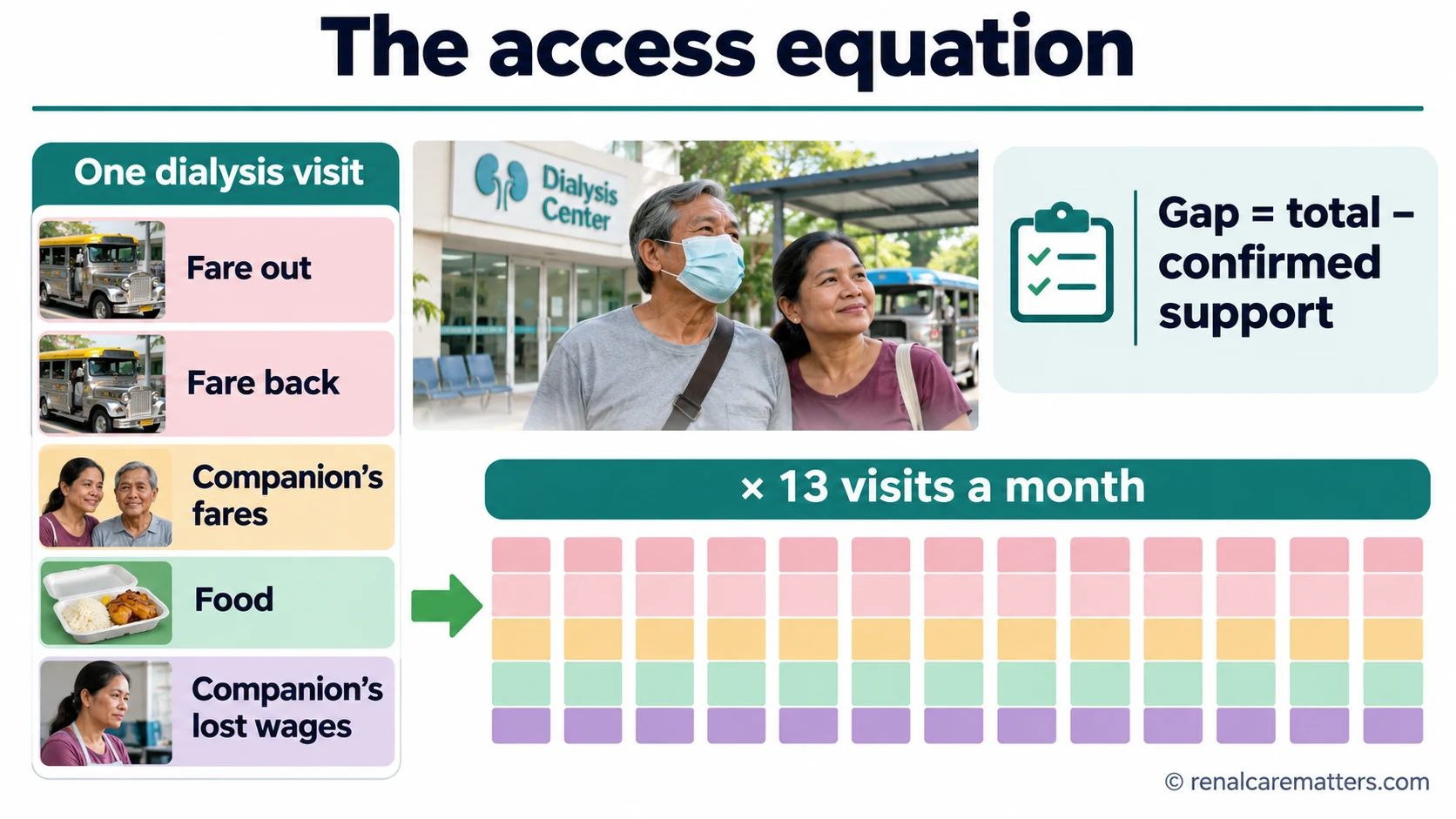
In plain wordsGetting to dialysis is a simple equation that families solve every week: fare out plus fare back, times two if someone has to come along, plus the meal on the way, plus the day of work the companion loses. Multiply by thirteen visits a month. When that number grows bigger than the household can pay, sessions start to disappear.
Figure 1. The access equation. Small costs per visit, multiplied by thirteen visits a month, decide whether a person can keep coming.
The picture has a limit. Families do not solve the equation once. A typhoon week, a sick companion, a fare increase, a lost job, or a move to a relative’s house in another town changes it overnight. And the costs are not only money: a four-hour session plus two hours of travel, three times a week, takes about eighteen hours, the equivalent of two working days.
Your job in this module is to make these costs visible, early, and to work on them before they become missed sessions. The evidence shows why. In the international Dialysis Outcomes and Practice Patterns Study (DOPPS) cohort of 20,994 patients, longer self-reported travel time was associated with higher mortality and lower health-related quality of life (heart rate (HR)-QOL); the travel time was a single unvalidated question and many patients did not respond, so the finding is an association.1 In 182,536 United States patients, transport problems and bad weather were among the reasons linked to missed treatments.2
Figure 2 · Key terms for this module
Access costEverything it costs to attend treatment beyond the treatment itself: fares, companion, food, lost income.
Confirmed supportAssistance that has been decided and will be paid; pending support does not count.
Health spending shareOut-of-pocket health spending divided by total household spending (or income).
SDG 3.8.2The United Nations indicator that counts households spending more than 10% or 25% of their budget on health.
PWD IDAn identification card for persons with disability, which carries legal discounts.
Food insecurityNot having reliable access to enough affordable, suitable food.
Opening case · fictional
Case: The tricycle fare and the 5 a.m. shift
Thursday, 6:15 a.m. Mr. Rodel Manalo, 51, arrives late for the 6:00 a.m. shift for the third time this month. He lives in a barangay 14 kilometers from the unit in Batangas. The jeepney does not run before 5:30 a.m., so he takes a special tricycle trip that costs PHP 250 each way. His wife comes with him because he is weak after dialysis; she loses her day at a carinderia, about PHP 400.
He used to drive a delivery truck; he lost the job two months after starting dialysis. The family of five now lives on his wife’s earnings and a monthly remittance from his brother. He has not applied for a PWD ID. He says they eat rice and instant noodles most nights “to save for the fare.”
The charge nurse asks you to “do something about his lateness”; late starts are delaying the next shift.
Before reading on, decide:
What does his attendance actually cost the household each month?
What options could reduce that cost or the lateness?
What else in his story needs a referral today?
Keep your answers in mind. The lesson gives you what you need, and the case review near the end shows one sound response.
Lesson · part 1
Count everything
Count the full cost of one visit, then multiply by the visits in a month. Include what families usually forget: the return trip, the companion’s fares, food, and the income the companion loses.
Worked example, illustrative. Gross = visits × (fare out + fare back + companion’s fares + other per visit) + one-time costs. Gap = gross − confirmed support. Six visits × (PHP 120 + PHP 120 + PHP 0 + PHP 30) + PHP 300 one-time = 6 × 270 + 300 = PHP 1,920. Confirmed support: PHP 1,000. Pending support: not subtracted. Gap = 1,920 − 1,000 = PHP 920. What the number tells you: what the household must still find. What it does not tell you: whether they can. Compare it with their budget.
The access cost tool does this arithmetic for any schedule. Do it with the family, not for them; seeing the number together often changes the conversation from “he is always late” to “this is what it costs.”
Then put the number in context. The household spending share tool divides out-of-pocket health spending by total household spending. The United Nations Sustainable Development Goal (SDG) indicator 3.8.2 tracks households whose health spending is more than 10% or more than 25% of their total spending or income. These marks describe financial hardship across populations; they are not eligibility rules for any Philippine program.
Worked example, illustrative. Share = out-of-pocket health spending ÷ total household spending × 100. Health spending this month (fares, companion, medicines, food on dialysis days): PHP 4,000. Total household spending: PHP 25,000. Share = 4,000 ÷ 25,000 × 100 = 16%. Above the 10% mark, below 25%. What the number tells you: kidney care is taking a large bite of this budget. What it does not tell you: what the family is giving up to pay it. Ask.
RememberCount the companion, the food, and the lost wages. Show the family the number, and compare it with what they actually have.
Lesson · part 2
Keeping a livelihood alongside treatment
Losing work is one of the biggest shocks of kidney failure, and it compounds every other cost. Many people stop working when dialysis starts, sometimes because of illness, often because the schedule and the job cannot fit together. Some of those jobs could have been kept.
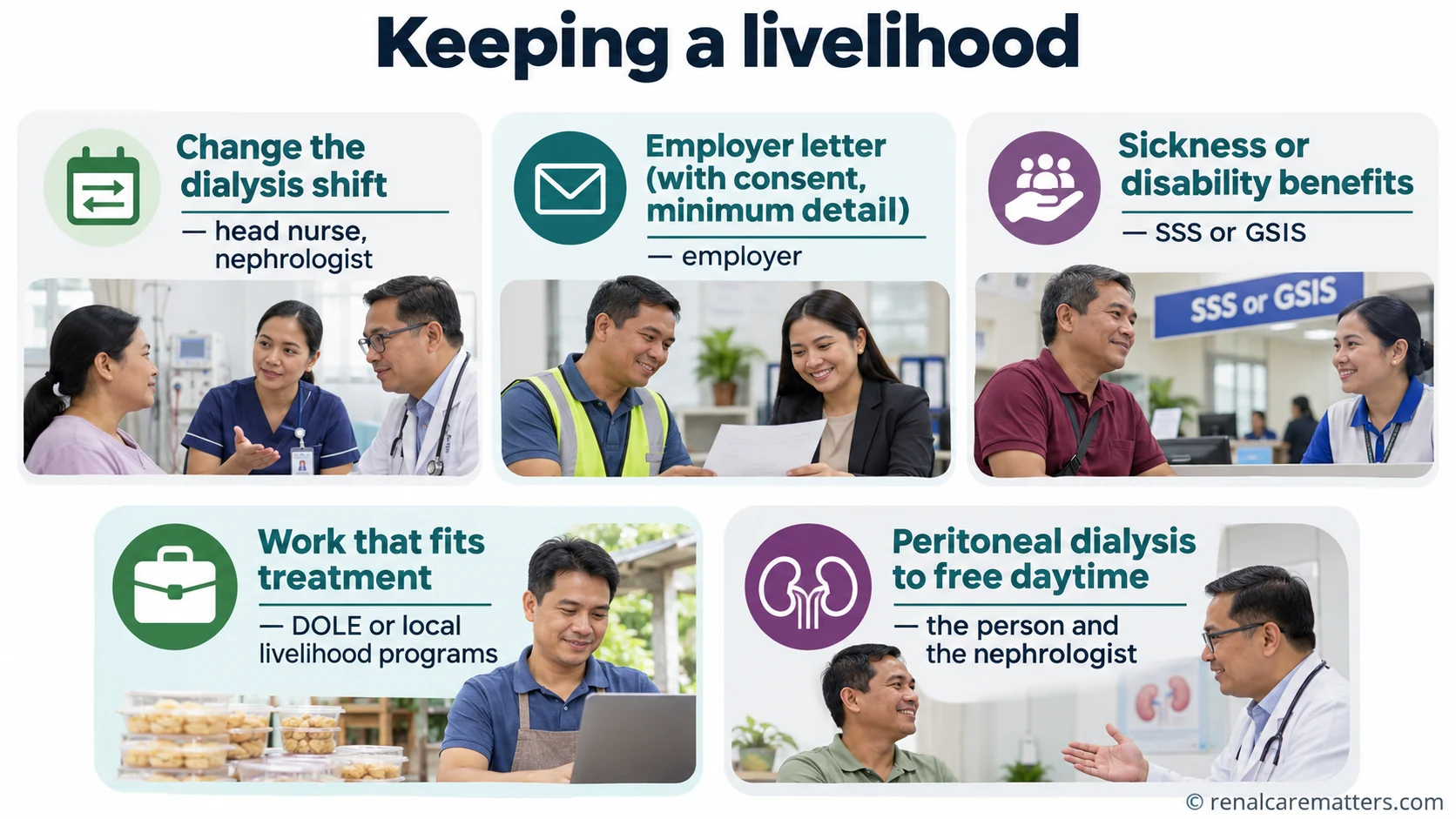
Figure 3. Ask about work in the first month.
Option
What you do
Who decides
Change the dialysis shift to fit work
Ask the unit about afternoon or evening slots
Head nurse and attending nephrologist
Ask the employer for adjusted hours
With consent, a letter stating the treatment schedule, without unnecessary detail
The employer
Sick leave, sickness or disability benefits
Check membership and contributions with the Social Security System (SSS) or the Government Service Insurance System (GSIS)
SSS or GSIS
Work that fits treatment
Referral to livelihood programs of the Department of Labor and Employment (DOLE) or local government; home-based work
The person
Peritoneal dialysis to free daytime hours
Raise it with the nephrologist if the person is interested (Module 14)
The person and the nephrologist
An employer letter needs the person’s consent and only the facts the employer needs: that they receive a treatment on set days and times. It should not name the diagnosis unless the person wants it named.
RememberAsk about work in the first month. A job kept is worth more than any assistance found later.
Lesson · part 3
When home makes treatment unsafe
A home affects treatment in concrete ways. Peritoneal dialysis needs a clean space and storage. Hemodialysis needs a fistula arm kept clean and safe. Everyone on dialysis needs food that fits the diet and a way to keep medicines dry and cool. Ask about these directly, without making the person feel judged.
Problem
Why it matters clinically
Who must hear
Skipping meals to pay fares
Weight loss, weakness, poor healing; low albumin is a warning sign on dialysis
Dietitian and nephrologist this week
Living on instant noodles and canned food
High salt; more thirst and fluid gain; often high phosphate
Dietitian
No clean water or a flooded home
Infection risk for peritoneal dialysis and wounds
Peritoneal dialysis nurse and nephrologist
Eviction, homelessness, unsafe home
Missed sessions; lost medicines; safety
Your supervisor and local social welfare office
Food is the hidden cost of the access equation. When money runs short, families cut food first, because the fare cannot be cut. A patient who says “we eat rice and noodles to save for the fare” is telling you the access cost has already reached their plate.
RememberAsk what the household eats. When food is being cut to pay for transport, the dietitian and nephrologist need to know this week.
Lesson · part 4
A legal discount many miss
People with kidney failure on dialysis may qualify as persons with disability under Philippine law, and a PWD ID carries a 20% discount on many purchases, including some medical services and medicines, as the site’s patient guide explains. Many patients have never applied. Check the current requirements with the local office that issues PWD IDs, and ask the attending physician for the medical certificate it requires.
A discount is a percentage of what the patient pays, so it helps most when costs are high. It does not replace Philippine Health Insurance Corporation (PhilHealth) or assistance; it adds to them.
Figure 4 · Helping a person get a PWD ID
Check eligibilityAsk the local issuing office about current rules for kidney failure and dialysis.
Medical certificateAsk the attending physician for the certificate in the format the office requires.
DocumentsIdentification, photo, barangay documents as required.
ApplyA family member may be able to file on the patient’s behalf; ask.
Use itShow the ID before each payment; ask how the discount was computed.
RememberAsk every patient on dialysis whether they have a PWD ID. It is a legal discount, not a favor.
On the floor · The shared ride
Social worker Ms. Joanna Dizon notices that four patients on the same shift live in the same municipality and each pays for a special trip.
With their consent, she introduces them to each other. They share one vehicle and split the cost, and the local government agrees to cover part of the fare for dialysis days.
The cost per person fell by more than half because someone looked at the schedule as a map.
Illustrative scenario. Names and details are invented.
On the floor
Real situations: problems and solutions
These are fictional but typical. For each one, cover the answer, decide what you would do, then compare. Where a step depends on local rules, your unit’s procedure and your supervisor’s direction come first.
Late again
What you see
A patient is late three times a month for the 6:00 a.m. shift.
What is likely going on
The first jeepney runs after 5:30 a.m.
What to do
Ask about a later shift and look for a shared ride.
Why it matters
Lateness often has a timetable behind it.
The silent job loss
What you see
A patient stops mentioning work after three months of dialysis.
What is likely going on
He may have lost his job and feel ashamed.
What to do
Ask directly and early about work, and check benefits from past contributions.
Why it matters
A job kept is worth more than assistance found later.
Noodles for the fare
What you see
A family eats instant noodles to save for transport.
What is likely going on
Access cost has reached the food budget.
What to do
Tell the dietitian and nephrologist, and work on the access cost.
Why it matters
Food cuts come before fare cuts, and they harm the patient.
Field notes
Ask every patient how they get to dialysis and how much it costs, at the first visit.
Keep a list of patients by barangay to spot shared-ride possibilities.
Case review
Back to the case: The tricycle fare and the 5 a.m. shift
The monthly cost. With 13 sessions a month: tricycle PHP 500 a day (250 each way) plus his wife’s lost earnings of about PHP 400 a day = PHP 900 per visit, about PHP 11,700 a month before food. Put it in the access cost tool with him and his wife. Then compare it with their total monthly spending in the spending share tool; it is likely far above the 25% mark.
Options. Ask the head nurse whether a later shift is possible (it would let him take the first jeepney and arrive on time, and solve the charge nurse’s problem). Look for other patients from his barangay to share a ride. Check his SSS contributions from his driving years for disability or sickness benefits. Help him apply for a PWD ID. Check local government transport aid. Raise with the nephrologist whether his post-dialysis weakness needs review, and whether he might be interested in hearing about peritoneal dialysis.
Referrals today. Eating mostly rice and instant noodles to save for the fare is a food and salt problem: tell the dietitian and nephrologist this week. His job loss and the family’s strain deserve a check on mood (Module 10) and on his wife’s load (Module 13). Tell the charge nurse what you found: the lateness has a cause, and a plan.
Skills lab · with your preceptor
Skills checklist: An access cost estimate with a family
With a simulated patient and companion, calculate the monthly access cost and spending share and agree a plan while your supervisor observes. Your preceptor rates each step as satisfactory, needs practice, or not observed. Steps marked Critical must all be satisfactory before sign-off. This checklist supports supervised learning; your unit’s own procedure and competency form are the authority. A printable version of every checklist is on the trainer page.
Calculates monthly access cost including the companion, food, and lost wages.
CriticalSubtracts only confirmed support when stating the gap.
Calculates the household health spending share and explains the 10% and 25% marks as population indicators, not eligibility rules.
Explores at least three work or schedule options and names who decides each.
CriticalAsks about food, water, and housing, and routes food insecurity to the dietitian and nephrologist.
Checks for a PWD ID and explains how to apply.
Placement activity. For one patient (with consent), complete an access cost estimate and review it with the patient a month later to see what changed.
Self-assessment
Check your understanding
Each visit draws 5 questions at random from this module’s 10-question bank. Choose the single best answer for each, then select Check answers; an explanation appears under the best answer. Select New set of questions for a different mix. A good target is 4 of 5 on two different sets. Nothing you select is sent anywhere; scoring happens in your browser.
Moist, L. M., Bragg-Gresham, J. L., Pisoni, R. L., Saran, R., Akiba, T., Jacobson, S. H., Fukuhara, S., Mapes, D. L., Rayner, H. C., Saito, A., & Port, F. K. (2008). Travel time to dialysis as a predictor of health-related quality of life, adherence, and mortality: The Dialysis Outcomes and Practice Patterns Study (DOPPS). American Journal of Kidney Diseases, 51(4), 641–650. https://doi.org/10.1053/j.ajkd.2007.12.021
Chan, K. E., Thadhani, R. I., & Maddux, F. W. (2014). Adherence barriers to chronic dialysis in the United States. Journal of the American Society of Nephrology, 25(11), 2642–2648. https://doi.org/10.1681/ASN.2013111160
Educational material for social workers and navigation staff in kidney care. Completing it is an Academy learning record only. It is not a Professional Regulation Commission (PRC) license, a specialty credential, CPD units, or DOH or PhilHealth recognition, and it does not authorize anyone to practice beyond their own registration.