Goals that belong to the person, actions with owners and dates, the referral loop, and review and closure.
PublishedNailathalaGipatikPepalwal:ReferencesMga SanggunianMga TinubdanReng Reperensya:1Audience: Registered social workers in dialysis units, hospital medical social work departments, and kidney transplant programs · medical social workers rotating into kidney care · navigation and support staff on the orientation pathRead timeOras ng pagbasaOras sa pagbasaOras ning pamamasa:
This module is study material for social workers and navigation staff in kidney care. It explains the reasoning behind social work decisions; it is not a facility procedure, legal advice, a benefits ruling, or a mental health diagnosis. Rules, assistance programs, and amounts change: confirm them against the current issuance and your facility’s approved policy. Medical treatment belongs to the nephrologist, benefits to PhilHealth, donation ethics to the ethics committee, and psychiatric diagnosis to the mental health team. Every case, name, and identifier is fictional.
Learning objectives
After this module you should be able to
Write care plan goals in the person’s own words, linked to the formulation.
Turn each goal into actions with an owner, a due date, and the evidence that will show it is done.
Track a referral through sent, accepted, decided, delivered, and confirmed, and close it only on evidence.
Set a review date and the triggers that bring a review forward.
Close a case, or step it down, with a clear handover to the person and the team.
Classroom 1 hSkills lab 1 hSupervised placement 1 h
Pre-testBefore you read, answer the 5 self-assessment questions and note your score. After the module, select New set of questions and compare. The difference is what you learned; the questions you still miss are what to reread.
Start here
The big picture, in plain words
In plain wordsA care plan is a relay race. Each runner carries the baton for one stretch, then hands it on. Races are not lost by slow runners as often as by dropped batons: the handoff where each runner thought the other had it.
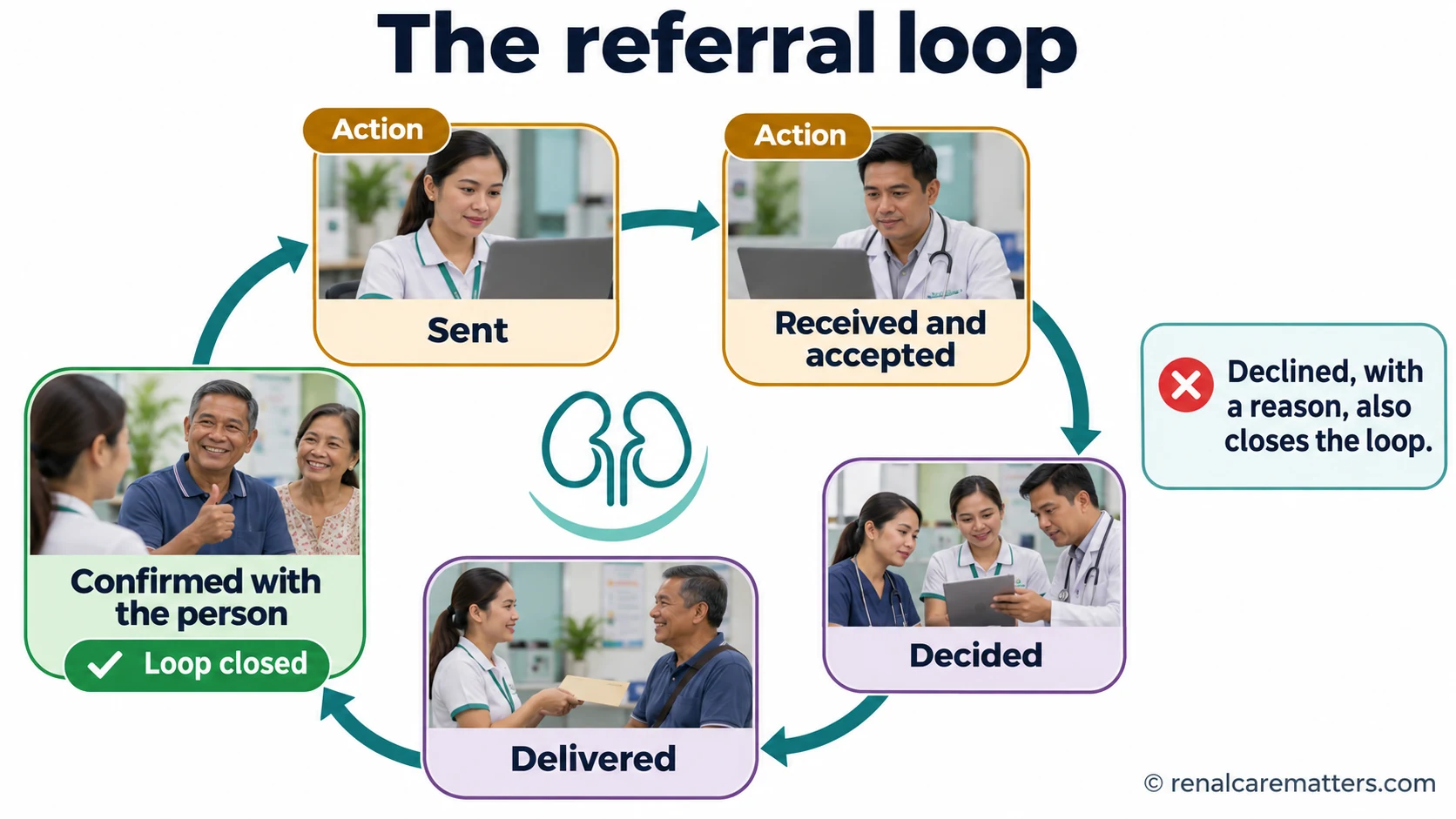
Figure 1. A referral sent is an action; an outcome confirmed is the result. Close the loop only on evidence.
The picture has a limit. In a relay the baton is visible, and everyone knows when it hits the ground. A referral that falls between two services makes no sound. The form was sent; the receiving office never opened it; the patient waited, assumed the answer was no, and stopped asking. Nobody saw the baton drop. That is why case management is mostly about one thing: making handoffs visible and checking that they happened.
Your job in this module is to build plans that belong to the person, to give every action an owner and a date, and to keep each referral open until you have evidence that the help reached the household. Navigation helps people finish steps. In a cluster randomized trial in 23 hemodialysis units, patients who met monthly with trained peer navigators completed more steps toward transplant than those with usual care (3.5 against 1.6 steps); the trial measured steps completed, a process outcome, and did not show more transplants or longer survival.1 The lesson for you is the mechanism: someone who knows the next step and follows up.
Figure 2 · Key terms for this module
Care planThe agreed goals, actions, owners, dates, and review point for one person.
specific, measurable, achievable, relevant and time-bound (SMART) goalSpecific, measurable, achievable, relevant, and time-bound.
OwnerThe one person responsible for an action, by name or role.
ReferralA request to another service to do something for the person.
Closed loopA referral closed only when the outcome is confirmed, not when the request is sent.
Step-downReducing contact once goals are met, with a clear route back.
Opening case · fictional
Case: Seven referrals, zero outcomes
You take over the caseload of a social worker who resigned. On Wednesday at 3:00 p.m. you open the file of Mrs. Josefina Cruz, 58, on hemodialysis for two years. Her care plan, dated four months ago, lists one goal: “Address financial concerns.”
The referral log shows seven entries, each marked “Referred”: a local government medical assistance office, a charity foundation, the Philippine Charity Sweepstakes Office (PCSO), the hospital Malasakit Center, the dietitian, a psychiatrist, and the barangay for transport. None has an outcome, a date of response, or a contact name.
When you call Mrs. Cruz, she says nobody ever called her back, and that she now borrows money every month from a lender in her neighborhood at what she calls “5-6.”
Before reading on, decide:
What is wrong with the existing care plan and log?
How would you rewrite the plan with Mrs. Cruz?
How will you track the referrals so this does not happen again?
Keep your answers in mind. The lesson gives you what you need, and the case review near the end shows one sound response.
Lesson · part 1
Her words, your structure
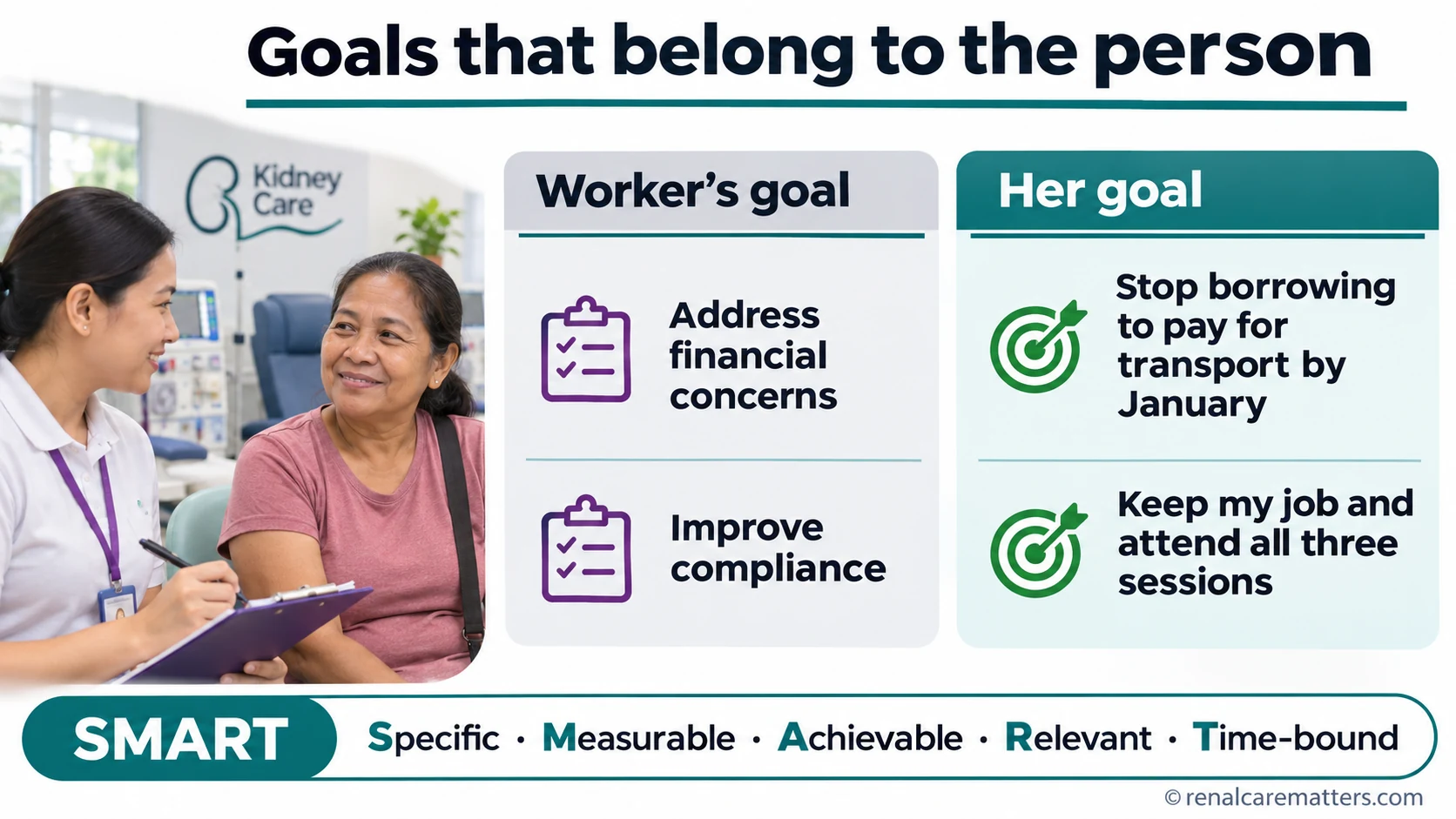
A goal written by the worker, for the worker, is a task list. A goal the person recognizes as theirs is a plan they will help carry out. Start from what they said matters most (Module 1), and connect it to the formulation (Module 5).
Figure 3. Rewrite the worker’s goal in the person’s words.
Weak goal
Why it fails
Stronger goal
“Address financial concerns.”
No outcome, no time, not the person’s words
“Stop borrowing from the lender to pay for transport by January.”
“Improve compliance.”
Blames, and measures nothing the person cares about
“Keep my job and attend all three sessions a week by changing to the afternoon shift.”
“Psychiatric evaluation.”
An action, not a goal
“Sleep through the night and feel like myself again.” (Action: mental health referral.)
Use the SMART test on each goal: specific, measurable, achievable, relevant, and time-bound. Two or three goals are enough. A plan with ten goals is a plan nobody follows.
RememberWrite goals in the person’s words, linked to the formulation, and keep to two or three at a time.
Lesson · part 2
Who does what by when
Each goal needs actions. Each action needs one owner, a due date, and the evidence that will show it is done. The person and the family own actions too; write theirs down as clearly as yours.
Action
Owner
Due
Closure evidence
Review the household budget and the lender debt
Social worker with Mrs. Cruz
Friday
Written budget with monthly gap (toolkit)
Ask the unit about an afternoon shift
Head nurse
Next Monday
Shift confirmed in the schedule
Bring barangay certificate of residency and indigency
Mrs. Cruz’s son
Next Wednesday
Documents in hand
Submit the Malasakit Center request
Social worker
Next Thursday
Receiving officer’s name and reference number
Confirm the decision and what was actually paid
Social worker
Two weeks after submission
Decision letter or billing record; patient confirms
The last row is the one that is usually missing. A submission is not help. Help is what reached the household. The access cost tool can show the monthly gap before and after, so the person sees what changed.
RememberEvery action has one owner, a due date, and closure evidence. The person’s own actions are written down too.
Lesson · part 3
Sent is not done
A referral passes through five stations. Only the last one closes it.
Figure 4 · The five stations of a referral
SentYou sent the request. Record date, channel, recipient name.
Received and acceptedThe service confirms it has the request and will act. Record who confirmed.
DecidedThe service decides (accepted, declined, partial, waitlisted). Record the decision and reason.
DeliveredThe help happened: the appointment took place, the funds were applied, the device arrived.
ConfirmedThe person confirms it reached them and made the difference intended.
Track each open referral by age. A referral that has not moved for longer than you agreed is an escalation, not a waiting game. The referral aging tool turns the open date and due date into days open, days overdue, and a tier: on track, due soon, overdue, or escalate.
Worked example, illustrative. Days open = today − date sent. Days overdue = today − due date (if positive). Sent March 3. Due March 13. Today March 20. Days open = 17. Days overdue = 7. Tier: overdue (7 days or fewer past due); more than 7 days past due would be “escalate.” What the number tells you: this referral needs a call today. What it does not tell you: whether the service lost it, declined it, or is waiting for a document.
When a referral is declined, the loop still closes, with a reason. A declined request with a reason is useful; it tells you what to try next. A request that simply vanished tells you nothing and costs the person weeks.
RememberClose a referral only on a confirmed outcome. A declined request with a reason closes the loop; silence never does.
On the floor · The dietitian referral
Social worker Ms. Nina Garcia refers a patient to the dietitian for weight loss on March 1. On March 8 her log shows “sent.” She calls: the request went to a dietitian on leave.
She resends it to the covering dietitian, who sees the patient on March 10. She closes the referral on March 11, after the patient tells her the meal plan fits her budget.
One phone call found a referral that would have waited another month.
Illustrative scenario. Names and details are invented.
Lesson · part 4
Keeping the plan alive
Set a review date when you write the plan. Most stable cases can be reviewed every three months; set a shorter interval for complex cases. Some events should bring the review forward at once.
Trigger
Why
Hospital admission or a fall
Function, money, and caregiving may all change
Missed or shortened sessions
A barrier has appeared or grown
Change of modality, transplant listing, or transfer
New demands on the household
Benefit sessions running out, job loss, death in the family
Financial and emotional shock
New distress, safety concern, or caregiver collapse
Risk has changed
Step a case down when its goals are met, and tell the person how to come back: whom to ask, and what kind of problem should bring them back. Closing a case is not abandoning it; it is handing the person back their own plan, with a door left open.
RememberEvery plan has a review date and named triggers. Every closure leaves a clear way back.
On the floor
Real situations: problems and solutions
These are fictional but typical. For each one, cover the answer, decide what you would do, then compare. Where a step depends on local rules, your unit’s procedure and your supervisor’s direction come first.
Referrals in a drawer
What you see
You find a folder of referral forms marked “sent” with no replies.
What is likely going on
Actions recorded as outcomes.
What to do
Call each receiving service, oldest first, and record the station each has reached.
Why it matters
A folder of sent forms hides every open loop.
The ten-goal plan
What you see
A care plan lists ten goals and no dates.
What is likely going on
A wish list, not a plan.
What to do
With the person, choose two or three goals and give each action an owner and a date.
Why it matters
Plans nobody can carry out are not followed.
The decline nobody heard
What you see
An agency declined a request a month ago, but the family is still waiting.
What is likely going on
The decision never reached the household.
What to do
Tell the family, explain the reason, and agree the next option today.
Why it matters
A decline with a reason is useful only if it is shared.
Field notes
Check your referral aging list every Monday morning.
Write the person’s own tasks into the plan as clearly as yours.
Case review
Back to the case: Seven referrals, zero outcomes
What is wrong. The goal is the worker’s, not Mrs. Cruz’s, and it measures nothing. The log records actions (“referred”) and no outcomes: no recipient, no response date, no decision. Seven referrals sent at once, with none followed up, probably wasted the family’s documents and trust. And the plan missed a growing harm: monthly borrowing from an informal lender at high interest.
The rewritten plan. Start with an apology for the delay, then ask what she wants. A goal such as “Stop borrowing to pay for dialysis transport by January.” Actions: a budget review with the access cost tool this week; a check of which of the seven requests is still alive (call each, starting with the oldest); one or two well-prepared applications rather than seven thin ones; a referral to the dietitian or psychiatrist only if those needs are still present, assessed afresh; and a review date in four weeks.
Tracking. One row per referral with the five stations, a named contact, and a due date. Check the aging tool weekly. Close each only on a confirmed outcome, including a decline with its reason.
Skills lab · with your preceptor
Skills checklist: A care plan and a referral log
From a fictional formulation, write a care plan and track two referrals while your supervisor observes. Your preceptor rates each step as satisfactory, needs practice, or not observed. Steps marked Critical must all be satisfactory before sign-off. This checklist supports supervised learning; your unit’s own procedure and competency form are the authority. A printable version of every checklist is on the trainer page.
Writes two or three goals in the person’s own words, linked to the formulation.
Gives each action one owner, a due date, and closure evidence, including the person’s own actions.
CriticalRecords each referral through sent, accepted, decided, delivered, and confirmed.
Uses the referral aging tool and escalates an overdue referral the same day.
CriticalCloses a referral only on a confirmed outcome, including a decline with its reason.
Sets a review date and names the triggers that bring it forward.
Placement activity. Audit five of your own open referrals. For each, find the evidence for its current station and call the owner of any that has not moved in two weeks.
Self-assessment
Check your understanding
Each visit draws 5 questions at random from this module’s 10-question bank. Choose the single best answer for each, then select Check answers; an explanation appears under the best answer. Select New set of questions for a different mix. A good target is 4 of 5 on two different sets. Nothing you select is sent anywhere; scoring happens in your browser.
Sullivan, C., Leon, J. B., Sayre, S. S., Marbury, M., Ivers, M., Pencak, J. A., Bodziak, K. A., Hricik, D. E., Morrison, E. J., Albert, J. M., Navaneethan, S. D., Reyes, C. M., & Sehgal, A. R. (2012). Impact of navigators on completion of steps in the kidney transplant process: A randomized, controlled trial. Clinical Journal of the American Society of Nephrology, 7(10), 1639–1645. https://doi.org/10.2215/CJN.11731111
Educational material for social workers and navigation staff in kidney care. Completing it is an Academy learning record only. It is not a Professional Regulation Commission (PRC) license, a specialty credential, CPD units, or DOH or PhilHealth recognition, and it does not authorize anyone to practice beyond their own registration.