Confirming ROSC, the first ten minutes after the pulse returns, what a freestanding unit can do, and a handover the ambulance can use.
PublishedNailathalaGipatikPepalwal:ReferencesMga SanggunianMga TinubdanReng Reperensya:4Audience: Every member of the dialysis shift team: hemodialysis nurses, charge and head nurses, physicians-on-duty, attending nephrologists, dialysis and biomedical technicians, nurse assistants and support staff · pediatric dialysis teams for Part 4Read timeOras ng pagbasaOras sa pagbasaOras ning pamamasa:
This module is study material for dialysis teams. It explains the reasoning behind resuscitation decisions; it is not a unit protocol, an order set, or certification. Doses and energies are quoted from the 2025 American Heart Association (AHA) guidelines and the European Resuscitation Council (ERC) where named, so you can recognize them; give medicines only within your license and your unit’s approved protocol. Escalation always follows your unit protocol, and you always ask the attending nephrologist for guidance. Every case, name, and identifier is fictional.
Learning objectives
After this module you should be able to
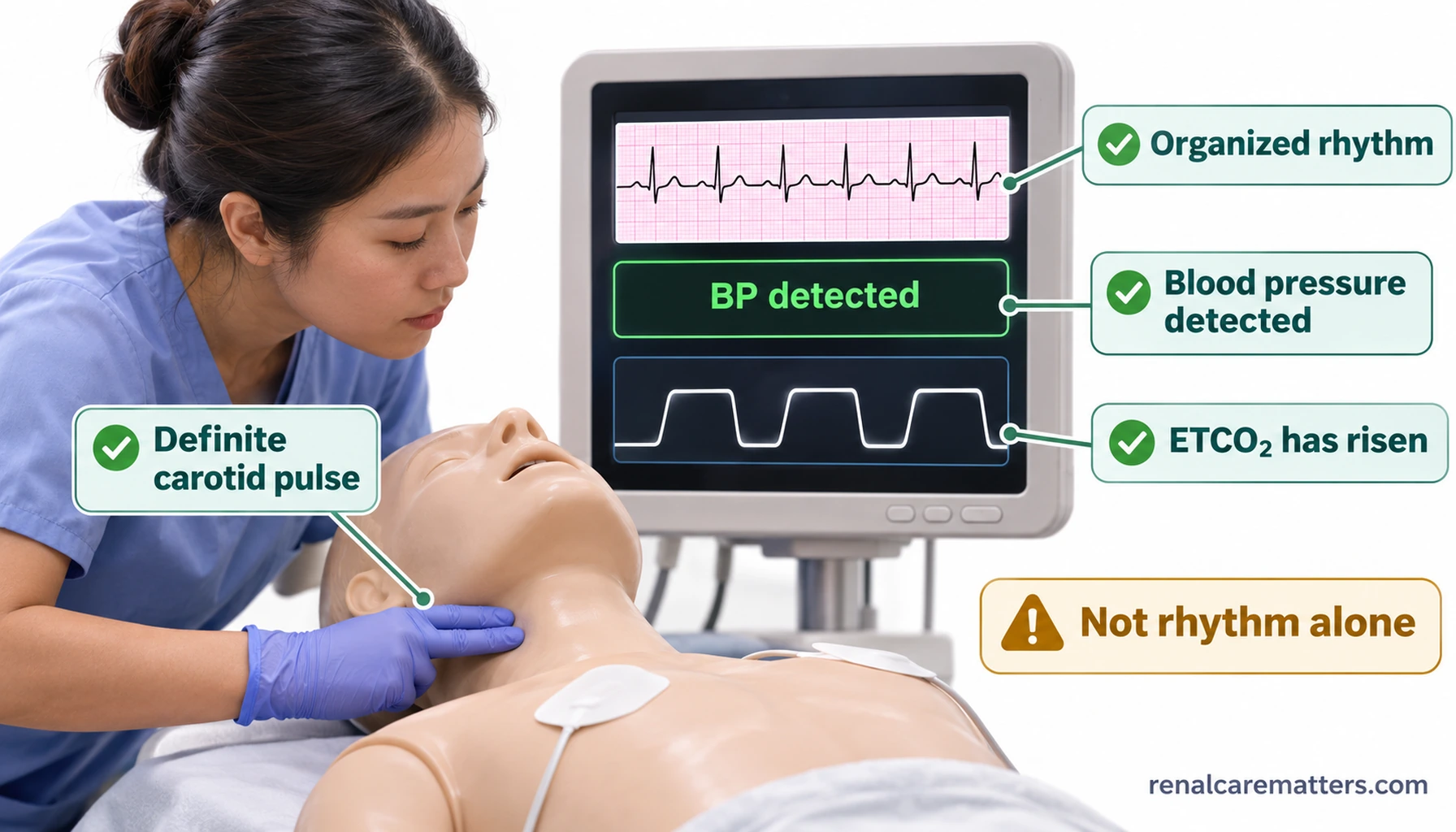
Confirm return of spontaneous circulation with a definite pulse and blood pressure, not with the rhythm alone.
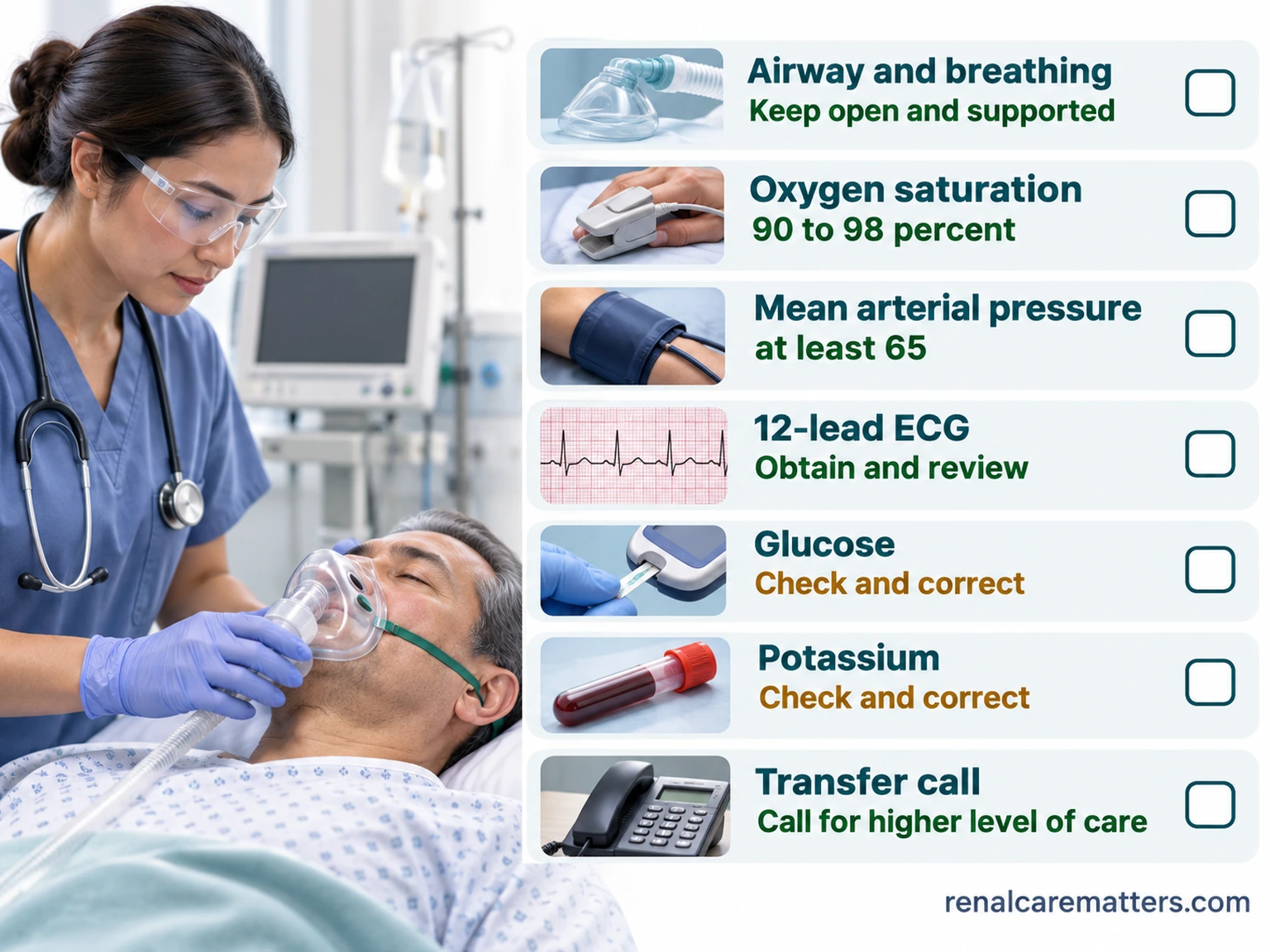
Deliver the first ten minutes of care after return of spontaneous circulation (ROSC): airway, oxygen titrated to 90 to 98%, mean arterial pressure of at least 65 mm Hg, a 12-lead electrocardiogram (ECG), glucose and potassium.
Recognize re-arrest early and return to the arrest algorithm without delay.
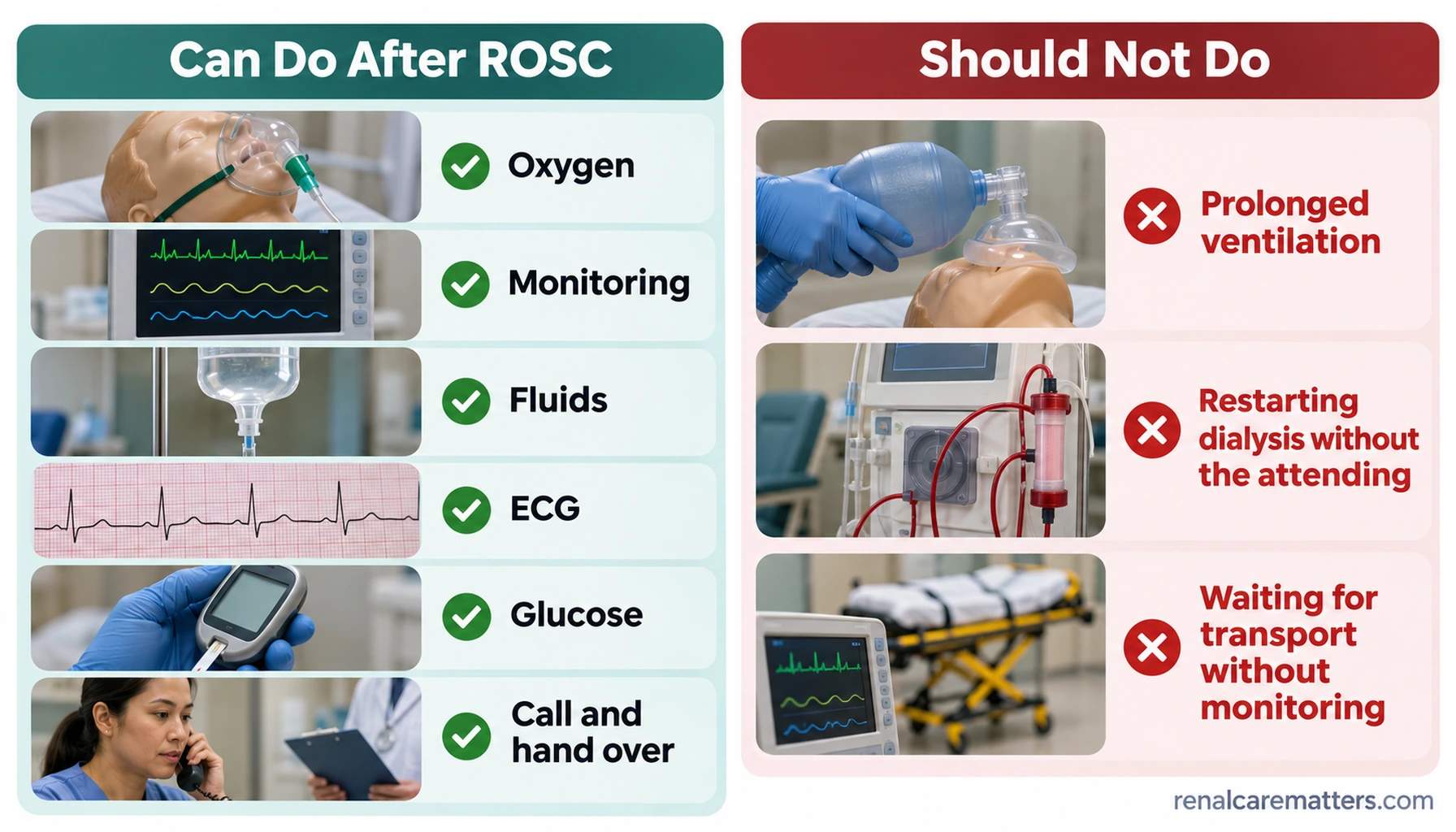
Explain what a freestanding dialysis unit can and should not do after ROSC, including why dialysis is not restarted without the attending nephrologist.
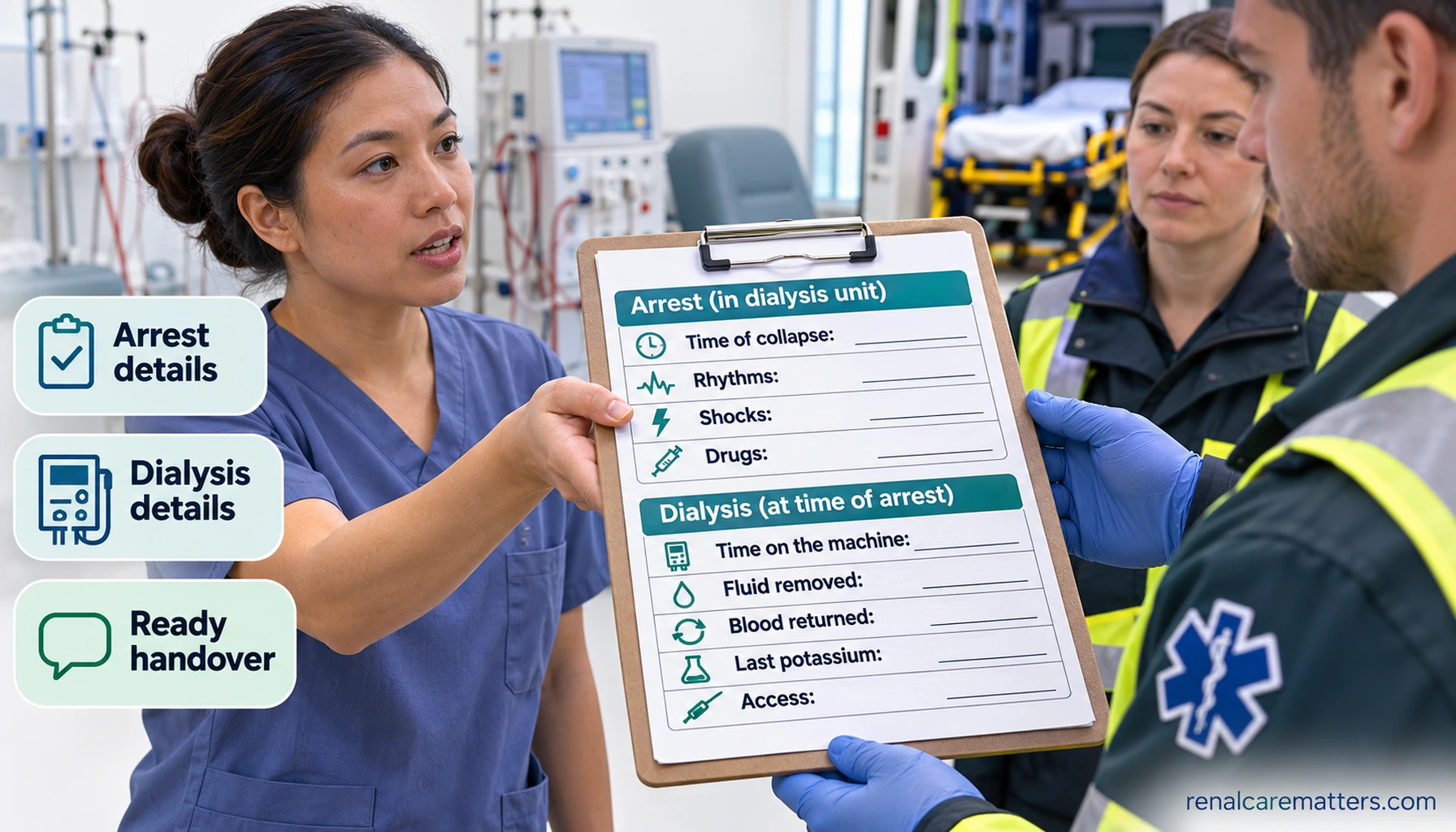
Give a structured handover that combines the arrest facts and the dialysis facts.
Classroom 1 hSkills lab 1 hSupervised placement 0 h
Pre-testBefore you read, answer the 5 self-assessment questions and note your score. After the module, select New set of questions and compare. The difference is what you learned; the questions you still miss are what to reread.
Start here
The big picture, in plain words
In plain wordsA returned pulse is like a fire that has stopped burning but is still smoking. The danger has changed shape, not ended. The heart that just restarted is stunned and irritable; the brain that went without blood is swelling; the cause of the arrest, whether potassium or blood loss or a blocked artery, is usually still there.
The picture has a limit. Smoke does not usually reignite on its own, but a heart after arrest often does: re-arrest is common in the first minutes and hours. And unlike a fire scene, the patient now needs things a dialysis unit may not have: mechanical ventilation, continuous blood pressure monitoring, emergency coronary angiography, temperature control. In one large series, 60% of patients who arrested in dialysis units died within 48 hours.1 The minutes after ROSC decide whether the patient reaches the place that can give that care.
This module covers the immediate post-ROSC priorities that apply in any dialysis unit, and the handover that lets the receiving team continue without starting over.
Figure 1 · Key terms for this module
Return of spontaneous circulation (ROSC)A definite pulse and measurable blood pressure after cardiac arrest.
Re-arrestLoss of circulation again after ROSC.
Mean arterial pressure (MAP)The average arterial pressure driving organ perfusion.
Temperature controlDeliberate management of body temperature after arrest in patients who do not follow commands.
HandoverStructured transfer of information and responsibility to the next team.
Post-cardiac arrest syndromeThe combined brain injury, heart dysfunction and whole-body inflammation that follow arrest.
Opening case · fictional
Case: Pulse restored, now what?
At 2:35 p.m., after 11 minutes of cardiopulmonary resuscitation (CPR), two shocks and two doses of epinephrine, Mr. Leonardo Ramos, 70, has a palpable carotid pulse at a freestanding unit in Taytay, Rizal. The monitor shows sinus tachycardia at 112. His blood pressure is 84/50 mm Hg. He is not following commands. He is breathing on his own, irregularly, with saturation 89% on a mask. He arrested 3 hours into a session; 2.6 L had been removed, and the blood was returned at the start of the arrest. His pre-dialysis potassium this morning was 5.1 mmol/L.
The ambulance, called at the start of the arrest, is stuck in traffic; expected arrival is 20 minutes. A nurse asks the physician-on-duty, “Should we put him back on dialysis while we wait?”
Before reading on, decide:
How do you confirm this is ROSC, and what do you check in the next ten minutes?
What should the answer be about restarting dialysis?
What goes into the handover when the ambulance arrives?
Keep your answers in mind. The lesson gives you what you need, and the case review near the end shows one sound response.
Lesson · part 1
Is it really ROSC?
ROSC is a clinical finding: a definite pulse and a measurable blood pressure. An organized rhythm on the monitor is not enough; it may be PEA (Module 3). Signs that support ROSC include a palpable central pulse, a measurable blood pressure, an abrupt rise in end-tidal carbon dioxide if capnography is in use (Class of Recommendation (COR) 2b, Level of Evidence (LOE) B-NR),2 spontaneous breathing, and movement.
Figure 2. Confirm ROSC with a definite pulse and a blood pressure, not with the rhythm alone.
Organized rhythm, weak uncertain pulse, no measurable pressure
Treat as no pulse
Resume compressions; recheck at the next pause
Pulse present, then lost
Re-arrest
Compressions; arrest algorithm
Keep the pads on and the defibrillator connected after ROSC. Re-arrest is common, and when it happens the team should be compressing again within seconds, with the last rhythm, drugs and times already on the recorder’s sheet.
RememberROSC means a definite pulse and a pressure, not just a rhythm. Keep the pads on, because re-arrest is common.
Lesson · part 2
The first ten minutes after the pulse returns
The 2025 American Heart Association (AHA) post-cardiac arrest guideline sets the targets for adults.3 A freestanding dialysis unit can meet most of them for the first minutes with what it already has: oxygen, a bag-mask, monitoring, intravenous (IV) access, saline, a 12-lead ECG, a glucose meter and a potassium sample.
Figure 3. The first ten minutes after the pulse returns: airway, oxygen, pressure, ECG, glucose, potassium, transfer.
Priority
2025 AHA recommendation
Grade
In a dialysis unit
Oxygen
100% inspired oxygen until saturation can be measured reliably; avoid hypoxemia; then titrate to peripheral oxygen saturation (SpO2) 90% to 98%
COR 1, B-R; COR 1, B-NR; COR 2a, B-R
Mask or bag-mask; assist breathing if slow or irregular
Ventilation
In comatose patients, keep arterial partial pressure of carbon dioxide (PaCO2) in the normal range (about 35 to 45 mm Hg)
COR 1, LOE B-R
Avoid over-bagging; usually no blood gas available
Blood pressure
Prevent hypotension with a MAP of at least 65 mm Hg
COR 1, LOE B-R
Saline per physician; vasopressor only if stocked and ordered
12-lead ECG
As soon as feasible after ROSC
COR 1, LOE B-NR
Record and send with the patient; ST elevation changes the destination
Glucose
Avoiding below 70 and above 180 mg/dL may be reasonable
COR 2b, LOE B-NR
Capillary glucose; treat low glucose
Temperature
Deliberate temperature control (32 to 37.5 °C) for at least 36 hours in patients who do not follow commands
COR 1, B-R; COR 2a, B-R
Do not warm actively; avoid fever; continues in hospital
The guideline also notes that pulse oximetry may miss hypoxemia in patients with darker skin pigmentation (COR 2b, LOE C-LD).3 Treat a borderline saturation with care and look at the patient’s color, breathing and mental status as well.
For a dialysis patient, add two checks: potassium (the cause or a rebound) and the access (bleeding, a dislodged needle, a clamped and capped catheter). The circuit nurse confirms the circuit is safe and the blood decision was recorded.
RememberAfter ROSC: oxygen to 90 to 98%, gentle ventilation, MAP at least 65, a 12-lead ECG, glucose, potassium, the access, and pads still on.
Lesson · part 3
What a freestanding unit can and should not do
A hospital-based unit hands over to an intensive care team in minutes. A freestanding unit holds a critically ill patient until the ambulance arrives, sometimes for longer than the arrest itself. Plan for that interval in advance.
Figure 4. What a freestanding unit can and should not do after ROSC.
Prolonged manual ventilation without a plan or a second person
Continuous monitoring; repeat blood pressure every few minutes
Leave the patient unmonitored while waiting for transport
Saline bolus per physician; glucose correction
Start drugs not stocked, not ordered, or outside protocol
12-lead ECG; potassium and glucose samples
Delay transfer to wait for laboratory results
Call the receiving hospital early with a summary
Send the patient without the ECG, the record sheet, or the dialysis facts
Keep the access safe for drugs and for the next dialysis
Restart dialysis without the attending nephrologist
Restarting dialysis after ROSC is tempting when potassium or fluid overload caused the arrest. Card 1 is clear: do not restart dialysis unless the attending nephrologist says so. The European Resuscitation Council (ERC) notes that dialysis may be needed early after ROSC,4 but a patient with a pressure of 84/50 who does not follow commands needs monitored care first, and the decision of where and when dialysis resumes belongs to the attending nephrologist and the receiving team. Restarting a circuit in an unstable patient can drop the pressure and cause re-arrest.
RememberStabilize, monitor, document and transfer. Dialysis restarts only on the attending nephrologist’s decision, usually in the receiving hospital.
Lesson · part 4
A handover the ambulance can use
The receiving team needs two kinds of facts: what happened in the arrest, and what was happening on the dialysis machine. The second kind is the one most often lost.
Figure 5. A handover the receiving team can use: the arrest and the dialysis facts together.
The eventTime of collapse, witnessed or not, first rhythm, time to first compression and first shock.
TreatmentShocks (number, energy), drugs (name, dose, times), airway, duration of CPR, time of ROSC.
The dialysis factsHours on the machine, fluid removed, whether the blood was returned, last potassium and its time, dialysis fluid potassium and calcium, heparin given.
NowCurrent pressure, rhythm, saturation, glucose, mental status, the 12-lead ECG, and what has been asked of the attending nephrologist.
Send the recorder’s sheet, the ECG, the dialysis treatment sheet, and the medication list. Tell the family as soon as a staff member is free, with the leader or charge nurse, in plain words. Then document, restock the cart, check the defibrillator, and hold the debrief (Module 13).
RememberHand over the arrest and the dialysis together: time on the machine, fluid removed, blood returned or not, and the last potassium travel with the patient.
Stop and callAfter any ROSC: keep the pads on, call the receiving hospital and the attending nephrologist, and follow your unit protocol for transfer. Never restart dialysis without the attending nephrologist’s explicit decision.
On the floor
Real situations: problems and solutions
These are fictional but typical. For each one, cover the answer, decide what you would do, then compare. Where a step depends on local rules, your unit’s procedure and your supervisor’s direction come first.
The missing dialysis facts
What you see
The emergency room calls back asking whether the blood was returned and how much fluid was removed; nobody wrote it down.
What is likely going on
The dialysis facts were not in the handover.
What to do
Make the recorder’s sheet include time on machine, fluid removed, blood decision and last potassium.
Why it matters
The receiving team cannot see the machine.
The 30-minute wait
What you see
After ROSC, the ambulance is 30 minutes away and the patient is hypotensive.
What is likely going on
A long stabilization interval in a freestanding unit.
What to do
Continue monitoring, oxygen and fluids per physician; call the receiving hospital; keep the pads on.
Why it matters
The minutes after ROSC may be longer than the arrest.
Pads off too soon
What you see
A nurse removes the pads after ROSC to make the patient comfortable, and he re-arrests five minutes later.
What is likely going on
The team lost seconds re-applying pads.
What to do
Keep pads on until handover to a monitored team.
Why it matters
Re-arrest is common after ROSC.
Field notes
Keep a printed post-ROSC handover sheet in the crash cart.
Agree with your receiving hospital in advance what you will send with the patient.
Case review
Back to the case: Pulse restored, now what?
Confirm and stabilize. A palpable carotid pulse with a measurable pressure (84/50) is ROSC; the pads stay on. In the next ten minutes: oxygen titrated to a saturation of 90 to 98% (89% is too low; support his breathing with the bag-mask if it stays irregular), gentle ventilation, a saline bolus per the physician to bring the MAP (about 61 now) to at least 65, a 12-lead ECG, capillary glucose, and a repeat potassium sample. The access is checked; the catheter or needles are safe and clamped.
Restart dialysis? No, not without the attending nephrologist. He is hypotensive and not following commands; he needs monitored care, and the decision where and when dialysis resumes belongs to the attending and the receiving team. His morning potassium was 5.1 and 2.6 L had been removed, so volume depletion is as likely a contributor as potassium.
Handover. Seventy, on dialysis, access type; collapse at 2:24 p.m., witnessed, first rhythm, compressions within seconds; two shocks with energies, two doses of epinephrine with times; ROSC at 2:35; three hours on the machine, 2.6 L removed, blood returned at the start; potassium 5.1 this morning; current pressure, rhythm, saturation, glucose; ECG attached; attending nephrologist informed. The recorder’s sheet and dialysis sheet go with him.
Interactive case · fictional
Interactive case: Pulse restored, now what?
Work through a shift one decision at a time. The panel at the top changes with what you choose. After each choice you see why it is, or is not, the best move; after a weaker one you can try again or carry on and see where it leads. Your first choice at each step is scored. The score stays on this device and nothing is sent anywhere. In real practice, your unit’s protocol and the people responsible for each decision come first.
🚨 Emergency quick card:Code during hemodialysis. One screen each, saved for use with no signal. Print a copy for the crash cart.
Skills lab · with your preceptor
Skills checklist: Post-ROSC care and handover
Continue a megacode past ROSC: stabilize for ten simulated minutes and give a handover to a facilitator playing the ambulance crew. Your preceptor rates each step as satisfactory, needs practice, or not observed. Steps marked Critical must all be satisfactory before sign-off. This checklist supports supervised learning; your unit’s own procedure and competency form are the authority. A printable version of every checklist is on the trainer page.
CriticalConfirms ROSC by a definite pulse and blood pressure, and keeps the pads on.
Titrates oxygen to a saturation of 90 to 98% and avoids over-ventilation.
Targets a MAP of at least 65 mm Hg with fluids or drugs per physician order.
Records a 12-lead ECG and checks glucose and potassium.
CriticalRecognizes re-arrest and resumes compressions within seconds.
CriticalDoes not restart dialysis without the attending nephrologist.
CriticalGives a structured handover including time on machine, fluid removed, blood decision and last potassium.
Placement activity. Draft your unit’s one-page post-ROSC handover sheet and agree it with the nearest receiving emergency room.
Self-assessment
Check your understanding
Each visit draws 5 questions at random from this module’s 10-question bank. Choose the single best answer for each, then select Check answers; an explanation appears under the best answer. Select New set of questions for a different mix. A good target is 4 of 5 on two different sets. Nothing you select is sent anywhere; scoring happens in your browser.
Karnik, J. A., Young, B. S., Lew, N. L., Herget, M., Dubinsky, C., Lazarus, J. M., & Chertow, G. M. (2001). Cardiac arrest and sudden death in dialysis units. Kidney International, 60(1), 350–357. https://doi.org/10.1046/j.1523-1755.2001.00806.x
Wigginton, J. G., Agarwal, S., Bartos, J. A., Coute, R. A., Drennan, I. R., Haamid, A., Kudenchuk, P. J., Link, M. S., Panchal, A. R., Pelter, M. M., Del Rios, M., Rodriguez, A. J., Perman, S. M., Sanko, S., Kotini-Shah, P., & Kurz, M. C. (2025). Part 9: Adult advanced life support: 2025 American Heart Association guidelines for cardiopulmonary resuscitation and emergency cardiovascular care. Circulation, 152(16_suppl_2), S538–S577. https://doi.org/10.1161/CIR.0000000000001376
Hirsch, K. G., Amorim, E., Coppler, P. J., Drennan, I. R., Elliott, A., Gordon, A. J., Jentzer, J. C., Johnson, N. J., Moskowitz, A., Mumma, B. E., Presciutti, A. M., Rodriguez, A. J., Yen, A. F., & Rittenberger, J. C. (2025). Part 11: Post-cardiac arrest care: 2025 American Heart Association guidelines for cardiopulmonary resuscitation and emergency cardiovascular care. Circulation, 152(16_suppl_2), S673–S718. https://doi.org/10.1161/CIR.0000000000001375
Lott, C., Karageorgos, V., Abelairas-Gomez, C., Alfonzo, A., Bierens, J., Cantellow, S., Debaty, G., Einav, S., Fischer, M., González-Salvado, V., Greif, R., Metelmann, B., Metelmann, C., Meyer, T., Paal, P., Peran, D., Scapigliati, A., Spartinou, A., Thies, K., . . . Deakin, C. D. (2025). European Resuscitation Council guidelines 2025 special circumstances in resuscitation. Resuscitation, 215(Suppl. 1), Article 110753. https://doi.org/10.1016/j.resuscitation.2025.110753
Educational reviewer and practice resource for dialysis teams. It is not an American Heart Association (AHA) course, it is not BLS, ACLS or PALS certification, and online completion does not establish hands-on competence. Staff certify through an authorized training center. Your unit’s approved protocol, crash-cart stock and machine manufacturer’s instructions govern every real event.