Weight-based doses, volumes and energies said aloud, concentration traps, extracorporeal volume, and the circuit and access in a child.
PublishedNailathalaGipatikPepalwal:ReferencesMga SanggunianMga TinubdanReng Reperensya:2Audience: Every member of the dialysis shift team: hemodialysis nurses, charge and head nurses, physicians-on-duty, attending nephrologists, dialysis and biomedical technicians, nurse assistants and support staff · pediatric dialysis teams for Part 4Read timeOras ng pagbasaOras sa pagbasaOras ning pamamasa:
This module is study material for dialysis teams. It explains the reasoning behind resuscitation decisions; it is not a unit protocol, an order set, or certification. Doses and energies are quoted from the 2025 American Heart Association (AHA) guidelines and the European Resuscitation Council (ERC) where named, so you can recognize them; give medicines only within your license and your unit’s approved protocol. Escalation always follows your unit protocol, and you always ask the attending nephrologist for guidance. Every case, name, and identifier is fictional.
Learning objectives
After this module you should be able to
Run the pediatric cardiac arrest algorithm, timing epinephrine for shockable and nonshockable rhythms as the 2025 Pediatric Advanced Life Support (PALS) guideline recommends.
Calculate weight-based epinephrine, amiodarone and lidocaine doses and volumes, and defibrillation energies, saying units and concentrations aloud with a second check.
Avoid concentration errors by distinguishing adult arrest, pediatric arrest and anaphylaxis epinephrine preparations.
Manage pediatric supraventricular tachycardia with vagal maneuvers, adenosine and synchronized cardioversion by weight.
Apply the circuit decisions to a child, including extracorporeal volume relative to blood volume and the risks of an uncertain weight.
Classroom 1 hSkills lab 1 hSupervised placement 1 h
Pre-testBefore you read, answer the 5 self-assessment questions and note your score. After the module, select New set of questions and compare. The difference is what you learned; the questions you still miss are what to reread.
Start here
The big picture, in plain words
In plain wordsIn an adult arrest, the drug doses are the same for almost everyone, and the team can say them from memory. In a child, every dose, every volume and every energy is a small calculation. Under stress, small calculations go wrong by a factor of ten. The safest pediatric code is the one where nobody calculates in their head.
The picture has a limit. Weight-based dosing is not only about arithmetic. It also depends on knowing the right weight (a dialysis child’s weight changes with fluid), the right concentration (the same drug comes in several), and the right maximum (a large child reaches adult doses). So the system matters more than the calculation: a written dose card or a length-based tape, a second person who repeats every dose and volume, and labeled syringes.
This module applies the 2025 American Heart Association (AHA) and American Academy of Pediatrics pediatric advanced life support guideline to the child on dialysis.1 The numbers below are those printed on the 2025 pediatric algorithms, quoted so you can recognize and check them. Give drugs only within your license and your unit’s approved protocol.
Figure 1 · Key terms for this module
Weight-based doseA dose calculated per kilogram of body weight, up to a maximum.
ConcentrationThe amount of drug in each milliliter, such as 0.1 mg/mL.
Length-based tapeA tape laid beside a child that gives an estimated weight and doses by length.
Extracorporeal volume (ECV)The blood held in the dialyzer and lines.
Synchronized cardioversionA shock timed to the R wave, used for unstable tachycardia with a pulse.
Expert consultationAdvice from a pediatric cardiologist or intensivist, recommended for complex rhythms.
Opening case · fictional
Case: Pediatric arrest during dialysis
Mika, 6, has been on hemodialysis for two years through a tunneled catheter. Her dry weight was 19 kg last month; today’s pre-dialysis weight was recorded as 21 kg, but the scale reading was later questioned. One hour into the session she becomes unresponsive and pulseless. The monitor shows a slow, wide rhythm, then a flat line confirmed in two leads.
The team starts compressions. The drug nurse asks, “Epinephrine, how much?” Someone reads the adult ampule label aloud: “1 mg per mL.”
Before reading on, decide:
What is the nonshockable plan, and when is epinephrine given?
What weight do you use, and how do you prevent a tenfold error?
What happens to the circuit blood, and why does it matter more in a 19 kg child?
Keep your answers in mind. The lesson gives you what you need, and the case review near the end shows one sound response.
Lesson · part 1
Pediatric arrest: two paths again
The pediatric cardiac arrest algorithm has the same two-path shape as the adult one: high-quality cardiopulmonary resuscitation (CPR) in two-minute cycles, a rhythm check, shock for ventricular fibrillation (VF) or pulseless ventricular tachycardia (VT), epinephrine and a search for causes for asystole or pulseless electrical activity (PEA).1 The differences are the doses, the energies, the ventilation, and how often the arrest is hypoxic.
2025 PALS recommendation
Grade
Epinephrine, nonshockable
Initial dose as early as possible
Class of Recommendation (COR) 2a, Level of Evidence (LOE) C-LD
Epinephrine, shockable
After 2 attempts at defibrillation, or sooner only when rapid defibrillation is not possible
COR 2b, LOE C-LD
Epinephrine repeat
Every 3 to 5 minutes until return of spontaneous circulation (ROSC)
COR 2b, LOE C-LD
First shock
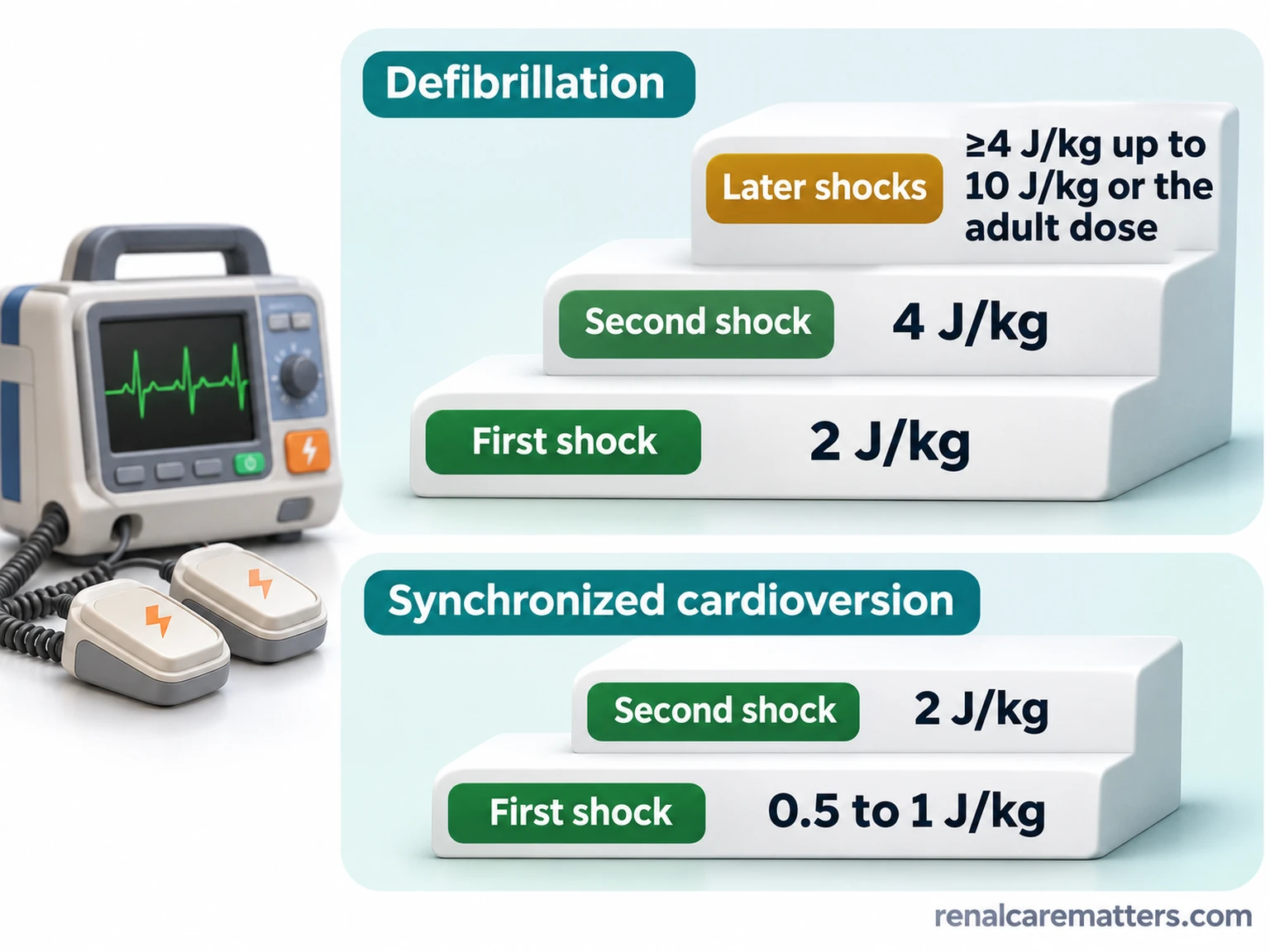
2 to 4 J/kg; 2 J/kg is reasonable for ease of teaching
COR 2a, LOE C-LD
Later shocks
4 J/kg; higher may be considered, not above 10 J/kg or the adult maximum
Reversible causes in a child on dialysis include all the adult dialysis causes (potassium, volume, bleeding from the access, air, low calcium, low glucose) plus the pediatric ones that dominate: hypoxia and acidosis from respiratory failure.
Figure 2. Pediatric energies climb by weight: 2, then 4, then up to 10 J/kg or the adult dose. Cardioversion starts lower.
RememberPediatric arrest: epinephrine as early as possible for asystole and PEA; shocks of 2, then 4 J/kg (up to 10 J/kg or the adult dose) for VF and pulseless VT.
Lesson · part 2
Weight, dose, volume, concentration: said aloud, checked twice
The 2025 pediatric cardiac arrest algorithm prints these drug doses: epinephrine 0.01 mg/kg intravenous (IV) or IO (0.1 mL/kg of the 0.1 mg/mL concentration), maximum 1 mg; amiodarone 5 mg/kg bolus (maximum 300 mg), which may be repeated up to 3 doses; or lidocaine 1 mg/kg.
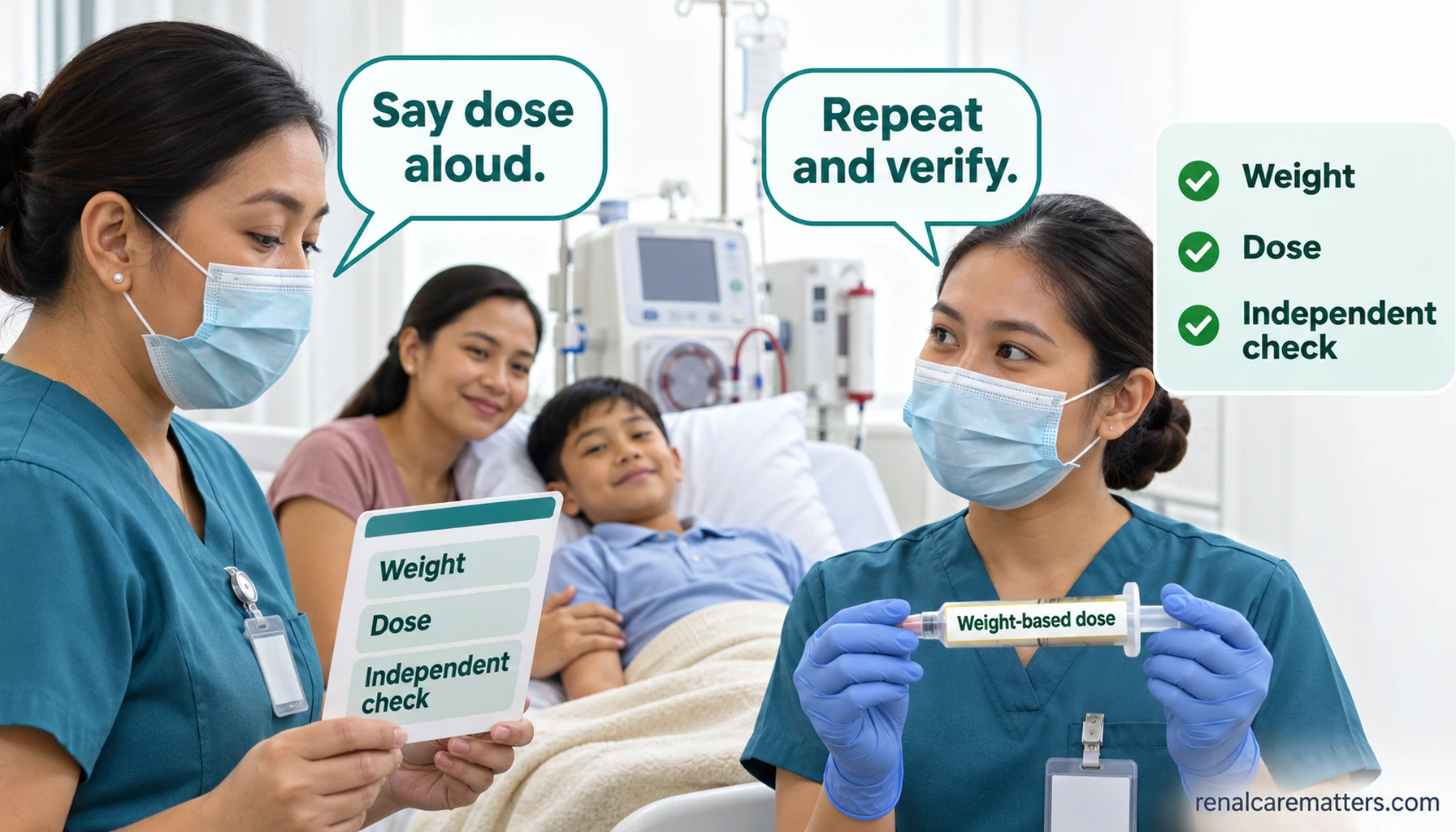
Figure 3. Weight-based doses are said aloud, calculated, and checked by a second person every time.
For a 20 kg child (teaching example)
Dose
Volume
Check
Epinephrine, 0.1 mg/mL
0.01 × 20 = 0.2 mg
0.2 mg ÷ 0.1 mg/mL = 2 mL
Below the 1 mg maximum
Amiodarone (concentration per your stock)
5 × 20 = 100 mg
Depends on the ampule concentration
Below the 300 mg maximum
Lidocaine
1 × 20 = 20 mg
Depends on the concentration
—
First shock
2 × 20 = 40 J
—
Nearest device setting
Second shock
4 × 20 = 80 J
—
Later shocks up to 10 J/kg or adult dose
The weight used is the one your unit protocol names. For a dialysis child, that is usually the most recent reliable weight; a questioned scale reading should not be used. A length-based tape gives an estimate when no reliable weight exists. Every dose follows the same spoken pattern: “Mika, 20 kilograms. Epinephrine 0.2 milligrams, which is 2 milliliters of 0.1 milligrams per milliliter.” The second nurse repeats it and checks the syringe label. The pediatric dose-and-volume trainer lets your team practice this arithmetic with the steps shown; it is a teaching tool, not a bedside calculator.
RememberName the weight, the dose in milligrams, the volume in milliliters and the concentration, aloud; a second person repeats and checks the label.
Lesson · part 3
One drug, three concentrations
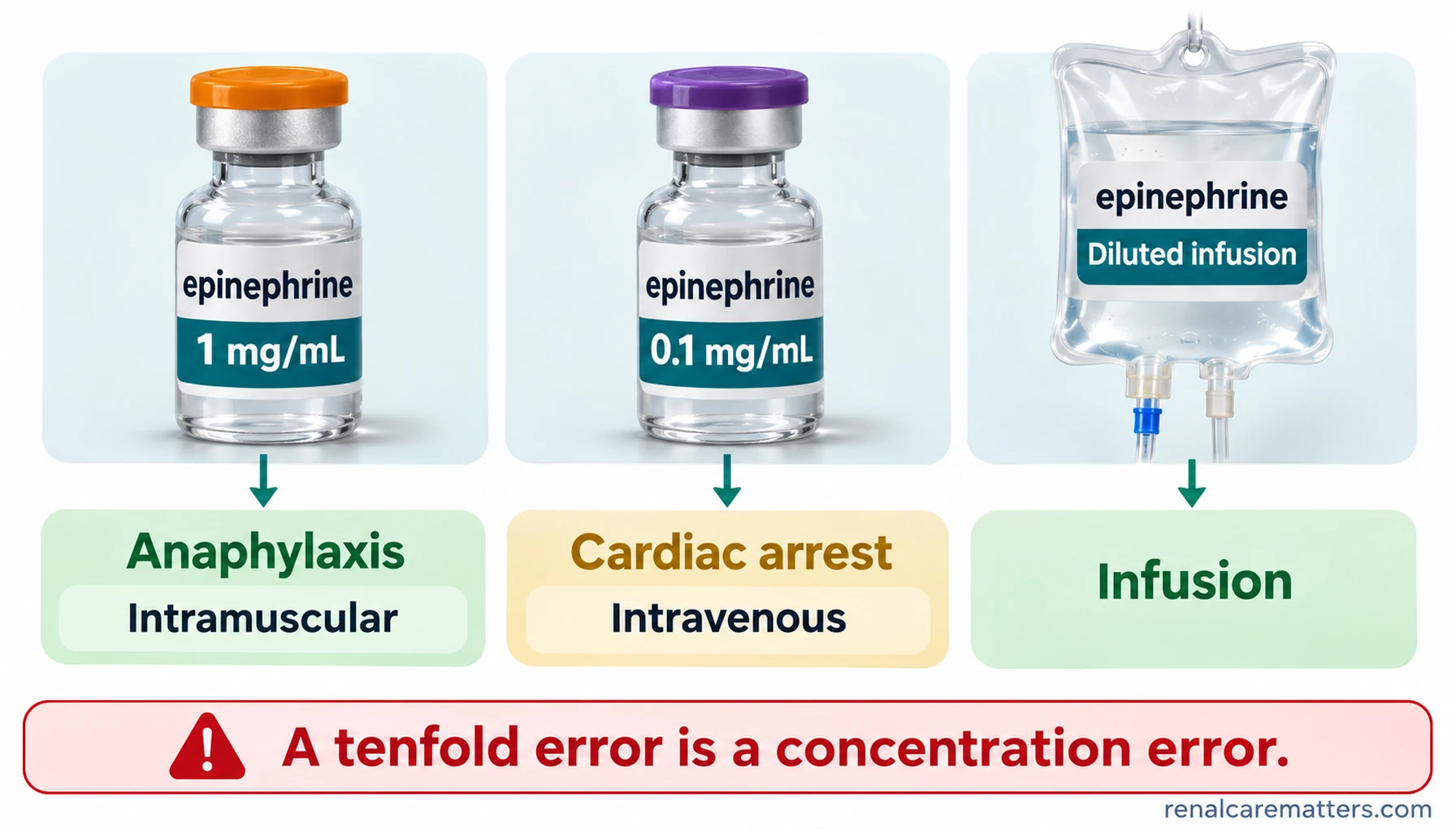
Epinephrine is the drug most often involved in tenfold errors in resuscitation, because the same name covers preparations that differ ten-fold or more, used by different routes for different problems.
Figure 4. One drug, three concentrations, three uses. A tenfold error is a concentration error.
Preparation
Use
Route
Danger if confused
1 mg/mL (1:1,000)
Anaphylaxis with a pulse
Intramuscular, outer thigh
Given IV as if 0.1 mg/mL: a tenfold overdose
0.1 mg/mL (1:10,000), or 1 mg/mL diluted to 10 mL
Cardiac arrest, adult and pediatric
IV or IO
Given intramuscular (IM) in anaphylaxis: too little
Dilute infusion
Bradycardia or shock with a pulse
IV infusion, titrated
Bolus of infusion concentration
In the case, someone read the adult ampule label aloud: 1 mg/mL. Drawing 2 mL of that for Mika would give 2 mg, ten times her dose. The safe system is to keep the arrest concentration (0.1 mg/mL, or a prepared dilution) separate and labeled, to dilute ampules only in a standard way set by protocol, and to say the concentration every time.
RememberBefore every pediatric epinephrine dose, say the concentration aloud. For arrest, it is 0.1 mg/mL: 0.1 mL/kg.
Lesson · part 4
Pediatric tachycardia, and the circuit in a child
For pediatric supraventricular tachycardia without compromise, the 2025 PALS guideline recommends vagal stimulation first (COR 1, LOE C-LD), then intravenous or intraosseous adenosine if access is ready (COR 1, LOE C-LD), and expert consultation if both fail. For supraventricular tachycardia (SVT) with cardiopulmonary compromise, synchronized cardioversion starting at 0.5 to 1 J/kg, increased to 2 J/kg if unsuccessful, is reasonable (COR 2a, LOE C-LD); the same energies apply to wide-complex tachycardia with compromise (COR 2a, LOE C-EO).1 The 2025 pediatric tachyarrhythmia algorithm prints adenosine 0.1 mg/kg (maximum 6 mg) as a rapid push with a flush, and a repeat dose of 0.2 mg/kg (maximum 12 mg).
The circuit in a child
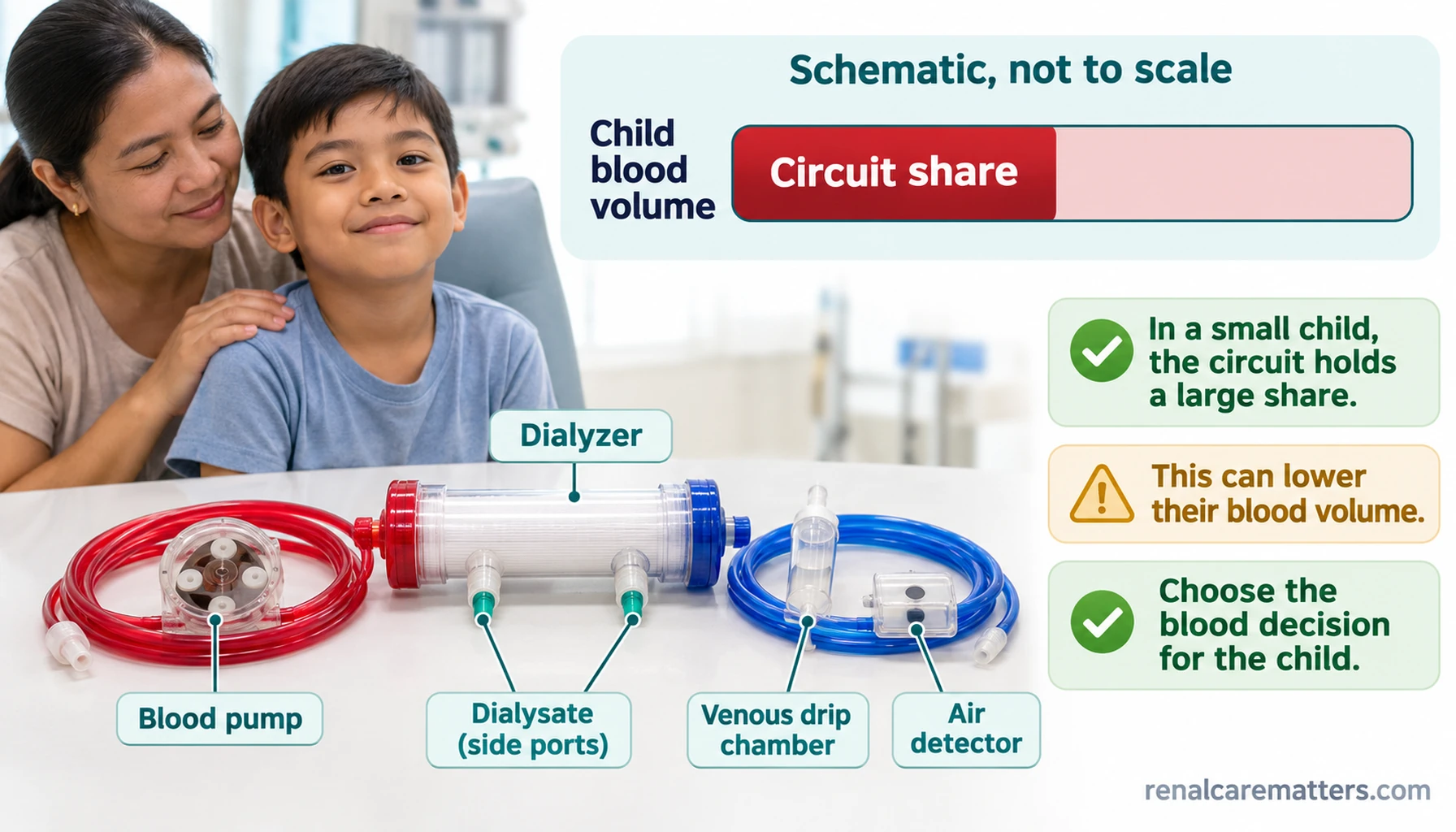
The circuit decisions of Module 7 apply, with one difference: the blood in the circuit is a larger share of a small child’s blood volume. Pediatric dialysis practice estimates blood volume at about 80 mL/kg in children, and European pediatric guidance states that total extracorporeal volume should be approximately less than 10% of blood volume.2 For a 19 kg child, blood volume is about 1,520 mL, and 10% is about 152 mL.
Figure 5. In a small child, the circuit can hold a large share of the blood volume. That changes the blood decision.
Circuit question
In a small child
Return the blood?
Returning it matters more for volume, unless air, hemolysis, a reaction or an open line forbids it
Blood-primed circuit?
The blood is donor blood; the pediatric nephrologist decides whether to return it
Saline bolus
By weight, per protocol: in septic shock, PALS uses 10 or 20 mL/kg boluses with reassessment (COR 2a, LOE C-LD)
Access for drugs
Aspirate the catheter lock first; limb volumes are small, so dead space matters
The extracorporeal volume check in the Pediatric Dialysis Nurse toolkit computes the circuit share for your lines and dialyzer.
RememberIn a small child, the circuit holds a large share of the blood. Return it unless air, hemolysis, a reaction or an open line forbids it, and let the pediatric nephrologist decide about blood-primed circuits.
Stop and callAny child on dialysis who is pulseless, has a rhythm with compromise, or needs a weight-based resuscitation drug: call for help, the pediatric cart and the dose card, and call the attending pediatric nephrologist. Follow your unit protocol; every dose is checked by a second person.
On the floor
Real situations: problems and solutions
These are fictional but typical. For each one, cover the answer, decide what you would do, then compare. Where a step depends on local rules, your unit’s procedure and your supervisor’s direction come first.
Mental arithmetic
What you see
During a pediatric drill, the leader calculates doses in her head while running the code.
What is likely going on
Calculation under stress with no check.
What to do
Use the dose card or toolkit; one person calculates, another repeats and checks.
Why it matters
Tenfold errors happen in heads, not on checked cards.
The questioned scale
What you see
A child’s weight jumped 2 kg overnight, and staff suspect a scale problem.
What is likely going on
An unreliable weight could distort every dose.
What to do
Use the most recent reliable weight per protocol; recheck the scale with the technician.
Why it matters
The weight is the first number in every pediatric dose.
The blood-primed circuit
What you see
A small infant dialyzing with a blood-primed circuit arrests.
What is likely going on
The circuit holds donor blood that is a large share of the infant’s volume.
What to do
Stop fluid removal and the pump; the pediatric nephrologist decides about returning the blood.
Why it matters
Circuit decisions in small children carry more volume consequences.
Field notes
Keep a weight-based dose card on the pediatric cart for the weights your unit treats.
Store the arrest epinephrine preparation separately from the anaphylaxis ampules.
Case review
Back to the case: Pediatric arrest during dialysis
The plan. A flat line confirmed in two leads in a pulseless child is asystole: the nonshockable path. Compressions at one-third of the chest depth, 15:2 with two rescuers, and epinephrine as early as possible, then every 3 to 5 minutes. Causes: potassium (a slow wide rhythm came first), hypoxia, volume, bleeding at the catheter, air.
The weight and the error. The questioned 21 kg reading is not used; the unit protocol names the most recent reliable weight, 19 kg (or a length-based tape estimate). Epinephrine is 0.01 mg/kg = 0.19 mg, which many protocols round to 0.2 mg: 2 mL of the 0.1 mg/mL concentration. The person who read “1 mg per mL” has identified the trap: 2 mL of the ampule would be 2 mg, a tenfold overdose. The drug nurse says the weight, dose, volume and concentration aloud, and a second nurse repeats and checks.
The circuit. The circuit nurse stops fluid removal and the pump. With no air, hemolysis or reaction, the blood is returned or clamped per protocol; in a 19 kg child (blood volume about 1,520 mL) the circuit blood is a large share of her volume, so returning it matters. The catheter lock is aspirated before the limb is used for drugs. The attending pediatric nephrologist is called.
Interactive case · fictional
Interactive case: Pediatric arrest during dialysis
Work through a shift one decision at a time. The panel at the top changes with what you choose. After each choice you see why it is, or is not, the best move; after a weaker one you can try again or carry on and see where it leads. Your first choice at each step is scored. The score stays on this device and nothing is sent anywhere. In real practice, your unit’s protocol and the people responsible for each decision come first.
Skills lab · with your preceptor
Skills checklist: Pediatric megacode with dose checks
Lead or act as drug nurse in a pediatric megacode on a manikin while a supervisor observes. Your preceptor rates each step as satisfactory, needs practice, or not observed. Steps marked Critical must all be satisfactory before sign-off. This checklist supports supervised learning; your unit’s own procedure and competency form are the authority. A printable version of every checklist is on the trainer page.
CriticalUses the protocol weight (reliable recent weight or length-based tape) and states it aloud.
CriticalCalculates and states epinephrine dose in mg and volume in mL of 0.1 mg/mL, below the 1 mg maximum.
CriticalHas every dose repeated and the syringe label checked by a second person.
Times epinephrine as early as possible for nonshockable rhythms and after two shocks for shockable rhythms.
CriticalSelects 2 J/kg then 4 J/kg, not exceeding 10 J/kg or the adult dose.
For SVT with compromise, selects synchronized cardioversion at 0.5 to 1 J/kg, then 2 J/kg.
States the circuit blood decision and the extracorporeal volume share for the child.
Placement activity. With the pediatric nephrologist, make or review your unit’s pediatric dose card for the weights you treat.
Self-assessment
Check your understanding
Each visit draws 5 questions at random from this module’s 10-question bank. Choose the single best answer for each, then select Check answers; an explanation appears under the best answer. Select New set of questions for a different mix. A good target is 4 of 5 on two different sets. Nothing you select is sent anywhere; scoring happens in your browser.
Lasa, J. J., Dhillon, G. S., Duff, J. P., Hayes, J., Kamath-Rayne, B. D., Levy, A., Mahgoub, M., Morgan, R. W., McCormick, T., Roberts, J. S., Ross, C. E., Schexnayder, S. M., Sweberg, T., Valdés, S. O., & Topjian, A. A. (2025). Part 8: Pediatric advanced life support: 2025 American Heart Association and American Academy of Pediatrics guidelines for cardiopulmonary resuscitation and emergency cardiovascular care. Circulation, 152(16_suppl_2), S479–S537. https://doi.org/10.1161/CIR.0000000000001368
Fischbach, M., Edefonti, A., Schröder, C., & Watson, A. (2005). Hemodialysis in children: General practical guidelines. Pediatric Nephrology, 20(8), 1054–1066. https://doi.org/10.1007/s00467-005-1876-y
Educational reviewer and practice resource for dialysis teams. It is not an American Heart Association (AHA) course, it is not BLS, ACLS or PALS certification, and online completion does not establish hands-on competence. Staff certify through an authorized training center. Your unit’s approved protocol, crash-cart stock and machine manufacturer’s instructions govern every real event.