Transitions of Care, Quality Improvement, and Capstone
Handoffs across settings, defining and charting a nutrition quality measure, a balancing measure, and one integrated case with a critical result.
PublishedNailathalaGipatikPepalwal:Audience: Registered nutritionist-dietitians entering adult kidney care · renal RND preceptors, nephrologists, and head nurses who orient themRead timeOras ng pagbasaOras sa pagbasaOras ning pamamasa:
This module is study material for dietitians in adult kidney care. It explains the reasoning behind common decisions; it is not a protocol. In practice, follow your facility’s policy and the responsible physician’s orders. Targets and cut-off values are set by your unit and the attending nephrologist. Every case is fictional.
Learning objectives
After this module you should be able to
Write a nutrition handoff that survives a move between clinic, hospital, dialysis unit, and home.
Define a nutrition quality measure with a numerator, denominator, period, and data source.
Add a balancing measure that shows whether the change caused harm elsewhere.
Plot and read a simple run chart.
Combine assessment, prescription, counseling, monitoring, and escalation in one case.
Stop routine work and escalate when a critical result arrives.
Pre-testBefore you read, answer the 8 self-assessment questions and note your score. After the module, select New set of questions and compare. The difference is what you learned; the questions you still miss are what to reread.
Start here
The big picture, in plain words
In plain wordsEach time a patient moves, from clinic to hospital, hospital to dialysis, or dialysis to home, the nutrition plan is carried across a river. Some plans arrive intact. Many are dropped halfway, and the patient lands with an old restriction or no plan at all. A good handoff is a bridge. A quality measure is a count of how many plans make it across.
Figure 1 · Key terms for this module
Transition of careA move between settings or teams.
HandoffPassing responsibility and information to the next person, with confirmation.
Quality measureA defined count that shows how often care meets a standard.
Numerator and denominatorThe patients who met the standard, out of all the patients who should have.
Balancing measureA count that checks whether improving one thing made another worse.
Run chartA graph of a measure over time, used to see whether a change made a difference.
Plan-Do-Study-Act (PDSA)A small test of change: plan it, try it, study the result, and act on what you learned.
Figure 2 · A small improvement cycle
Measure nowBaseline for several weeks.
PlanOne change, one owner.
DoTest it on a small scale.
StudyPlot the result on a run chart.
ActKeep, adapt, or drop it.
Opening case · fictional
Case: Capstone: Ramon
Ramon, 63, moved from chronic kidney disease (CKD) G5 to maintenance hemodialysis three weeks ago. His agreed calculation weight today is 60 kg after dialysis. At his first outpatient session it was 63 kg after dialysis. He estimates he eats about 45 g of protein a day, about half his usual meals, and he avoids food until he gets home after treatment. His potassium is stable. His phosphorus is above the unit’s range for the second month in a row, and he is unsure when to take his binder. He likes rice, fish, and vegetables.
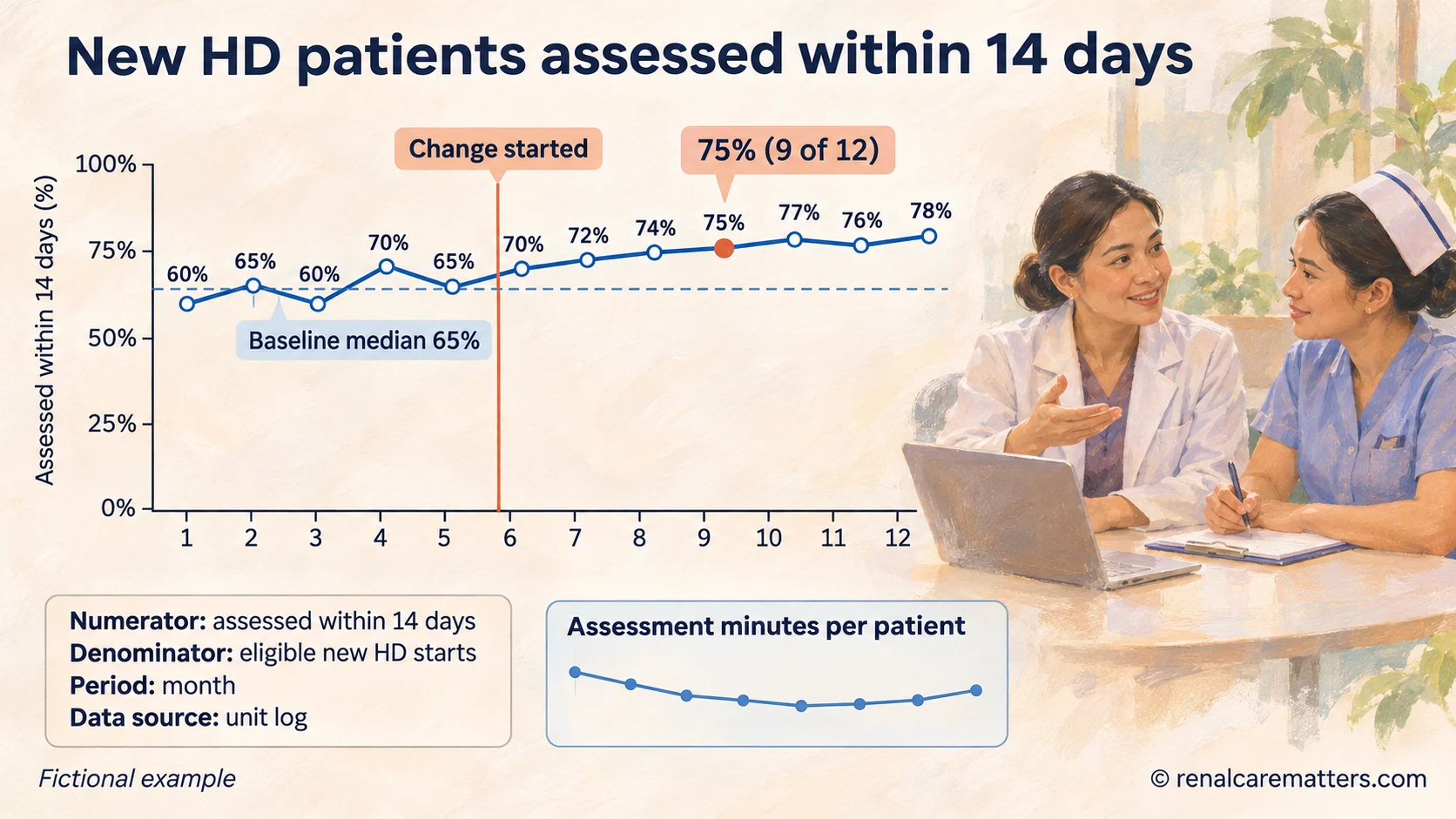
The unit is testing a change: every new patient should have a dietitian assessment within 14 days of starting hemodialysis (HD). The log shows 9 of 12 eligible new patients were assessed in time last quarter.
During the exercise, after you describe routine follow-up, the examiner will hand you a new result.
Before reading on, decide:
Write the assessment, a problem, etiology, signs and symptoms (PES) statement, and the protein calculation.
Give a patient-chosen change, a monitoring plan, and a handoff line about the phosphorus.
Calculate the quality measure and propose a balancing measure.
Keep your answers in mind. The lesson gives you what you need, and the case review near the end shows one sound response.
Lesson · part 1
A handoff that survives the move
Plans are lost at transitions. A low-protein order from the clinic follows the patient into the intensive care unit (ICU). A hospital tube-feeding plan ends at discharge with nobody watching intake at home. A new dialysis patient keeps a pre-dialysis diet for months. The fix is a short, structured nutrition handoff every time a patient moves.
Figure 3 · What a nutrition handoff carries
The questionWhy the patient was referred and what is still open.
Kidney statusCause, stage or treatment type, and any recent change.
WeightsComparable weights with dates and timing.
IntakeWhat the patient eats now, and the main barrier.
PrescriptionEnergy and protein targets, the guideline used, and why they changed.
Open issuesResults awaiting review, binder questions, supplements.
Owner and dateWho follows up and when.
AcceptanceWho received the handoff and confirmed it.
Give the patient the next step too, in plain words: what to eat this week and when the next check is. Follow your facility’s documentation and privacy rules. Academy exercises use only fictional patients.
Lesson · part 2
Define a measure, then add its balance
Quality improvement starts with a clear count. A vague aim, such as “better nutrition care for new patients,” cannot be measured. A defined measure can.
Part
Example
Denominator
Adults who started outpatient HD in the unit during the month, with transfers in counted by a written rule
Numerator
Those in the denominator with a documented dietitian assessment within 14 days of the first session
Period
Each calendar month, reported quarterly
Data source
The unit’s admission log and the nutrition notes
Target
Set locally from the baseline; the 14-day window is an illustrative local standard, not a guideline
Then add a balancing measure. If the dietitian rushes every new patient to meet the 14-day window, other work may suffer. Count something that would reveal that: assessment time per patient, the share of assessments with a complete monitoring plan, or the number of follow-up visits missed for existing patients.
Plot the measure month by month on a run chart, mark when the change began, and look for a sustained shift rather than reacting to one good or bad month. Small numbers swing widely; 9 of 12 and 10 of 12 differ by one patient.
Figure 4. Plot the measure over time. Look for a sustained shift, not one good month.
Lesson · part 3
Putting it all together
A safe capstone answer connects everything in this series: comparable weights, the right protein range for the treatment, laboratory trends read with their causes, the patient’s own priorities, and a clear path for escalation. It also shows judgment: the plan changes when the patient’s condition changes, and routine work stops when a critical result arrives.
DiagnoseA PES statement with a cause you can act on.
PrescribeTargets with the weight and guideline named.
CounselOne change the patient chooses; teach-back.
MonitorMeasure, date, owner.
Hand offOpen issues to the right person.
EscalateStop and call when the situation changes.
Stop and reportIf a critical result with new symptoms arrives at any point, stop the routine work. Activate the urgent pathway, give a structured handoff, obtain a read-back, and document who accepted responsibility.
Scoring is described on the trainer page. The capstone passes at 8 of 10, with the escalation criterion scored as complete and independent.
On the floor
Real situations: problems and solutions
These are fictional but typical. For each one, cover the answer, decide what you would do, then compare. Where a step depends on local rules, your unit’s procedure and your supervisor’s direction come first.
The discharge with no nutrition plan
What you see
A patient left the hospital after acute kidney injury (AKI) on a tube-feed-to-oral transition. No one told the outpatient clinic.
What is likely going on
The plan was lost at the transition.
What to do
Call the patient and the clinic, reassess intake by telephone, and send a handoff. Propose a discharge checklist item for nutrition.
Why it matters
Most plans are lost between settings, not within them.
A measure that looks worse after improvement
What you see
After a new process, the 14-day assessment measure fell from 10 of 12 to 9 of 13.
What is likely going on
Small numbers; one patient changes the result a lot.
What to do
Keep plotting the run chart. Look for a sustained shift over several months before judging.
Why it matters
Reacting to one month’s noise can stop a good change.
Field notes
Name an owner and a date in every handoff.
Pair every quality measure with a balancing measure.
Case review
Back to the case: Capstone: Ramon
Assessment and calculation. Comparable post-dialysis weights: (63 − 60) ÷ 63 × 100 = 4.8% in three weeks. Confirm with the nurse that this is tissue loss and not a change in dry weight. Stable HD protein at 60 kg: 1.0 to 1.2 × 60 = 60 to 72 g a day. He eats about 45 g, so he is 15 to 27 g short. Before finalizing, check for acute illness or other reasons he may not be metabolically stable.
PES. “Inadequate oral intake related to missed meals around dialysis, as evidenced by about half his usual intake, an estimated 45 g of protein a day, and a 4.8% loss on comparable post-dialysis weights over three weeks.”
Change and monitoring. Ask what he could manage on dialysis days. He likes fish and rice: perhaps a small rice-and-fish packed meal or a fish sandwich to eat early in the session or right after, if the unit allows. Use teach-back. Recheck intake and same-timing weights in one week.
Phosphorus handoff. “Ramon’s phosphorus is above range for the second month. He is unsure of his binder timing. I have checked his diet for additives and found [result]. Could pharmacy confirm the prescribed binder instructions with him? His protein intake is low, so please do not restrict protein.”
Quality measure. 9 ÷ 12 = 75%. A balancing measure: assessment time per new patient, or the share of assessments with a complete monitoring plan, reported each quarter.
The new result. When the examiner reports a critical potassium with new weakness, stop the routine work at once. Activate the urgent pathway, give the structured handoff, obtain a read-back, and document who accepted it. Everything else can wait. Knowing when to stop the diet plan is the last skill in this series, and the most important.
Skills lab · with your preceptor
Skills checklist: Capstone integration and quality measure
Allow 25 minutes for the written plan and 5 minutes for the oral handoff. The examiner introduces a critical result after routine follow-up is described. Your preceptor rates each step as satisfactory, needs practice, or not observed. Steps marked Critical must all be satisfactory before sign-off. This checklist supports supervised learning; your unit’s own procedure and competency form are the authority. A printable version of every checklist is on the trainer page.
Calculates comparable weight loss and the stable HD protein range, with the stability caveat.
Writes a PES statement with an actionable cause and a patient-chosen change with teach-back.
Protects protein intake while addressing persistent high phosphorus and binder timing.
Sets a monitoring measure, an interval, and an owner.
CriticalOn the critical result with weakness, stops routine work, activates the urgent pathway, and confirms an accepted handoff.
Calculates the quality measure and defines a balancing measure with a reporting period.
Placement activity. With your preceptor, choose one nutrition measure your unit could track, define its numerator and denominator, and collect three months of baseline data.
Self-assessment
Check your understanding
Each visit draws 8 questions at random from this module’s 15-question bank. Choose the single best answer for each, then select Check answers; an explanation appears under the best answer. Select New set of questions for a different mix. A good target is 7 of 8 on two different sets. Nothing you select is sent anywhere; scoring happens in your browser.
Educational study material for registered nutritionist-dietitians. Does not replace the nephrologist’s orders, facility policy, the Nutrition Care Process documentation required by the Department of Health, or supervised practice.