Glucose data in advanced kidney disease, hypoglycemia, carbohydrate planning, newer medicines that change appetite and fluid needs, and weight loss that keeps muscle.
PublishedNailathalaGipatikPepalwal:ReferencesMga SanggunianMga TinubdanReng Reperensya:4Audience: Registered nutritionist-dietitians entering adult kidney care · renal RND preceptors, nephrologists, and head nurses who orient themRead timeOras ng pagbasaOras sa pagbasaOras ning pamamasa:
This module is study material for dietitians in adult kidney care. It explains the reasoning behind common decisions; it is not a protocol. In practice, follow your facility’s policy and the responsible physician’s orders. Targets and cut-off values are set by your unit and the attending nephrologist. Every case is fictional.
Learning objectives
After this module you should be able to
Explain why the risk of low blood glucose rises as kidney function falls.
Say when glycated hemoglobin (HbA1c) can mislead in advanced chronic kidney disease (CKD) and dialysis, and what other glucose data to use.
Plan carbohydrate amount and timing around the patient’s meals, work, and medicines.
Recognize recurrent low glucose as a safety problem and route it to the diabetes team.
Describe how newer medicines change appetite, intake, and fluid, and what the dietitian watches for.
Plan weight loss in CKD that protects muscle.
Pre-testBefore you read, answer the 8 self-assessment questions and note your score. After the module, select New set of questions and compare. The difference is what you learned; the questions you still miss are what to reread.
Start here
The big picture, in plain words
In plain wordsInsulin is like a key that lets glucose into cells. A healthy kidney does two quiet jobs with that key: it clears used insulin from the blood, and it makes some glucose of its own between meals. When the kidney fails, insulin keys stay in the lock longer, and the kidney’s own glucose supply shrinks. So the same insulin dose that was safe last year can now push glucose too low, especially when a meal is skipped.
Figure 1 · Key terms for this module
Glycated hemoglobin (HbA1c)The share of hemoglobin carrying glucose. It reflects average glucose over the life of red cells, about three months.
Continuous glucose monitor (CGM)A small sensor under the skin that reads glucose every few minutes.
Sodium-glucose cotransporter 2 (SGLT2) inhibitorA medicine such as dapagliflozin or empagliflozin that makes the kidney pass glucose in urine and protects kidneys and heart.
Glucagon-like peptide-1 receptor agonist (GLP-1 RA)A medicine such as semaglutide that lowers glucose, reduces appetite, and slows stomach emptying.
Sarcopenic obesityExcess body fat together with low muscle mass and strength.
Figure 2 · Order of work in diabetes with CKD
SafetyAny low glucose readings? Who treats them?
DataTime-stamped readings, meals, and medicine times.
PatternWhich meals are skipped, late, or very large?
PlanCarbohydrate spread across the day, built from food the patient eats.
WeightIf weight loss is a goal, protect protein and muscle.
HandoffMedicine changes go to the diabetes team.
Opening case · fictional
Case: The skipped lunch
Ms. Ramos, 52, works shifts at a call center. She has type 2 diabetes and CKD G4. She takes insulin glargine at night and a short-acting insulin with breakfast and dinner. She received iron and an erythropoiesis-stimulating agent for anemia two months ago. Her HbA1c dropped from 8.1% to 6.4% in that time, and her doctor was pleased.
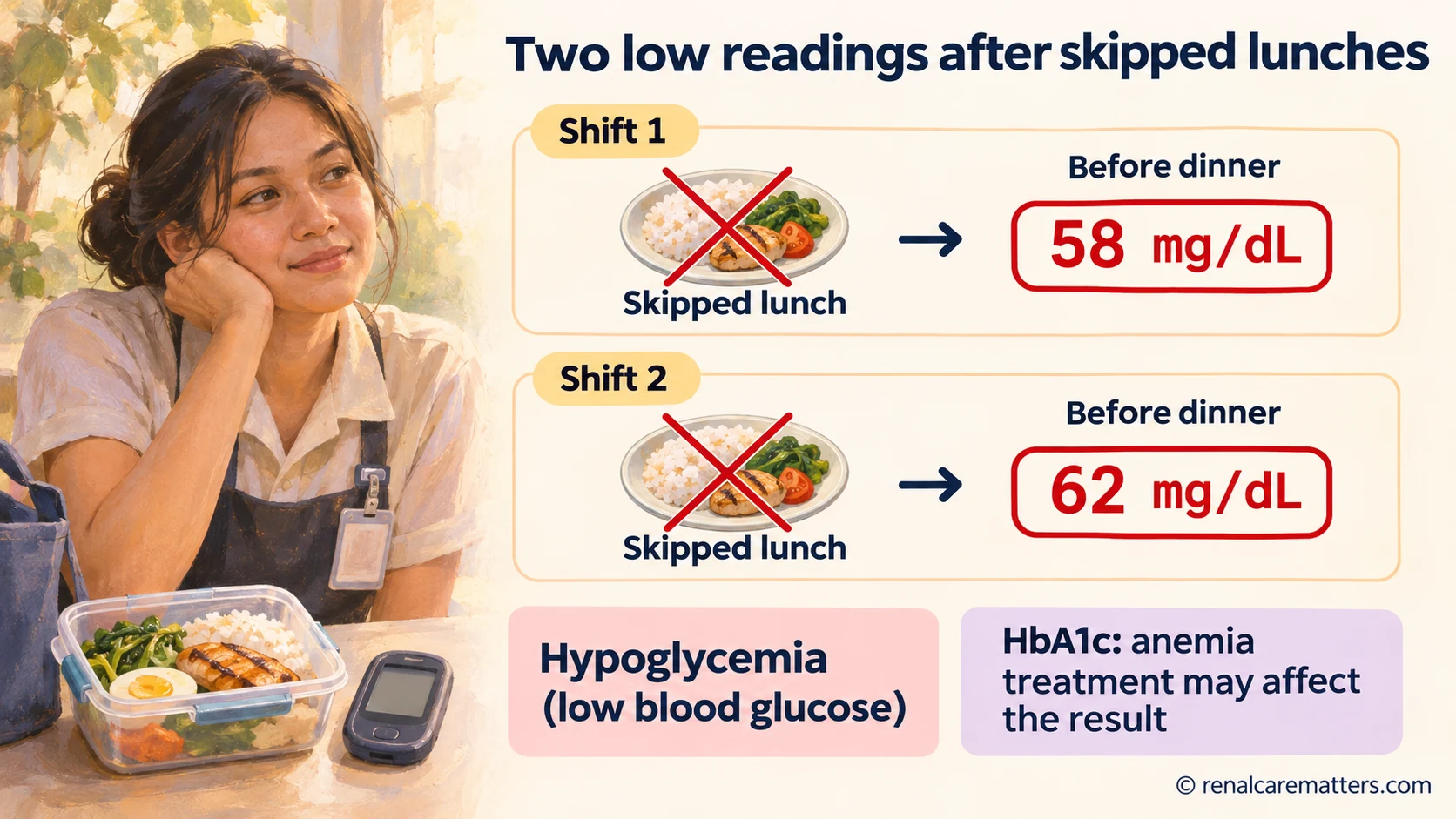
Her meter shows two readings of 58 and 62 mg/dL before dinner this week, both on days she skipped lunch because her break was cut short. She felt shaky and sweaty and drank a soft drink. Today she feels well, and her glucose is 140 mg/dL.
Before reading on, decide:
What is your first action, and who must know?
Why might her HbA1c look better than her glucose really is?
What food plan would fit her shift?
Keep your answers in mind. The lesson gives you what you need, and the case review near the end shows one sound response.
Lesson · part 1
Why low glucose becomes more likely
To understand why, start with what a healthy kidney does for glucose. Between meals, the liver and the kidney both release glucose into the blood. The kidney supplies a real share of it after an overnight fast. The kidney also clears insulin from the blood, so a dose wears off on time.
As estimated glomerular filtration rate (eGFR) falls, both jobs fade. Insulin and some tablets, such as the sulfonylureas, stay active longer. The kidney adds less glucose between meals. Appetite is often poor, and meals are skipped on dialysis days. Put together, a patient whose glucose was hard to bring down five years ago may now go low on the same treatment. Kidney Disease: Improving Global Outcomes (KDIGO) advises individual HbA1c targets from below 6.5% to below 8.0%, aiming higher in people at greater risk of hypoglycemia (a firm recommendation, grade 1C).1
RememberA patient with advanced CKD whose glucose readings are “getting better on their own” may be losing kidney function or eating less. Ask, and tell the diabetes team.
Lesson · part 2
When HbA1c misleads, and what to use instead
HbA1c measures glucose stuck to hemoglobin, so it depends on how long red cells live. In advanced CKD and on dialysis, red cells live a shorter time, and treatment with erythropoiesis-stimulating agents, iron, or a transfusion brings a wave of young cells that have not yet picked up much glucose. HbA1c then reads lower than the true average glucose.1,2 KDIGO advises that when HbA1c and measured glucose do not agree, a continuous glucose monitor or self-monitoring can guide treatment (advice without a formal grade).
Data
What it tells you
Watch for
HbA1c
Average over about three months
Falsely low after anemia treatment or transfusion, and on dialysis
Meter readings with time and meal notes
When glucose goes high or low, and why
Readings taken only in the morning miss afternoon lows
Continuous glucose monitor
Time in range and time below range
Cost; ask what the patient can afford
Food and medicine diary
Links each low to a skipped meal or a dose
The most useful thing you can ask for
Your job with these data is not to change a dose. It is to find the pattern, such as lows only on workdays, only after dialysis, or only when lunch is missed, and bring it to the diabetes team with the times.
Figure 3. Readings with times reveal the pattern. Here, the lows follow skipped lunches.
Lesson · part 3
Plan carbohydrate around the person
There is no special “renal diabetic diet.” The American Diabetes Association and KDIGO both advise an eating pattern rich in vegetables, fruits, whole grains, fiber, legumes, and plant protein, and low in refined carbohydrate and sweetened drinks, with protein at 0.8 g/kg/day for CKD not on dialysis.3,1 The work is to make that fit the person: her shift, her budget, her rice.
Figure 4 · Carbohydrate planning in practice
Rice in a measured cupOne cup of cooked rice is about 40 to 45 g of carbohydrate. Keep it steady from meal to meal, especially with fixed insulin doses.
No skipped meals on insulinIf a meal cannot be eaten, the patient needs a plan agreed with the diabetes team, not a guess.
Portable foodA packed lunch, a sandwich, or crackers with egg for short breaks.
Sweet drinksSoft drinks, juice, and 3-in-1 coffee are the first sugars to replace, except when treating a low.
Treating a lowFast sugar first, as the team taught her, then a snack with protein once she recovers. Glucose tablets avoid the phosphorus in colas.
Then check that the plan still gives enough energy. Diabetes advice and kidney advice together can shrink a diet until little is left. A patient who cuts rice for her glucose, meat for her kidneys, and fruit for her potassium is on a starvation diet. Count the day’s energy before you send her home.
Stop and callRecurrent glucose below 70 mg/dL, any reading below 54 mg/dL, a low that needed another person’s help, or a patient on insulin who cannot eat because of illness: tell the diabetes team the same day. Severe symptoms or a patient who cannot swallow safely go through the emergency pathway.
Lesson · part 4
New medicines, and weight loss that keeps muscle
SGLT2 inhibitors make the kidney pass glucose in the urine, about 200 to 300 kcal a day in people with good kidney function and less as eGFR falls. They protect the kidneys and heart. Patients may lose a little weight and feel thirsty. Ask about sick days: the team usually tells patients to pause these medicines when they cannot eat or drink, to avoid a rare, serious acid problem called ketoacidosis. That instruction comes from the prescriber; you make sure the patient knows it exists.
GLP-1 receptor agonists reduce appetite and slow the stomach. In the FLOW trial, 3,533 people with type 2 diabetes and CKD were randomly assigned to weekly semaglutide or placebo. Over a median of 3.4 years, the main outcome, a combination of kidney failure, a large fall in eGFR, and death from kidney or heart causes, happened 24% less often with semaglutide (hazard ratio 0.76).4 This was a large randomized trial, so the benefit is well supported for people like those enrolled. For you, the practical point is that appetite can fall a lot. Watch for intake dropping below protein needs, nausea, and dehydration, and report them.
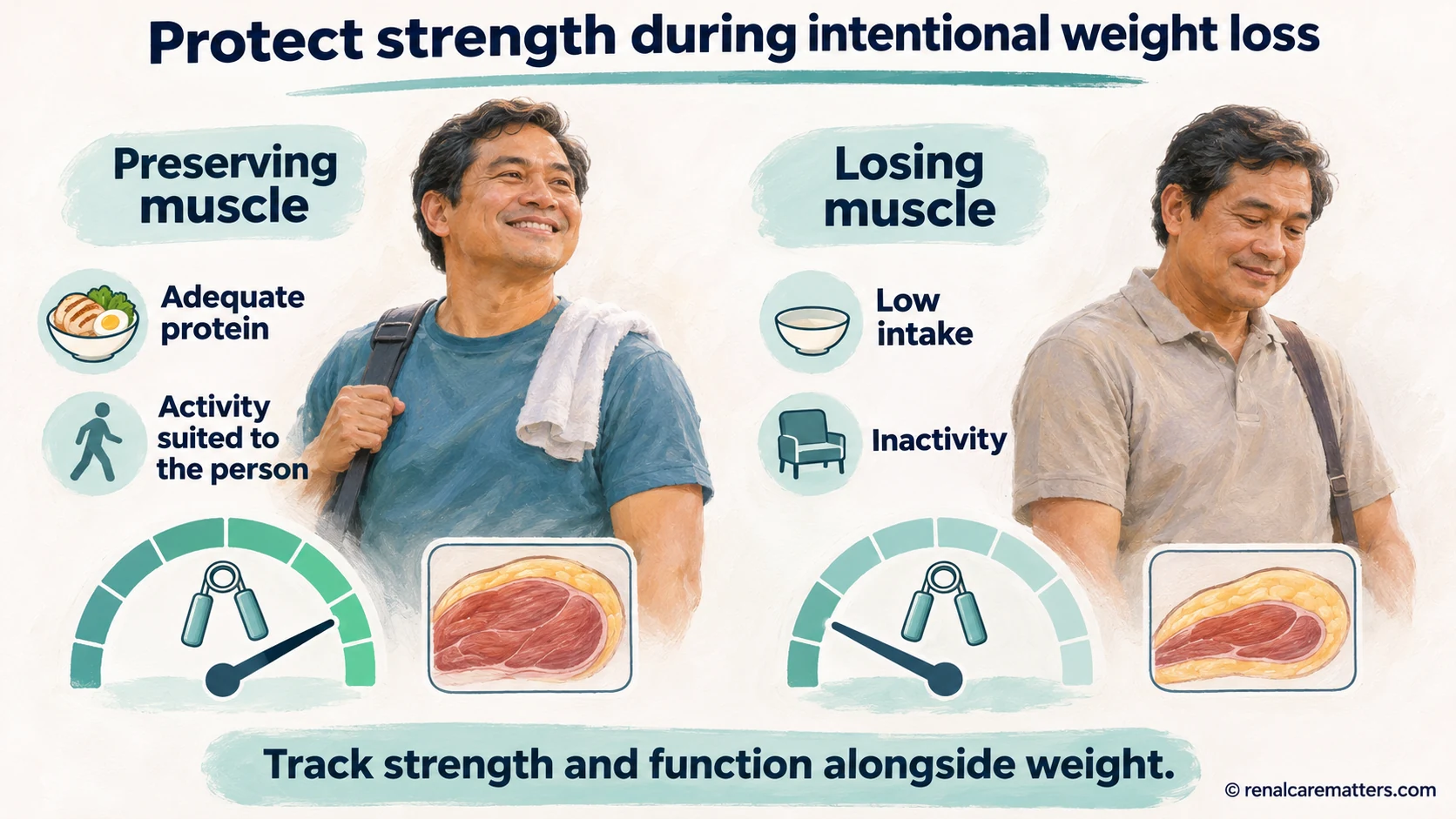
Weight loss. Many patients with diabetes and CKD carry excess weight, and losing some of it helps blood pressure, glucose, and sometimes eligibility for a transplant. But in CKD, a fast loss often takes muscle with it. Aim for a modest deficit, keep protein at the prescribed level, spread it over meals, and pair the diet with activity the patient can do. Track grip strength or a chair-stand test, not only the scale. When weight falls and strength falls with it, the plan needs changing.
Figure 5. Weight loss in CKD should take fat, not muscle. Track strength as well as weight.
On the floor
Real situations: problems and solutions
These are fictional but typical. For each one, cover the answer, decide what you would do, then compare. Where a step depends on local rules, your unit’s procedure and your supervisor’s direction come first.
Shaky at the end of dialysis
What you see
A patient on insulin feels shaky in the last hour of hemodialysis (HD); his meter shows 62 mg/dL.
What is likely going on
Glucose fell during dialysis, which can happen with insulin on board and no food.
What to do
Follow the unit’s hypoglycemia protocol with the nurse now. Afterward, tell the diabetes team, and plan a snack early in the session if the unit allows.
Why it matters
Treat first, then fix the pattern.
Not hungry since the new injection
What you see
A patient started a weekly GLP-1 receptor agonist and now eats half his usual meals.
What is likely going on
The medicine is working on appetite, perhaps too well for his protein needs.
What to do
Check protein intake and weight; plan small protein-rich meals; tell the prescriber about the size of the drop.
Why it matters
Benefit from the medicine should not come at the cost of muscle.
Field notes
Ask for readings with times, not just averages.
A falling HbA1c after anemia treatment may not mean better control.
Case review
Back to the case: The skipped lunch
What is the first action? Tell the diabetes team today. Two symptomatic readings in the 50s and low 60s in one week, on insulin, are recurrent hypoglycemia. Give them the readings, the times, the skipped lunches, and her insulin doses. Check that she has a written plan for treating a low and knows whom to call. If a low happens during your visit, follow the unit’s protocol.
Why might her HbA1c mislead? She had anemia treatment two months ago. The young red cells it produced have carried glucose for only a short time, so her HbA1c fell faster than her average glucose did. It may also be falling because she is having lows. A falling HbA1c here is not proof that her diabetes is better controlled. Her meter readings with times tell you more.
What food plan fits her shift? A lunch she can eat in a short break: rice in a measured cup with egg or fish and a vegetable, packed from home, or a sandwich with egg if her break is very short. A small snack with protein in her bag for days the break is cut. Ask whether she can take a fixed meal break and whether her employer would allow it. Replace the soft drinks she drinks as treats with water, and keep a fast sugar source for actual lows.
What do you leave to the team? Insulin doses and timing. Her shift changed and her kidneys changed, and the prescription may need to follow. Your part is to show the team exactly when the lows happen. When you bring them a pattern, they can make a decision.
Skills lab · with your preceptor
Skills checklist: Glucose pattern review and hypoglycemia handoff
Use a fictional week of meter readings with meal and medicine times. Your preceptor rates each step as satisfactory, needs practice, or not observed. Steps marked Critical must all be satisfactory before sign-off. This checklist supports supervised learning; your unit’s own procedure and competency form are the authority. A printable version of every checklist is on the trainer page.
CriticalAsks first about any low readings and how they were treated.
Explains why HbA1c can read falsely low after anemia treatment or on dialysis.
Links each low or high reading to a meal, a missed meal, or a medicine time.
CriticalReports recurrent lows to the diabetes team the same day with readings and times, without changing a dose.
Plans carbohydrate portions and timing around the patient’s work and meals.
Checks that combined diabetes and kidney restrictions still meet the energy target.
Asks about sick-day instructions for SGLT2 inhibitors and appetite changes on GLP-1 receptor agonists.
For weight loss, sets a protein target and a measure of muscle function as well as weight.
Placement activity. Sit with a diabetes educator or physician for one clinic and note how each insulin change was decided.
Self-assessment
Check your understanding
Each visit draws 8 questions at random from this module’s 15-question bank. Choose the single best answer for each, then select Check answers; an explanation appears under the best answer. Select New set of questions for a different mix. A good target is 7 of 8 on two different sets. Nothing you select is sent anywhere; scoring happens in your browser.
Kidney Disease: Improving Global Outcomes (KDIGO) Diabetes Work Group. (2022). KDIGO 2022 clinical practice guideline for diabetes management in chronic kidney disease. Kidney International, 102(5S), S1–S127. https://doi.org/10.1016/j.kint.2022.06.008
Babitt, J. L., Berns, J. S., Bozkurt, B., Cheung Khedairy, R. S., Cuevas, Y., Effa, E. E., Eisenga, M. F., Fishbane, S., Ginzburg, Y. Z., Haase, V. H., Hedayati, S. S., Kim, S., Moura-Neto, J. A., Nagler, E. V., Rossignol, P., Sahay, M., Tanaka, T., Yee-Moon Wang, A., Wheeler, D. C., . . . Tonelli, M. (2026). Executive summary of the KDIGO 2026 clinical practice guideline for the management of anemia in chronic kidney disease (CKD). Kidney International, 109(1), 44–56. https://doi.org/10.1016/j.kint.2025.06.005
American Diabetes Association Professional Practice Committee for Diabetes. (2026). 11. Chronic kidney disease and risk management: Standards of Care in Diabetes—2026. Diabetes Care, 49(Suppl. 1), S246–S260. https://doi.org/10.2337/dc26-S011
Perkovic, V., Tuttle, K. R., Rossing, P., Mahaffey, K. W., Mann, J. F. E., Bakris, G., Baeres, F. M. M., Idorn, T., Bosch-Traberg, H., Lausvig, N. L., Pratley, R., & FLOW Trial Committees and Investigators. (2024). Effects of semaglutide on chronic kidney disease in patients with type 2 diabetes. New England Journal of Medicine, 391(2), 109–121. https://doi.org/10.1056/NEJMoa2403347
Educational study material for registered nutritionist-dietitians. Does not replace the nephrologist’s orders, facility policy, the Nutrition Care Process documentation required by the Department of Health, or supervised practice.