Why sodium drives thirst and blood pressure, counting sodium in patis, toyo, bagoong, and noodles, weight gain between dialysis sessions, and salt substitutes.
PublishedNailathalaGipatikPepalwal:ReferencesMga SanggunianMga TinubdanReng Reperensya:7Audience: Registered nutritionist-dietitians entering adult kidney care · renal RND preceptors, nephrologists, and head nurses who orient themRead timeOras ng pagbasaOras sa pagbasaOras ning pamamasa:
This module is study material for dietitians in adult kidney care. It explains the reasoning behind common decisions; it is not a protocol. In practice, follow your facility’s policy and the responsible physician’s orders. Targets and cut-off values are set by your unit and the attending nephrologist. Every case is fictional.
Learning objectives
After this module you should be able to
Convert between sodium and salt, and between milligrams and millimoles.
State the Kidney Disease: Improving Global Outcomes (KDIGO) and Kidney Disease Outcomes Quality Initiative (KDOQI) sodium recommendations with their grades and the main exception.
Estimate sodium from a label, a recipe, and table condiments, including broth and second servings.
Calculate interdialytic weight gain as kilograms and as a percentage, and interpret it with the interval and symptoms.
Explain why salt substitutes containing potassium chloride need individual review in kidney disease.
Recognize the volume findings that need urgent medical assessment.
Pre-testBefore you read, answer the 8 self-assessment questions and note your score. After the module, select New set of questions and compare. The difference is what you learned; the questions you still miss are what to reread.
Start here
The big picture, in plain words
In plain wordsSalt is a sponge for water. Every teaspoon of salt a person without kidney function eats will hold about a liter of water in the body until dialysis removes it, and the thirst it causes is the body asking for that water. Asking a patient to drink less while the salt stays the same is asking him to ignore thirst for two days. The sponge picture is close to the truth: sodium holds water outside the cells, where it raises blood pressure and fills the lungs.
Figure 1 · Key terms for this module
Sodium (Na)The mineral in salt that holds water outside cells. Labels list it in milligrams.
Salt (sodium chloride)About 40% sodium by weight. 1 g of sodium equals about 2.5 g of salt.
Interdialytic weight gain (IDWG)Weight gained between two dialysis sessions; almost all of it is fluid.
Dry weightThe post-dialysis weight at which the patient has no excess fluid. Set by the nephrologist.
Residual kidney functionUrine the patient still makes. It allows more fluid and should be protected.
Ultrafiltration rateHow fast fluid is removed during dialysis, in mL per kg per hour.
Salt substituteA product that replaces some sodium chloride with potassium chloride.
Figure 2 · Teach in this order
Find the sodiumCondiments, broth, instant and processed foods.
Change one sourceThe one the family agrees to change.
Then discuss fluidOnly if weight gains or symptoms call for it.
CheckWeight gain, blood pressure, thirst, and whether meals are still enjoyed.
Opening case · fictional
Case: The whole packet
Mr. Lim, 54, dialyzes twice a week, on Monday and Thursday, and makes about one glass of urine a day. On Monday his pre-dialysis weight is 66.5 kg. His post-dialysis weight last Thursday was 64.0 kg. He feels well.
He eats instant noodles most evenings. The label (fictional) lists 720 mg of sodium per serving and two servings per packet; he eats the whole packet with the broth. He also keeps patis on the table. The nurse asks you to “put him on a one-liter fluid restriction.”
Before reading on, decide:
How much sodium is in his noodle dinner, and what share of a 2,000 mg day is that?
What is his weight gain in kilograms and as a percentage, and over how many days?
What would you teach first, and what symptom would change today’s visit into an urgent one?
Keep your answers in mind. The lesson gives you what you need, and the case review near the end shows one sound response.
Lesson · part 1
Sodium arithmetic and the guideline targets
Labels list sodium; cooks think in salt; some laboratory and urine reports use millimoles. Learn three conversions and you can move between them.
Salt (g) = sodium (g) × 2.5 · Sodium (mmol) = sodium (mg) ÷ 23 · One level teaspoon of salt is about 5 g of salt, or about 2,000 mg of sodium.
Two guidelines set the target, and they are close. KDIGO suggests less than 2 g of sodium a day for people with chronic kidney disease (CKD), which is less than 90 mmol, or about 5 g of salt (a weak suggestion, grade 2C).1 KDOQI recommends less than 2.3 g a day, or 100 mmol, to lower blood pressure and help control fluid (a firm recommendation, grade 1B, in CKD stages 3 to 5; grade 1C on dialysis).2 KDIGO adds one exception: people whose kidneys waste sodium usually should not be restricted. They are uncommon, and the nephrologist will tell you who they are.
How good is the evidence? A Cochrane review pooled 21 randomized trials in people with CKD. Cutting sodium by about 1,700 mg a day lowered blood pressure by about 7/4 mm Hg, and the reviewers were highly confident of that result. Albuminuria fell too, in earlier stages. But the trials lasted only 1 to 36 weeks, too short to show whether fewer people reached dialysis, had a stroke, or died.3 The same review found that some patients on lower salt had symptomatic low blood pressure. When a patient on several blood pressure medicines makes a big change, tell the team.
RememberA target of 2,000 mg of sodium is about one level teaspoon of salt for the whole day, from all sources: cooking, the table, and what is already inside processed food.
Lesson · part 2
Where the sodium is in a Filipino diet
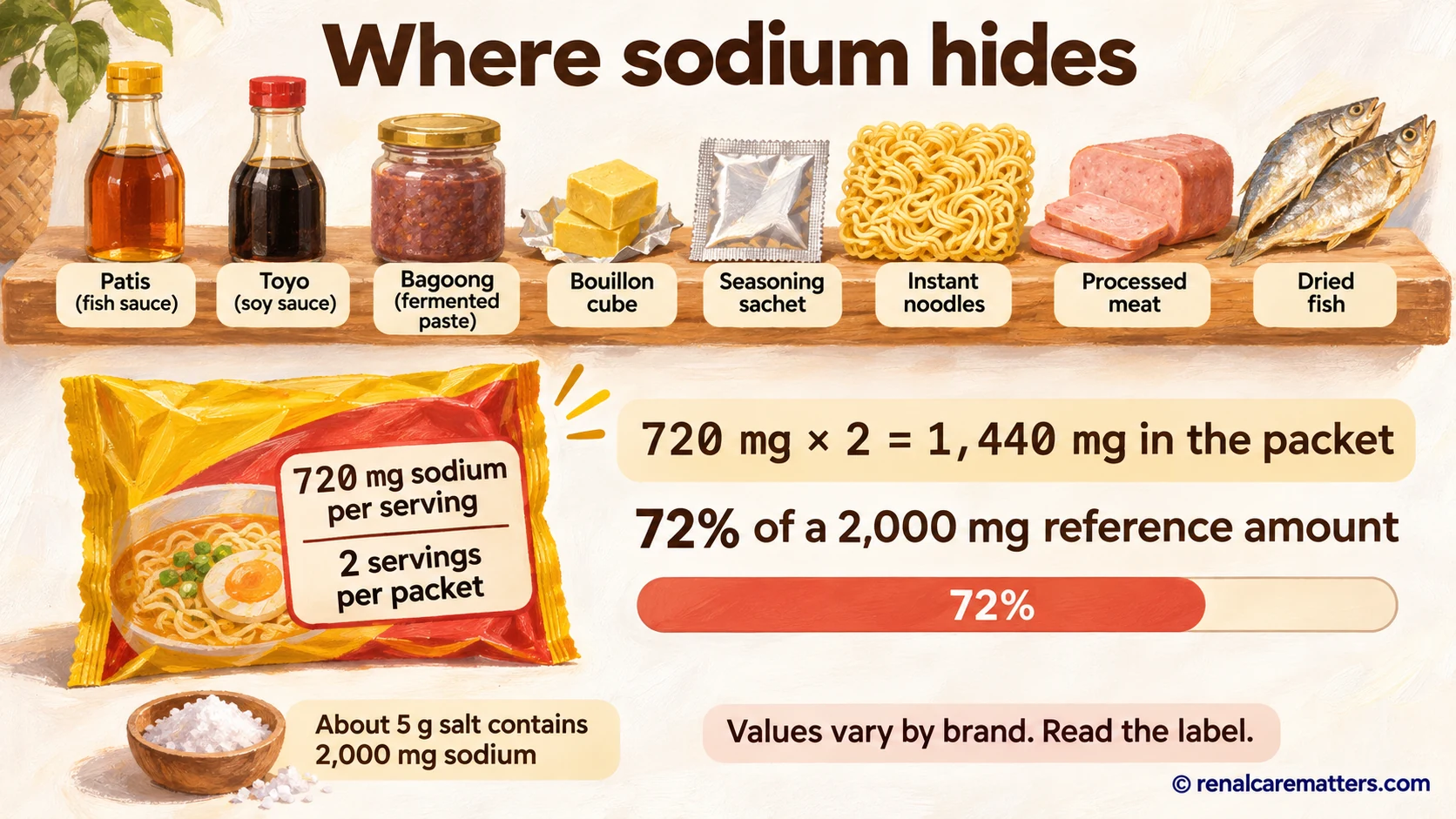
In home cooking, most sodium comes from a short list: table salt, patis (fish sauce), toyo (soy sauce), bagoong, bouillon cubes and seasoning granules, and sinigang or other soup mixes. A tablespoon of patis or toyo often carries 1,000 mg of sodium or more, half a day’s allowance; brands differ, so read the label. Outside the home, the main sources are instant noodles, canned goods, processed meats such as tocino, longganisa, hotdog, and ham, dried and salted fish, chips, and fast food.
Figure 3 · Four habits that hide sodium
SawsawanA dipping saucer refilled through the meal. Ask how many times, and measure one refill.
BrothSoup dissolves the seasoning. A second bowl of sabaw can double the sodium of the dish.
The whole packetMany labels give values per serving, with two or more servings in the pack.
Seasoning stacked on seasoningBouillon plus patis plus soup mix in one pot.
To estimate a recipe, add the sodium of every seasoning that went into the pot, divide by the number of servings, and then adjust for the person who takes extra broth. State the uncertainty; you are estimating, not measuring. The site’s label scanner and recipe analyzer can do the arithmetic, and Module 15 practices it by hand.4
Flavor does not have to fall with sodium. Calamansi, vinegar, garlic, onion, ginger, tomato, lemongrass, pepper, and chili carry a dish when salt is reduced, and taste adapts to lower salt within a few weeks if the change is gradual.
Figure 4. Where the sodium hides. Values vary by brand; read the label.
Lesson · part 3
Salt substitutes: good evidence, wrong population
Salt substitutes replace part of the sodium chloride with potassium chloride. In a large randomized trial in rural China, among about 21,000 people with prior stroke or aged 60 and older with high blood pressure, a substitute of 75% sodium chloride and 25% potassium chloride lowered the rate of stroke (rate ratio 0.86), major cardiovascular events, and death over about five years, without a detectable increase in serious hyperkalemia.5
That is strong evidence for the general hypertensive population. It does not transfer to your patients, because people with serious kidney disease and those taking potassium-sparing medicines were excluded from the trial. Potassium chloride is absorbed almost completely, and a kidney that cannot excrete potassium, or a patient on an angiotensin receptor blocker or spironolactone, may not handle it.6
Stop and reportAsk every patient with CKD, on dialysis, or after transplant whether a “low-sodium salt,” “lite salt,” or “heart salt” is used at home, and read the ingredient list for potassium chloride. Do not recommend one yourself. If a patient wants to use one, the nephrologist decides, with a potassium check.
Lesson · part 4
Fluid: individualize, then measure
Not every patient with kidney disease needs a fluid limit. Most patients with CKD who still pass urine normally should drink to thirst. A fluid limit is for patients who retain water: those on dialysis with little or no urine, and those with heart failure or low serum sodium as directed by the physician. For a patient on hemodialysis, a common starting rule is the previous day’s urine volume plus about 500 to 750 mL, adjusted by the nephrologist to weight gain, blood pressure, and climate; it is a rule of thumb and not a graded recommendation.
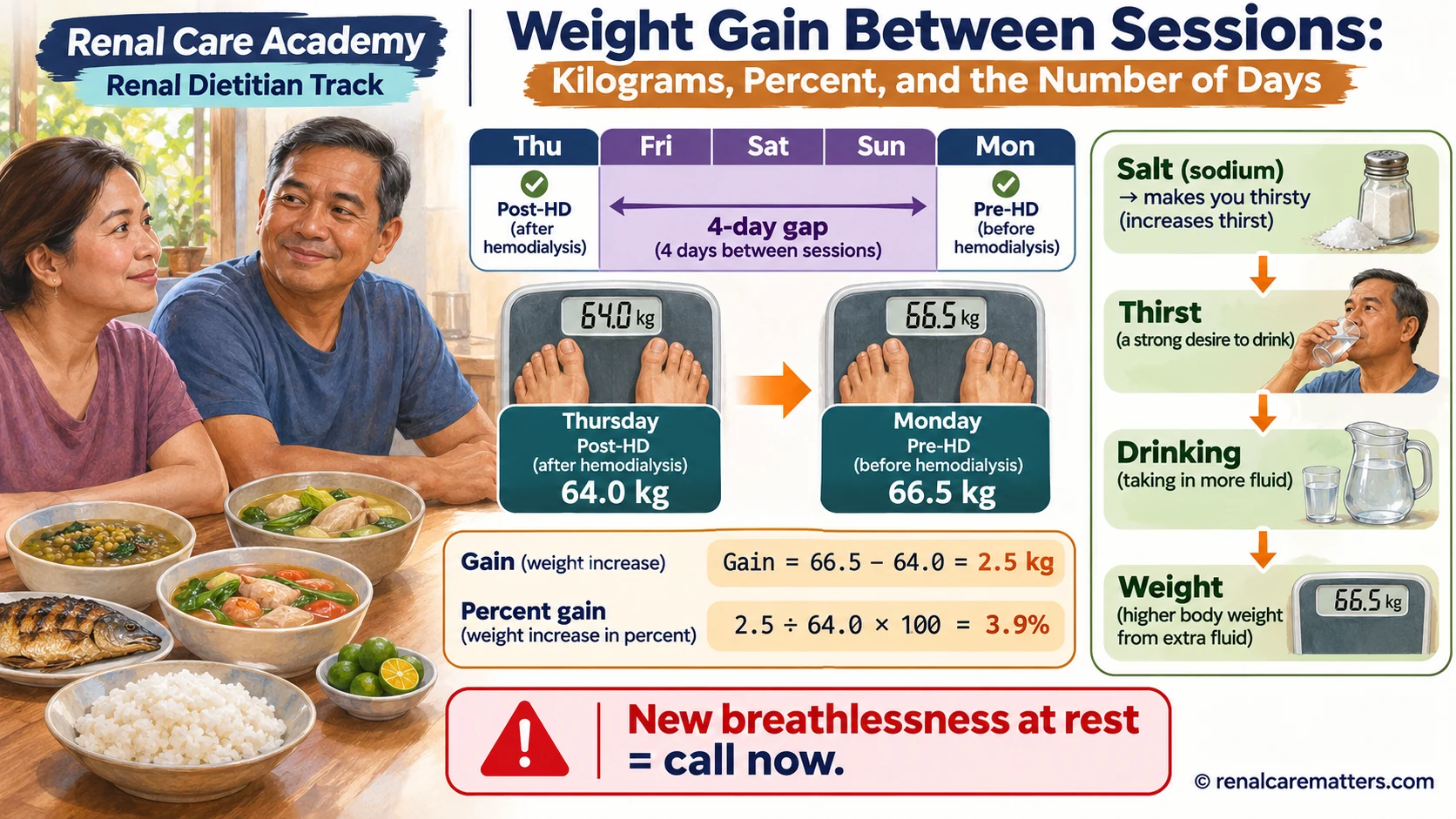
Interdialytic weight gain. Compare today’s pre-dialysis weight with the last post-dialysis weight, and note the number of days between.
Many units aim to keep gains below about 4% to 4.5% of dry weight, because larger gains mean higher blood pressure before dialysis and faster fluid removal during it. Faster ultrafiltration is associated with low blood pressure during dialysis, cramps, and higher mortality in observational studies, and KDIGO’s conference on volume management advises counseling on sodium as the first step in limiting gains, with targets individualized.7 The percentage thresholds are convention, not trial-proven cut-offs. In the Philippines many patients dialyze twice a week, so the interval is three or four days and the same daily intake produces a larger gain; interpret the number against the interval, the urine output, and the symptoms.
A very low gain is not always good news. A patient who gains almost nothing and is losing weight may simply not be eating. Read IDWG together with the food record.
Figure 5 · Practical fluid tools
Count what countsWater, coffee, juice, soup, lugaw, ice, gelatin, and watery fruit.
One measured bottleFill a marked bottle each morning; when it is empty, the day’s drinking is done.
For thirstLower the sodium first. Then small sips, ice chips counted as fluid, rinsing without swallowing, sugar-free gum, and good glucose control.
In hot weatherAsk the nephrologist whether the limit changes; sweat losses rise.
Figure 6. Weight gain between sessions: kilograms, percent, and the number of days.
Stop and reportNew breathlessness at rest or when lying flat, a sudden large weight gain, chest pain, or oxygen saturation below the unit’s threshold is not a counseling problem. Call the nurse and the physician on duty now.
On the floor
Real situations: problems and solutions
These are fictional but typical. For each one, cover the answer, decide what you would do, then compare. Where a step depends on local rules, your unit’s procedure and your supervisor’s direction come first.
The low-sodium salt from the pharmacy
What you see
A patient proudly shows you the “heart salt” she switched to. The label lists potassium chloride.
What is likely going on
She is trying to follow advice and does not know about the potassium.
What to do
Thank her for cutting sodium. Explain the potassium risk, ask her to stop it, and tell the nephrologist. Offer calamansi, garlic, and ginger for flavor.
Why it matters
A safe-looking product can be the most dangerous item on the table.
Weight gain after the long weekend
What you see
A patient arrives Monday with a 5% weight gain, mild breathlessness on walking, and a holiday story.
What is likely going on
Salt and fluid accumulated over three days.
What to do
Tell the nurse and physician on duty about the breathlessness now. Then, separately, review the holiday food with the patient and plan for the next one.
Why it matters
Symptoms come before teaching. Teaching prevents the next time.
Field notes
Measure the sawsawan refills, not just the first one.
Teach sodium first. Fluid limits fail when salt drives thirst.
Case review
Back to the case: The whole packet
How much sodium is in the noodle dinner? Two servings × 720 mg = 1,440 mg. That is 72% of a 2,000 mg day in one bowl, before any patis from the table.
How much did he gain, and over how long? 66.5 − 64.0 = 2.5 kg, which is 2.5 ÷ 64.0 × 100 = 3.9%. It built up over four days, Thursday to Monday, and he still passes about a glass of urine a day. For that interval, it is a moderate gain. He has no symptoms.
Should you start a one-liter fluid limit? Not yourself, and not first. A fluid prescription belongs to the nephrologist. And a fluid limit without a salt change will fail, because the noodles will keep him thirsty. Pass the nurse’s request on, with your findings.
What would you teach first? The sodium. Offer him choices: use half the seasoning sachet, leave the broth, or swap three noodle dinners a week for rice, fresh fish, and a vegetable with calamansi and garlic. Ask him to measure his patis with a teaspoon for one week. Check his weight gain and thirst in two weeks.
What would make this visit urgent? New breathlessness at rest or when lying flat. Then you stop the counseling and call the nurse and the physician on duty. The nurse saw a fluid problem. You found the salt behind it. The nephrologist decides what to prescribe. That is how the three roles fit together.
Skills lab · with your preceptor
Skills checklist: Sodium estimate and volume-aware counseling
Materials: two food labels, a household recipe card, a teaspoon and tablespoon, and a fictional dialysis record. Your preceptor rates each step as satisfactory, needs practice, or not observed. Steps marked Critical must all be satisfactory before sign-off. This checklist supports supervised learning; your unit’s own procedure and competency form are the authority. A printable version of every checklist is on the trainer page.
Reads serving size and servings per pack and calculates sodium for the amount actually eaten.
Converts sodium to salt and to teaspoons for the patient.
Estimates sodium per serving of a recipe and states the uncertainty from broth and second servings.
Asks about table condiments, refills, and food eaten outside the home.
CriticalChecks the ingredient list of any salt substitute for potassium chloride and refers the question to the nephrologist.
Calculates interdialytic weight gain in kg and percent with the correct weights and states the interval.
CriticalTeaches sodium before fluid and does not set a fluid limit independently.
CriticalRecognizes resting breathlessness as urgent and calls the nurse and physician.
Agrees on one change chosen by the patient and sets a review date.
Placement activity. With permission, review three patients’ weight gains over one month with the charge nurse and note which gains followed a long interval.
Self-assessment
Check your understanding
Each visit draws 8 questions at random from this module’s 15-question bank. Choose the single best answer for each, then select Check answers; an explanation appears under the best answer. Select New set of questions for a different mix. A good target is 7 of 8 on two different sets. Nothing you select is sent anywhere; scoring happens in your browser.
Kidney Disease: Improving Global Outcomes (KDIGO) CKD Work Group. (2024). KDIGO 2024 clinical practice guideline for the evaluation and management of chronic kidney disease. Kidney International, 105(4S), S117–S314. https://doi.org/10.1016/j.kint.2023.10.018
Ikizler, T. A., Burrowes, J. D., Byham-Gray, L. D., Campbell, K. L., Carrero, J. J., Chan, W., Fouque, D., Friedman, A. N., Ghaddar, S., Goldstein-Fuchs, D. J., Kaysen, G. A., Kopple, J. D., Teta, D., Yee-Moon Wang, A., & Cuppari, L. (2020). KDOQI clinical practice guideline for nutrition in CKD: 2020 update. American Journal of Kidney Diseases, 76(3, Suppl. 1), S1–S107. https://doi.org/10.1053/j.ajkd.2020.05.006
McMahon, E. J., Campbell, K. L., Bauer, J. D., Mudge, D. W., & Kelly, J. T. (2021). Altered dietary salt intake for people with chronic kidney disease. Cochrane Database of Systematic Reviews, 6(6), Article CD010070. https://doi.org/10.1002/14651858.CD010070.pub3
Department of Science and Technology, Food and Nutrition Research Institute. (n.d.). Philippine food composition tables online database (PhilFCT). Retrieved November 23, 2026, from https://i.fnri.dost.gov.ph/login/fct
Neal, B., Wu, Y., Feng, X., Zhang, R., Zhang, Y., Shi, J., Zhang, J., Tian, M., Huang, L., Li, Z., Yu, Y., Zhao, Y., Zhou, B., Sun, J., Liu, Y., Yin, X., Hao, Z., Yu, J., Li, K. C., . . . Elliott, P. (2021). Effect of salt substitution on cardiovascular events and death. New England Journal of Medicine, 385(12), 1067–1077. https://doi.org/10.1056/NEJMoa2105675
Clase, C. M., Carrero, J. J., Ellison, D. H., Grams, M. E., Hemmelgarn, B. R., Jardine, M. J., Kovesdy, C. P., Kline, G. A., Lindner, G., Obrador, G. T., Palmer, B. F., Cheung, M., Wheeler, D. C., Winkelmayer, W. C., Pecoits-Filho, R., & Conference Participants. (2020). Potassium homeostasis and management of dyskalemia in kidney diseases: Conclusions from a Kidney Disease: Improving Global Outcomes (KDIGO) Controversies Conference. Kidney International, 97(1), 42–61. https://doi.org/10.1016/j.kint.2019.09.018
Flythe, J. E., Chang, T. I., Gallagher, M. P., Lindley, E., Madero, M., Sarafidis, P. A., Unruh, M. L., Wang, A. Y., Weiner, D. E., Cheung, M., Jadoul, M., Winkelmayer, W. C., Polkinghorne, K. R., & Conference Participants. (2020). Blood pressure and volume management in dialysis: Conclusions from a Kidney Disease: Improving Global Outcomes (KDIGO) Controversies Conference. Kidney International, 97(5), 861–876. https://doi.org/10.1016/j.kint.2020.01.046
Educational study material for registered nutritionist-dietitians. Does not replace the nephrologist’s orders, facility policy, the Nutrition Care Process documentation required by the Department of Health, or supervised practice.