Energy, Protein, and Eating Patterns in Stable Chronic Kidney Disease
The KDIGO and KDOQI protein recommendations side by side, energy, plant-dominant patterns, ketoanalogues, and who should not be restricted.
PublishedNailathalaGipatikPepalwal:ReferencesMga SanggunianMga TinubdanReng Reperensya:11Audience: Registered nutritionist-dietitians entering adult kidney care · renal RND preceptors, nephrologists, and head nurses who orient themRead timeOras ng pagbasaOras sa pagbasaOras ning pamamasa:
This module is study material for dietitians in adult kidney care. It explains the reasoning behind common decisions; it is not a protocol. In practice, follow your facility’s policy and the responsible physician’s orders. Targets and cut-off values are set by your unit and the attending nephrologist. Every case is fictional.
Learning objectives
After this module you should be able to
State the KDIGO 2024, KDOQI 2020, and American Diabetes Association 2026 protein recommendations for adults with CKD not on dialysis, with their grades, and explain why they differ.
Decide whether a patient is metabolically stable before any protein restriction is discussed.
Calculate an energy and protein prescription and record the weight and guideline used.
Describe what randomized trials show, and do not show, about low-protein and ketoanalogue-supplemented diets.
Identify the patients in whom protein should not be restricted, including frail older adults.
Build a plant-dominant, less processed eating pattern from familiar Filipino foods.
Pre-testBefore you read, answer the 8 self-assessment questions and note your score. After the module, select New set of questions and compare. The difference is what you learned; the questions you still miss are what to reread.
Start here
The big picture, in plain words
In plain wordsProtein in kidney disease is like fuel for a truck with a worn engine. Too rich a mixture strains the engine; too lean, and the truck starts burning its own frame. The dietitian sets the mixture for this engine, on this road, and checks the frame at every visit. Where the picture falls short: the “frame” is muscle, and it is also lost to acidosis and inflammation even when the fuel is right.
Figure 1 · Key terms for this module
Metabolically stableNo active inflammatory or infectious illness, no hospital stay in the past two weeks, no poorly controlled diabetes or wasting cancer, no recent significant weight loss, and not on high-dose steroids.
Low-protein diet (LPD)About 0.55 to 0.60 g of protein per kg per day.
Very low-protein diet (VLPD)About 0.28 to 0.43 g/kg/day, always with ketoanalogue or essential amino acid supplements.
KetoanaloguesNitrogen-free versions of essential amino acids; the body adds nitrogen from its own waste to complete them.
High biological value proteinProtein with all essential amino acids in good proportion, such as egg, fish, meat, milk, and soy.
Plant-dominant dietA pattern in which more than half the protein comes from plants.
Ultra-processed foodIndustrial formulations with additives, such as instant noodles, processed meats, and sweetened drinks.
Figure 2 · Order of work
StabilityIs the patient metabolically stable and eating enough?
WeightWhich weight, and why?
Energy firstWithout enough energy, protein is burned as fuel.
Protein secondWhich guideline, which target, which sources?
PatternMore plants, fewer ultra-processed foods.
ReviewWeight, intake, function, and laboratory results at a set date.
Opening case · fictional
Case: Two guidelines, one patient
Mr. Santos, 58, has CKD G4 A2 from hypertension. He does not have diabetes. He weighs 60 kg with no edema, his weight has been steady for a year, and he walks to the market daily. A food record shows about 75 g of protein a day, mostly pork and processed meats, and about 1,650 kcal.
His nephrologist writes: “Protein restriction per dietitian.” The clinic normally follows KDIGO. A supervised low-protein pathway with ketoanalogues is available, at his own expense.
Before reading on, decide:
What is his protein target under KDIGO 2024, and under KDOQI 2020?
What must be true before a lower target is offered?
What would you change first on his plate?
Keep your answers in mind. The lesson gives you what you need, and the case review near the end shows one sound response.
Lesson · part 1
Three guidelines, three numbers
To understand protein in kidney disease, start with a healthy adult. The recommended intake for healthy adults is about 0.8 g of protein per kilogram of body weight a day. Most Filipino adults with chronic kidney disease (CKD) eat more than that, often 1.2 g/kg/day or above, much of it as pork and processed meat.
All the major guidelines agree on one thing: in CKD that is getting worse, very high protein intake should be avoided. They disagree on how low to go. They read the same trials, but they weigh the benefit of slowing the kidney disease differently against the risk of losing muscle.
Guideline
What it says for adults with CKD G3 to G5, not on dialysis
How firm
Kidney Disease: Improving Global Outcomes (KDIGO) 2024
Keep protein at 0.8 g/kg/day. In adults at risk of progression, avoid more than 1.3 g/kg/day. A very low-protein diet with ketoanalogues may be offered to willing, able adults, with close supervision.
0.8 g/kg/day is a weak suggestion (grade 2C). The rest is advice without a formal grade.
Kidney Disease Outcomes Quality Initiative (KDOQI) 2020, without diabetes
In stable adults, under close supervision, 0.55 to 0.60 g/kg/day, or 0.28 to 0.43 g/kg/day with ketoanalogues.
A firm recommendation (grade 1A).
KDOQI 2020, with diabetes
0.6 to 0.8 g/kg/day is reasonable.
Expert opinion.
American Diabetes Association 2026 and KDIGO Diabetes 2022
Aim for 0.8 g/kg/day in diabetes with CKD not on dialysis.
So which number do you use? Not the average. Choose one guideline with the nephrologist, write down which one, and write down why. For most patients in a general clinic, KDIGO’s 0.8 g/kg/day is a sound starting point. It is the same as the healthy-adult intake, so it feels normal to patients, and because most of them arrive eating far more, reaching it is already a real change. The lower KDOQI range is for a smaller group: stable, well-nourished, motivated patients who can see a dietitian every one to three months.
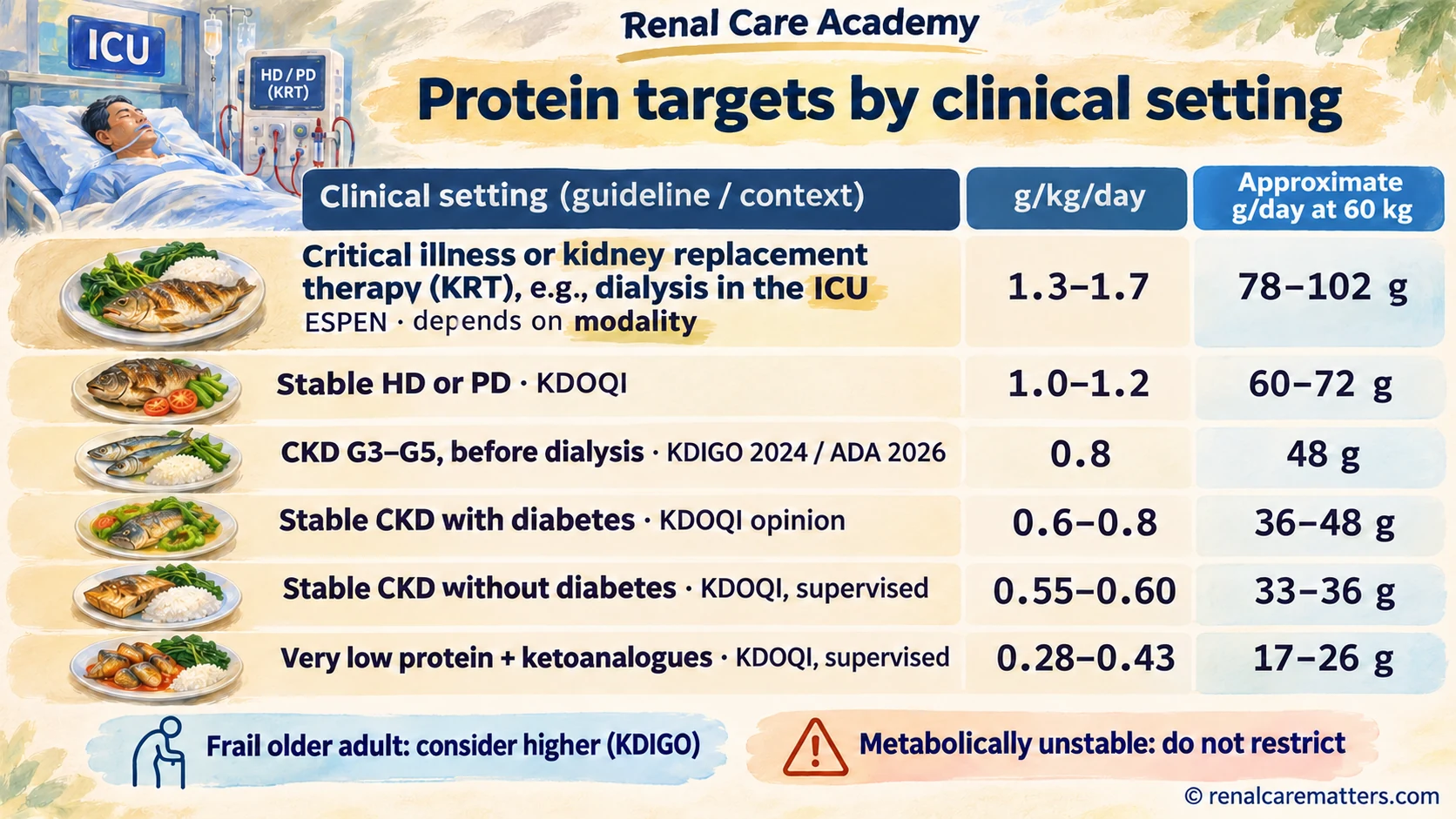
Figure 3. Protein targets differ by stage, treatment, and illness. Know which rung your patient is on.
RememberQuote each guideline’s grade as it is written. KDOQI’s 1A and KDIGO’s 2C come from two panels using their own systems. One cannot be turned into the other.
Lesson · part 2
What the trials show, and what they cannot
Low-protein diets. A Cochrane review pooled 17 trials in 2,996 adults without diabetes. Very low-protein diets probably reduced the number of people with CKD stage 4 or 5 who reached kidney failure. Ordinary low-protein diets may have made little difference to that outcome. Neither probably changed the risk of death. The trials told us little about muscle loss or quality of life.5 In plain words: the evidence is strongest for the hardest diet to follow, and weakest for the moderate one.
Ketoanalogues. In a single-center trial in Romania, 207 adults without diabetes, with estimated glomerular filtration rate (eGFR) below 30, were assigned for 15 months either to a vegetarian very low-protein diet (0.3 g/kg/day) with ketoanalogues or to a standard low-protein diet (0.6 g/kg/day). Fewer patients on the ketoanalogue diet needed dialysis or lost half their kidney function. About one patient was spared that outcome for every four to five treated.6 Now look at who was in it. Only 14% of the patients screened were enrolled, and only after a three-month trial period that kept those who followed the diet and were well nourished. The result shows what is possible in ideal candidates. It does not tell you what to expect in an ordinary clinic.
Older adults. Three cohorts, two in Spain and one in Sweden, followed 8,543 adults aged 60 and older. Among those with CKD, mostly stages 1 to 3, people who ate 1.0 g/kg/day of protein died less often than those who ate 0.8 g/kg/day (hazard ratio 0.88).7 This was an observational study. Healthier people eat more, so it shows an association and does not prove that more protein prolongs life. It is still a good reason not to restrict protein in older adults who are frail or losing muscle, which is what KDIGO advises.
Energy. KDOQI recommends 25 to 35 kcal/kg/day for stable adults with CKD, on dialysis, or after transplant, adjusted for age, sex, activity, body build, weight goals, and illness (a firm recommendation, grade 1C).2 The reason is simple. Protein is kept for building and repair only when the body has enough energy from other foods. If energy is short, the body burns protein, from the plate first and then from muscle. A low-protein diet at 20 kcal/kg/day is a wasting diet.
Lesson · part 3
Check stability before you restrict
Protein restriction is a treatment for stable people with years ahead in which slowing progression matters. It is the wrong treatment for someone who is losing tissue now.
Figure 4 · Do not lower protein when
Metabolically unstableAcute infection, hospital stay in the past two weeks, uncontrolled diabetes, active cancer, high-dose steroids.
Already wastingUnintentional weight loss, intake below need, low grip strength, or protein-energy wasting (PEW) criteria met.
Frail or sarcopenic and olderFunction now outweighs progression years from now.
Starting dialysis soon or on dialysisNeeds rise to 1.0 to 1.2 g/kg/day (Module 9).
Pregnant, or a childRefer; adult targets do not apply.
Heavy proteinuria with low albumin and edemaDiscuss with the nephrologist; do not add a restriction on your own.
For those who are suitable, a low-protein prescription needs four things in place: energy intake at target, at least half the protein from high biological value or well-combined plant sources, a review every one to three months with weight, intake, and grip strength, and a clear rule for stopping. Ketoanalogues are a prescription product; dosing and monitoring of calcium belong to the nephrologist.
Stop and reportIf a patient on a low-protein diet loses weight without intending to, eats less than the energy target for two weeks, or becomes ill, stop the restriction, return to at least 0.8 g/kg/day, and tell the nephrologist the same day.
Lesson · part 4
From grams to a Filipino plate
Beyond grams, the pattern of eating matters. KDIGO advises a healthy, diverse diet with more plant-based than animal-based foods and fewer ultra-processed foods (advice without a formal grade).1 KDOQI suggests a Mediterranean-style pattern, and more fruits and vegetables, in CKD stages 1 to 4 (a weak suggestion, grade 2C).2 In the Chronic Renal Insufficiency Cohort, higher intake of ultra-processed foods was associated with faster CKD progression and higher mortality; the study is observational, and people who eat more processed food differ in income and health in ways that are hard to adjust for.8 The plant-dominant low-protein diet, 0.6 to 0.8 g/kg/day with more than half from plants, is an idea built on this physiology. No trial has yet tested whether it changes outcomes.9
Why would plants help? Compared with processed meats, they bring less phosphorus that the body can absorb, less acid, more fiber, and less sodium. The usual worry is potassium, which Module 6 addresses; in most patients with normal potassium, vegetables do not need to be restricted.
Food (cooked, household measure)
Approximate protein
Note
Fish, meat, or chicken, one matchbox-size piece (about 30 g)
7 to 8 g
One meat exchange in the Philippine Food Exchange Lists
Egg, one medium
6 to 7 g
The yolk carries most of the phosphorus
Tofu (tokwa), about half a cup of cubes
7 to 8 g
Plant protein of high quality
Cooked mung beans (monggo), half a cup
about 7 g
Also carries potassium and fiber
Cooked rice, one cup
about 4 g
Three cups a day adds 12 g that patients forget to count
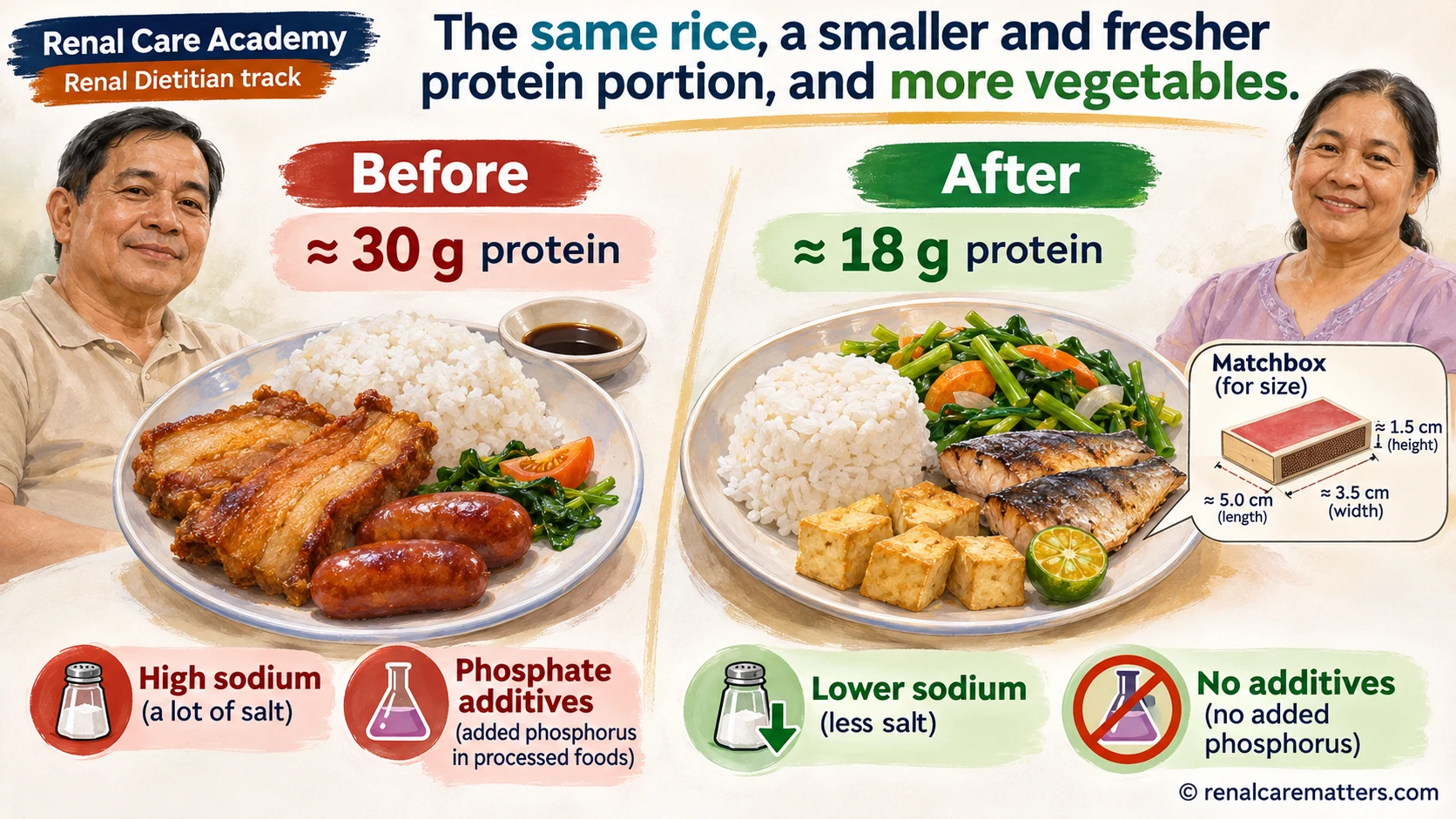
These values are rounded teaching figures. Check the Philippine Food Composition Tables and the Food Exchange Lists for the food and preparation in front of you.10,11 In practice, most of the change comes from three moves: shrink the meat portion to one or two matchbox pieces per meal, replace processed meats with fresh fish, egg, or tofu, and keep the rice, vegetables, and cooking oil that supply energy.
Figure 5. The same rice, a smaller and fresher protein portion, and more vegetables.
On the floor
Real situations: problems and solutions
These are fictional but typical. For each one, cover the answer, decide what you would do, then compare. Where a step depends on local rules, your unit’s procedure and your supervisor’s direction come first.
The patient who wants the lowest possible protein
What you see
A motivated patient read about very low-protein diets and wants to start one tomorrow. He lives alone and eats one meal a day.
What is likely going on
He is motivated but not stable in intake, and energy is already low.
What to do
Praise the motivation. Explain that low protein without enough energy burns muscle. Build energy and a regular meal pattern first, then discuss the supervised pathway with the nephrologist.
Why it matters
The right diet for the wrong patient causes harm.
Two dietitians, two numbers
What you see
A patient was told 48 g by one dietitian and 35 g by another, and is confused.
What is likely going on
Each used a different guideline without saying which.
What to do
Agree on one plan with the nephrologist, write which guideline and why, and explain the difference to the patient in plain words.
Why it matters
Patients lose trust when the team disagrees without explaining.
Field notes
Count the protein in rice. Three cups add about 12 g.
Check energy before protein. A low-protein diet at 20 kcal/kg is a wasting diet.
Case review
Back to the case: Two guidelines, one patient
What is his target under each guideline? Under KDIGO, 0.8 × 60 = 48 g a day. Under KDOQI’s low-protein range, 0.55 to 0.60 × 60 = 33 to 36 g a day, with close supervision. For energy, KDOQI’s 25 to 35 kcal/kg gives 1,500 to 2,100 kcal a day. His 1,650 kcal sits inside that range, and his steady weight says it is enough for now.
Could he have the lower target? He could be offered it. He is stable, well nourished, active, and has not lost weight. But it needs four things: enough energy every day, a visit every one to three months, his own informed choice, and money for ketoanalogues if they are used. If he says no, 48 g a day is a sound, guideline-backed target, and it is already about a third less than the 75 g he eats now.
What would you change first on his plate? The processed meats. They carry sodium and phosphate additives as well as protein, so one swap lowers three things. Replace them with fresh fish, egg, or tofu, about two matchbox-size pieces at lunch and dinner and one at breakfast, which comes to roughly 35 to 40 g of protein from those foods. Let rice and vegetables supply the rest. Keep the rice and the cooking oil so his energy does not fall.
What goes in the note? The guideline you used, the 60 kg weight and why you used it, and a review in six to eight weeks with his weight and a repeat food record. The nephrologist wrote “per dietitian.” That is trust, and the note is how you show what you did with it.
Skills lab · with your preceptor
Skills checklist: Writing a stable-CKD nutrition prescription
Use a fictional patient card with stage, weight, a three-day food record, and laboratory results. Your preceptor rates each step as satisfactory, needs practice, or not observed. Steps marked Critical must all be satisfactory before sign-off. This checklist supports supervised learning; your unit’s own procedure and competency form are the authority. A printable version of every checklist is on the trainer page.
CriticalScreens for metabolic instability, poor intake, and frailty before discussing restriction.
States the weight used for calculation and the reason.
Calculates energy and protein in kcal/day and g/day, with units.
Names the guideline chosen and quotes its grade as written.
Explains to the preceptor why the KDIGO and KDOQI targets differ and why they are not averaged.
Converts the protein target into household portions using the patient’s usual foods.
CriticalChecks that the plan still meets the energy target.
Sets a review date with weight, intake, and function, and states the rule for stopping a restriction.
Placement activity. For one supervised patient, write the prescription twice, once under KDIGO and once under KDOQI, and discuss with your preceptor which fits and why.
Self-assessment
Check your understanding
Each visit draws 8 questions at random from this module’s 15-question bank. Choose the single best answer for each, then select Check answers; an explanation appears under the best answer. Select New set of questions for a different mix. A good target is 7 of 8 on two different sets. Nothing you select is sent anywhere; scoring happens in your browser.
Kidney Disease: Improving Global Outcomes (KDIGO) CKD Work Group. (2024). KDIGO 2024 clinical practice guideline for the evaluation and management of chronic kidney disease. Kidney International, 105(4S), S117–S314. https://doi.org/10.1016/j.kint.2023.10.018
Ikizler, T. A., Burrowes, J. D., Byham-Gray, L. D., Campbell, K. L., Carrero, J. J., Chan, W., Fouque, D., Friedman, A. N., Ghaddar, S., Goldstein-Fuchs, D. J., Kaysen, G. A., Kopple, J. D., Teta, D., Yee-Moon Wang, A., & Cuppari, L. (2020). KDOQI clinical practice guideline for nutrition in CKD: 2020 update. American Journal of Kidney Diseases, 76(3, Suppl. 1), S1–S107. https://doi.org/10.1053/j.ajkd.2020.05.006
American Diabetes Association Professional Practice Committee for Diabetes. (2026). 11. Chronic kidney disease and risk management: Standards of Care in Diabetes—2026. Diabetes Care, 49(Suppl. 1), S246–S260. https://doi.org/10.2337/dc26-S011
Kidney Disease: Improving Global Outcomes (KDIGO) Diabetes Work Group. (2022). KDIGO 2022 clinical practice guideline for diabetes management in chronic kidney disease. Kidney International, 102(5S), S1–S127. https://doi.org/10.1016/j.kint.2022.06.008
Hahn, D., Hodson, E. M., & Fouque, D. (2020). Low protein diets for non-diabetic adults with chronic kidney disease. Cochrane Database of Systematic Reviews, 10(10), Article CD001892. https://doi.org/10.1002/14651858.CD001892.pub5
Garneata, L., Stancu, A., Dragomir, D., Stefan, G., & Mircescu, G. (2016). Ketoanalogue-supplemented vegetarian very low-protein diet and CKD progression. Journal of the American Society of Nephrology, 27(7), 2164–2176. https://doi.org/10.1681/ASN.2015040369
Carballo-Casla, A., Avesani, C. M., Beridze, G., Ortolá, R., García-Esquinas, E., Lopez-Garcia, E., Dai, L., Dunk, M. M., Stenvinkel, P., Lindholm, B., Carrero, J. J., Rodríguez-Artalejo, F., Vetrano, D. L., & Calderón-Larrañaga, A. (2024). Protein intake and mortality in older adults with chronic kidney disease. JAMA Network Open, 7(8), Article e2426577. https://doi.org/10.1001/jamanetworkopen.2024.26577
Sullivan, V. K., Appel, L. J., Anderson, C. A. M., Kim, H., Unruh, M. L., Lash, J. P., Trego, M., Sondheimer, J., Dobre, M., Pradhan, N., Rao, P. S., Chen, J., He, J., Rebholz, C. M., & CRIC Study Investigators. (2023). Ultraprocessed foods and kidney disease progression, mortality, and cardiovascular disease risk in the CRIC study. American Journal of Kidney Diseases, 82(2), 202–212. https://doi.org/10.1053/j.ajkd.2023.01.452
Kalantar-Zadeh, K., Joshi, S., Schlueter, R., Cooke, J., Brown-Tortorici, A., Donnelly, M., Schulman, S., Lau, W. L., Rhee, C. M., Streja, E., Tantisattamo, E., Ferrey, A. J., Hanna, R., Chen, J. L. T., Malik, S., Nguyen, D. V., Crowley, S. T., & Kovesdy, C. P. (2020). Plant-Dominant low-protein diet for conservative management of chronic kidney disease. Nutrients, 12(7), Article 1931. https://doi.org/10.3390/nu12071931
Department of Science and Technology, Food and Nutrition Research Institute. (n.d.). Philippine food composition tables online database (PhilFCT). Retrieved November 23, 2026, from https://i.fnri.dost.gov.ph/login/fct
Department of Science and Technology, Food and Nutrition Research Institute. (2019). Food exchange lists for meal planning (4th ed.). DOST-FNRI. https://www.fnri.dost.gov.ph/
Educational study material for registered nutritionist-dietitians. Does not replace the nephrologist’s orders, facility policy, the Nutrition Care Process documentation required by the Department of Health, or supervised practice.