Putting It Together: Bedside Skills and a Simulated Shift
Orders, handoffs, practice stations, and a simulated shift that brings the series together.
PublishedNailathalaGipatikPepalwal:ReferencesMga SanggunianMga TinubdanReng Reperensya:17Audience: Physicians who cover hemodialysis shifts · attending nephrologists, medical directors, and head nurses who orient themRead timeOras ng pagbasaOras sa pagbasaOras ning pamamasa:
This module is study material for physicians on duty in hemodialysis units. It explains the reasoning behind common decisions; it is not a protocol. At the chairside, follow your unit’s protocol and ask the attending nephrologist for guidance. Doses and cut-off values are set by your unit. Every case is fictional.
Learning objectives
After this module you should be able to
Write orders and event notes that are clear, timed, within the attending nephrologist’s prescription, and free of error-prone abbreviations.
Hand off a patient to the attending nephrologist and to an emergency room physician using a structured format, with a written transfer letter.
Perform the ten core bedside skills of the series to the standard on each station’s scoring sheet, including every Critical step.
Prioritize several simultaneous problems on one shift and explain the order you chose.
Explain what simulation, deliberate practice, and debriefing add to reading, with the strength of the evidence.
Complete the written test and the Competency Passport, and state what a passing score does and does not show.
Pre-testBefore you read, answer the 8 self-assessment questions and note your score. After the module, select New set of questions and compare. The difference is what you learned; the questions you still miss are what to reread.
Start here
The big picture, in plain words
In plain wordsThink of learning to swim. A good book can teach you the stroke, the breathing, and why you kick from the hip. You can pass a written test on all of it. Then you step into the pool, and your body does something else. The earlier modules were the book. This module is the pool.
The picture has a limit. A swimmer faces one task in calm water. A shift brings several at once. Knowing each module is not the same as acting on four problems in the right order while writing a note someone else can act on.
Figure 1 · Key terms for this module
Objective structured clinical examination (OSCE)A timed practice station in which an examiner scores observed actions against a written checklist.
Critical stepA step on a scoring sheet that must be done for the station to pass, whatever the total score.
SimulationPractice of a clinical task in a realistic setting without risk to a real patient.
Deliberate practiceRepeated practice of a defined skill with immediate feedback and a clear standard to reach.
DebriefingA guided discussion after a simulation in which the learner reviews what happened and why.
In situ simulationSimulation run in the real unit, with the real equipment and the real team.
EntrustmentThe decision that a trainee can carry out a professional task without supervision.
HandoffThe transfer of information and responsibility for a patient from one clinician to another.
This module re-teaches nothing. Each station points back to the module that teaches it. Most of what you need you already know. A few skills, such as sorting a full floor and handing off under pressure, only develop with practice and feedback. Your work is to practice them until they hold under pressure, and to be signed off by people who watched you do it.
Opening case · fictional
Case: A full floor
It is Tuesday, 10:15 a.m., on the first shift of a 12-station unit in Bulacan. You are the only physician in the building. In the next five minutes, four things happen.
At Station 3, Mrs. Erlinda Bautista, 66, is in hour two. She says she feels faint. Her pressure is 84/50 mm Hg (illustrative). At Station 7, the nurse, Mr. Paolo Reyes, reports foam in the venous drip chamber of Mr. Ramon Cruz’s circuit and an air detector alarm. Mr. Cruz is coughing. At Station 9, Ms. Grace Villanueva, 34, who dialyzes through a tunneled catheter, has a temperature of 38.6 °C and rigors 30 minutes into her session. At Station 12, Mr. Leonardo Garcia, 52, wants to stop now because his son’s school has called. He is 1.5 kilograms above his dry weight (illustrative).
The charge nurse, Ms. Liza Ramos, stands beside you holding the telephone. At Station 7, the machine’s air detector has already stopped the blood pump and closed the venous line clamp.
Before reading on, decide:
In what order do you go to these four patients, and what do you delegate first?
For which patient must the blood not be returned, and for which is the session continued?
Whom do you call, in what order, and what do you write afterward?
Keep your answers in mind. The lesson gives you what you need, and the case review near the end shows one sound response.
Lesson · part 1
Orders that cannot be misread
An order is a relay baton. The runners can be fast and fit, but if the baton is dropped, or passed to the wrong hand, the race is lost. In a dialysis unit the runners are you, the nurse, and the attending nephrologist. The baton is the written or spoken order.
What a sound order does, and how orders fail
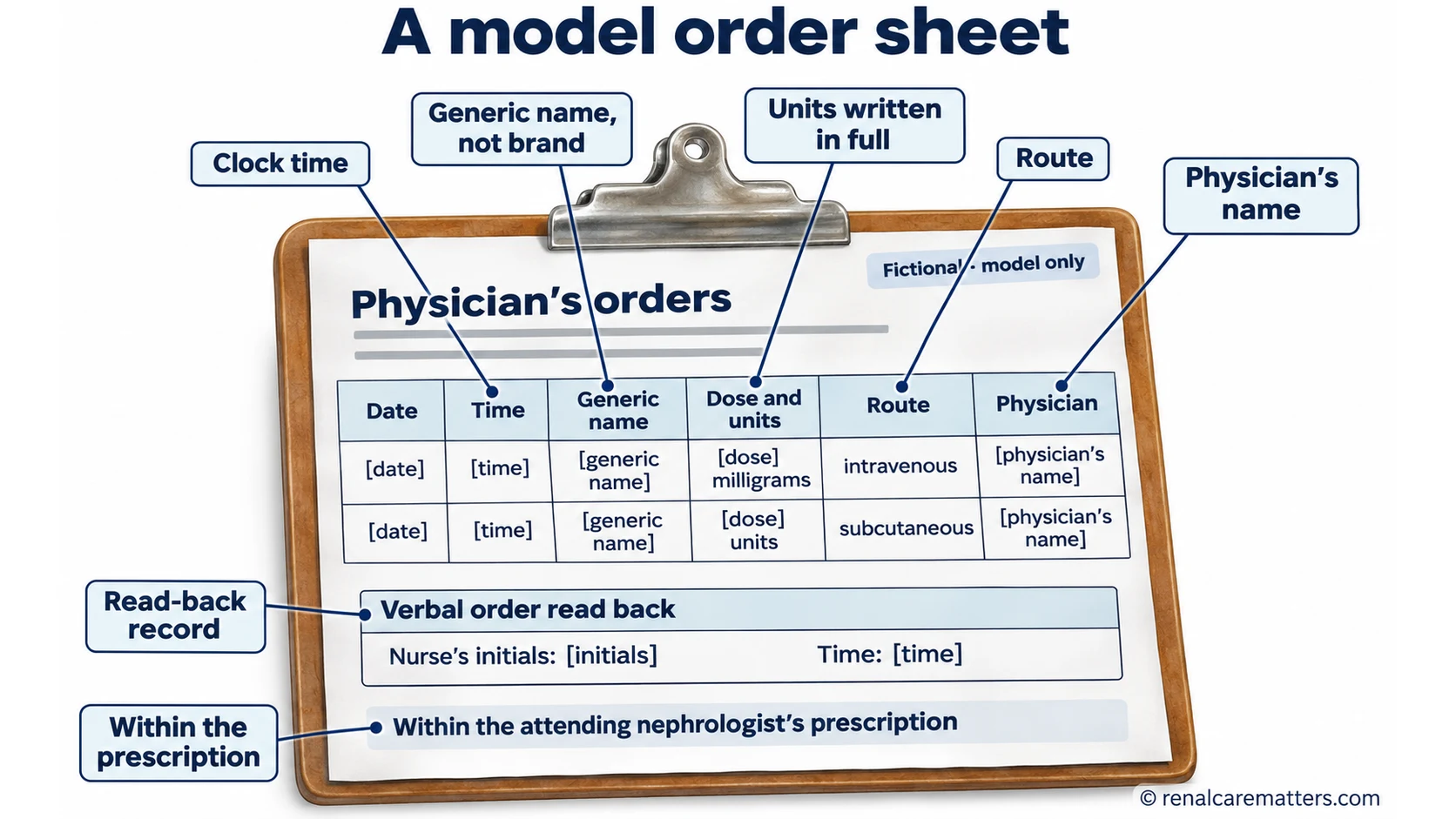
A sound order carries five facts from your head to the nurse’s hands without loss: which patient, which drug or action, how much, by which route, and when. Every gap is filled by a guess, and guesses fail most at night and under pressure.
In one descriptive report from four hemodialysis units, clinical directors recorded 88 errors and adverse events over 64,541 treatments. Of 35 medication errors, omission of an ordered medicine was the most common, at 24 of 35 (69%). No patient needed admission because of an event.1 The report shows where to look first: the order written but never carried out.
Figure 2. A model order sheet. Every order carries the time, the generic name, units written in full, the route, a read-back record for verbal orders, and a note that it sits within the attending nephrologist’s prescription.
Weak order
What can go wrong
Clear order
A brand name only
The nurse cannot find it in stock, or gives a different product
The generic name, with the brand in brackets if the unit stocks only one
“U” or “IU” for units
A handwritten U can be read as a zero, so the dose is multiplied tenfold
“units” written in full
A trailing zero or a bare decimal point
A dose read ten times too high or too low
No trailing zero. A zero before a leading decimal point
“Give now” called across the floor
No record, no read-back, wrong patient
A verbal order read back by the nurse, then written in the chart as soon as the emergency allows
“Reduce the fluid goal”
A change to the prescription without the nephrologist
“Ultrafiltration paused at 10:20 per unit protocol. Attending nephrologist informed at 10:24. Advice: …”
What you order, and what you do not
Module 1 set the line of authority, and Module 7 explained each line of the dialysis order. You order within the prescription and within the unit’s standing orders. Changes to the dialysis prescription belong to the attending nephrologist: the time, the fluid goal, the dialysis fluid, the anticoagulation, and the access plan. In an emergency you act on the unit’s protocol first, then call. You do not write a new prescription.
When you order a medicine for a patient without kidney function, check its dose and its removal by dialysis. The renal medication safety calculator linked below is a quick lookup. Module 20 explains the reasoning.
Stop and callStop and call the attending nephrologist before any order that would change the dialysis prescription: the session time, the fluid goal, the dialysis fluid, the anticoagulant, or the access plan. Follow your unit’s protocol for the first minutes of an emergency while you call.
RememberWrite every order so that a nurse you have never met can carry it out correctly at 3 a.m. without calling you.
Lesson · part 2
Handing off to the nephrologist and the emergency room
A handoff is a bridge. Whatever you know about the patient is lost if it does not cross, however well you knew it on your side of the river. Most handoffs in your work cross two bridges: the telephone call to the attending nephrologist, and the transfer to an emergency room.
Why handoffs fail, and what a structure adds
Under stress, a speaker leaves out what seems obvious. A fixed structure works as a checklist for speech. It reminds you to say what you would otherwise assume.
Module 1 taught the Situation, Background, Assessment, Recommendation (SBAR) format: situation, background, assessment, recommendation. A systematic review of 11 studies found moderate evidence that introducing SBAR improved patient safety, especially for telephone communication, and noted that high-quality studies are few.2
The I-PASS program goes further. I-PASS stands for illness severity, patient summary, action list, situation awareness and contingency planning, and synthesis by the receiver. In a prospective study of resident handoffs at nine hospitals covering 10,740 admissions, the program was associated with a fall in medical errors from 24.5 to 18.8 per 100 admissions and in preventable adverse events from 4.7 to 3.3 per 100 admissions. Oral handoffs did not take longer: 2.4 and 2.5 minutes per patient.3 The design compared periods before and after, in pediatric resident teams, not in dialysis units. It supports a structured handoff. It does not show which structure is best for you.
Use SBAR for a short call that asks for advice. Use the fuller I-PASS items when responsibility passes to someone else. With either, the receiver repeats back the key facts and the plan.
The transfer letter
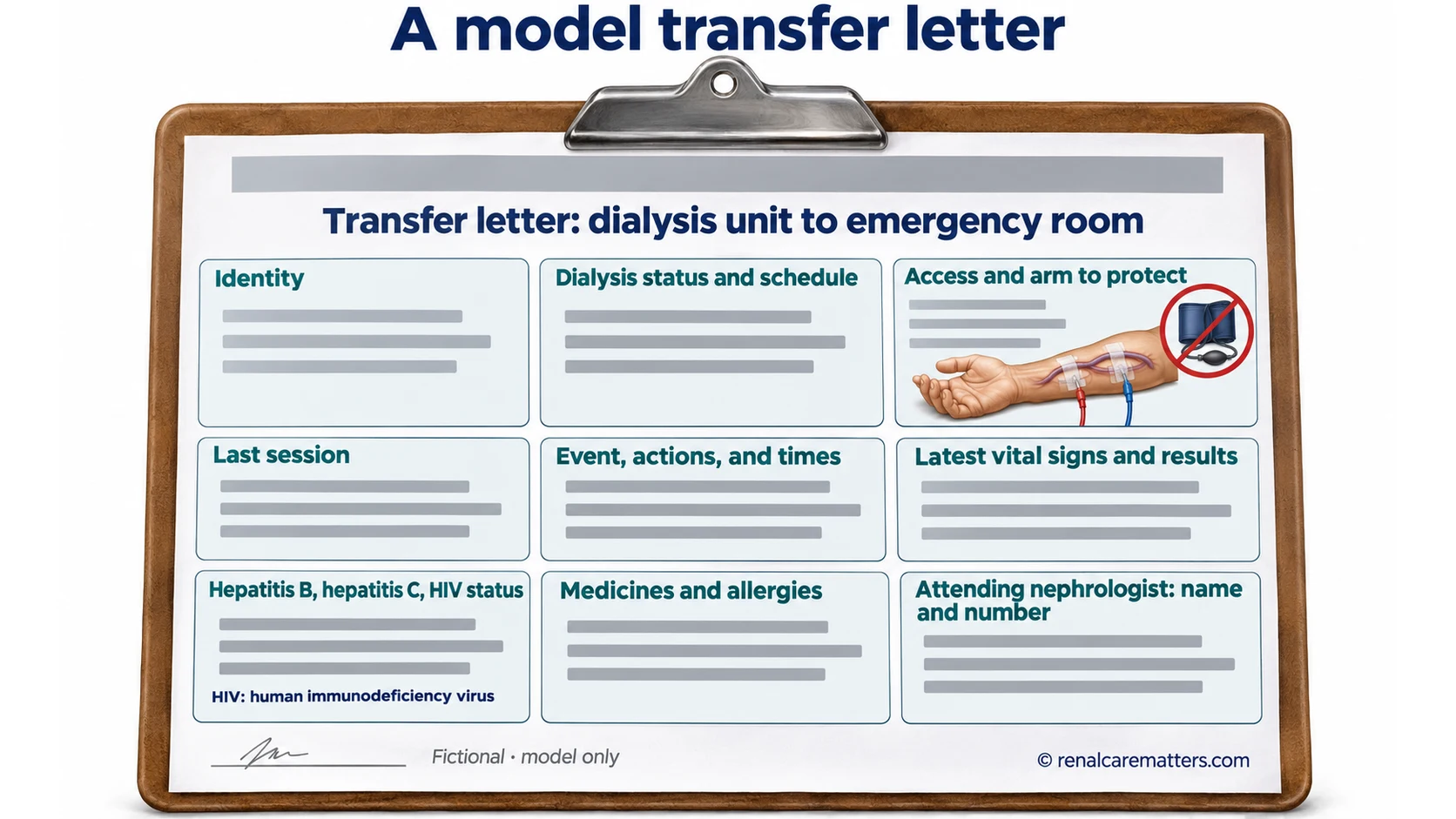
A call reaches one person. A letter travels with the patient to everyone at the receiving end.
Figure 3. A model transfer letter. A receiving physician who has never met the patient should be able to act on it without a telephone call.
Item in the letter
Why the receiving team needs it
Identity, age, and dialysis status and schedule
Tells them the patient has no kidney function and when dialysis is next due
The access, and the arm to protect
Prevents blood pressure cuffs, needles, and lines on the fistula arm
The last session: time on, fluid removed, anticoagulant given
Explains low volume, and warns of bleeding risk after heparin
The event, what was done, and when
Avoids repeating or omitting treatment
Latest vital signs and results, with times
Gives a baseline to compare against
Hepatitis B, hepatitis C, and HIV (human immunodeficiency virus) status
Allows correct isolation if the hospital dialyzes the patient
Medicines and allergies
Prevents harmful prescribing on arrival
The attending nephrologist’s name and number, and yours
Gives them someone to call
Figure 4 · Handoff to the emergency room
CallCall the attending nephrologist before transfer, unless the delay would harm the patient.
ReportCall the receiving emergency room and give an SBAR report.
LetterSend the transfer letter with the patient, with a copy kept in the chart.
ConfirmConfirm that the patient arrived and that the receiving physician has the letter.
DocumentRecord whom you spoke to, at what time, and what was agreed.
Stop and callStop and call the attending nephrologist before any transfer to the emergency room, unless the patient is in cardiac arrest or the delay would harm the patient. In that case, follow your unit’s protocol, have a team member call while you act, or call as soon as the patient has left, and record why you could not call first.
RememberSay it in a structure, send it in writing, and have the receiver repeat it back.
Lesson · part 3
The ten core bedside skills as practice stations
A driving test does not ask you to define a brake. It watches whether you press it at the right moment. Each station asks you to do, not to describe.
How a station works
Each station is an objective structured clinical examination (OSCE) station. It has a fictional scenario, a time limit, a scoring sheet, a set of Critical steps, and a debrief. The OSCE was designed to improve the validity and reliability of performance assessment, which had relied on long and short case examinations.4 A checklist makes the examiner look at the same actions in every learner. A Critical step marks an action whose omission could harm a patient, however well the rest was done.
Each station uses the skills checklist of its source module and tests whether you can perform it in order, on time, and aloud. The emergency content follows the sources each module used, including a core curriculum on hemodialysis emergencies.5,6
Station
Source module
Examples of Critical steps
Time allowed (set by the unit)
1. Fistula or graft examination before cannulation
Module 9
Looks, feels for the thrill, listens for the bruit; names a finding that stops cannulation
2. Catheter exit site and flow check
Module 10
Inspects the exit site and tunnel; recognizes poor flow and states the unit’s next step
3. Safe to start and safe to go home
Module 11
Identifies a patient who should not start; checks standing pressure and the access before discharge
4. Falling pressure and the hypotension ladder
Module 13
Lays the patient back, stops fluid removal, screens for a dangerous cause, calls
5. Electrocardiogram (ECG) for high potassium and arrhythmia, and the code at the chair
Modules 15 and 18
Recognizes the ECG pattern; starts resuscitation and directs the circuit
Stops the blood pump, clamps the lines, does not return the blood when it must not be returned
7. The shivering catheter patient and blood cultures
Module 17
Separates catheter infection from a reaction; starts the fever protocol; calls
8. Bleeding on heparin
Module 19
Controls the bleeding site; reports heparin given; calls
9. Emergency take-off with manual blood return
Module 30
Assigns one staff member to each patient and names who watches the venous line; states when the blood must not be returned
Timed
10. Refusal of treatment and the incident report
Module 31
Checks capacity; explains risks; documents an informed refusal with witnesses
Station 4 uses the session review calculator linked below. Other stations use the site’s corrected QT, sepsis screening, and heparin-induced thrombocytopenia calculators. The sepsis scores were not derived in dialysis patients. Calculators support your judgment. They do not replace it.
The scoring sheet
Step
Critical?
Done
Not done
Assessor’s comment
1. Goes to the chair and checks response, breathing, and pulse
Yes
☐
☐
2. Asks for help and states the problem aloud
No
☐
☐
3. … (the source module’s checklist)
…
☐
☐
Time taken against the unit’s standard
—
Minutes:
Result: pass or repeat. Assessor’s name and signature, date
—
Critical steps are gates, not points
A station passes only when every Critical step is done and the total meets the Medical Director’s standard.
Illustrative station score, not a pass mark. Pass = all Critical steps done AND (steps done ÷ total steps × 100) ≥ the unit’s percentage standard. Station 4 has 12 steps, 4 of them Critical. A learner completes 10 of 12 steps: 10 ÷ 12 × 100 = 83%, with all 4 Critical steps done. Whether that passes depends on the percentage the Medical Director sets. A second learner completes 11 of 12 steps (92%) but misses one Critical step. That learner does not pass, whatever the percentage. What the number tells you: how much of the checklist was done. What it does not tell you: whether the omitted steps mattered. The Critical flag answers that.
Illustrative results at the emergency take-off station (Station 9). 11 steps, 3 of them Critical. Learner A: 10 of 11 = 91%, all 3 Critical steps done. Passes under any percentage standard up to 91%. Learner B: 11 of 11 = 100%, but slower than the unit’s time standard. Repeat the station. Learner C: 9 of 11 = 82%, and missed “names who watches the venous line,” a Critical step. Does not pass. Teaching point: the percentage and the time standard are educational judgments. They should be set by a recognized standard-setting method, not copied from another program.
RememberA station is passed by doing every Critical step, aloud, in order, on time. Knowing the step is not enough.
Lesson · part 4
Why practice beats reading, and what the evidence shows
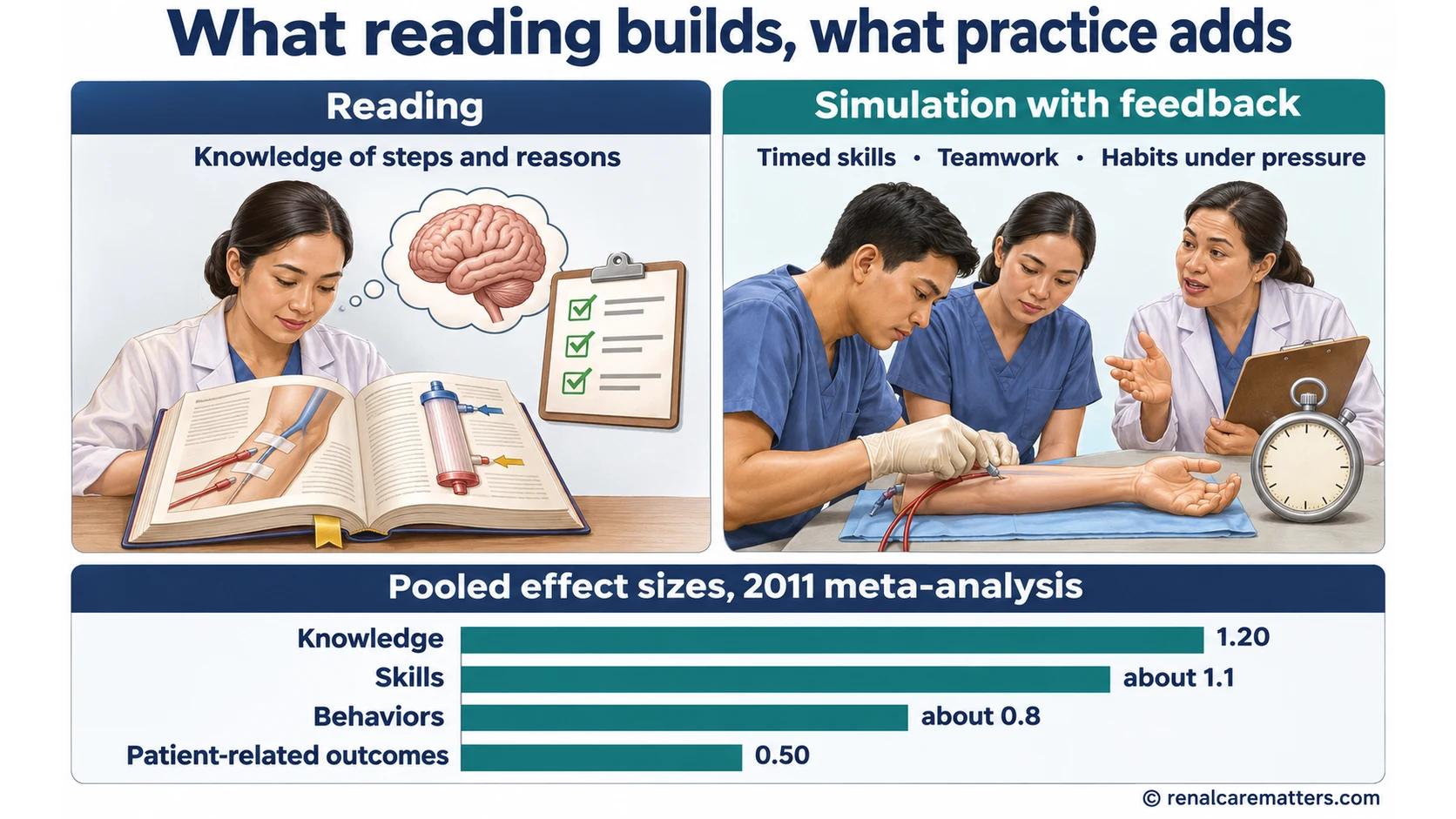
Back to the swimmer. Reading builds a map of the task. Under pressure, people do not consult maps; they do what they have rehearsed. Practice with feedback makes a known sequence automatic, which frees attention for the patient.
The picture has a limit. Practice does not replace understanding. A learner who rehearses steps without the reasons freezes when the case departs from the script. The series put the reasons first. This module adds the rehearsal.
Figure 5. What reading builds and what practice with feedback adds. The effect sizes come from studies comparing simulation with no training, outside dialysis units.
What the studies show
Cook and colleagues pooled 609 studies with 35,226 trainees that compared technology-enhanced simulation with no training. Simulation was associated with large effects on knowledge (pooled effect size 1.20) and on skills (1.09 to 1.18), with effects on behaviors with patients of 0.79 to 0.81, and a moderate effect on direct patient outcomes (0.50, 95% confidence interval [confidence interval (CI)] 0.34 to 0.66). Heterogeneity was large, and 405 of the studies used a single group tested before and after.7 An effect size is a difference expressed in standard deviations. Values near 0.8 or more are conventionally called large.
Beating no training is easy. Does simulation beat ordinary clinical teaching? McGaghie and colleagues pooled 14 studies of simulation with deliberate practice against traditional clinical education. The overall effect size for specific skill acquisition was 0.71 (95% CI 0.65 to 0.76).8 The number of studies was small.
Does any of this reach patients? A community hospital in Chicago required residents to reach a mastery standard on a simulator before inserting central venous catheters in its intensive care unit (ICU). Line infections fell from 3.82 to 1.29 per 1,000 catheter-days. After adjustment for severity of illness, the incidence rate ratio was 0.26 (95% CI 0.09 to 0.74), a 74% reduction.9 This was a before-and-after study at one hospital. Other changes over the same months could have contributed.
Debriefing
Much of the learning happens afterward, in the review. Cheng and colleagues found favorable effects for simulation with debriefing against no intervention across all outcomes (effect sizes 0.28 to 2.16). Video-assisted debriefing made a negligible difference over debriefing without video (0.10). The key features of debriefing were usually reported incompletely, so which method works best remains unclear.10
Resuscitation training
The 2025 American Heart Association (AHA) guideline on resuscitation education is the first full update of its education recommendations since 2020.11
Topic
2025 AHA recommendation
Class and level of evidence
Teamwork training
Life support training for health care professionals should include a specific emphasis on teamwork
Class 1, LOE B-R
Booster sessions
Recommended when training is delivered in a single concentrated course
Class 1, LOE B-R
In situ training
Reasonable in addition to traditional training
Class 2a, LOE C-LD
Rapid-cycle deliberate practice
May be reasonable as part of basic or advanced life support training for health care personnel
Class 2b, LOE C-LD
Scripted debriefing
May be reasonable for instructors
Class 2b, LOE C-LD
LOE means level of evidence: B-R is moderate-quality randomized evidence, and C-LD is limited data. Class 1 is strong; Classes 2a and 2b are weaker.
In situ simulation has a second use. Practicing in the real unit, with the real cart, exposes hidden hazards before a patient meets them. A systematic review of 15 emergency department studies found equipment problems in 83% of studies and teamwork or communication problems in 67%.12 Many studies did not report whether the hazards were fixed. A missing clamp found during practice is a success.
Two limits apply. Knowledge and skill scores are surrogates, not harm avoided. And none of these studies took place in a dialysis unit.
RememberReading tells you what to do. Practice with feedback is how you become able to do it under pressure.
Lesson · part 5
The simulated shift: four problems at once
Picture a nurse at a typhoon evacuation center. Everyone needs help, and every family is right that their need is real. The order in which help arrives decides who is harmed. A full dialysis floor is the same problem in a smaller room.
The logic of the order
The order below is built from the earlier modules and rests on how fast each problem can harm. It is a teaching synthesis, not a validated triage tool.
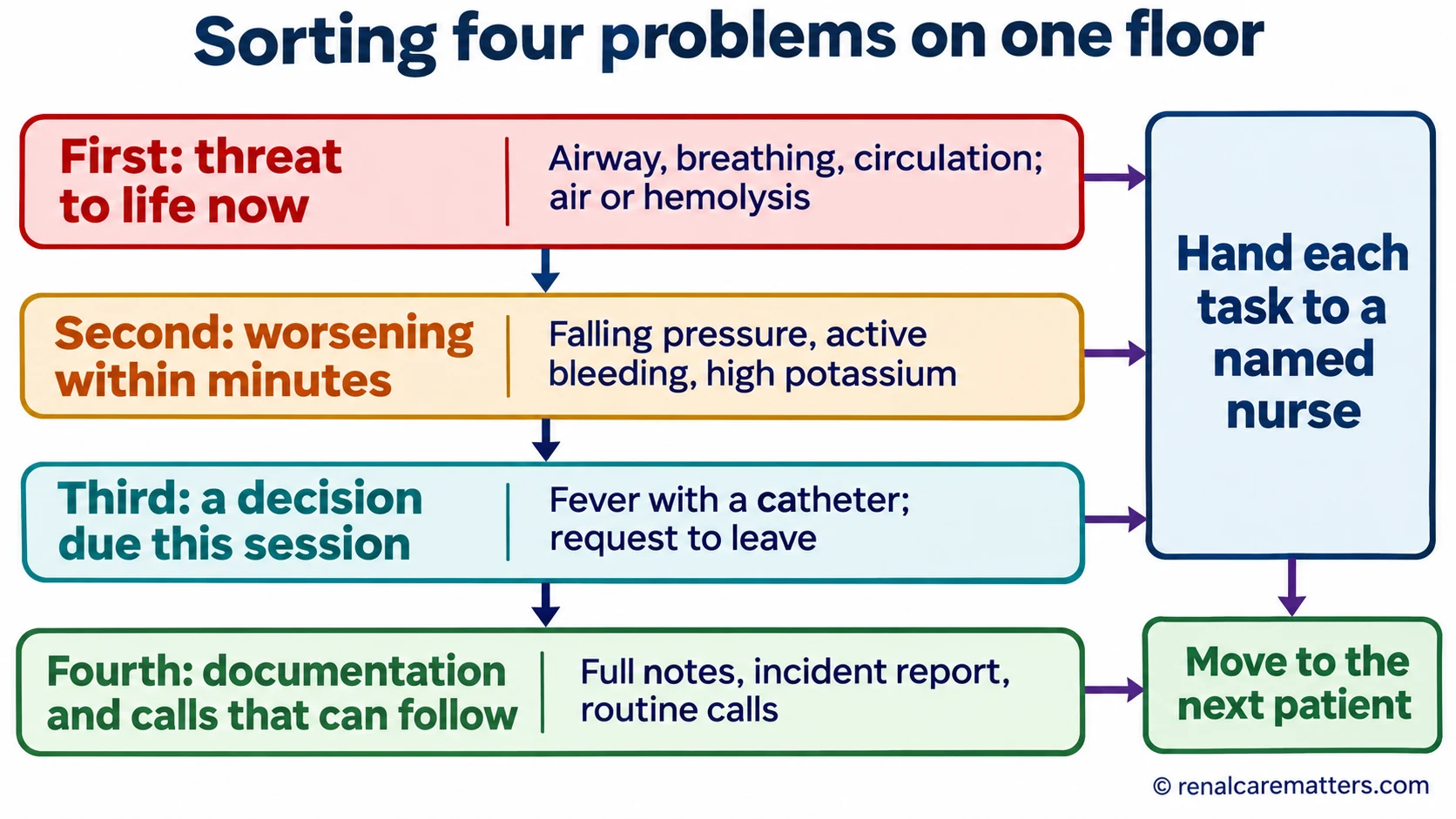
Figure 6. Sorting one shift’s problems: threat to life first, then what worsens within minutes, then what needs a decision this session, then what can wait. Delegate as you move.
Figure 7 · Sorting a full floor
First: threat to life nowAny threat to the airway, breathing, circulation, or consciousness. Any circuit event in which the blood must not be returned: air, hemolysis, a severe dialyzer reaction (Modules 15 and 16).
Second: worsening within minutesA falling pressure, active bleeding, or high potassium with ECG changes (Modules 13, 18, and 19).
Third: a decision due this sessionFever in a patient with a catheter, or a patient asking to leave early (Modules 17 and 31).
Fourth: what can follow within the shiftFull notes, the incident report, and routine calls.
Throughout: delegateHand each protocol step to a named nurse before you move. The nurse continues the protocol while you go to the next patient.
You are not the only pair of hands. Nurses start the first steps of most emergencies under the unit’s protocol. Your job is to confirm, decide, and call. A quick look can also change a tier: a faint patient who turns out to be confused moves up.
The shock index, heart rate divided by systolic pressure, is a quick check of how a patient is coping. The site’s shock index calculator is linked below. A number helps you sort. It does not decide for you.
Worked walk-through
Illustrative walk-through of the opening case, not a protocol. Order: Station 7 (possible air, threat to life) → Station 3 (falling pressure, minutes) → Station 9 (fever with a catheter, decision this session) → Station 12 (request to leave, conversation and consent). Delegated before leaving Station 7: the call to the attending nephrologist, and the hypotension ladder at Station 3. At Station 3, shock index = heart rate ÷ systolic pressure. With an illustrative pulse of 92 and a systolic pressure of 84: 92 ÷ 84 = 1.1. What the shock index tells you: a higher value suggests more circulatory strain and should prompt a closer look. What it does not tell you: the cause, or whether she will recover with first steps. It was not derived in dialysis patients.
How the shift is scored
Colleagues play patients and staff. Four or five events arrive close together. You state aloud what you are doing and why.
Domain
What the preceptor looks for
Critical?
Order of actions
The immediate threat first, with a stated reason for each choice
Yes
Circuit decisions
Blood not returned when it must not be; blood pump stopped and lines clamped
Yes
Delegation
Each protocol step handed to a named nurse before you move
No
Calls
The attending nephrologist called at the right time, in SBAR, with a read-back of the advice
Yes
Orders
Within the prescription, read back, written promptly
Yes
Notes
Event notes with the eight elements of Module 31; an incident report for the air event
No
Debrief
Names one thing to do differently
No
Stop and callDuring the simulated shift, state aloud when you would call the attending nephrologist and what you would say. Follow your unit’s protocol for the first steps of each event. A missed call for any Stop-and-call trigger from Modules 13 to 19 or Module 30 is a failed Critical step.
RememberSort by threat to life, then by speed, then by what must be decided today. Hand off each task to a named person before you move.
Lesson · part 6
The written test, the passport, and what a score means
A learner’s permit is not a driver’s license. Your written test is the permit. Your signed passport, earned while people watched you work, is the license.
The written test
The proposed test has 80 newly written items, sampling every module in proportion to its weight. First-Shift Essentials modules weigh most, because you need them on day one.
Illustrative test blueprint arithmetic. Items for a module = total items × that module’s weight ÷ sum of all weights. Weights: First-Shift Essentials (9 modules) = 2; Core (20 modules) = 1; Advanced (3 modules) = 0.5. Sum of weights = 9 × 2 + 20 × 1 + 3 × 0.5 = 18 + 20 + 1.5 = 39.5. Per Essentials module: 80 × 2 ÷ 39.5 = 4.05, about 4. Per Core module: 80 × 1 ÷ 39.5 = 2.03, about 2. Per Advanced module: 80 × 0.5 ÷ 39.5 = 1.01, about 1. Check: 9 × 4 + 20 × 2 + 3 × 1 = 36 + 40 + 3 = 79. The remaining item goes to an emergency module. What the arithmetic does: it makes the weights explicit. What it does not do: choose them. The weights are the Medical Director’s educational judgment.
Tier
Modules
Weight
Items per module
Items in the tier
First-Shift Essentials
1, 2, 5, 9, 10, 11, 13, 15, 16
2
4
36
Core
3, 4, 6, 7, 8, 12, 14, 17 to 24, 26, 29 to 32
1
2
40
Advanced
25, 27, 28
0.5
1
3
Extra item
One emergency module
—
1
1
Total
32
—
—
80
What a score shows
A written score shows study, not competence. The cut score, proposed at 80%, is an educational judgment for a recognized standard-setting method. Competence is shown at the stations and on supervised shifts.
Ten Cate proposed that competency-based training rest on entrustment: a decision, made by people who have watched the work, that a trainee can carry out a professional activity without supervision.13 The passport records those decisions.
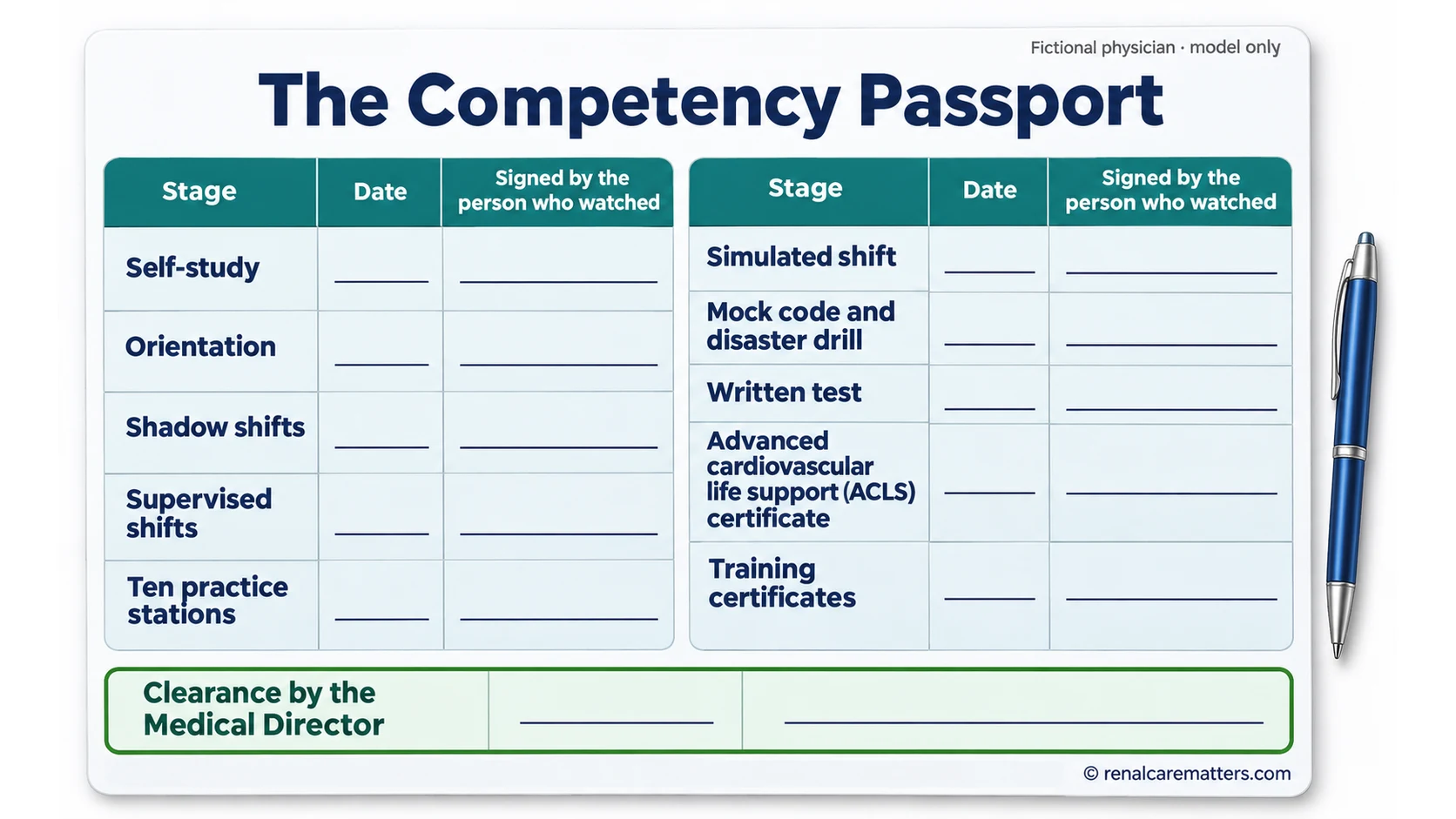
Figure 8. The Competency Passport. Each line is signed by a person who watched the work, not by the learner.
The Competency Passport
The passport is one page. It lists the skills checklists from each module, the ten stations, the simulated shift, the mock code and disaster drill, and the written test. It carries the advanced cardiovascular life support (ACLS) certificate that the Department of Health (DOH) licensing order for dialysis facilities, Administrative Order (AO) 2012-0001, requires of physicians on duty.14 It also carries the training certificates set out in the Philippine Society of Nephrology (PSN) guidelines for hemodialysis clinics.15 Each line has a date and a signature.
RememberA written score shows that you studied. A signature from someone who watched you work shows that you can do it.
Lesson · part 7
Clearance for independent duty
Before a new bridge opens, an engineer inspects it against a standard and signs. Clearance for independent duty works the same way.
Figure 9 · From self-study to clearance
Self-studyThe 32 modules, with each module’s self-assessment.
OrientationThe unit, its protocols, its emergency cart, and its staff.
Shadow and supervised shiftsYou work beside an experienced physician on duty, then under supervision.
Mock code and disaster drillRun in the unit with the team you will work with.
Stations and simulated shiftAll Critical steps satisfactory.
Written testPassed at the cut score the Medical Director sets.
ClearanceThe Medical Director signs the passport.
The code station and the mock code follow the current AHA guidelines for basic life support and for systems of care.16,17 The figure below, from the site’s emergency series, shows what the team leader directs in the first minutes.
Figure 10. The first five minutes of a cardiac arrest in a dialysis unit. The team leader directs both resuscitation and what happens to the circuit.
Skills fade without use. Keep the passport current, and ask for a repeat station after a long absence or a serious event in which you were involved. A repeat is not a penalty.
What is uncertain
Figure 11 · Honest limits of this module
No dialysis dataNo study of simulation training for physicians on duty in dialysis units was found. Every effect estimate here is borrowed from other settings.
SurrogatesMost simulation evidence measures knowledge and skill scores. Patient-outcome evidence comes mostly from before-and-after studies.
Standards are judgmentsPass marks, time standards, and the written-test cut score are educational judgments, to be set by a recognized standard-setting method.
DebriefingWhich debriefing method works best is unclear.
The sorting logicThe order in the simulated shift is a teaching synthesis of earlier modules, not a validated triage tool.
RememberClearance is a signature from people who watched you work. Keep it current, and ask for a repeat when you have been away.
On the floor
Real situations: problems and solutions
These are fictional but typical. For each one, cover the answer, decide what you would do, then compare. Where a step depends on local rules, your unit’s procedure and your supervisor’s direction come first.
The order nobody carried out
What you see
At 4:30 p.m. you review the chart of Mr. Danilo Santos before he leaves. An order you gave aloud at 1:15 p.m., during a busy hour, does not appear in the nurse’s record. No one remembers who heard it.
What is likely going on
A verbal order given across the floor without a read-back and never written down. Omission is the most common medication error reported in dialysis units.
What to do
Check whether the order is still needed and safe now. If it is, write it, have it read back, and confirm it is given. Tell the attending nephrologist if the delay may matter, and record what happened.
Why it matters
An order that exists only in your memory has not been given. Read-back and prompt writing close the gap.
The emergency room calls back
What you see
An hour after you transferred Mrs. Teresita Dizon with chest pain, the emergency room physician calls. They do not know when she last dialyzed or which arm carries her fistula, and they have placed an intravenous line in that arm.
What is likely going on
The patient went without a transfer letter, or the letter left out the access and the last session.
What to do
Give the missing facts by telephone now, in SBAR, and ask that the line be moved if the hospital’s staff judge it safe. Send the written letter. Inform the attending nephrologist and record the call.
Why it matters
Information that does not cross the bridge is lost. A letter travels with the patient even when no one answers the telephone.
A station passed by points
What you see
During practice, a colleague completes 11 of 12 steps at the circuit failure station in good time. She returns the blood after a hemolysis scenario because the patient’s pressure was low.
What is likely going on
She knows the steps but missed the one that matters most: hemolyzed blood is not returned.
What to do
The preceptor records a repeat. In the debrief, she explains why returning the blood would harm the patient, then repeats the station.
Why it matters
Critical steps are gates. A high score with a missed Critical step does not show safe practice.
Two calls at once
What you see
At 7:40 p.m., a patient’s potassium result returns high, and the nurse reports peaked T waves on the monitor. At the same moment, another patient’s needle site oozes under pressure after heparin.
What is likely going on
Both problems can worsen within minutes. The potassium with ECG changes threatens the heart rhythm. The oozing site is usually controlled by firm pressure.
What to do
Ask a named nurse to hold firm pressure on the oozing site and report back. Go to the potassium patient, obtain the ECG, start the unit’s protocol, and call the attending nephrologist. Then reassess the bleeding site.
Why it matters
Delegation lets two urgent problems be handled at once. Each task needs a named person and a time to report back.
The empty oxygen tank
What you see
During an in situ practice code on a quiet Saturday, the team finds that the spare oxygen tank on the emergency cart reads empty.
What is likely going on
A latent safety threat: a hazard that has not yet harmed a patient.
What to do
Stop the drill long enough to replace the tank. Report the finding to the charge nurse and the Medical Director, and add a check of the tank to the unit’s routine.
Why it matters
Finding a hazard during practice is a success. In situ simulation finds equipment problems more often than any other kind.
Field notes
Write each verbal order into the chart before you leave the floor, even when the event is over.
Keep a blank transfer letter in the emergency folder, already headed with the unit’s name and the attending nephrologist’s number.
When you delegate, use a name and a task: “Nurse Ana, lay Station 3 back and stop fluid removal, then tell me the pressure.”
Ask your preceptor to run one station in your own unit during a quiet hour each month.
Bring your passport to every supervised shift. A signature you forget to collect does not exist.
Case review
Back to the case: A full floor
In what order, and what do you delegate first? Station 7 first. Foam in the venous drip chamber, an air detector alarm, and a coughing patient mean possible air embolism, an immediate threat to life. You confirm that the blood pump has stopped and the venous line is clamped, and you position Mr. Cruz and give oxygen as Module 16 describes. Before you leave him, you delegate twice: Ms. Ramos calls the attending nephrologist now, and a named nurse starts the hypotension ladder at Station 3. Station 3 comes second, because a falling pressure can worsen within minutes. Station 9 comes third: fever with rigors in a catheter patient needs a decision this session, and the fever protocol starts now. Station 12 comes last. Mr. Garcia is stable, and his request needs a calm conversation.
Blood returned or not, and which sessions continue? The blood is not returned at Station 7, because air may remain in the venous line. The circuit is kept for inspection. At Station 3, the session usually continues once the pressure recovers, and the attending nephrologist decides the remaining fluid goal. At Station 9, the nephrologist decides whether the session continues. If it ends, the circuit is sound, and no cluster or contaminated fluid is suspected, the blood is returned per protocol (Module 17). At Station 12, Mr. Garcia may leave after an informed refusal that covers the risk of leaving above his dry weight, with a normal blood return.
Whom do you call, and what do you write? The attending nephrologist hears about Station 7 first, at once. A combined SBAR update on Stations 3, 9, and 12 follows after you have examined each patient. If Mr. Cruz needs transfer, you call before he leaves and send a transfer letter with him. Afterward you write a timed event note for each patient, an incident report for the air event, and the informed refusal form for Mr. Garcia, signed by witnesses.
Skills lab · with your preceptor
Skills checklist: The simulated shift, scored by the preceptor
Run this shift with your preceptor and two colleagues playing patients and nurses. State aloud what you are doing and why. The preceptor scores each step. Your preceptor rates each step as satisfactory, needs practice, or not observed. Steps marked Critical must all be satisfactory before sign-off. This checklist supports supervised learning; your unit’s own procedure and competency form are the authority. A printable version of every checklist is on the trainer page.
CriticalReceives the four reports and states aloud the order of response with a reason for each.
CriticalGoes first to the patient with an immediate threat (possible air embolism) and confirms that the pump is stopped, the line clamped, and the blood not returned.
Delegates the hypotension ladder to a named nurse before leaving that patient.
CriticalExamines the hypotensive patient and screens for a dangerous cause (Module 13).
CriticalRecognizes fever with a catheter and starts the unit’s protocol.
CriticalCalls the attending nephrologist at the right time with an SBAR report.
Conducts the refusal conversation, checks capacity, and documents an informed refusal with witnesses.
CriticalWrites clear, timed orders within the prescription and reads back verbal orders.
Prepares a transfer letter that a receiving physician could act on.
Writes event notes containing the eight elements of Module 31.
Completes an incident report for the air event.
Takes part in the debrief and names one thing to do differently.
Placement activity. Over your supervised shifts, complete all ten stations and one simulated shift with a preceptor. Run at least one station in situ, in your own unit with its real equipment, and report any hazard you find to the charge nurse. Bring your passport to each session for signature.
Self-assessment
Check your understanding
Each visit draws 8 questions at random from this module’s 15-question bank. Choose the single best answer for each, then select Check answers; an explanation appears under the best answer. Select New set of questions for a different mix. A good target is 7 of 8 on two different sets. Nothing you select is sent anywhere; scoring happens in your browser.
Holley, J. L. (2006). A descriptive report of errors and adverse events in chronic hemodialysis units. Nephrology News & Issues, 20(12), 57–58, 60–61, 63 passim. https://pubmed.ncbi.nlm.nih.gov/17125098/
Müller, M., Jürgens, J., Redaèlli, M., Klingberg, K., Hautz, W. E., & Stock, S. (2018). Impact of the communication and patient hand-off tool SBAR on patient safety: A systematic review. BMJ Open, 8(8), e022202. https://doi.org/10.1136/bmjopen-2018-022202
Starmer, A. J., Spector, N. D., Srivastava, R., West, D. C., Rosenbluth, G., Allen, A. D., Noble, E. L., Tse, L. L., Dalal, A. K., Keohane, C. A., Lipsitz, S. R., Rothschild, J. M., Wien, M. F., Yoon, C. S., Zigmont, K. R., Wilson, K. M., O’Toole, J. K., Solan, L. G., Aylor, M., . . . Landrigan, C. P. (2014). Changes in medical errors after implementation of a handoff program. New England Journal of Medicine, 371(19), 1803–1812. https://doi.org/10.1056/NEJMsa1405556
Khan, K. Z., Ramachandran, S., Gaunt, K., & Pushkar, P. (2013). The Objective Structured Clinical Examination (OSCE): AMEE Guide No. 81. Part I: An historical and theoretical perspective. Medical Teacher, 35(9), e1437–e1446. https://doi.org/10.3109/0142159X.2013.818634
Greenberg, K. I., & Choi, M. J. (2021). Hemodialysis emergencies: Core curriculum 2021. American Journal of Kidney Diseases, 77(5), 796–809. https://doi.org/10.1053/j.ajkd.2020.11.024
Daugirdas, J. T., Blake, P. G., & Ing, T. S. (Eds.). (2015). Handbook of dialysis (5th ed.). Wolters Kluwer.
Cook, D. A., Hatala, R., Brydges, R., Zendejas, B., Szostek, J. H., Wang, A. T., Erwin, P. J., & Hamstra, S. J. (2011). Technology-enhanced simulation for health professions education: A systematic review and meta-analysis. JAMA, 306(9), 978–988. https://doi.org/10.1001/jama.2011.1234
McGaghie, W. C., Issenberg, S. B., Cohen, E. R., Barsuk, J. H., & Wayne, D. B. (2011). Does simulation-based medical education with deliberate practice yield better results than traditional clinical education? A meta-analytic comparative review of the evidence. Academic Medicine, 86(6), 706–711. https://doi.org/10.1097/ACM.0b013e318217e119
Barsuk, J. H., Cohen, E. R., Potts, S., Demo, H., Gupta, S., Feinglass, J., McGaghie, W. C., & Wayne, D. B. (2014). Dissemination of a simulation-based mastery learning intervention reduces central line-associated bloodstream infections. BMJ Quality & Safety, 23(9), 749–756. https://doi.org/10.1136/bmjqs-2013-002665
Cheng, A., Eppich, W., Grant, V., Sherbino, J., Zendejas, B., & Cook, D. A. (2014). Debriefing for technology-enhanced simulation: A systematic review and meta-analysis. Medical Education, 48(7), 657–666. https://doi.org/10.1111/medu.12432
Donoghue, A. J., Auerbach, M., Banerjee, A., Blewer, A. L., Cheng, A., Kadlec, K. D., Lin, Y., Diederich, E., Sawyer, T., Stallings, D. T., Toft, L. E. B., Torman, D., Wright, J. I., Schexnayder, S. M., & Dainty, K. N. (2025). Part 12: Resuscitation education science: 2025 American Heart Association guidelines for cardiopulmonary resuscitation and emergency cardiovascular care. Circulation, 152(16 Suppl. 2), S719–S750. https://doi.org/10.1161/CIR.0000000000001374
Grace, M. A., & O’Malley, R. (2024). Using in situ simulation to identify latent safety threats in emergency medicine: A systematic review. Simulation in Healthcare, 19(4), 243–253. https://doi.org/10.1097/SIH.0000000000000748
Kleinman, M. E., Buick, J. E., Huber, N., Idris, A. H., Levy, M., Morgan, S. G., Nassal, M. M. J., Neth, M. R., Norii, T., Nunnally, M. E., Rodriguez, A. J., Walsh, B. K., & Drennan, I. R. (2025). Part 7: Adult basic life support: 2025 American Heart Association guidelines for cardiopulmonary resuscitation and emergency cardiovascular care. Circulation, 152(16_suppl_2), S448–S478. https://doi.org/10.1161/CIR.0000000000001369
Dezfulian, C., Cabañas, J. G., Buckley, J. R., Cash, R. E., Crowe, R. P., Drennan, I. R., Mahgoub, M., Mannarino, C. N., May, T., Salcido, D. D., Uzendu, A. I., Vogelsong, M. A., Worth, J. A., & Girotra, S. (2025). Part 4: Systems of care: 2025 American Heart Association guidelines for cardiopulmonary resuscitation and emergency cardiovascular care. Circulation, 152(16_suppl_2), S353–S384. https://doi.org/10.1161/CIR.0000000000001378
Educational study material for physicians. Does not replace the attending nephrologist’s orders, the unit’s protocols, required certification courses, or supervised practice.