The rules that govern dialysis units, what a physician signs, consent, data privacy, sound records, and how a unit measures its quality.
PublishedNailathalaGipatikPepalwal:ReferencesMga SanggunianMga TinubdanReng Reperensya:20Audience: Physicians who cover hemodialysis shifts · attending nephrologists, medical directors, and head nurses who orient themRead timeOras ng pagbasaOras sa pagbasaOras ning pamamasa:
This module is study material for physicians on duty in hemodialysis units. It explains the reasoning behind common decisions; it is not a protocol. At the chairside, follow your unit’s protocol and ask the attending nephrologist for guidance. Doses and cut-off values are set by your unit. Every case is fictional.
Learning objectives
After this module you should be able to
Outline who regulates a Philippine hemodialysis facility and state what the Department of Health licensing order expects of a physician on duty.
Obtain, witness, and document consent and informed refusal, using the four elements the Supreme Court set out for informed consent.
Protect patient data under the Data Privacy Act and the unit’s privacy procedures.
Write session notes, event notes, certificates, and abstracts that state facts, times, actions, and calls, and sign only what you have verified.
Name the main quality indicators of a dialysis unit, read a run chart, and explain what a rate per 100 patient-months means.
Report an incident or near miss, take part in a root cause review, and describe one Plan-Do-Study-Act cycle with a dialysis example.
Pre-testBefore you read, answer the 8 self-assessment questions and note your score. After the module, select New set of questions and compare. The difference is what you learned; the questions you still miss are what to reread.
Start here
The big picture, in plain words
In plain wordsThink of a jeepney route. One agency grants the franchise for the route. Another licenses the driver and registers the vehicle. The barangay decides where the stops are. Each body checks a different thing, and the driver answers to all of them at once. A dialysis unit works the same way: several bodies each check one part of what happens on your shift.
The picture has a limit. In health care the bodies overlap, their rules leave gaps, and your professional duty to the patient applies even where no rule is written. The rules set the floor.
Every session ends with signatures: on the treatment sheet, the progress note, and sometimes a certificate, an abstract, or a refusal form. Each is read later by someone who was not there: an insurer, a court, a receiving hospital, or a quality review. Errors and adverse events in dialysis units are common enough to count. One report from four units found 88 of them in 64,541 treatments, about one every 733 treatments.1
Figure 1 · Key terms for this module
Licensing orderThe Department of Health (DOH) administrative order that sets the minimum standards a dialysis facility must meet to operate.
Informed refusalA patient’s decision to decline or stop a treatment after the risks of declining have been explained in words the patient understands.
Sensitive personal informationUnder the Data Privacy Act, a class of personal data that includes health information. It carries stricter rules on sharing.
Event noteA timed entry in the chart that records what happened, what was done, the response, and who was called.
Quality indicatorA measure tracked over time to show how well a unit cares for its patients, such as the infection rate.
Run chartA graph of a measure in time order with its median drawn as a line, used to tell a real change from noise.
Near missAn error or hazard that was caught before it reached the patient.
Plan-Do-Study-Act (PDSA) cycleA small, planned test of one change, measured and then kept, adapted, or abandoned.
Most of what you sign is routine and true. A few signatures certify things you did not see, and a few events never reach the logbook. Your work is to sign only what you verified, to record events so a stranger can follow them, and to bring what you see to the unit’s quality review.
Opening case · fictional
Case: “Please sign the form, Doc”
It is Friday, 6:40 p.m., at the end of the second shift in a 15-station unit in Angeles City. Mr. Danilo Mendoza, 49, asked to come off at hour two of his four-hour session because his ride home was leaving. His pre-dialysis potassium this week was 6.1 mmol/L, and he arrived today 3.2 kilograms above his dry weight. These values are illustrative.
The nurse, Ms. Arlene Pangilinan, hands you three papers. The first is a “Refusal of Treatment” form, already filled in with “patient refused” and a blank line for your signature. The second is a medical certificate his employer requested, stating that he “completed dialysis today.” The third is the incident log, where she has written that his venous needle infiltrated at hour one and was replaced. The attending nephrologist has not been called. Mr. Mendoza is already standing.
Before reading on, decide:
What must you do and document before you sign the refusal, and who should witness it?
Can you sign the certificate as written, and what would you write instead?
What goes into the incident log about the infiltration, and is this also a near miss worth reviewing?
Keep your answers in mind. The lesson gives you what you need, and the case review near the end shows one sound response.
Lesson · part 1
Who regulates what
Module 1 set out your role. This section names the rules behind it.
Body
What it governs
What it checks in your unit
Department of Health (DOH)
Licensing of the facility. Administrative Order (AO) 2012-0001 for dialysis facilities2 and AO 2013-0003 for dialysis water3
Staff, equipment, water, records, and quality systems
Philippine Health Insurance Corporation (PhilHealth)
The hemodialysis benefit, accreditation, and claims, set by circular4
Whether the sessions claimed match the records
National Privacy Commission (NPC)
Personal data under the Data Privacy Act5 and breach management6
How patient information is handled
Professional Regulation Commission (PRC)
Your license to practice
That you are licensed
Philippine Society of Nephrology (PSN)
A public professional standard for hemodialysis clinics, 3rd edition, 20247
Good practice. A standard, not a law
What the licensing order expects of you
AO 2012-0001 is the licensing order for dialysis facilities.2 It lists what the physician on duty must be. You attend to patients under the supervision of the Medical Director. You are licensed by the PRC and hold one of the qualifying credentials the order lists. You have experience in the care of patients with end-stage kidney disease. You have updated training in advanced cardiovascular life support (ACLS). You are present during the unit’s hours of operation.2 The order states that the ratio of physician on duty to hemodialysis stations “shall not be more than 1:15.”2 The order also limits a Medical Director to three facilities and requires an adverse events logbook and a continuous quality improvement (CQI) system.2
The PSN standard states that the ratio of physician on duty to stations is ideally 1:15, and that where physicians on duty are few in the area, a maximum of 1:20 is allowed “as long as he/she is able to adequately attend to the needs of the patients.”7
Requirement
DOH licensing order (the legal floor)
PSN standard (good practice)
Presence
Present during hours of operation
Able to attend adequately to the patients’ needs
Resuscitation
Updated ACLS training
Updated ACLS certificate from a DOH-accredited provider
Stations per physician on duty
Not more than 1:15
Ideally 1:15. Up to 1:20 where physicians on duty are few, if the patients’ needs are met
Where the two differ, the DOH order is the law and the PSN standard is advice. On staffing, the PSN allowance of up to 1:20 does not lift the order’s limit of 1:15. Your Medical Director sets the unit’s rule within the order and can show you the current licensing documents.
PhilHealth sets its hemodialysis benefit by circular. Circular 2024-0023 adjusted the package for members and their qualified dependents with chronic kidney disease stage 5, effective October 9, 2024.4 Benefit rules change often, so this module does not quote them. Your unit’s claims officer is the source for the rules in force.
RememberThe DOH order is the floor, not the goal. Know what it requires of you by name: present, licensed, experienced, ACLS current, and supervised by the Medical Director.
Lesson · part 2
What you sign, and what each signature certifies
A signature is a promise in ink. It says “I saw this,” “I did this,” or “I checked this.” A later reader takes it as a statement of fact.
Document
What your signature certifies
Who usually signs
Session record or progress note
You assessed the patient at the time written
The physician on duty
An order during the session
You take responsibility for the instruction, within the attending nephrologist’s prescription
The physician on duty, often after a call
Medical certificate
You examined the patient and every statement on it is true
The physician who examined the patient
Clinical abstract
It summarizes the chart accurately
Usually the attending nephrologist
Transfer or referral letter
The receiving physician can act on what it says
The physician on duty, with the attending nephrologist’s plan
Refusal or against-advice form
The risks were explained and the patient declined
The patient, the physician who explained, and witnesses
How a documentation error becomes a false statement
A form arrives pre-filled, the shift is ending, and the family is waiting. You sign without reading, sign for a session you did not witness, or back-date an entry. A missing entry is a gap in the record. A signed entry that is untrue is a false statement, and it carries your license number.
Read every document before you sign it. Sign only what you personally verified. When you summarize another clinician’s findings, write “per chart” or name the source. Refer requests outside your role, such as a disability certification, to the attending nephrologist.
Stop and callStop and call the attending nephrologist or the Medical Director when you are asked to sign a document about care you did not provide or a finding you did not verify, or when the document’s purpose is a claim, a legal matter, or a death. Follow your unit’s protocol on who signs what.
Lesson · part 3
Consent and refusal
Consent is like a map handed over before a trip. The patient sees where each road leads, including the road of doing nothing, and then chooses. The map is yours to draw. The choice is the patient’s.
What the law asks
In Li v. Spouses Soliman (G.R. No. 165279, en banc, June 7, 2011), the Supreme Court set out four elements of a malpractice claim based on informed consent: the physician had a duty to disclose material risks; the physician failed to disclose them or disclosed them inadequately; as a direct result, the patient consented to treatment he or she would otherwise have refused; and the patient was injured by it.8
The ruling turns on disclosure of material risks. For dialysis, these include the risks of declining treatment. The PSN standard asks that dialysis consent be updated at least annually and as needed, and that the consent form preferably be witnessed by two people who also sign it.7
Who consents, and to what
A patient with decision-making capacity consents for himself or herself. Capacity means the patient can understand the information, weigh it, and communicate a choice. When a patient lacks capacity, a representative decides, as your unit’s policy directs. Blood transfusion and catheter insertion usually need their own consent.
Refusal is a decision, and it is documented like a procedure
A competent adult may refuse a session, shorten one, or leave against advice. Your job is to make sure the refusal is informed and that the record shows it. For a patient with a high potassium, plain words mean saying that the heart can stop.
Figure 2 · Consent and refusal at the chair
Check capacityCan the patient understand, weigh, and communicate a choice? If not, involve the representative per the unit’s policy.
Explain in plain wordsThe treatment, the main risks, the alternatives, and the risks of declining. Use the patient’s language.
Ask the reasonA ride, a cost, a symptom, or a fear can often be solved.
Hear the decisionLet the patient say it in his or her own words.
WitnessHave the form witnessed as your unit’s policy requires. The PSN standard prefers two witnesses who also sign.
CallTell the attending nephrologist before the patient leaves if you can, and agree on the follow-up plan.
DocumentWhat was explained, the risks named, the patient’s words, the witnesses, the call, and the plan.
A pre-filled form that says only “patient refused” documents none of this. Withdrawal from dialysis altogether is a different conversation, covered in Module 26.
RememberAn informed refusal is documented like a procedure: what was explained, what the patient said, who witnessed it, and who was called.
Lesson · part 4
Patient data and privacy
A patient’s chart is like a house key. You give a copy only to people who live in the house. A copy sent to the wrong person cannot be called back.
Republic Act 10173, the Data Privacy Act of 2012, governs personal information. Health information falls in its stricter class of sensitive personal information.5 NPC Circular 16-03 governs personal data breaches. It requires the organization responsible for the data to notify the Commission and the affected patients within 72 hours of knowing of a breach that requires notification, and it gives the response to a breach response team that keeps the data protection officer informed.6 You do not decide whether a breach meets that test. You report it at once so that the people who do decide have their full 72 hours.
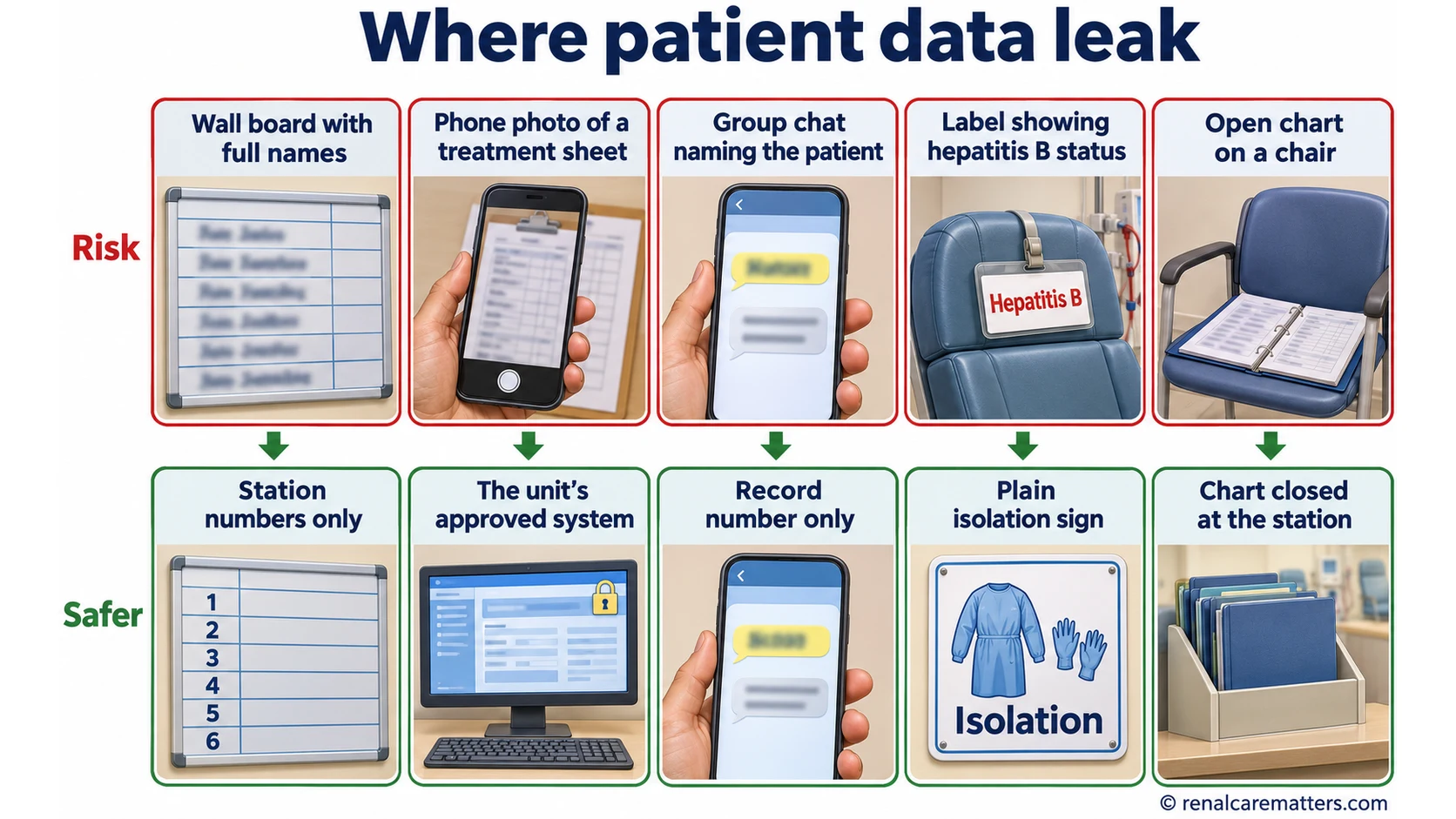
Where dialysis units leak data
Patients sit together for hours, for years. Staff coordinate by phone. Serology status decides where a patient sits. Each habit is useful, and each can expose a patient.
Figure 3. Five ways patient data leak in a dialysis unit, and the safer practice for each.
Risk
How it exposes a patient
Safer practice
Patient board on the wall
Full names, diagnoses, or schedules visible to every visitor
Initials or station numbers, per the unit’s policy
Photos of the treatment sheet
Images stay on personal phones and in cloud backups
The unit’s approved channel for images and results
Group chats
Names and laboratory results reach people with no need to know
Minimum information, the approved channel, no names where a record number will do
Station labels
Hepatitis B, hepatitis C, or human immunodeficiency virus (HIV) status visible to other patients
Isolation signs that follow infection control rules without naming the infection, per the unit’s policy
Open charts
A chart left on a chair can be read by the next patient’s family
Charts closed and returned to the station
When you suspect a breach, such as a lost phone or a message sent to the wrong group, report it to the data protection officer and the Medical Director at once.
RememberShare the least, with the fewest, through the approved channel. Report a suspected breach the moment you know of it.
Lesson · part 5
Notes that hold up
Write every note for a stranger who will read it at 3 a.m. or in a courtroom two years later. That reader cannot ask you what you meant.
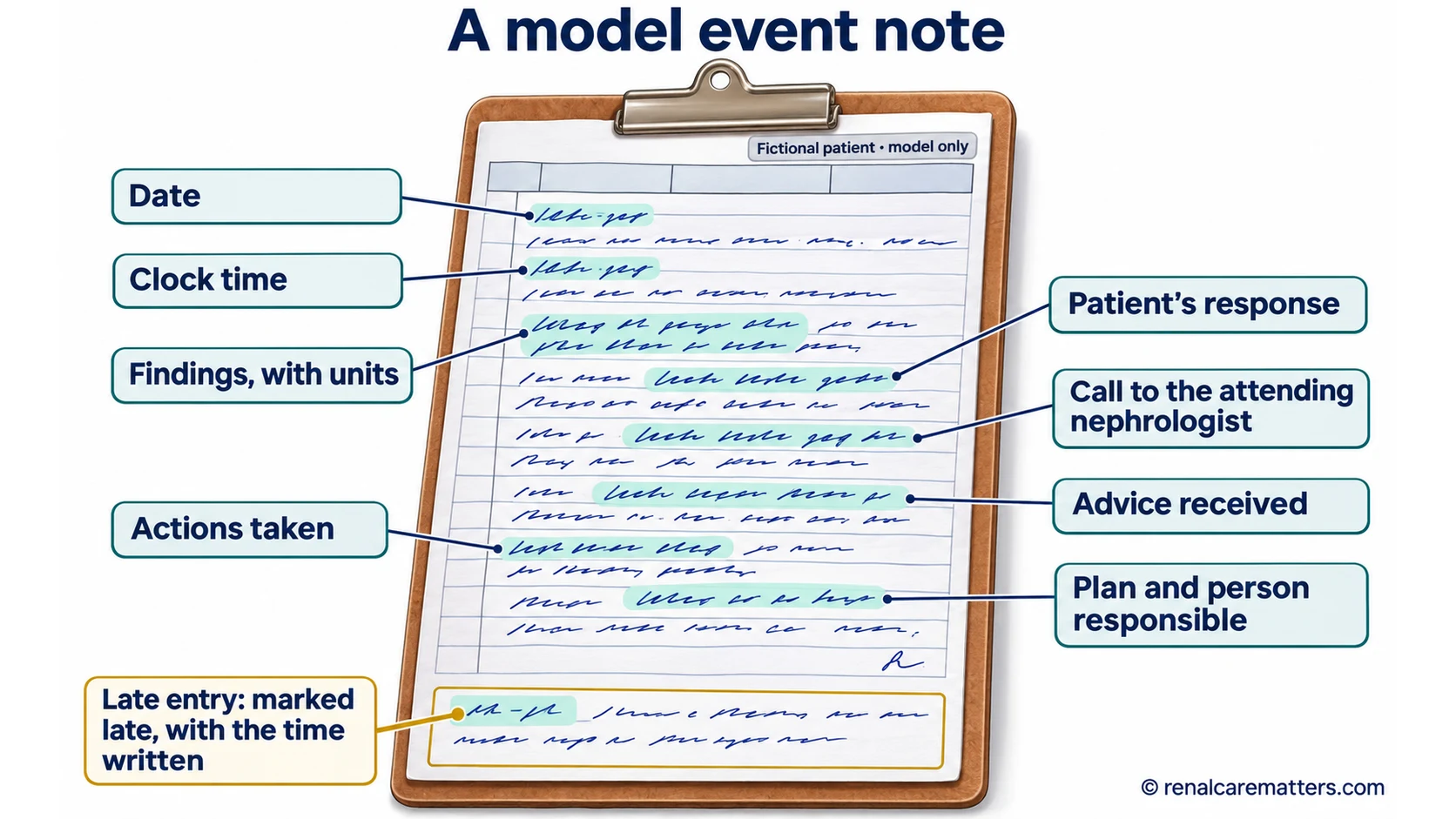
AO 2012-0001 requires confidential records that identify the patient, and an adverse events logbook.2 The PSN standard requires complete records for every patient.7 Neither says how to write a good note. The elements below come from what a later reader needs.
Figure 4. A model event note. Each of the eight elements answers a question a later reader cannot ask you.
Element
What to write
Why a later reader needs it
Date and clock time
The time of the event and the time of the entry
Sets the order of events
Findings
Vital signs with units, symptoms, the access, the machine readings that matter
Shows what you knew when you acted
Actions
What was done, by whom, and when
Shows the response was timely
Response
What changed after each action
Shows whether the plan worked
Call made
Whom you called and when
Shows escalation
Advice received
What the attending nephrologist advised
Shows who decided what
Plan and owner
What happens next and who is responsible
Lets the next shift continue
Signature
Your name, signature, and license number per the unit’s format
Shows who wrote it
Label late entries as late, with the time written. Never insert them to look contemporaneous. Correct errors with a single line, dated and initialed.
What the evidence on structured communication shows
In a prospective study of a pediatric resident handoff program in nine hospitals, covering 10,740 admissions, medical errors fell from 24.5 to 18.8 per 100 admissions and preventable adverse events from 4.7 to 3.3 per 100 admissions after standardized written and oral handoffs were introduced.9 The design was before and after, without a control group, and the setting was not dialysis. Module 1 reviews the Situation-Background-Assessment-Recommendation (SBAR) format. A systematic review of eleven studies, eight of them before-and-after designs, found moderate evidence that SBAR improves patient safety, most clearly for telephone calls, and noted a lack of high-quality research.10
In dialysis, a mailed survey of 422 nurses in outpatient units found that negative ratings of handoff safety were associated with frequent access thrombosis and patient complaints.11 The survey was cross-sectional and relied on nurses’ reports, so it shows an association and not that better handoffs prevent clotting.
Illustrative documentation check, not a target. Score one of your own event notes for eight elements: date, time, findings, actions, response, call made, advice received, and plan with owner. Note with 6 of 8 elements: 6 ÷ 8 = 0.75, or 75%. Five notes scoring 8, 6, 7, 5, and 7: mean = 33 ÷ 5 = 6.6 of 8; 6.6 ÷ 8 = 82.5%. The element most often missing in this example: advice received. This is a teaching checklist; no validated score exists for dialysis notes. The number shows which element you drop, not whether a note would satisfy a court.
RememberA good event note answers six questions for a stranger: when, what you saw, what you did, what changed, whom you called, and what happens next.
Lesson · part 6
How a unit measures itself
A pilot reads an instrument panel. No single gauge says the flight is going well; together, watched over time, they do. A unit reads its quality the same way.
Figure 5. An illustrative quality dashboard. Trends over time tell you more than any single result.
The main indicators, and what each measures
A surrogate is a laboratory value or process measure expected to track an outcome. An outcome is what patients feel: death, admission, infection. A unit can improve a surrogate without improving the outcome.
Indicator
What it measures
Surrogate or patient outcome
Delivered dose: single-pool Kt/V or urea reduction ratio (URR)
How much urea each session removes, as set out in the Kidney Disease Outcomes Quality Initiative (KDOQI) adequacy guideline12. Module 7 owns the target
Surrogate
Catheter use
The share of patients dialyzing through a catheter
Process measure linked to infection risk
Bloodstream infection rate
Infections per 100 patient-months
Patient outcome
Hemoglobin, phosphate, and parathyroid hormone
Anemia and mineral control
Surrogates
Hospitalization and mortality
Admissions and deaths, best read as standardized ratios
Patient outcomes
Missed and shortened sessions
Treatment not delivered
Process measure. Skipping is associated with higher mortality in the Dialysis Outcomes and Practice Patterns Study (DOPPS)13
Water test results
Whether the water meets the order’s limits
Process measure
Patient-reported outcomes
Symptoms and quality of life in the patient’s words
Patient outcome
In DOPPS, an international prospective cohort, skipping one or more sessions a month was associated with higher mortality (relative risk 1.30).13 Patients who skip differ in many ways from those who do not, so this is an association, not the effect of one skipped session.
Rates need the right denominator
A count of infections means little without the time at risk. Patel and colleagues reported bloodstream infections per 100 patient-months.14 One patient dialyzing for a whole month contributes one patient-month.
Rate per 100 patient-months, illustrative. Formula: events ÷ patient-months × 100, the denominator used by Patel and colleagues. One month: 3 bloodstream infections in a unit of 60 patients. 3 ÷ 60 × 100 = 5.0 per 100 patient-months. Six months: 4 infections over 360 patient-months. 4 ÷ 360 × 100 = 1.1 per 100 patient-months. In a small unit, one infection more or less moves the monthly rate a great deal, so read the longer period and the run chart. Rates per 1,000 catheter-days cannot be compared directly with rates per 100 patient-months.
The site’s access infection calculator gives a rate per 1,000 catheter-days with an exact confidence interval. Label the denominator whenever you report a rate.
Reading a run chart
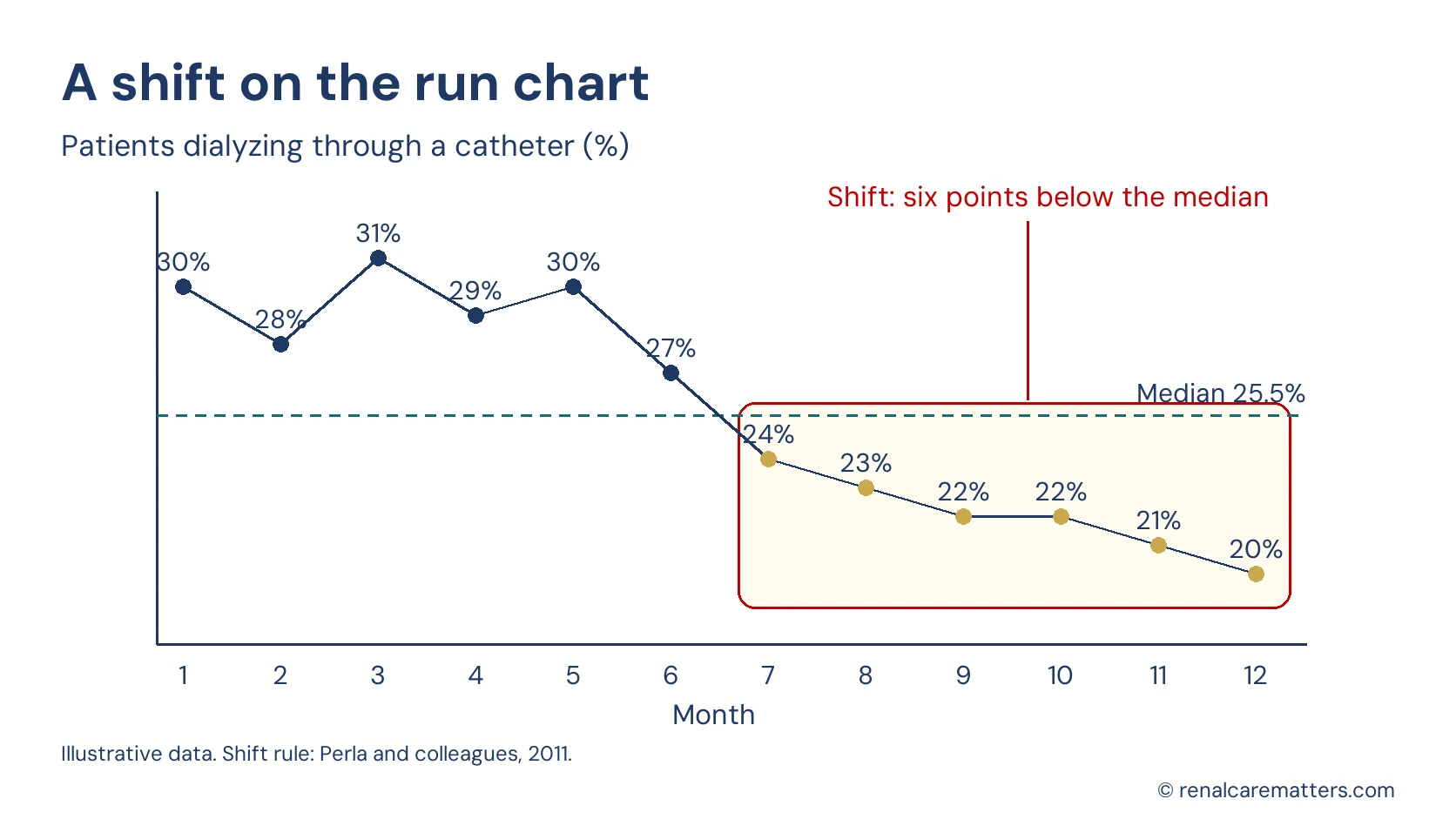
Perla and colleagues describe four rules that separate a real change from random variation.15 A shift is six or more consecutive points all above or all below the median. A trend is five or more consecutive points all going up or all going down. Too few or too many runs (crossings of the median) and an obviously different astronomical point are the other two. Points on the median are skipped: they neither add to nor break a shift. The shift and run rules need more than ten points before they apply.15
Figure 6. Six consecutive points below the median form a shift: a signal that something changed around month 7. Illustrative data.
Run chart, illustrative data. Percentage of patients dialyzing through a catheter, months 1 to 12: 30, 28, 31, 29, 30, 27, 24, 23, 22, 22, 21, 20. Sorted: 20, 21, 22, 22, 23, 24, 27, 28, 29, 30, 30, 31. The middle two values are 24 and 27, so the median is (24 + 27) ÷ 2 = 25.5. Months 7 to 12 (24, 23, 22, 22, 21, 20) are six consecutive points below the median. By the shift rule of Perla and colleagues, this is a signal. The run chart tells you that something changed around month 7. It does not tell you what. Ask what the unit did differently that month.
The site’s run chart calculator draws the median and applies these rules for you.
Standardized ratios compare like with like
A unit with older, sicker patients will have more admissions and deaths. A standardized ratio divides the observed number by the number expected for that unit’s case mix.
Standardized ratio, illustrative. Observed admissions in a year: 18. Expected for this case mix: 15. Ratio = observed ÷ expected = 18 ÷ 15 = 1.2. Above 1 means more events than expected. With small numbers the confidence interval, from the site’s standardized ratio calculator, decides whether 1.2 is a signal. The ratio is only as good as the model behind the expected number.
Payment programs are not proof of quality
In the United States, a regression discontinuity study of 5,830 outpatient centers found that 19.0% were penalized under the End-Stage Renal Disease Quality Incentive Program. Penalization was not associated with improvement in total performance scores (0.4 point, 95% confidence interval −2.5 to 3.2).16 The study was observational and could not see how centers responded. It suggests that a penalty alone does not make a unit better.
RememberRead trends, not single months. A run chart tells you whether a change is real; a single red number does not.
Lesson · part 7
Incidents, near misses, and root cause review
An incident is the crash. A near miss is the swerve that avoided it. Both show the dangerous bend in the road.
What goes wrong in dialysis units
Holley reviewed 18 months of quality assurance forms from four hemodialysis units: 88 errors and adverse events in 64,541 treatments. Infiltration of the access (31) and clotting of the circuit (19) were the most common. There were 35 medication errors, and omission of an ordered medicine was the most frequent kind (24 of 35, 69%). No patient was hospitalized as a result.1 The report was descriptive and relied on what staff wrote down. A unit that reports little is not necessarily safe.
Figure 7 · The incident and near-miss loop
Make the patient safeTreat the patient first, as your unit’s protocol directs.
Report the same shiftWrite it in the unit’s logbook or reporting system, with times and facts, without blame.
NotifyTell the attending nephrologist of any event that reached the patient. Tell the charge nurse and the Medical Director per protocol.
ReviewThe unit looks for causes in the system, not only in the person.
Fix the systemChoose the strongest change the unit can make.
Feed backStaff hear what was found and what changed.
Root cause review, and why it often disappoints
A root cause review asks why an event happened, and why again, until it reaches causes the unit can change.
Figure 8. A fishbone diagram for a cluster of catheter bloodstream infections sorts possible causes into groups, so the team looks beyond the first explanation that comes to mind.
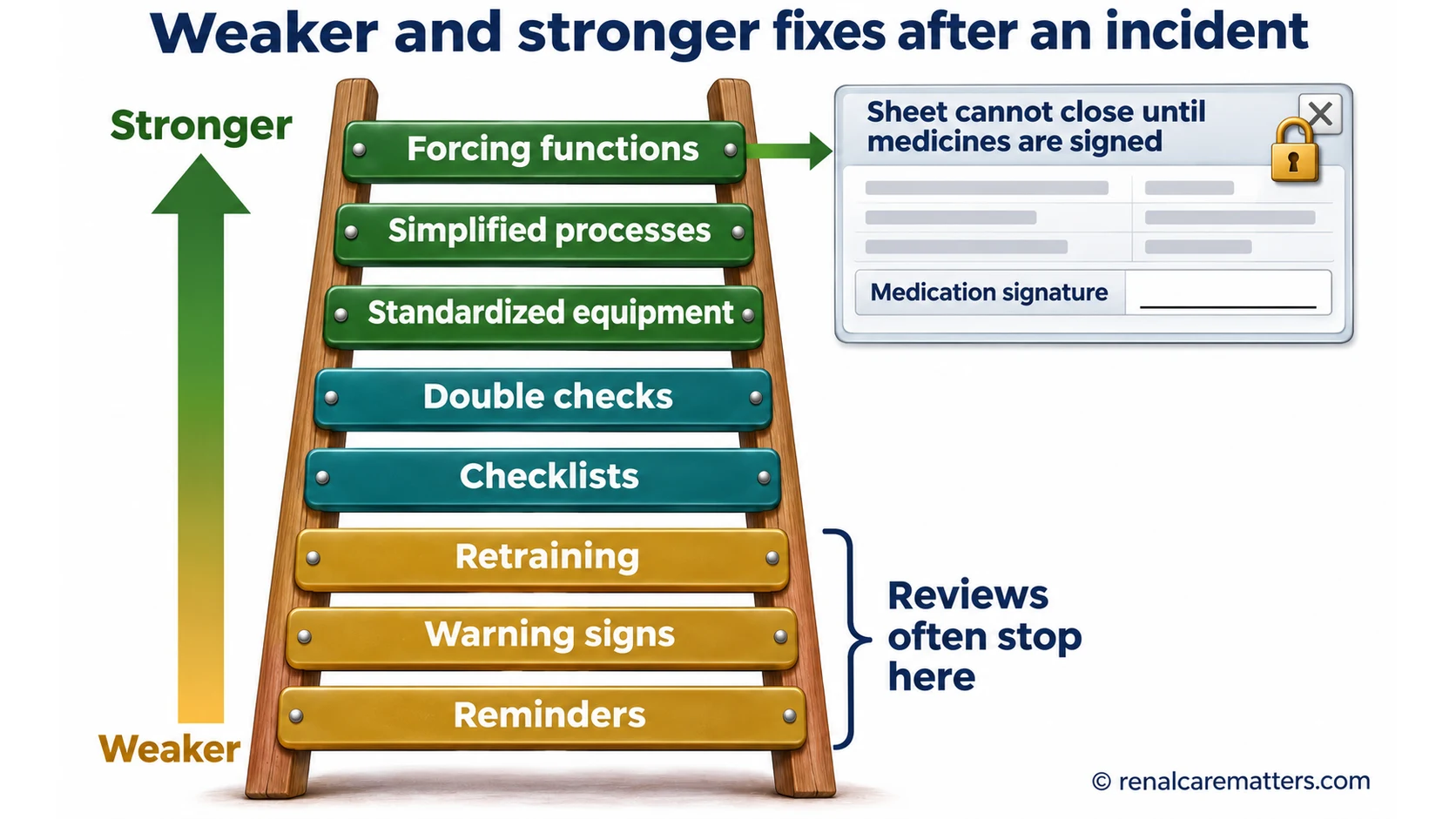
Peerally and colleagues argue that root cause analysis in health care often falls short. Investigators settle for weaker administrative fixes, such as reminders, instead of fixing latent causes such as poorly designed technology. They recommend skilled investigators, involving patients and families, and checking whether each fix worked.17 Their paper is an expert analysis, not a trial.
Figure 9. Fixes that depend on people remembering are weaker than fixes that change the system. Reviews often stop at the lower rungs.
Event
Weaker fix
Stronger fix
A patient’s ordered medicine was not given during the session
Remind the nurses to check the orders
A medication line on the treatment sheet that must be signed before the session can be closed
A dialyzer was set up for the wrong patient
Retrain on labeling
Labels printed from the patient list and a two-person check at the chair
DOH patient safety issuances also shape how a unit reports events. This module does not summarize them. Ask your Medical Director which ones your unit’s reporting follows.
Report every incident and near miss the same shift, without blame words. In a review, describe what happened, not who is at fault.
Stop and callStop and call the attending nephrologist and the Medical Director the same day for any event that caused harm, any medication or blood transfusion error that reached the patient, any wrong-patient or wrong-dialyzer event, and any cluster of similar illness among patients (Module 30). Make the patient safe first, as your unit’s protocol directs.
RememberReport the near miss as carefully as the incident. It shows the same bend in the road without the injury.
Lesson · part 8
One improvement cycle, and what is uncertain
Cooking adobo for a new family is a fair picture of improvement. You change one thing at a time, taste, and keep what works.
The picture has a limit. A cook tastes in minutes. A unit “tastes” through noisy monthly data, so it needs a clear measure and a run chart.
The method
In a Plan-Do-Study-Act (PDSA) cycle you plan one change and predict its effect, do it on a small scale, study the data against the prediction, and act: keep, adapt, or abandon it.
Figure 10. Improvement runs in small cycles. In the catheter care example below, each cycle tests one part of the bundle and the team checks the run chart.
PDSA is often done badly. A systematic review of 73 published projects found that fewer than 20% (14 of 73) documented a sequence of iterative cycles. Only 15% of the projects analyzed in detail (7 of 47) used data collected monthly or more often to guide each cycle.18
AO 2012-0001 requires every dialysis facility to keep a system for continuous quality improvement.2 The PSN standard expects CQI meetings at least once a month, documented, and led by the unit’s clinical head.7
A dialysis example with evidence
A Centers for Disease Control and Prevention (CDC) collaborative of 17 outpatient units used a bundle: chlorhexidine exit-site care, staff training, care audits, and feedback of rates. Pooled bloodstream infection rates went from 1.09 to 0.89 per 100 patient-months, and access-related infection rates from 0.73 to 0.42. Modeled rates fell 32% and 54% at the start of the intervention.14 The project had no control arm.
A cluster-randomized initiative in 211 matched facility pairs was stronger. Units that adopted chlorhexidine-alcohol exit-site care and “scrub the hubs” had 0.81 bloodstream infections per 1,000 catheter-days during follow-up, against 1.04 in usual-care units. Adjusted analysis confirmed reductions of 21% to 22%.19 The CDC lists its core interventions on one page.20
Figure 11 · A PDSA cycle on catheter care, illustrative
PlanPredict that a hub-scrub step will lower infections. Measure: infections per 100 patient-months, monthly.
DoTwo nurses on one shift test it for two weeks and record adherence.
StudyAdherence was high. The infection rate needs months of data.
ActExtend to all shifts and review the run chart at each CQI meeting.
Your part is practical. Bring data and observations to the CQI meeting. Carry out the agreed change on your shift. Say so when a change does not fit the floor.
What is uncertain
Whether AO 2012-0001 is still the operative order. No superseding order was found in public sources on November 25, 2026. Your Medical Director confirms this with the DOH.
The staffing ratio. The DOH order sets a maximum of 1:15. The PSN standard allows up to 1:20 with conditions. The order is the legal limit; your Medical Director confirms how the unit applies it.
Most quality improvement evidence in dialysis comes from before-and-after or observational studies. Only one study cited here is cluster-randomized.19 Penalizing low scores did not improve U.S. center scores.16
No validated score exists for the quality of dialysis notes. The eight-element checklist in this module is a teaching tool.
RememberA good improvement project changes one thing, measures it monthly, and keeps the change only if the run chart moves.
On the floor
Real situations: problems and solutions
These are fictional but typical. For each one, cover the answer, decide what you would do, then compare. Where a step depends on local rules, your unit’s procedure and your supervisor’s direction come first.
The stack of forms at 7 p.m.
What you see
At the end of the shift, the clerk places twelve treatment sheets in front of you for signature. Four of them are for patients who dialyzed in the morning, before you arrived.
What is likely going on
The morning physician on duty left without signing. The sheets certify assessments you did not make.
What to do
Sign only the sheets for patients you assessed. Return the morning sheets to the clerk with a note for the morning physician, and tell the Medical Director per the unit’s policy.
Why it matters
A signature certifies what you saw. Signing for another physician’s shift makes the record untrue, even when the care was good.
The daughter on the phone
What you see
Mrs. Aquino’s daughter calls from abroad and asks you to send her mother’s latest laboratory results and a photo of the treatment sheet by messaging app.
What is likely going on
A relative is asking for sensitive personal information through an unapproved channel. You cannot confirm her identity or her mother’s consent by phone.
What to do
Explain politely that results are released through the unit’s process. Ask Mrs. Aquino, at her next session, whom she authorizes to receive her information, and record her answer. Refer the request to the unit’s records process.
Why it matters
Health information is sensitive personal information. Good intentions do not replace the patient’s consent and the approved channel.
The wrong group chat
What you see
At 3:15 p.m., a nurse realizes she sent a list of patients with their hepatitis B and hepatitis C results to a family group chat instead of the staff chat.
What is likely going on
This is a suspected personal data breach. The clock for the unit’s breach decision has started.
What to do
Ask her to delete the message and note the time, but do not stop there. Report it at once to the data protection officer and the Medical Director, and write down what was sent, to whom, and when.
Why it matters
The breach response team needs the full time the circular allows to decide on notification. Delay shortens it.
Two near misses in one week
What you see
On Tuesday a nurse caught a dialyzer labeled for the wrong patient before connection. On Friday another nurse caught the same error at a different station.
What is likely going on
Two near misses of the same kind suggest a system problem, such as how labels are printed or where dialyzers are stored.
What to do
Make sure both are in the reporting system with times and facts. Tell the Medical Director and the charge nurse, and ask that the pattern be reviewed at the next CQI meeting.
Why it matters
Near misses show the hazard without the injury. A wrong-dialyzer event that reaches a patient is far harder to undo.
The red number on the dashboard
What you see
At the monthly CQI meeting, the infection rate for October is shown in red: 4.2 per 100 patient-months, against 0 in September. A colleague proposes retraining all staff at once.
What is likely going on
In a unit of 48 patients, two infections in one month produce this rate. One month alone cannot show a real change.
What to do
Ask to see the quarter and the run chart. Ask whether the infections share a cause, such as catheter care on one shift. Suggest a small test of one change with a monthly measure.
Why it matters
Reacting to a single month wastes effort and can hide the real cause. Trends, and a fix aimed at the system, are what move outcomes.
Field notes
Before you sign anything at the end of a shift, read the first line and the last line aloud to yourself. It catches most pre-filled surprises.
Write “called Dr. ___ at ___; advised ___” in every event note. It is the element most often left out.
Keep patient names out of your personal phone’s photo gallery. Use the unit’s system for any image you need.
When a patient wants to leave early, ask “What would make it possible for you to stay?” before you explain the risks.
Bring one near miss to every monthly CQI meeting. It shows the team you are watching the system, not the people.
Case review
Back to the case: “Please sign the form, Doc”
What must you do before you sign the refusal? Do not sign the pre-filled form yet. First go to Mr. Mendoza. Check that he can understand, weigh, and communicate a choice. If he can, the decision is his. His reason is his ride, which the family may be able to solve. Explain the risks in plain words: with a high potassium this week and a large weight gain, a session cut in half leaves him at risk of a dangerous heart rhythm and of fluid in the lungs. Call the attending nephrologist while he is still in the unit, because the nephrologist may want to change the plan or arrange an earlier session. If he still leaves, record what you explained, his reason in his own words, the time, the call and the advice, and the follow-up plan. Have the form witnessed as your unit’s policy requires. The PSN standard prefers two witnesses who also sign, such as Ms. Pangilinan and a second staff member.
Can you sign the certificate as written? No. It says he completed dialysis today, and he did not. Signing it would be a false statement. A true certificate states that he attended the unit today for scheduled hemodialysis, with the actual start and end times. The employer does not need his diagnosis or his potassium. If your unit reserves certificates for the attending nephrologist, refer the request.
What goes into the incident log, and is there a near miss? The infiltration reached the patient, so it is an incident. The entry states the time, what was seen and done, the patient’s condition, and who was told, without blame words. The early end of the session is a refusal, documented in the chart. There is also a near miss worth reviewing: a high-risk patient nearly left with only a pre-filled form and no call to the nephrologist. That points to the system, not to Ms. Pangilinan, and a CQI meeting can fix pre-filled forms.
Skills lab · with your preceptor
Skills checklist: Auditing your own notes and writing an incident report
Work through these steps with your own recent notes and one real or simulated event, while your preceptor or the Medical Director reviews your work. Your preceptor rates each step as satisfactory, needs practice, or not observed. Steps marked Critical must all be satisfactory before sign-off. This checklist supports supervised learning; your unit’s own procedure and competency form are the authority. A printable version of every checklist is on the trainer page.
Selects five of your own event notes from the last month, using the unit’s approved system.
Scores each note for the eight elements and records the element most often missing.
CriticalIdentifies any signature on a document that certified something you did not personally verify.
CriticalWrites a refusal note that includes what was explained, the patient’s words, the witnesses, and the call to the attending nephrologist.
CriticalWrites an incident report that is factual, timed, and free of blame language.
Classifies the event as an incident or a near miss, and as reaching or not reaching the patient.
CriticalNames who must be notified for this event and notifies them.
States one contributing factor in the system, not in a person.
Computes one unit indicator as a rate with the correct denominator.
Places one month’s value on the unit’s run chart and states whether the chart shows a signal.
Proposes one PDSA test of change with a measure and a review date.
CriticalHandles the audit data without exposing patient identifiers outside the unit’s system.
Placement activity. Over the next month, score five of your event notes each week with the eight-element checklist. Bring your most-missed element and one near miss you saw to the unit’s monthly CQI meeting, and agree with the Medical Director on one small change to test.
Self-assessment
Check your understanding
Each visit draws 8 questions at random from this module’s 15-question bank. Choose the single best answer for each, then select Check answers; an explanation appears under the best answer. Select New set of questions for a different mix. A good target is 7 of 8 on two different sets. Nothing you select is sent anywhere; scoring happens in your browser.
Go deeper
Read next on this site
Dialysis Center Quality ManagementHow quality assessment and continuous quality improvement work in a dialysis unit, with the monthly meeting.
Holley, J. L. (2006). A descriptive report of errors and adverse events in chronic hemodialysis units. Nephrology News & Issues, 20(12), 57–58, 60–61, 63 passim. https://pubmed.ncbi.nlm.nih.gov/17125098/
Department of Health. (2013). Implementing guidelines in the analysis, monitoring and maintenance of water used in dialysis facilities pursuant to Administrative Order No. 2012-0001 (Administrative Order No. 2013-0003). https://elibrary.judiciary.gov.ph/thebookshelf/showdocs/10/69036
Starmer, A. J., Spector, N. D., Srivastava, R., West, D. C., Rosenbluth, G., Allen, A. D., Noble, E. L., Tse, L. L., Dalal, A. K., Keohane, C. A., Lipsitz, S. R., Rothschild, J. M., Wien, M. F., Yoon, C. S., Zigmont, K. R., Wilson, K. M., O’Toole, J. K., Solan, L. G., Aylor, M., . . . Landrigan, C. P. (2014). Changes in medical errors after implementation of a handoff program. New England Journal of Medicine, 371(19), 1803–1812. https://doi.org/10.1056/NEJMsa1405556
Müller, M., Jürgens, J., Redaèlli, M., Klingberg, K., Hautz, W. E., & Stock, S. (2018). Impact of the communication and patient hand-off tool SBAR on patient safety: A systematic review. BMJ Open, 8(8), e022202. https://doi.org/10.1136/bmjopen-2018-022202
Thomas-Hawkins, C., & Flynn, L. (2015). Patient safety culture and nurse-reported adverse events in outpatient hemodialysis units. Research and Theory for Nursing Practice, 29(1), 53–65. https://doi.org/10.1891/1541-6577.29.1.53
National Kidney Foundation. (2015). KDOQI clinical practice guideline for hemodialysis adequacy: 2015 update. American Journal of Kidney Diseases, 66(5), 884–930. https://doi.org/10.1053/j.ajkd.2015.07.015
Saran, R., Bragg-Gresham, J. L., Rayner, H. C., Goodkin, D. A., Keen, M. L., Van Dijk, P. C., Kurokawa, K., Piera, L., Saito, A., Fukuhara, S., Young, E. W., Held, P. J., & Port, F. K. (2003). Nonadherence in hemodialysis: Associations with mortality, hospitalization, and practice patterns in the DOPPS. Kidney International, 64(1), 254–262. https://doi.org/10.1046/j.1523-1755.2003.00064.x
Patel, P. R., Yi, S. H., Booth, S., Bren, V., Downham, G., Hess, S., Kelley, K., Lincoln, M., Morrissette, K., Lindberg, C., Jernigan, J. A., & Kallen, A. J. (2013). Bloodstream infection rates in outpatient hemodialysis facilities participating in a collaborative prevention effort: A quality improvement report. American Journal of Kidney Diseases, 62(2), 322–330. https://doi.org/10.1053/j.ajkd.2013.03.011
Perla, R. J., Provost, L. P., & Murray, S. K. (2011). The run chart: A simple analytical tool for learning from variation in healthcare processes. BMJ Quality & Safety, 20(1), 46–51. https://doi.org/10.1136/bmjqs.2009.037895
Sheetz, K. H., Gerhardinger, L., Ryan, A. M., & Waits, S. A. (2021). Changes in dialysis center quality associated with the End-Stage Renal Disease Quality Incentive Program: An observational study with a regression discontinuity design. Annals of Internal Medicine, 174(8), 1058–1064. https://doi.org/10.7326/M20-6662
Peerally, M. F., Carr, S., Waring, J., & Dixon-Woods, M. (2017). The problem with root cause analysis. BMJ Quality & Safety, 26(5), 417–422. https://doi.org/10.1136/bmjqs-2016-005511
Taylor, M. J., McNicholas, C., Nicolay, C., Darzi, A., Bell, D., & Reed, J. E. (2014). Systematic review of the application of the plan-do-study-act method to improve quality in healthcare. BMJ Quality & Safety, 23(4), 290–298. https://doi.org/10.1136/bmjqs-2013-001862
Rosenblum, A., Wang, W., Ball, L. K., Latham, C., Maddux, F. W., & Lacson, E., Jr. (2014). Hemodialysis catheter care strategies: A cluster-randomized quality improvement initiative. American Journal of Kidney Diseases, 63(2), 259–267. https://doi.org/10.1053/j.ajkd.2013.08.019
Educational study material for physicians. Does not replace the attending nephrologist’s orders, the unit’s protocols, required certification courses, or supervised practice.