What a physician on duty is responsible for, who does what on the team, the shape of a shift, when to call the attending nephrologist, and how to report and record.
PublishedNailathalaGipatikPepalwal:ReferencesMga SanggunianMga TinubdanReng Reperensya:3Audience: Physicians who cover hemodialysis shifts · attending nephrologists, medical directors, and head nurses who orient themRead timeOras ng pagbasaOras sa pagbasaOras ning pamamasa:
This module is study material for physicians on duty in hemodialysis units. It explains the reasoning behind common decisions; it is not a protocol. At the chairside, follow your unit’s protocol and ask the attending nephrologist for guidance. Doses and cut-off values are set by your unit. Every case is fictional.
Learning objectives
After this module you should be able to
Describe what a physician on duty is responsible for, and what belongs to the attending nephrologist.
Name the members of the dialysis team and what each one decides.
Follow one shift from before the first patient arrives to the last handoff.
Separate what your unit’s protocol lets you do at once from what needs a call first.
Report to the attending nephrologist with a clear, structured message, and record what was done.
Apply professional conduct on the floor: confidentiality, consent, boundaries, and speaking up.
Pre-testBefore you read, answer the 8 self-assessment questions and note your score. After the module, select New set of questions and compare. The difference is what you learned; the questions you still miss are what to reread.
Start here
The big picture, in plain words
In plain wordsThink of a dialysis shift as a flight. The attending nephrologist wrote the flight plan for each patient. The nurses and technicians fly the aircraft. You are the doctor on board. You do not rewrite the flight plan in mid-air, but when a passenger becomes ill, you are the one who examines, acts in the first minutes, and radios the ground with exactly what is happening.
Figure 1 · Key terms for this module
Physician on duty (POD)The doctor who is physically present in the unit while patients are on dialysis.
Attending nephrologistThe kidney specialist responsible for a patient’s dialysis prescription and long-term care.
Dialysis prescriptionThe nephrologist’s order for one patient: time, flows, dialysis fluid, fluid removal target, and blood thinner.
Unit protocolA written, approved instruction that says what staff may do in a defined situation without a new order.
EscalateTell the right person now, clearly, because the problem is beyond your role or is not improving.
Situation, Background, Assessment, Recommendation (SBAR)A four-part way to report: Situation, Background, Assessment, Recommendation.
Dry weightThe target weight at the end of dialysis, when extra fluid has been removed. It is set by the nephrologist.
Figure 2 · Three habits this module teaches
Look firstSee the patient yourself before you decide anything.
Act within protocolDo what your unit’s protocol allows for this situation.
Call earlyTell the attending nephrologist what you found, what you did, and what you need.
Opening case · fictional
Case: The first Monday
It is your first morning as physician on duty. Mrs. Santos, 61, arrives for her Monday session. She dialyzes twice a week, and her last session was on Thursday. She is short of breath when she walks from the scale to her chair. She is 4.5 kilograms above her dry weight, her blood pressure is 180/100 mm Hg, and her oxygen saturation is 91% on room air.
The nurse, who has worked in the unit for nine years, says: “Doctor, her dry weight is too high. She is always like this on Mondays. Can you just lower it by one kilogram and write the order so we can start?” Three other patients are waiting to be seen.
Before reading on, decide:
What do you do in the next five minutes?
Is changing the dry weight your decision to make?
What will you say when you call the attending nephrologist?
Keep your answers in mind. The lesson gives you what you need, and the case review near the end shows one sound response.
Lesson · part 1
What a physician on duty is, and is not
A hemodialysis (HD) unit treats many patients at once, each connected to a machine that moves about 300 milliliters of blood a minute outside the body. Serious problems are uncommon, but they develop within minutes. For that reason, Philippine standards expect a physician to be physically present whenever the unit is operating.1
The Philippine Society of Nephrology (PSN) standards for hemodialysis clinics describe the physician on duty (POD) as a licensed physician who gives acute care to patients during treatment, under the supervision of each patient’s attending nephrologist and the clinical head of the unit.1 The same standards expect the POD to hold a current advanced cardiac life support (ACLS) certificate and a certificate from a recognized course for physicians on duty, and they describe one POD for about 15 treatment stations as the ideal.1
Figure 3 · What the standards expect of you
See every patientEvaluate all patients during your tour of duty and write down what you find.
Give acute careManage urgent problems before, during, and after dialysis.
Carry out the prescriptionFollow the attending nephrologist’s orders; you do not replace them.
Keep the nephrologist informedReport acute problems and emergencies.
ReviewRead the previous treatment records and new laboratory results, and interpret them with the nephrologist.
Refer or admitSend a patient to the hospital when needed, with the nephrologist’s knowledge.
Two limits follow from this. First, the dialysis prescription belongs to the attending nephrologist, who provides both the first and the ongoing prescription.1 Second, the standards say that no referral to another specialty is made without the knowledge of the attending nephrologist or the clinical head.1 The reason is practical: the nephrologist knows the patient’s history over months and years, and you are seeing one day of it.
RememberYou are responsible for what happens during your shift. The attending nephrologist is responsible for the plan. Good care needs both, and the link between them is your phone call.
Lesson · part 2
Who does what on the dialysis floor
You will be the newest person in a team that has worked together for years. Knowing what each member decides helps you ask the right person the right question.
Figure 4. The team around one patient. Each member sees a different part of the picture.
Team member
Decides or does
Ask them about
Attending nephrologist
The dialysis prescription, dry weight, medicines, access plan, long-term care
Any change to the plan; any problem that is serious, new, or not improving
Medical director or clinical head
Unit protocols, quality and safety, staff privileges
Protocol questions; events that affect several patients; anything you cannot resolve with the attending nephrologist
Physician on duty
Assessment and acute care during the shift, within protocol
—
Dialysis nurse
Patient assessment, needle insertion, machine settings as ordered, monitoring, medicines as ordered
How this patient usually behaves on dialysis; what has changed today
Head or charge nurse
Staffing, patient flow, station assignment, isolation
Where to put an unstable or infectious patient; who can help
Dialysis technician
Machine preparation, water system checks, equipment problems
Alarms that will not clear; water and dialysis fluid checks
Renal dietitian
Diet and fluid advice
High weight gains, high potassium or phosphate, weight loss
Social worker or patient navigator
Financing, transport, family support
Missed sessions, money problems, caregiver strain
Dialysis nurses often know a patient far better than you will after one examination. A nurse who says “he is not himself today” is giving you a clinical finding. Take it seriously and go and look.
RememberRespect for the nurses’ experience and responsibility for your own decisions go together. Listen to the nurse, examine the patient yourself, then decide what is yours to decide.
Lesson · part 3
The shape of one shift
A unit usually runs two or three shifts a day, each about four hours of treatment plus the time to connect and disconnect patients. The work comes in waves. Most problems appear at three points: before the session starts, in the last hour when the most fluid has been removed, and when needles come out.
Figure 5 · One shift from start to finish
Before patients arriveCheck the emergency cart, oxygen, suction, and defibrillator. Read the handoff notes. Ask the charge nurse who worries her today.
Arrival and weighingSee each patient: weight gain, blood pressure, breathing, the access, and any new complaint.
First hourStay on the floor. Reactions to the dialyzer and access problems show early.
Middle hoursReview laboratory results and records. Write notes. Walk the floor again.
Last hourBlood pressure falls and cramps are most likely now. Be visible.
DisconnectionCheck bleeding from needle sites, standing blood pressure, and how the patient feels before leaving.
HandoffTell the next physician and the attending nephrologists what happened and what is pending.
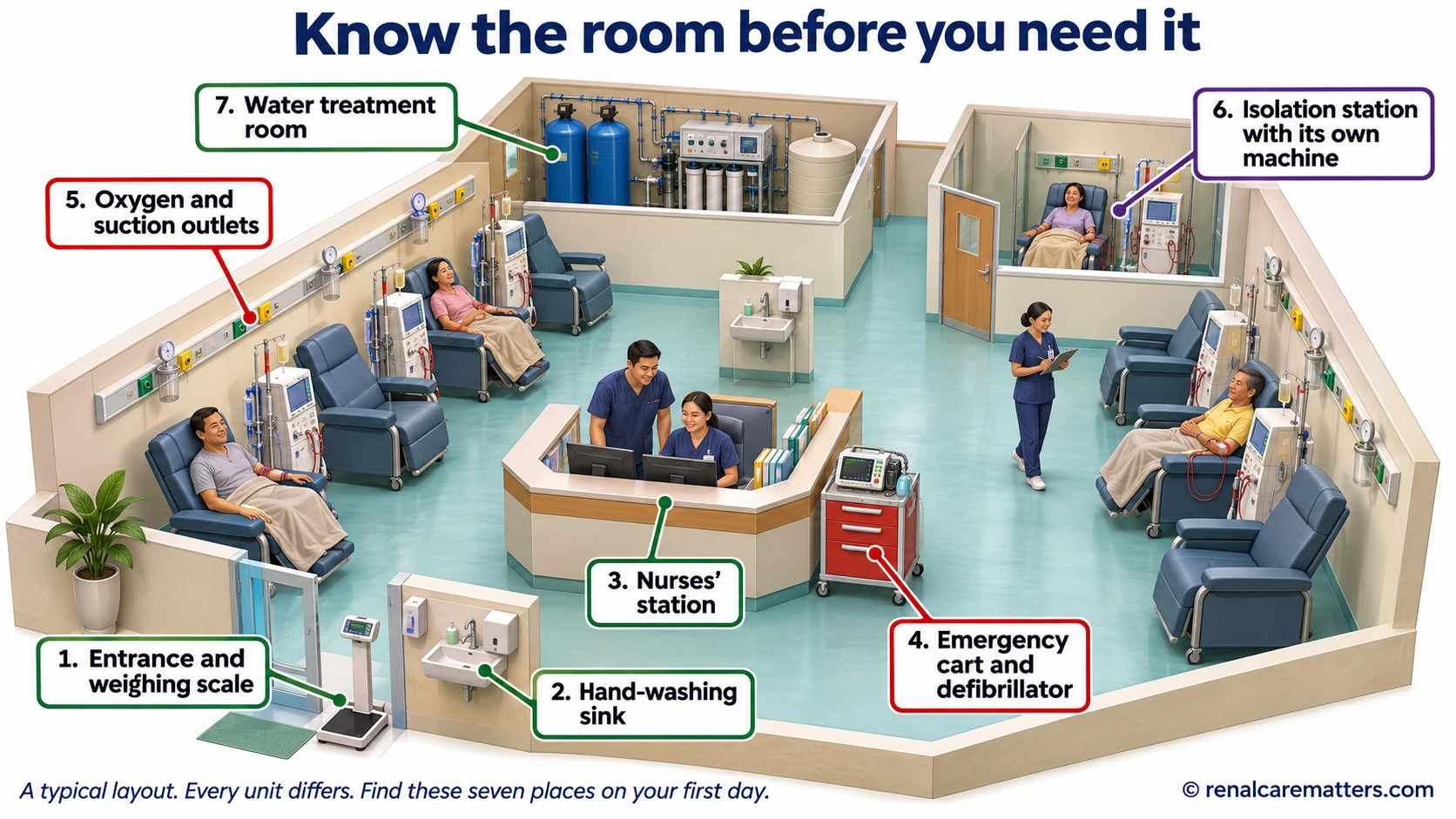
Figure 6. A typical unit layout. Learn where the emergency cart, oxygen, and isolation station are before your first patient arrives.
Learn the room before you need it. On your first day, find the emergency cart, the oxygen outlets, the suction, the defibrillator, the isolation station, and the list of telephone numbers for every attending nephrologist. Ask a nurse to show you how a treatment is stopped and blood is returned to the patient. In an emergency you will not have time to look.
Figure 7. An emergency-ready dialysis unit. Check these items yourself at the start of every shift.
Lesson · part 4
What you may do at once, and what needs a call
Every unit should have written protocols for common problems, such as a fall in blood pressure, muscle cramps, chest pain, or fever. A protocol tells staff what they may do immediately, without waiting for a new order. Read your unit’s protocols before your first shift. If your unit has none for a situation, treat the situation as one that needs a call.
The rule for this series is simple. Follow your unit’s protocol, and ask the attending nephrologist for guidance. The two are not alternatives. The protocol covers the first minutes. The call covers what comes next, and it lets the nephrologist adjust the plan for a patient they know.
Situation
Usually within protocol (act, then report)
Needs the attending nephrologist (call first)
Blood pressure falls during dialysis
First steps in the unit’s hypotension protocol
Pressure that does not recover; any change to the fluid removal target or dry weight
Patient arrives very overloaded
Oxygen, positioning, assessment
Extra time, an extra session, or a new dry weight
Laboratory result out of range
Repeat or confirm as protocol allows; examine the patient
Any change to the dialysis fluid (potassium, calcium, bicarbonate) or to medicines
Access problem
Examine; hold needle insertion if unsafe; control bleeding
Use of a different access; referral to the access surgeon
Fever or chills
Assessment and cultures as protocol allows
Antibiotic choice; catheter removal; admission
Chest pain, new confusion, seizure
Emergency first steps; call for help
Call during the first steps, not after; decide transfer together
Patient asks to stop early or skip a session
Listen; explain the risk; document
Inform the nephrologist the same day
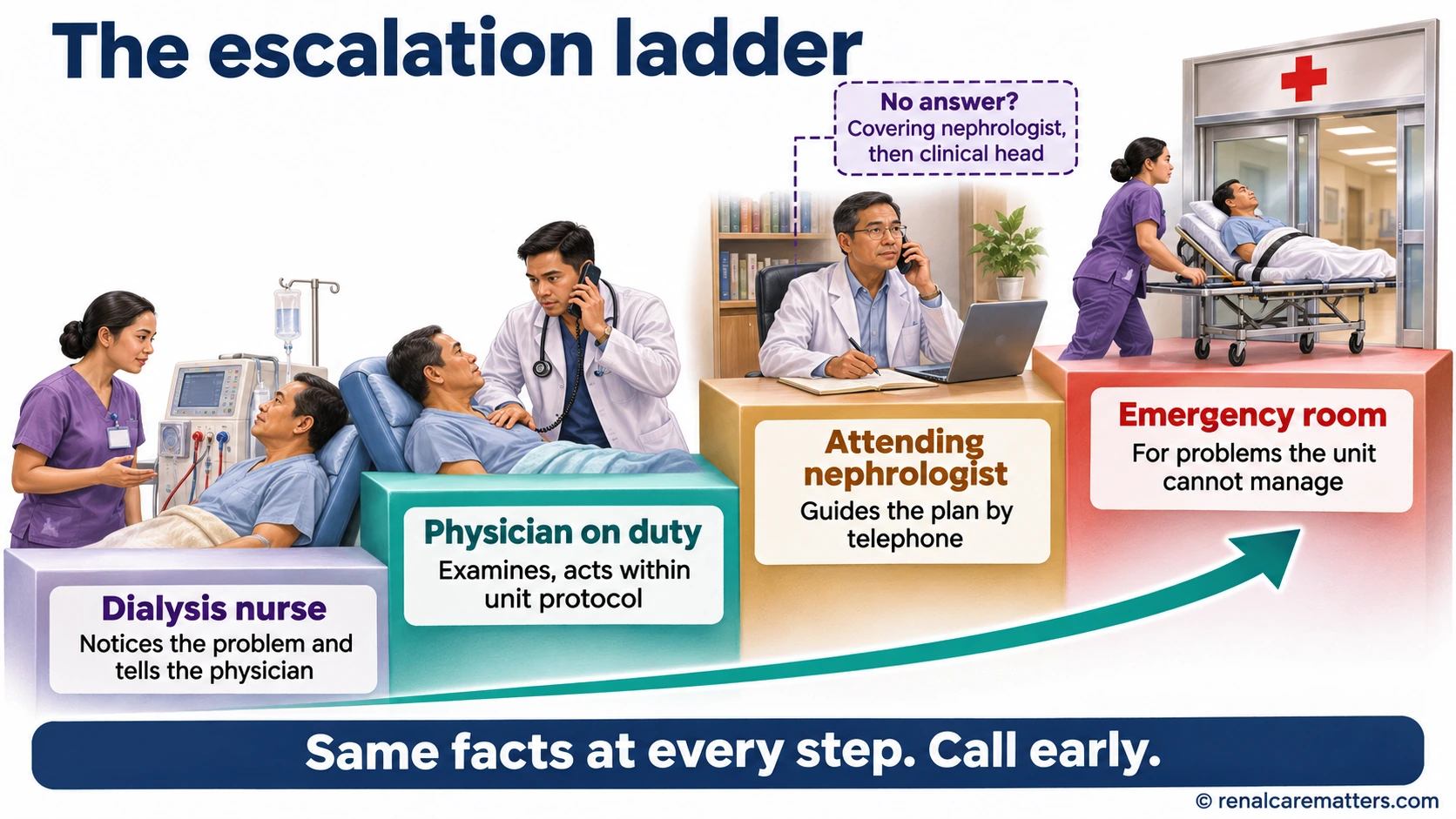
Stop and callCall the attending nephrologist before you change the dry weight, the dialysis fluid, the treatment time, the blood thinner, or the access plan. Call during, not after, any emergency. If you cannot reach the attending nephrologist, follow your unit’s escalation list to the covering nephrologist or the clinical head.
Figure 8. The escalation ladder. Problems move up one step at a time, quickly, with the same facts at every step.
New physicians sometimes worry that calling shows weakness. The opposite is true. Nephrologists expect to be called and would rather hear about a problem early. A late call, after an avoidable admission, is the one that damages trust.
Lesson · part 5
How to call the nephrologist: SBAR
A telephone report fails in two common ways. The caller tells a long story and the listener cannot find the problem, or the caller gives a number with no context. A fixed structure prevents both. The most widely used is SBAR: Situation, Background, Assessment, Recommendation.
How well does it work? A systematic review of 11 studies found moderate evidence that introducing SBAR improved patient safety, especially for telephone communication, and noted that high-quality studies are few.2 The structure is supported by evidence and by long practice, but it has not been proven in large trials.
Figure 9 · SBAR for a dialysis call
SituationWho you are, who the patient is, and the problem in one sentence.
BackgroundWhy the patient is on dialysis, the access, the schedule, and what is relevant from today.
AssessmentWhat you found and what you think is happening. Give numbers.
RecommendationWhat you have done, what you propose, and what you need from the nephrologist.
Worked example. S: “Doctor, this is Dr. Reyes, physician on duty at the morning shift. I am calling about Mrs. Santos. She arrived short of breath and I have not started her dialysis.” B: “She is on dialysis twice a week through a left arm fistula. Her last session was Thursday. Her dry weight is 52 kilograms.” A: “She is 4.5 kilograms above dry weight. Blood pressure 180/100, heart rate 104, oxygen saturation 91% on room air, crackles in both lung bases, no chest pain. Her electrocardiogram shows no new changes. I think this is fluid overload after the long gap.” R: “I have given oxygen and sat her upright. I would like to start dialysis now. May I have your orders for the fluid removal target and treatment time today? The nurse also thinks her dry weight needs review.”
Three habits complete the call. Have the chart in front of you before you dial. Repeat the orders back to the nephrologist so that both of you hear the same thing. Write the orders, the time, and the nephrologist’s name in the record straight away.
RememberBefore you call, be able to state the weight gain, the vital signs, the access, the last session, and the latest potassium. Most of the nephrologist’s questions will be about these.
Lesson · part 6
What to write, and when
Your note is how the attending nephrologist, the next physician, and the patient’s future doctors learn what happened. It is also a legal record. Write it during the shift, not from memory afterward.
For every patient
For every event
Complaints since the last session
The time it started and who noticed it
Weight gain, blood pressure, breathing, access findings
What you found on examination, with numbers
Whether the session started as ordered, and any change
What was done, in order, with times
New laboratory results and what was done about them
Whom you called, when, and the orders received
How the patient was at the end
The outcome: recovered, sent home, transferred, admitted
Report events and near misses through your unit’s incident system as well as in the chart. A near miss is an error that was caught before it reached the patient. Reporting it is not an admission of fault. It is how a unit finds a weak point before someone is harmed.
Lesson · part 7
Professional conduct on the floor
Patients on dialysis come to the same room two or three times a week for years. They know the staff, each other, and each other’s families. That closeness is good for care and it creates risks that a ward or clinic does not.
Figure 10 · Conduct that protects patients and you
ConfidentialityAn open floor carries voices. Discuss results, hepatitis or human immunodeficiency virus (HIV) status, money, and family matters quietly at the chair or in private, never across the room.
ConsentExplain what you propose and why before you do it. A patient may refuse a treatment or stop a session early. Explain the risk, record the discussion, and inform the nephrologist.
BoundariesBe warm and consistent. Decline gifts of value, loans, and private arrangements. Do not treat favorite patients differently.
Photographs and social mediaNever post or share a patient’s image, record, or story without written consent, even in a private chat group.
Speaking upIf you see something unsafe, say so at once, whoever is involved. If someone corrects you, thank them.
Knowing your limitsSay “I do not know, I will find out.” It is safer than guessing and it earns trust.
Patient information is protected by law. The Data Privacy Act of 2012 treats health information as sensitive personal information, and it applies to photographs and messages on personal telephones as much as to paper charts.3
Stop and callTell the attending nephrologist and the clinical head the same day if a patient refuses treatment, makes a complaint about care, or says anything that suggests self-harm.
On the floor
Real situations: problems and solutions
These are fictional but typical. For each one, cover the answer, decide what you would do, then compare. Where a step depends on local rules, your unit’s procedure and your supervisor’s direction come first.
Two calls at once
What you see
A nurse reports chest pain at station 4 while you are examining a breathless patient at station 9.
What is likely going on
Two patients may both be unstable, and you can be in only one place.
What to do
Ask the charge nurse to send a nurse with the emergency cart to station 4, get an electrocardiogram and vital signs there, and have someone telephone the attending nephrologist. Finish the first minute of care where you are, then move to the sicker patient.
Why it matters
You lead by assigning tasks. A physician who tries to do everything alone delays both patients.
The order that does not fit
What you see
The prescription says dialysis fluid potassium 2 mmol/L. This morning’s result shows the patient’s potassium is at the low end of normal, and he has had diarrhea for three days.
What is likely going on
The standing prescription was written for his usual state, not for today.
What to do
Hold the start, examine him, and call the attending nephrologist with the result and the history. Do not change the dialysis fluid yourself.
Why it matters
The prescription belongs to the nephrologist, but noticing that it no longer fits today’s patient belongs to you.
The family at the nurses’ station
What you see
A patient’s daughter asks loudly, in front of other patients, whether her father’s hepatitis test came back.
What is likely going on
She is worried, and she has not thought about who can hear.
What to do
Take her to a private space before answering. Confirm that the patient agrees to share his results with her, then explain, or arrange for the attending nephrologist to do so.
Why it matters
Health information is sensitive, and other patients on an open floor hear everything.
“Doctor, just sign here”
What you see
At the end of a busy shift you are handed a stack of forms and certificates to sign for patients you did not examine.
What is likely going on
The paperwork has fallen behind and you are the available physician.
What to do
Sign only what you can personally confirm. For the rest, review the record or see the patient first, or leave it for the physician who did.
Why it matters
Your signature certifies that something is true. It is a legal statement.
The nephrologist does not answer
What you see
A patient’s blood pressure has not recovered after the first steps of the protocol. You have called the attending nephrologist twice with no answer.
What is likely going on
The nephrologist may be in a procedure or out of signal.
What to do
Continue care, and go to the next name on the unit’s escalation list now: the covering nephrologist, then the clinical head. Record each call and its time.
Why it matters
An escalation list exists for exactly this. Waiting for one person is not a plan.
Field notes
Walk the floor at the start of the last hour of every shift. That is when blood pressure falls and cramps begin.
Save every attending nephrologist’s number in your telephone on the first day.
When a nurse calls you to a chair, go. You can decide it was nothing after you have looked.
Write the time on every note and every order.
If you are unsure whether to call, call.
Case review
Back to the case: The first Monday
What to do in the next five minutes. See Mrs. Santos before anything else. Sit her upright, give oxygen, and examine her: breathing, heart, lungs, legs, and the fistula. Ask about chest pain, fever, and cough, and ask what she ate and drank over the weekend. Review her recent sessions. Ask for an electrocardiogram if your protocol calls for one in a breathless patient. Fluid overload after a long gap is the most likely cause, but a heart attack, a chest infection, and a rhythm problem can look the same at the door.
Is the dry weight yours to change? No. Dry weight is part of the prescription and belongs to the attending nephrologist. The nurse may well be right that it needs review. Nine years of Mondays is useful evidence, and you should pass her observation on. But lowering a dry weight means removing more fluid at every session from now on, and if it is wrong the patient pays with low blood pressure, cramps, and a damaged heart over time. That decision needs the person who knows her history.
What to say. The worked SBAR example in this module is the call. Notice what it contains: the reason you have not started, the numbers, your assessment, what you have already done, and a clear request. It also carries the nurse’s concern forward, so the nephrologist can act on it.
And the three patients waiting? Tell the charge nurse that you are with an unstable patient and ask her to tell you at once if any of the three is unwell. A breathless patient with low oxygen comes first.
Skills lab · with your preceptor
Skills checklist: Start-of-shift readiness round
Complete this round before the first patient is connected, with the charge nurse. Your preceptor rates each step as satisfactory, needs practice, or not observed. Steps marked Critical must all be satisfactory before sign-off. This checklist supports supervised learning; your unit’s own procedure and competency form are the authority. A printable version of every checklist is on the trainer page.
CriticalLocates the emergency cart and confirms that it is sealed or checked and signed for the day.
CriticalConfirms that the defibrillator is present, charged, and has pads, and switches it on to test it as the unit allows.
CriticalConfirms working oxygen and suction, with a mask and tubing at hand.
CriticalFinds the contact list for every attending nephrologist on the shift and the escalation list for when one cannot be reached.
Reads the handoff notes from the previous shift.
Asks the charge nurse which patients concern her today, and why.
Identifies the isolation station and which patients use it.
CriticalKnows where the unit’s written protocols are kept and has read the protocols for low blood pressure, chest pain, and cardiac arrest.
Asks a nurse to demonstrate how a treatment is stopped and blood is returned, including by hand if power fails.
Introduces themselves to the staff and to each patient as the physician on duty.
Placement activity. On your first observed shift, write one SBAR report for a real problem, give it to your preceptor before you call, and compare it with what the nephrologist asked.
Self-assessment
Check your understanding
Each visit draws 8 questions at random from this module’s 15-question bank. Choose the single best answer for each, then select Check answers; an explanation appears under the best answer. Select New set of questions for a different mix. A good target is 7 of 8 on two different sets. Nothing you select is sent anywhere; scoring happens in your browser.
Müller, M., Jürgens, J., Redaèlli, M., Klingberg, K., Hautz, W. E., & Stock, S. (2018). Impact of the communication and patient hand-off tool SBAR on patient safety: A systematic review. BMJ Open, 8(8), e022202. https://doi.org/10.1136/bmjopen-2018-022202
Educational study material for physicians. Does not replace the attending nephrologist’s orders, the unit’s protocols, required certification courses, or supervised practice.