After this module you should be able to
- Explain the mechanisms of outflow failure, dialysate leaks, hernias and pleural leaks from the pressure physiology of a fluid-filled abdomen.
- Triage poor drainage, leaks, swelling, pain on inflow or outflow, and fluid overload by urgency.
- Recognize the emergencies that override routine troubleshooting.
- Prepare patients for power interruptions, typhoons, floods and supply disruption.
- Escalate with the data the team needs and avoid unsafe manipulation.
The big picture, in plain words
Most mechanical problems in peritoneal dialysis (PD) are fixable if found early and handled gently. A constipated bowel pushing the catheter out of the pelvis, a leak tracking into the abdominal wall, a slow hernia: none of these is an emergency on day one. Each can become one if it is missed, or if someone forces fluid through a blocked catheter at midnight. Your work is to sort the urgent from the routine, protect the catheter, and keep the patient safe when the power or the supply chain fails.
The picture has a limit. A balloon has uniform walls. The abdomen has known weak points, and a bowel that moves and can displace the catheter. Pressure also changes breathing and venous return, which is why large fills can cause breathlessness or discomfort in some patients.
Case: Three pillows at 9 PM
Mr. Dante Ramos, 60, on continuous ambulatory peritoneal dialysis (CAPD) for two years, calls at 9 preventive maintenance (PM). Nurse Liezl answers.
9:00. Over three days his drain volumes have fallen from about 2,300 to 1,500 mL per exchange. He has not moved his bowels in five days. Tonight he feels breathless lying down and needed three pillows.
Before reading on, decide:
- Which detail changes this from a drain problem to an emergency?
- Should you try position changes over the phone?
- What goes into the handoff?
Keep your answers in mind. The lesson gives you what you need, and the case review near the end shows one sound response.
Mechanisms and what you see
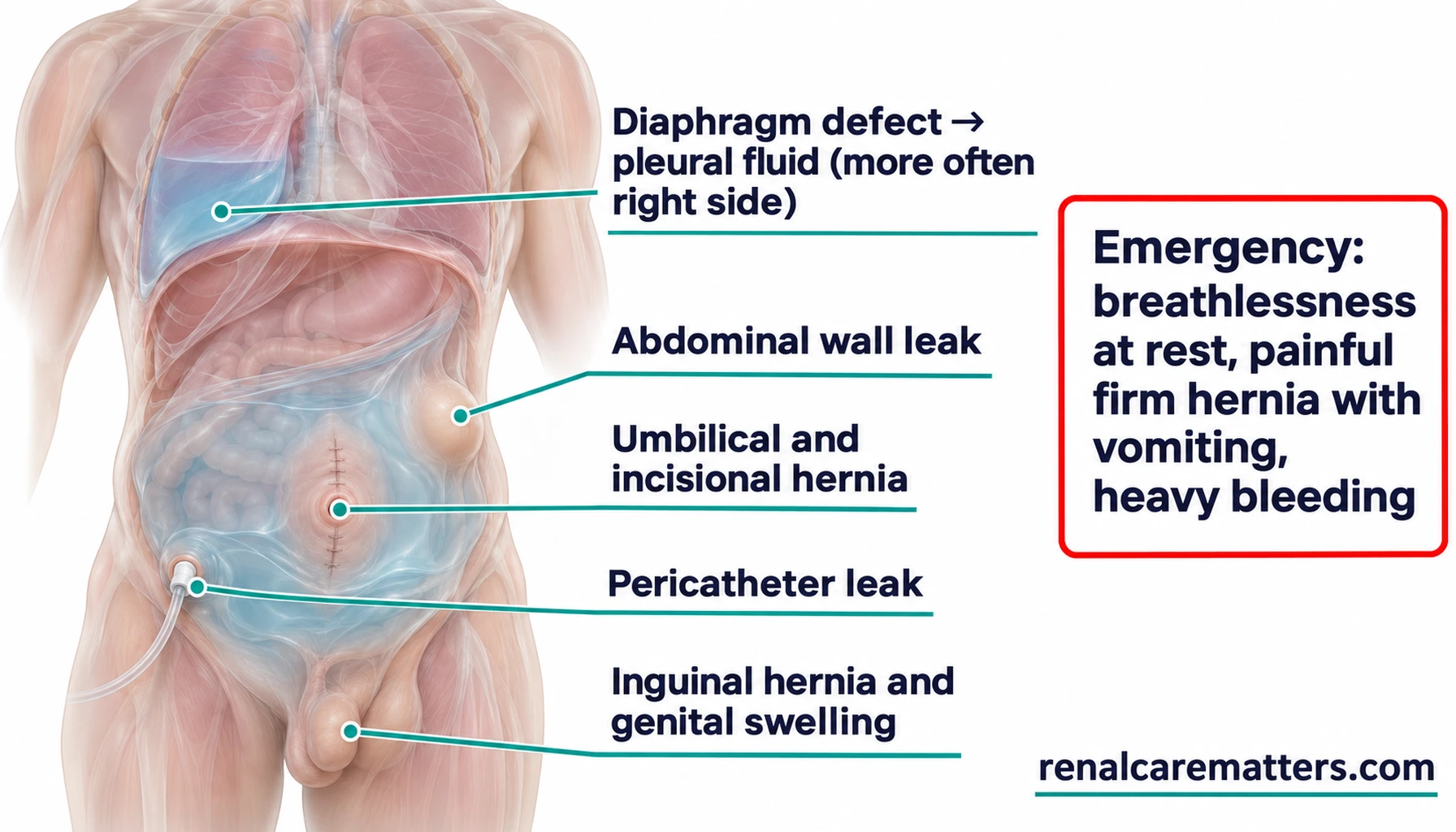
| Problem | Mechanism | What you see | Urgency |
|---|---|---|---|
| Outflow failure | Constipated bowel displaces catheter; catheter tip migrates out of pelvis; kinked tubing; fibrin plug; omentum wraps catheter | Fill normal, drain slow or incomplete; drain alarms; ultrafiltration (UF) falls | Same-day call if persistent; urgent if pain, fever or cloudy effluent |
| Pericatheter leak | Fluid tracks along tunnel, especially early after insertion or with large fills | Wet dressing, clear fluid at exit site (glucose-positive on testing per protocol) | Same-day; team decides on holding or reducing PD |
| Abdominal wall or genital leak | Fluid dissects into tissue planes | Asymmetric abdominal wall swelling, scrotal or labial swelling, falling UF | Same-day |
| Hernia | Raised pressure enlarges a weakness | Painless bulge that grows with fill | Routine to same-day; urgent if painful, firm, red or with vomiting (possible strangulation) |
| Pleural leak (hydrothorax) | Dialysate crosses a diaphragmatic defect, more often on the right | New breathlessness, especially after fills; falling UF | Urgent; stop fills and call |
| Pain on inflow | Solution temperature, acidity, rapid inflow, catheter jet | Pain at start of fill | Routine review; urgent if persistent or with cloudy effluent |
| Pain at end of drain | Catheter tip against bowel or bladder as fluid empties | Pain in last minutes of drain | Routine review; tidal automated peritoneal dialysis (APD) often considered by the team |
| Hemoperitoneum | Menstruation, ovulation, minor trauma, rarely serious intra-abdominal bleeding | Blood-tinged effluent | Report; urgent if heavy, persistent, with pain or hypotension |
| Fluid overload | Falling UF, falling urine, missed therapy, intake | Weight gain, edema, hypertension, dyspnea | Same-day; emergency if dyspnea at rest, chest pain, hypoxia |
Encapsulating peritoneal sclerosis is a rare, serious late complication in which the peritoneum thickens and encases the bowel. Symptoms include recurrent bowel obstruction, weight loss and falling UF, sometimes after PD has stopped. Report persistent obstructive symptoms in long-term or former PD patients.
Assess first
Before any troubleshooting, ask: When did it start? Which phase (fill, dwell, drain)? How much therapy was completed? Pain? Effluent clarity? Bowel pattern? Recent surgery, lifting or trauma? Swelling anywhere? Breathing?
Screen for emergencies: severe abdominal pain, respiratory distress or breathlessness at rest, syncope, altered mentation, unstable vital signs, signs of sepsis, painful irreducible hernia, heavy bleeding. These go to the emergency pathway. Any associated cloudy effluent or abdominal pain also activates the peritonitis pathway (PD07).
Safe troubleshooting
Permitted, if the patient is stable and the unit protocol allows: check clamps; look for kinks along the line; change position (stand, walk, lean, lie on the other side); confirm cycler or bag height; ask about bowel movements.
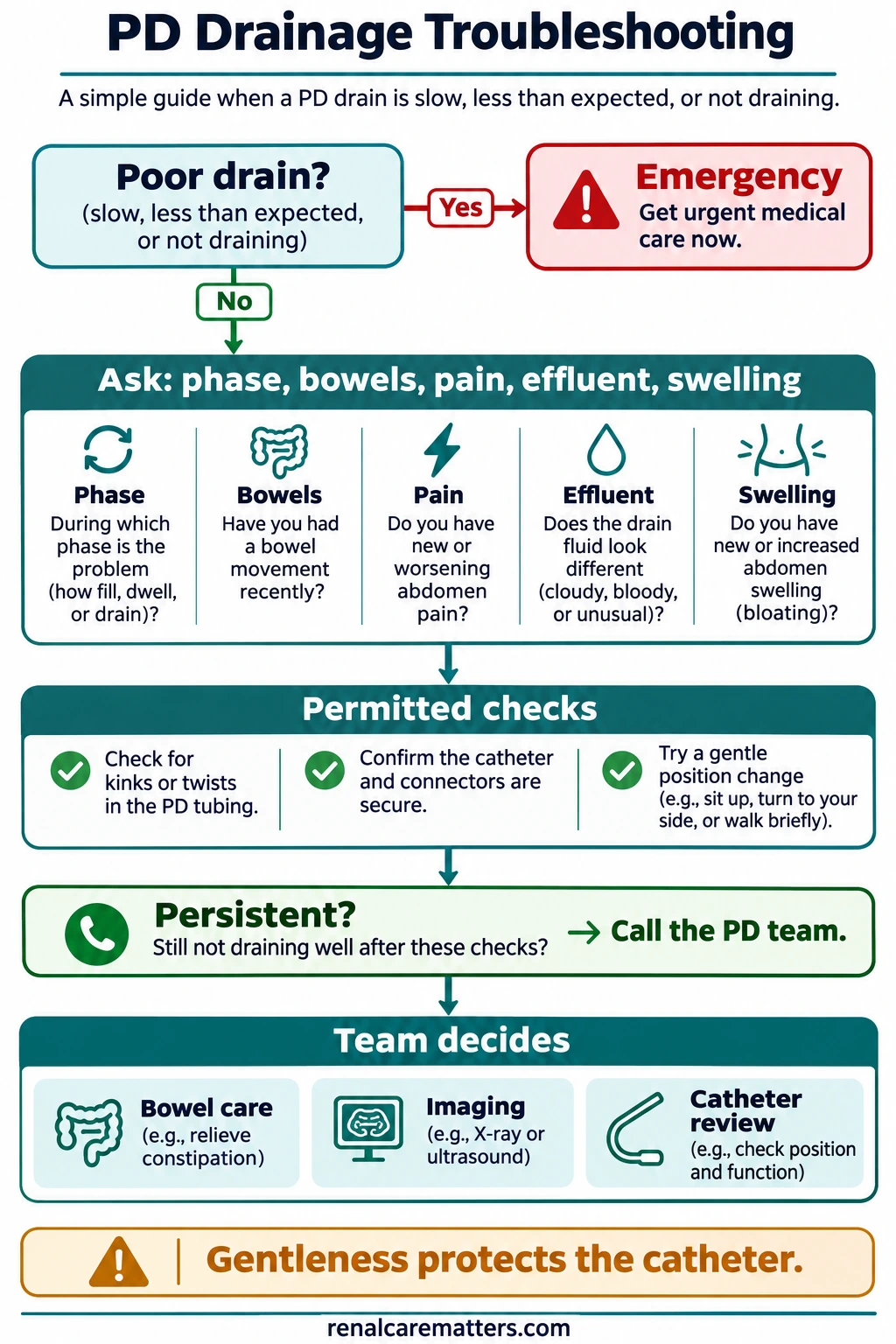
Not permitted unless specifically ordered and trained: forceful flushing with a syringe, aspiration, inserting anything into the catheter, unapproved cycler overrides, or continuing fills when a leak or breathlessness is present. Treatments such as intraperitoneal heparin for fibrin, laxatives, imaging and catheter repositioning are prescriber decisions.1
Anticipate disruption
The Philippines sees typhoons, floods, earthquakes, brownouts and heat waves. PD can continue through many of these if the patient has planned.
At training and every few months, review:
| Plan element | What the patient should know or have |
|---|---|
| Contacts | PD unit hours, after-hours number, backup contact, nearest emergency department |
| Supplies | At least the reserve the program recommends; storage off the floor and away from floodwater |
| Power | For APD: prescribed backup CAPD regimen, supplies for it, and validated competence; whom to tell about planned outages |
| Evacuation | A go-bag with solutions, connection supplies, caps, medicines, records and the current order |
| Missed therapy | How to report; what symptoms mean urgent care |
| Heat | Storage temperature limits for solutions; recognizing dehydration versus overload |
The site’s guides on typhoon and disaster preparedness and on heat and dialysis give patient-facing language you can reuse.
Back to the case: Three pillows at 9 PM
9:03. Liezl asks: Is he breathless at rest now? ("A bit, even sitting.") Chest pain? (No.) Confusion? (No.) Swelling? (Legs up to knees.) Effluent? (Clear.) Abdominal pain? (Bloated, not severe.)
9:05. Liezl recognizes possible acute fluid overload with breathlessness at rest. This changes the priority. She does not try position changes or more exchanges over the phone. She directs urgent emergency evaluation through the local pathway, tells the family to call an ambulance if he worsens, and calls the nephrologist on duty with Situation, Background, Assessment, Recommendation (SBAR): last completed exchange, drain volumes for three days, weight if known, bowel history, breathlessness at rest, clear effluent.
Next day. After stabilization, the team addresses constipation and catheter function. Liezl arranges a bowel-care teaching session and a follow-up drain check.
Take-home. Breathlessness at rest turns a drain problem into an emergency. Troubleshoot later.
Skills checklist: After-hours outage call
Simulate an after-hours power-failure call for an APD patient. Confirm stability, whether the patient is connected, how much therapy was delivered, whether a prescribed backup plan exists, supplies on hand, and when power is expected back. Document and close the loop. Your preceptor rates each step as satisfactory, needs practice, or not observed. Steps marked Critical must all be satisfactory before sign-off. This checklist supports supervised learning; your unit’s own procedure and competency form are the authority. A printable version of every checklist is on the trainer page.
- CriticalConfirms the patient is stable before troubleshooting.
- Confirms connection status and therapy delivered.
- CriticalConfirms a prescribed backup plan, supplies and validated competence before backup CAPD.
- CriticalUses only permitted external checks.
- Documents and closes the loop with a named clinician.
Check your understanding
Each visit draws 5 questions at random from this module’s 15-question bank. Choose the single best answer for each, then select Check answers; an explanation appears under the best answer. Select New set of questions for a different mix. A good target is 4 of 5 on two different sets. Nothing you select is sent anywhere; scoring happens in your browser.
Read next on this site
- Typhoon and Disaster Preparedness in DialysisDisaster preparedness for dialysis patients.
- El Niño, Heat, and DialysisHeat and dialysis.