After this module you should be able to
- Explain how peritonitis develops through the intraluminal, periluminal, transmural (enteric) and hematogenous routes, and what each implies for prevention.
- Apply the 2022 International Society for Peritoneal Dialysis (ISPD) diagnostic criteria to understand the team’s assessment, including the short-dwell automated peritoneal dialysis (APD) caveat.
- Activate the peritoneal dialysis (PD) pathway on suspicion, screen for instability, and coordinate effluent sampling so that culture-negative results stay rare.
- Use the 2022 ISPD outcome definitions (refractory, relapsing, recurrent, repeat, catheter-related, enteric, pre-PD) in follow-up documentation.
- Lead post-episode prevention: technique review, retraining and modifiable risk factors.
The big picture, in plain words
Peritonitis is the complication that most often ends PD. It drives hospitalization, catheter removal, transfer to hemodialysis and, in severe or fungal cases, death. In Peritoneal Dialysis Outcomes and Practice Patterns Study (PDOPPS), an international cohort of 7,051 adults, the crude rate was 0.28 episodes per patient-year, and one facility in ten exceeded 0.50. Most episodes respond to prompt antibiotics. The difference between a cured episode and a lost catheter is often hours: how fast the patient calls, how fast the sample is taken, how fast treatment starts. Your work is to make those hours short.1
The picture has a limit. The peritoneum is not passive: it has macrophages and recruits neutrophils within hours. That is why effluent turns cloudy. Cloudiness is the body’s defense made visible, white cells by the billions. It is the alarm, not the damage itself. The damage comes when the defense is overwhelmed or the organism is hard to kill.
Case: Coconut milk at 6:40 AM
Lola Aida, 74, on APD, assisted by her granddaughter Mika, calls at 6:40 AM. Nurse Ramon is on call.
6:40. Mika reports the drain bag "looks like gata" (coconut milk). Lola Aida has chills and mild abdominal discomfort. No vomiting. She is alert and talking.
Before reading on, decide:
- Is this peritonitis until proven otherwise?
- What do you screen for in the first five minutes?
- What must be in your handoff before you hang up?
Keep your answers in mind. The lesson gives you what you need, and the case review near the end shows one sound response.
The physiology
| Route | How | Typical organisms | Prevention focus |
|---|---|---|---|
| Intraluminal (touch) | Contamination at connection | Skin flora, coagulase-negative staphylococci | Technique, flush before fill, contamination response (PD04) |
| Periluminal | Along the outside of the catheter from an infected exit site or tunnel | S. aureus, P. aeruginosa | Exit-site care (PD03) |
| Transmural (enteric) | Across the bowel wall in constipation, diverticulitis, colitis | Gram-negative rods, mixed enteric flora, anaerobes | Bowel care, hypokalemia correction, antibiotic prophylaxis before invasive procedures |
| Hematogenous / ascending | Bloodstream, gynecologic | Streptococci, others | Procedure prophylaxis |
Why the abdomen hurts. Inflammation of the parietal peritoneum stimulates somatic pain fibers. Pain can be absent early, especially in APD or in older or diabetic patients. That is why cloudy effluent without pain still counts.
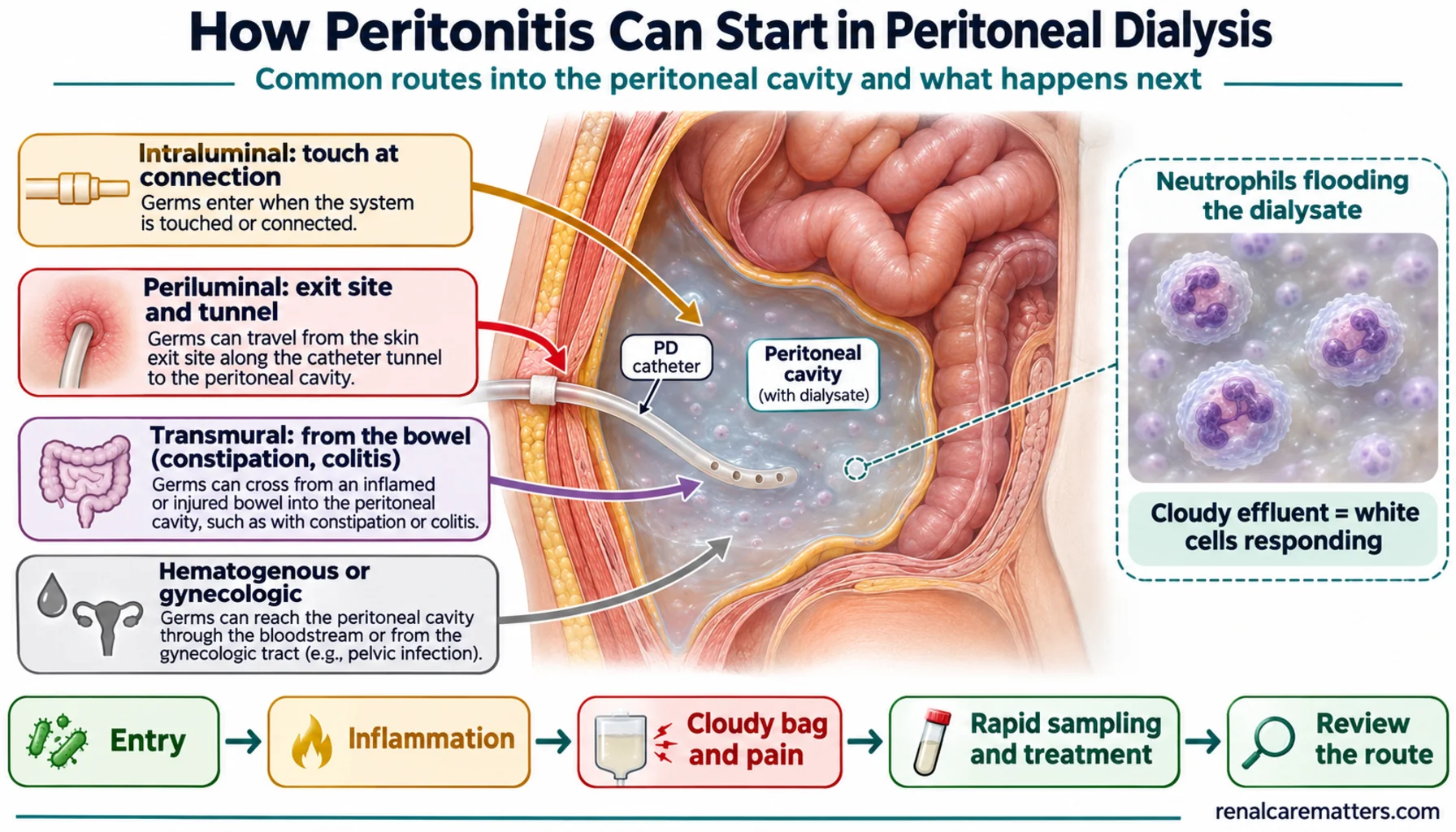
Why ultrafiltration falls. Inflammation increases capillary surface area and permeability. Glucose is absorbed faster, the osmotic gradient fades faster, and ultrafiltration (UF) falls. Patients may become fluid overloaded during an episode. Protein loss rises.
Diagnosis (ISPD 2022)
The 2022 ISPD recommendations diagnose peritonitis when at least two of the following are present (GRADE 1C):2
- Clinical features consistent with peritonitis: abdominal pain and/or cloudy dialysis effluent.
- Dialysis effluent white cell count above 100/µL (above 0.1 × 10⁹/L) after a dwell of at least 2 hours, with more than 50% polymorphonuclear leukocytes.
- Positive dialysis effluent culture.
Short APD dwells. Because cycler dwells are short, the absolute white cell count may be lower than 100/µL even during real peritonitis. The proportion of polymorphonuclear cells above 50% remains meaningful. This is why you always record dwell duration with the sample.
Not all cloudy effluent is infection. Other causes include chemical irritation, eosinophilic effluent (often early after insertion), chylous effluent (milky, lipid-rich), hemoperitoneum (blood-tinged, for example during menstruation), malignancy, and reactions associated with some solutions or medications. The team sorts these out. You treat every cloudy bag as possible peritonitis until the team says otherwise.
What you do: the first hour
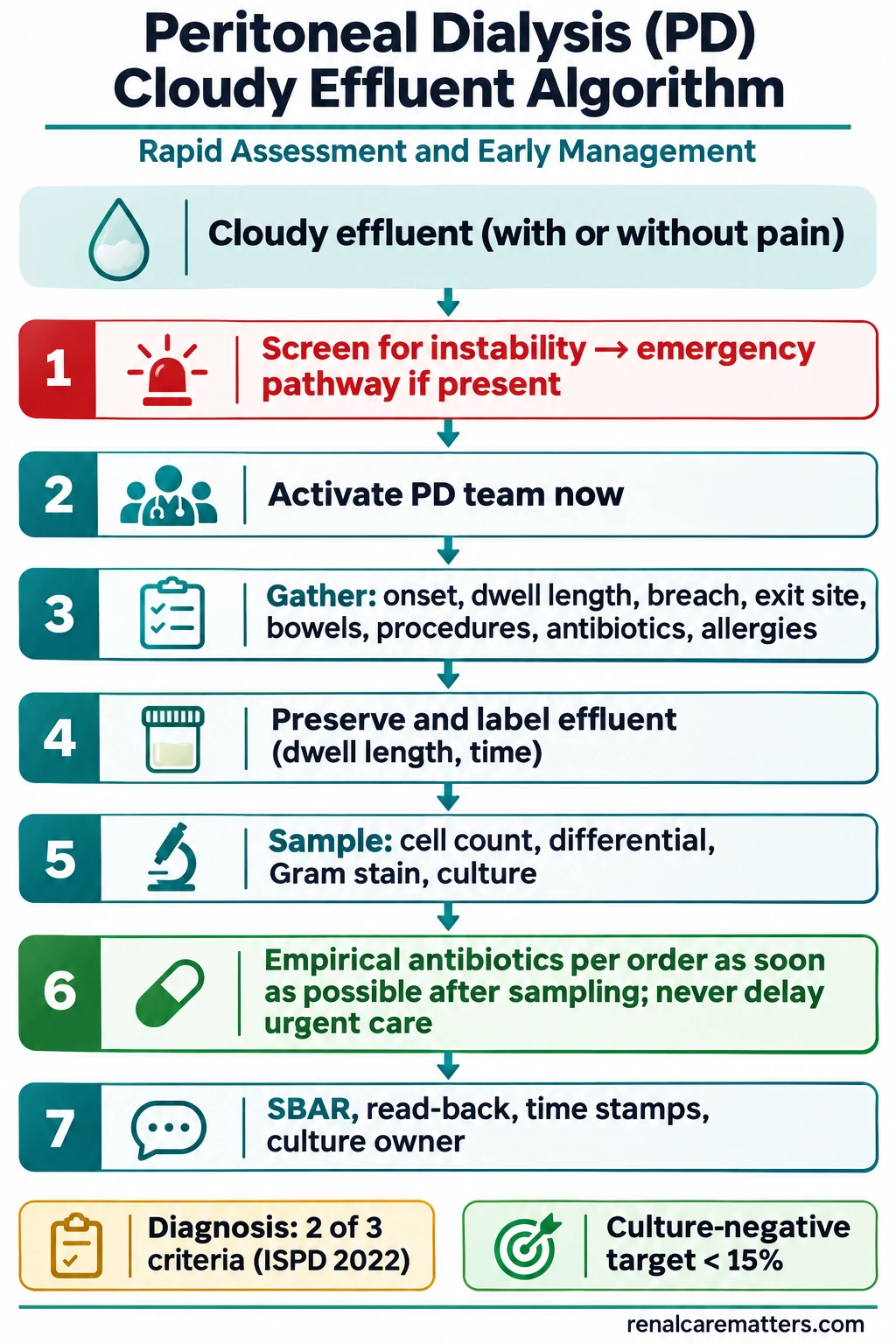
- Recognize and activate. Cloudy effluent, with or without pain, means immediate PD team contact.
- Screen for instability. Fever with rigors, hypotension, confusion, severe pain, vomiting preventing oral intake, rapid breathing. Use emergency services or the emergency department per the local pathway.
- Gather the facts. Onset; last exchange and dwell length; recent contamination or breach; exit-site changes; constipation or diarrhea; recent procedures (colonoscopy, dental, gynecologic); recent antibiotics; allergies; prior episodes and organisms.
- Preserve the effluent. Instruct the patient to keep the cloudy bag, closed and labeled, and bring it, or follow the program’s instructions for the first bag. If the patient presents with a dry abdomen (for example APD with no day dwell), the unit protocol may call for a fill and a short dwell before sampling.
- Coordinate sampling. Cell count and differential, Gram stain and culture, per protocol. Blood-culture bottle inoculation of effluent is the preferred culture technique in ISPD guidance; follow your laboratory’s exact volumes and transport times. Label with dwell duration and collection time.
- Do not delay treatment. Empirical antibiotics, usually intraperitoneal, covering both gram-positive and gram-negative organisms, should start as soon as possible after specimens are taken. Collection before antibiotics is preferred when feasible, but must not delay urgent care. Antibiotic choice and dose are the prescriber’s; administration follows the written order or standing protocol.
- Close the loop. Situation, Background, Assessment, Recommendation (SBAR) to the accepting clinician, read-back, time stamp, disposition (admit, treat at home with return visit, emergency), and who will follow the culture.
Program quality markers (ISPD 2022)
| Marker | 2022 target |
|---|---|
| Overall peritonitis rate | No more than 0.40 episodes per year at risk |
| Patients free of peritonitis per year | More than 80% |
| Culture-negative episodes | Less than 15% of all episodes (GRADE 1C) |
A culture-negative rate above 15% usually points to sampling or laboratory problems, or to antibiotics given before sampling. Nurses control much of that.
PDOPPS country rates ranged from 0.26 episodes per patient-year in the United States to 0.40 in Thailand; Thailand had more gram-negative and culture-negative episodes. Philippine program data should be compared against these figures with care, because definitions and case-finding differ.1
Follow-through and outcome definitions
The 2022 update revised and clarified these definitions. Use them in documentation so episodes are counted consistently:2
| Term | Meaning |
|---|---|
| Refractory | Failure of the effluent to clear after 5 days of appropriate antibiotics. The 2022 update allows expectant management beyond day 5 if the effluent white cell count is falling toward normal, rather than mandatory catheter removal. |
| Relapsing | An episode within 4 weeks of completing therapy for a prior episode, with the same organism or one sterile episode |
| Recurrent | An episode within 4 weeks of completing therapy, with a different organism |
| Repeat | An episode more than 4 weeks after completing therapy, with the same organism |
| Catheter-related | Peritonitis with an exit-site or tunnel infection with the same organism (or one site sterile) |
| Enteric | Peritonitis arising from an intestinal source (inflammation, perforation or ischemia) |
| Pre-PD | Peritonitis after catheter insertion but before PD training or treatment begins |
| Medical cure | Resolution without complications such as relapse, catheter removal, hemodialysis transfer or death |
Nursing follow-through: repeat cell counts as ordered, track culture and sensitivities, confirm the antibiotic course is complete, watch UF and weight during the episode (UF often falls), watch for hearing changes if aminoglycosides are used (the 2022 update added a recommendation on adjunctive oral N-acetylcysteine to mitigate aminoglycoside ototoxicity, a prescriber decision), and confirm antifungal prophylaxis if the program uses it whenever antibiotics are given.2
Prevention after every episode
Every episode is a signal. Review it as a team:
- Root cause. Which route? Touch, exit site, bowel, procedure?
- Technique. Observe a full exchange. The 2022 ISPD update revised its recommendations on training and reassessment; retraining after peritonitis is standard practice.
- Modifiable risk factors named in 2022: domestic pets in the exchange area, hypokalemia, and histamine-2 receptor antagonist use. Report these to the prescriber; do not change medicines yourself.
- Procedures. Antibiotic prophylaxis before invasive procedures such as colonoscopy or gynecologic procedures, and emptying the abdomen beforehand, per the revised recommendations and the prescriber’s order.
Back to the case: Coconut milk at 6:40 AM
6:45. Ramon screens: temperature 38.2 °C on their thermometer, no confusion, no dizziness on standing, pulse 96 by Mika’s count. Last night’s cycler dwell was about 1 hour 30 minutes. No known contamination. Exit site dry. Last bowel movement three days ago. No recent procedures. Allergy: none known.
6:52. Ramon activates the PD pathway: calls the nephrologist on duty with SBAR. Situation: cloudy effluent, chills, fever 38.2 °C, hemodynamically stable by home assessment. Background: 74, APD, assisted by granddaughter, no prior peritonitis. Assessment: suspected peritonitis, short APD dwell (record for cell count interpretation), possible constipation. Recommendation: urgent same-morning assessment at the PD unit for sampling and empirical treatment; emergency department if she becomes unstable before arrival.
6:58. The nephrologist accepts. Ramon reads back the plan. He tells Mika to clamp and bring the drain bag (or a sample per protocol), to bring Lola’s medicines, and to call 911 or go to the nearest emergency department if Lola becomes confused, faint or breathless on the way.
8:10. At the unit, samples are sent, labeled with dwell duration and collection time. Empirical intraperitoneal antibiotics start per order at 8:25. Ramon documents times from call to sample to first dose, the accepting clinician, and who will review the culture at 48 hours. He schedules technique review with Mika after the episode.
Skills checklist: Cloudy bag with pain (OSCE station 3)
Run a timed mock call. Deliver SBAR, document read-back, disposition and time stamps. Faculty scores against objective structured clinical examination (OSCE) station 3 in FACULTY.md. Your preceptor rates each step as satisfactory, needs practice, or not observed. Steps marked Critical must all be satisfactory before sign-off. This checklist supports supervised learning; your unit’s own procedure and competency form are the authority. A printable version of every checklist is on the trainer page.
- CriticalRecognizes urgency and activates the PD pathway.
- CriticalChecks for systemic instability and routes emergency care as indicated.
- Preserves the specimen and coordinates timely sampling under protocol.
- Relays SBAR and obtains read-back.
- Time-stamps contact and disposition.
Check your understanding
Each visit draws 5 questions at random from this module’s 15-question bank. Choose the single best answer for each, then select Check answers; an explanation appears under the best answer. Select New set of questions for a different mix. A good target is 4 of 5 on two different sets. Nothing you select is sent anywhere; scoring happens in your browser.
Read next on this site
- Antibiotic Stewardship in Hemodialysis: Using Antibiotics WiselyAntibiotic stewardship in dialysis units.
- Dialysis Access InfectionDialysis access infections.