Same trousers
- What you see
- A child’s height has not changed in a year.
- What is likely going on
- Growth failure.
- What to do
- Confirm measurement, plot, report with velocity.
- Why it matters
- Height lost is hard to regain.
Growth as an outcome, feeding and the renal dietitian, growth hormone candidacy, anemia and bone in children.

This module is study material for registered nurses in pediatric dialysis. It explains the reasoning behind common nursing decisions; it is not a procedure. Exact steps follow your unit’s pediatric protocol and the device instructions; treatment parameters follow the written order of the pediatric nephrologist. Nurses assess, verify, teach, document and escalate; they do not prescribe, choose antibiotics, change doses or adjust anticoagulation. Every case is fictional and every value in a case is illustrative. Pending review by a pediatric nephrologist and a senior pediatric dialysis nurse.
For an adult on dialysis, success is staying well. For a child, success also means growing. Growth failure is one of the hardest problems in pediatric chronic kidney disease (CKD), and it does not repair itself: height lost in childhood is often not regained. Growth is therefore an outcome in its own right, measured at every visit and plotted on a chart.
Your work in this module is to measure accurately, plot honestly, reinforce the feeding plan, and notice when anemia or bone disease is holding a child back.
The picture has a limit. More bricks do not always build a better house. Feeding a child more calories without enough protein, or without controlling phosphate and acid, adds fat rather than height, and some children on tube feeds become overweight. Growth needs the whole plan, which is why a renal dietitian leads it.
Figure 1 · Key terms for this module
Rafael Cruz, 7, has been on peritoneal dialysis (PD) for two years. His mother jokes that he still fits the trousers he wore when he started. On the clinic stadiometer he measures 112 cm; the chart shows his height below the 3rd percentile and his height velocity below the 25th percentile for the past year. His appetite is poor, and he often refuses the evening feed. Nurse Cathy plots the numbers.
Before reading on, decide:
Keep your answers in mind. The lesson gives you what you need, and the case review near the end shows one sound response.
Measure the same way every time (Module 4), plot on the reference chart your unit uses, and look at the line, not one point. Two numbers matter most: height for age and height velocity.
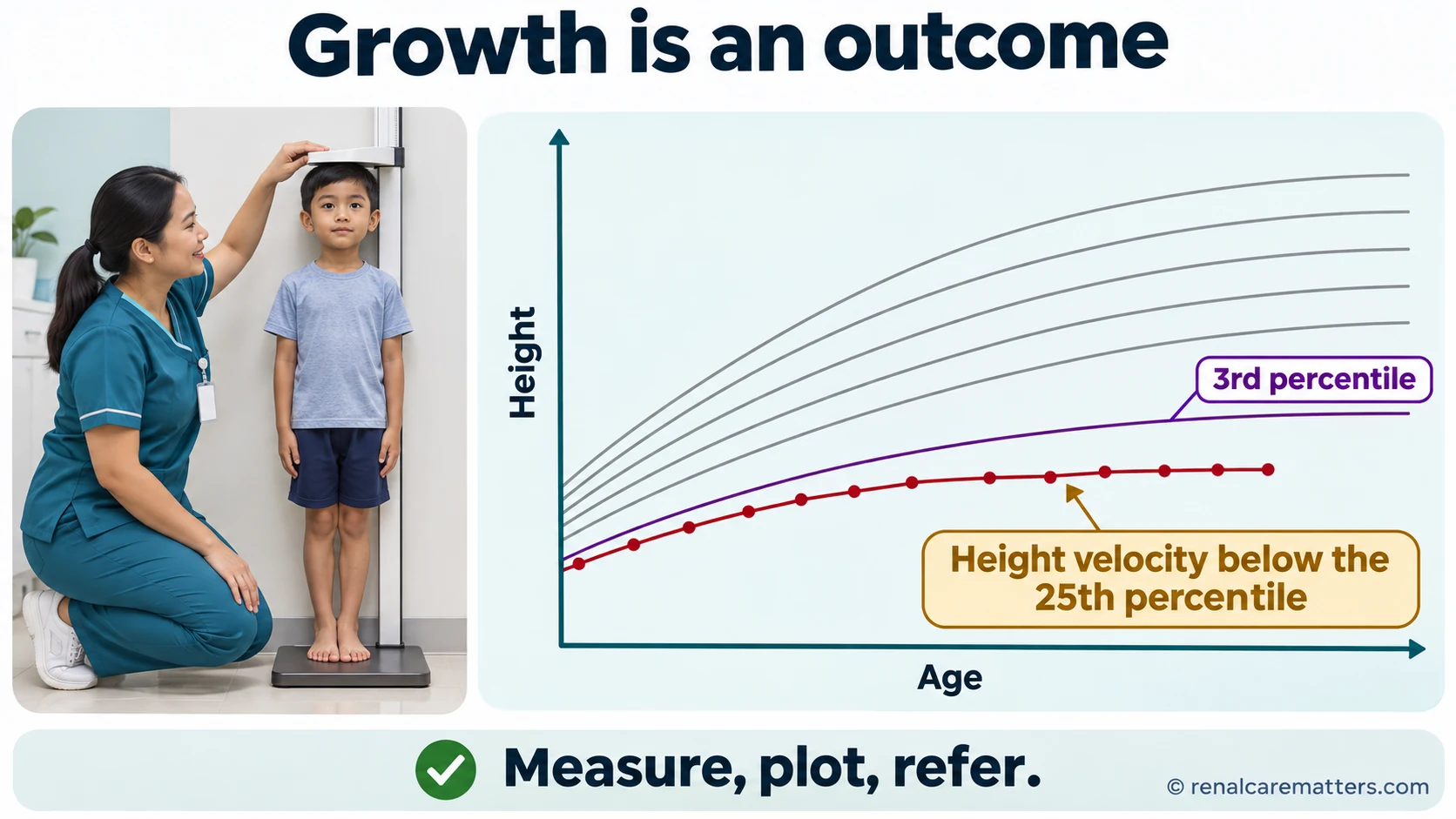
The European Society for Paediatric Nephrology clinical practice recommendations state that children with CKD stages 3 to 5 or on dialysis should be candidates for growth hormone if they have persistent growth failure, defined as height below the 3rd percentile for age and sex and height velocity below the 25th percentile, once other treatable causes have been addressed and the child still has growth potential.1 The treatable causes include poor intake, acidosis, bone-mineral disorder and anemia. The decision belongs to the pediatric nephrologist; your accurate measurements are its evidence.
Nutrition problems in children on PD are common and vary by region. In the International Pediatric Peritoneal Dialysis Network (IPPN) registry of 1,001 children from 35 countries, 8.9% were underweight and 19.7% overweight or obese at the start of PD; underweight was most prevalent in South and Southeast Asia (20%).2
Children on dialysis often eat poorly: uremia dulls appetite, PD fluid fills the abdomen and absorbs glucose, medicines taste bad, and infants may vomit. PD also removes protein into the dialysate. The Pediatric Renal Nutrition Taskforce (PRNT) recommendations address energy needs in poor growth and obesity, the extra protein needed to replace dialysate losses, and how to deliver the plan with breast milk, formula, food and supplements.3 Many of their statements carry low grades or rest on opinion and must be adapted by the treating physician and dietitian.
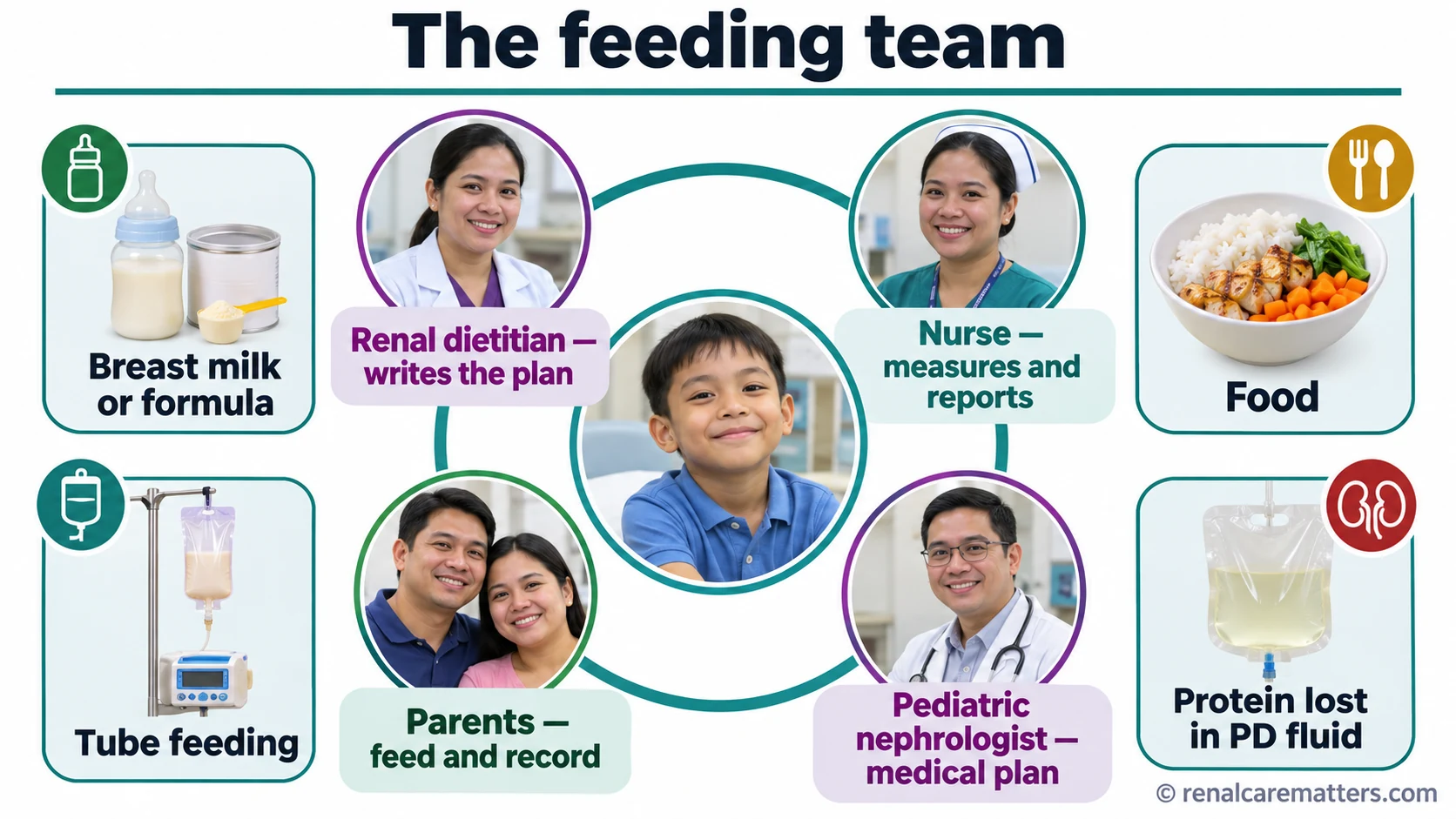
| Nurse’s task | Why |
|---|---|
| Weigh and measure accurately | The dietitian’s plan depends on it |
| Ask what the child actually ate and kept down | Prescribed feeds and delivered feeds often differ |
| Check gastrostomy sites and tube function | Feeds stop when tubes block or sites become sore |
| Reinforce the plan in the family’s food culture | Rice, soups and snacks are part of Filipino meals; advice must fit them |
| Report vomiting, refusal and weight change | The plan may need changing |
Anemia in CKD comes mainly from too little erythropoietin and from iron deficiency, worsened by blood losses from sampling and circuits. In a child it shows as pallor, tiredness, poor school stamina and breathlessness on play. Treatment with erythropoiesis-stimulating agents and iron follows the pediatric nephrologist’s orders.
CKD-mineral and bone disorder begins early in childhood CKD: phosphate rises, active vitamin D falls, parathyroid hormone rises, and growing bones deform or fracture. Signs include bone pain, limping, bowed legs or knock knees, and slow growth. Phosphate binders must be taken with meals to work, which is hard for children who graze or refuse food; ask how they are taken.
Minimize blood sampling to what is ordered and record volumes (Module 13). A growing child’s blood volume is small, and avoidable losses worsen anemia.
These are fictional but typical. For each one, cover the answer, decide what you would do, then compare. Where a step depends on local rules, your unit’s procedure and your supervisor’s direction come first.
Growth failure? Height below the 3rd percentile and height velocity below the 25th percentile over a year fit the ESPN definition. Cathy first confirms the measurement technique and plotting, then reports.
Growth hormone. The pediatric nephrologist decides, after addressing treatable causes such as intake, acidosis, bone disease and anemia, and if Rafael still has growth potential.
Feeding. Cathy records what he actually eats and refuses, asks whether the evening feed coincides with a full abdomen after a PD fill, and refers to the renal dietitian for a revised plan that fits the family’s meals.
Use growth charts and fictional records. Your preceptor rates each step as satisfactory, needs practice, or not observed. Steps marked Critical must all be satisfactory before sign-off. This checklist supports supervised learning; your unit’s own procedure and competency form are the authority. A printable version of every checklist is on the trainer page.
Each visit draws 5 questions at random from this module’s 15-question bank. Choose the single best answer for each, then select Check answers; an explanation appears under the best answer. Select New set of questions for a different mix. A good target is 4 of 5 on two different sets. Nothing you select is sent anywhere; scoring happens in your browser.
Module 17 of 203 modules to go

Internal Medicine · Nephrology · Nutrition · Philippines · PRC 0105184
Educational material for registered nurses. Completing it is an Academy learning record only. It does not confer CPD units, PSN or National Kidney and Transplant Institute (NKTI) training recognition, PhilHealth staffing credit, or clinical privileges, and it does not replace your facility’s protocols, device instructions, or written orders.

Scan and save