Nephrology Nursing specialty subtrack for pediatric dialysis
This module is study material for registered nurses in pediatric dialysis. It explains the reasoning behind common nursing decisions; it is not a procedure. Exact steps follow your unit’s pediatric protocol and the device instructions; treatment parameters follow the written order of the pediatric nephrologist. Nurses assess, verify, teach, document and escalate; they do not prescribe, choose antibiotics, change doses or adjust anticoagulation. Every case is fictional and every value in a case is illustrative. Pending review by a pediatric nephrologist and a senior pediatric dialysis nurse.
Learning objectives
After this module you should be able to
Recognize early warning signs in a child on dialysis before blood pressure falls.
Take the first nursing actions for the main dialysis emergencies: hyperkalemia, hypotension, air in the circuit, bleeding and disconnection, dialyzer reactions, seizures and hypoglycemia.
Prepare the pediatric emergency equipment and the team for a resuscitation at the dialysis chair.
Hand over a child in an emergency with a structured format.
Classroom 3 hSkills lab 4 hSupervised placement 4 h
Pre-testBefore you read, answer the 5 self-assessment questions and note your score. After the module, select New set of questions and compare. The difference is what you learned; the questions you still miss are what to reread.
Start here
The big picture, in plain words
Most children on dialysis never have a dialysis emergency, which is why staff forget what to do when one happens. Children also hide trouble well: their hearts speed up and their vessels tighten, so blood pressure stays normal until it suddenly does not. Emergencies in children are often recognized late and treated well; the aim is to recognize them early.
Your work in this module is to see the early signs, take the first protective actions in seconds, and call a team that already knows its roles.
In plain wordsThink of a child’s circulation as a tightrope walker with a long pole. The pole (compensation) keeps the walker steady through many wobbles, so from the ground everything looks fine. When the pole is finally lost, the fall is fast.
The picture has a limit. You can see the pole if you know where to look: a rising heart rate, slower capillary refill, cool hands, a change in behavior. These are the wobbles. Watching for them is how you act before the fall.
Figure 1 · Key terms for this module
Compensated shockPoor tissue perfusion with blood pressure still normal.
Capillary refill timeSeconds for color to return after pressing a fingertip or sternum.
HyperkalemiaHigh blood potassium; can cause dangerous heart rhythms.
Air embolismAir entering the bloodstream from the circuit.
Pediatric resuscitationAge-specific life support taught in courses such as Pediatric Advanced Life Support (PALS).
Opening case · fictional
Case: The missed Friday
Rey Fernandez, 15, 45 kilograms, missed Friday’s hemodialysis for a school event and arrives Monday morning. He feels weak, his legs feel “heavy”, and his pulse is slow and irregular. The monitor shows tall, peaked T waves. His pre-dialysis potassium sample has just been sent. Nurse Mae is setting up.
Before reading on, decide:
What does Mae suspect, and what does she do in the first minute?
Should she wait for the laboratory result before calling?
What does the team need to have ready?
Keep your answers in mind. The lesson gives you what you need, and the case review near the end shows one sound response.
Lesson · part 1
Recognize early
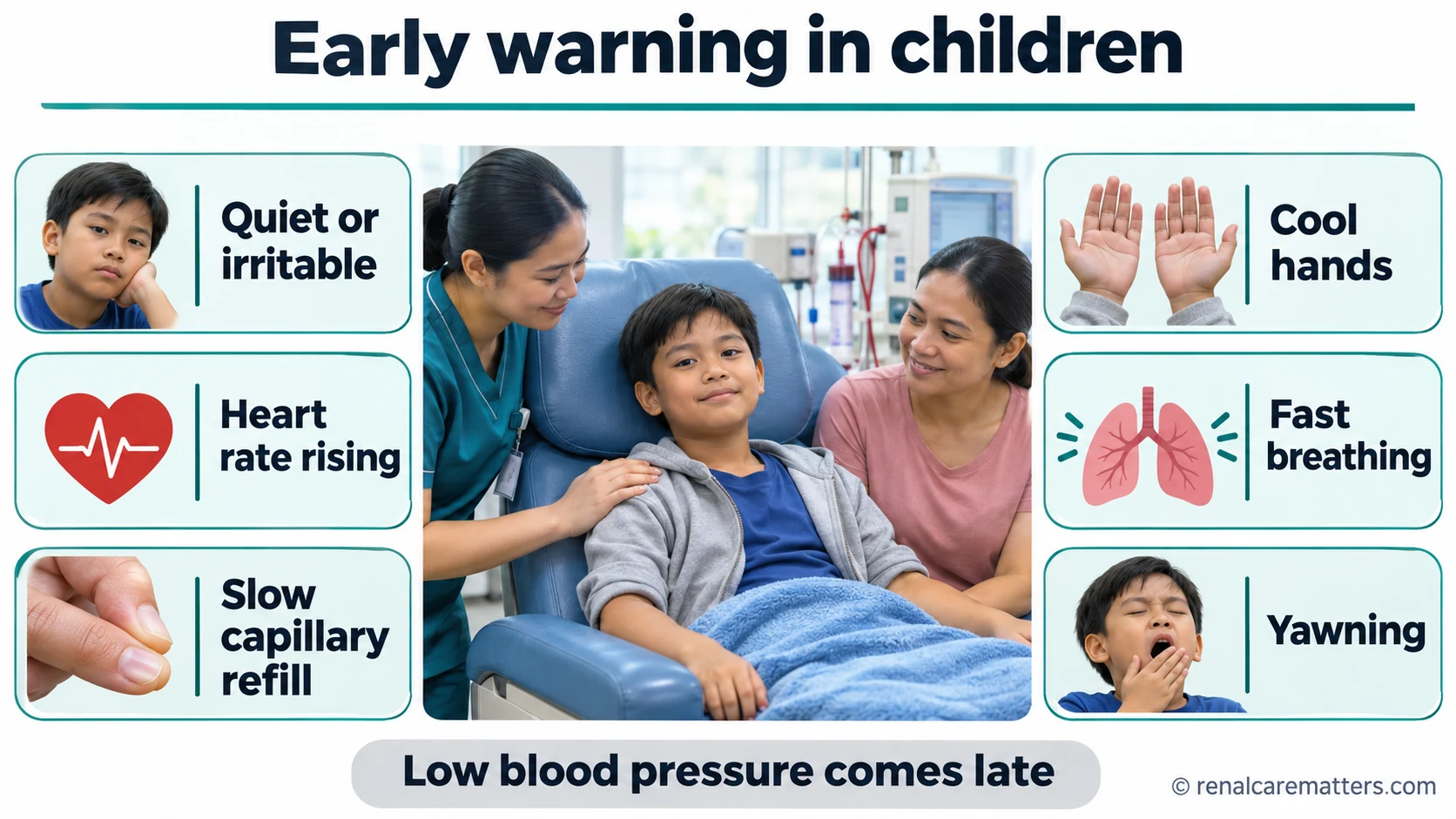
In children, falling perfusion shows first in heart rate, skin and behavior. Low blood pressure is a late sign (Module 4).
Figure 2. Early warning in children. Compensation hides shock until it fails; behavior and heart rate change first.
Domain
Early warning
Behavior
Unusually quiet, irritable, restless, confused, hard to wake, floppy in an infant
Circulation
Heart rate rising above the child’s baseline, capillary refill slowing, cool or mottled hands and feet
Breathing
Fast breathing, grunting, flaring, retractions; consider fluid overload, pleural leak in peritoneal dialysis (PD), or acidosis
Symptoms
Chest pain, abdominal pain, severe headache, muscle weakness, palpitations
Use your unit’s pediatric early warning score if it has one, and trust your concern even when the score is low.
RememberBehavior, heart rate and capillary refill change before blood pressure. Call on the wobble, not the fall.
Lesson · part 2
Dialysis emergencies: first actions
For each emergency below, the first nursing actions protect the child in seconds. Treatments such as medicines follow the unit’s emergency protocol and the team’s orders. The 2025 American Heart Association guidance on special circumstances of resuscitation covers adult and pediatric life-threatening hyperkalemia among other situations.1
Emergency
What you see
First nursing actions
Hyperkalemia
Weakness, slow or irregular pulse, peaked T waves or other electrocardiogram (ECG) changes; often after missed sessions
Monitor, call the team at once, prepare emergency drugs per protocol, do not wait for the laboratory value if the ECG is abnormal
Hypotension
Yawning, pallor, rising heart rate, then falling pressure
Lay flat, reduce or stop ultrafiltration per protocol, call; fluids only as ordered
Air in the circuit
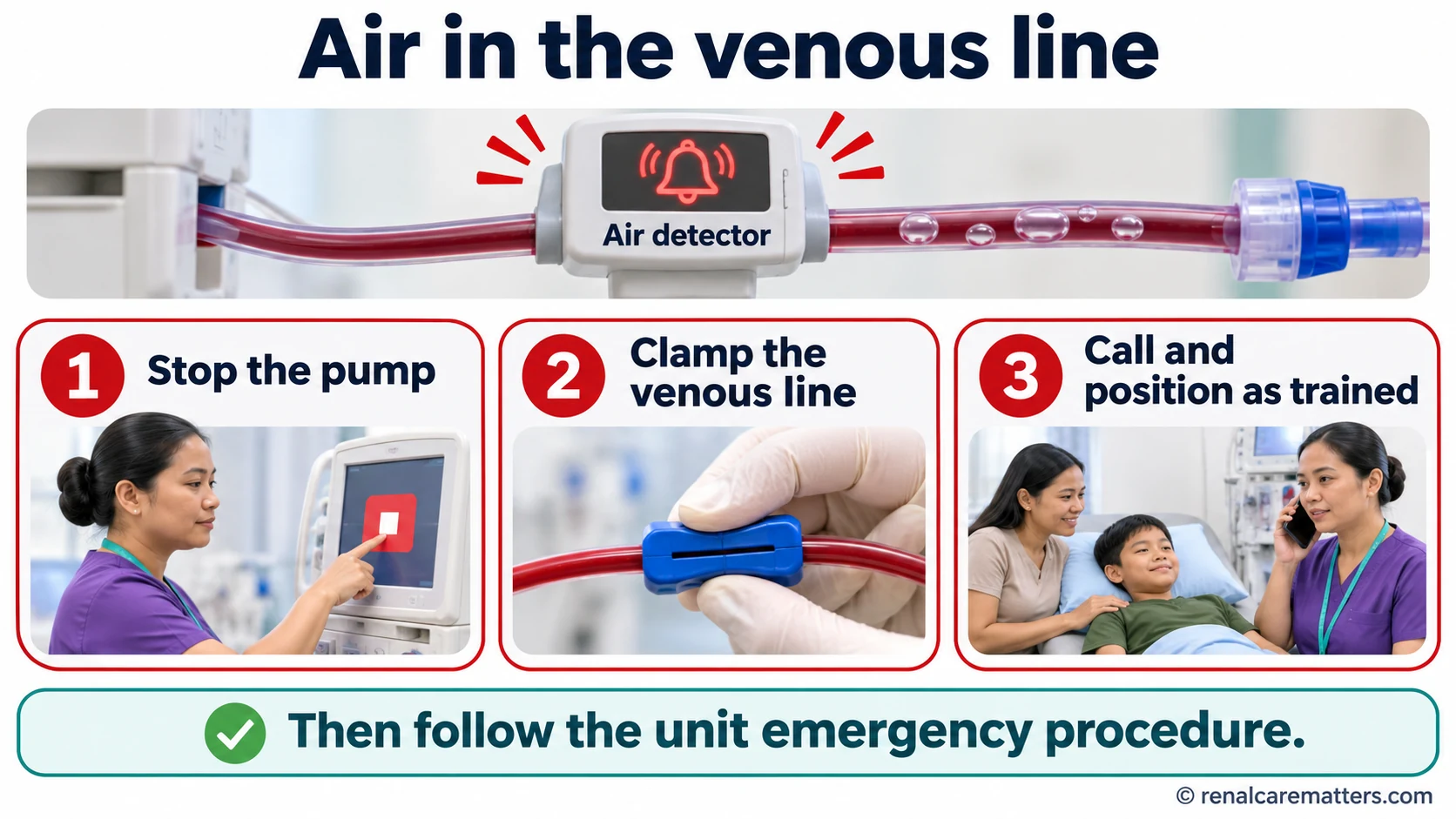
Air detector alarm, foam in the venous line, sudden breathlessness or chest pain
Stop the pump, clamp the venous line, call for help, position as trained, oxygen per protocol
Bleeding or disconnection
Blood at a connection or needle site; a separated line
Stop the pump, clamp the catheter and line, apply pressure, call; estimate loss
Dialyzer or drug reaction
Itching, flushing, breathlessness, wheeze, hypotension early in the session
Stop, do not return the blood if a severe reaction is suspected (per protocol), call
Seizure
Convulsion, often with disequilibrium, hypoglycemia or hypertension
Protect the child and access, stop the pump per protocol, check glucose, call
Hypoglycemia
Sweating, shakiness, drowsiness, especially in infants
Check glucose, treat per protocol, call
Figure 3. Air in the venous line. Stop, clamp, call; then follow the unit’s emergency procedure.
RememberStop the pump, clamp, call. Then follow the protocol. In children, the first ten seconds are nursing seconds.
Lesson · part 3
The team response
A resuscitation at a dialysis chair is harder than on a ward: the child is connected to a machine, the lines can pull, and the family is often in the room. Preparation decides the outcome.
Equipment: a pediatric emergency cart with sizes for the children you treat, a weight-based drug reference approved by the unit, suction, oxygen and bag-valve masks of the right sizes, a defibrillator with pediatric pads, checked and logged daily.
Roles: leader, airway, compressions, drugs and recorder, machine and access (stop, clamp, decide on blood return with the leader), family support.
Credentials: pediatric resuscitation training as your employer requires; the Philippine regional licensing tool lists basic life support for nurses and at least one nurse trained in advanced cardiac life support each shift, which is an adult standard, so pediatric preparation is a local decision.
Drills: rare events are practiced in simulation and recorded as simulation.
Hand over with a structured format such as Illness severity, Patient summary, Action list, Situation awareness, Synthesis by receiver (I-PASS) or Situation, Background, Assessment, Recommendation (SBAR), including dialysis details: time stopped, fluid removed, blood returned or not, last potassium, access type.2
On the floor · Monday, 7:10 a.m.
Mae sees peaked T waves and a slow, irregular pulse in a teenager who missed a session. She keeps Rey on the monitor, calls the pediatric nephrologist and the emergency team immediately, and brings the emergency cart. She does not wait for the potassium result. While the team gives treatment per protocol, she prepares for urgent dialysis as ordered.
An abnormal ECG after a missed session is treated as hyperkalemia now, not after the laboratory calls back.
Illustrative scenario. Names and details are invented.
RememberCheck the cart daily, know your role before the emergency, and hand over the dialysis details every time.
On the floor
Real situations: problems and solutions
These are fictional but typical. For each one, cover the answer, decide what you would do, then compare. Where a step depends on local rules, your unit’s procedure and your supervisor’s direction come first.
Missed session, slow pulse
What you see
Teen after a missed session with weakness and peaked T waves.
What is likely going on
Hyperkalemia.
What to do
Monitor, call the team, bring the cart, do not wait for lab.
Why it matters
Arrhythmias can be sudden.
Foam in the line
What you see
Air detector alarm with foam.
What is likely going on
Air in the circuit.
What to do
Stop the pump, clamp, call, position as trained.
Why it matters
Air embolism is preventable and treatable early.
The empty cart
What you see
The pediatric cart lacks small masks.
What is likely going on
Checks skipped.
What to do
Restock and report; log daily checks.
Why it matters
Preparation decides outcome.
Field notes
Know your role before the emergency.
Hand over dialysis details.
Case review
Back to the case: The missed Friday
Suspicion and the first minute. Life-threatening hyperkalemia after a missed session. Mae keeps him monitored, calls the team at once, brings the cart, and prepares emergency drugs and urgent dialysis per protocol.
Wait for the laboratory? No. ECG changes with symptoms after a missed session justify immediate action; the result confirms but does not delay.
Readiness. A checked pediatric cart, a weight-based drug reference, defibrillator with suitable pads, assigned roles and a prepared dialysis setup. Afterward, the team reviews why the session was missed and plans with Rey for school events (Module 19).
Interactive case · fictional
Interactive case: The missed Friday
Work through a shift one decision at a time. The panel at the top changes with what you choose. After each choice you see why it is, or is not, the best move; after a weaker one you can try again or carry on and see where it leads. Your first choice at each step is scored. The score stays on this device and nothing is sent anywhere. In real practice, your unit’s protocol and the people responsible for each decision come first.
🚨 Emergency quick card:Code during hemodialysis. One screen each, saved for use with no signal. Print a copy for the crash cart.
Skills lab · with your preceptor
Skills checklist: Emergency readiness
Simulate each scenario at least once. Your preceptor rates each step as satisfactory, needs practice, or not observed. Steps marked Critical must all be satisfactory before sign-off. This checklist supports supervised learning; your unit’s own procedure and competency form are the authority. A printable version of every checklist is on the trainer page.
CriticalIdentifies early warning signs in a child before hypotension
CriticalPerforms stop-the-pump and clamp actions for air, bleeding and disconnection
CriticalCalls the team for ECG changes after a missed session without waiting for laboratory results
Checks the pediatric emergency cart and logs the check
Takes a team role in a simulated resuscitation and gives a structured handoff with dialysis details
Self-assessment
Check your understanding
Each visit draws 5 questions at random from this module’s 15-question bank. Choose the single best answer for each, then select Check answers; an explanation appears under the best answer. Select New set of questions for a different mix. A good target is 4 of 5 on two different sets. Nothing you select is sent anywhere; scoring happens in your browser.
Cao, D., Arens, A. M., Chow, S. L., Easter, S. R., Hoffman, R. S., Lagina, A. T., Lavonas, E. J., Patil, K. D., Sutherland, L. D., Tijssen, J. A., Wang, G. S., Zelop, C. M., Rodriguez, A. J., Drennan, I. R., & McBride, M. E. (2025). Part 10: Adult and pediatric special circumstances of resuscitation: 2025 American Heart Association guidelines for cardiopulmonary resuscitation and emergency cardiovascular care. Circulation, 152(16_suppl_2), S578–S672. https://doi.org/10.1161/CIR.0000000000001380
Starmer, A. J., Spector, N. D., Srivastava, R., West, D. C., Rosenbluth, G., Allen, A. D., Noble, E. L., Tse, L. L., Dalal, A. K., Keohane, C. A., Lipsitz, S. R., Rothschild, J. M., Wien, M. F., Yoon, C. S., Zigmont, K. R., Wilson, K. M., O’Toole, J. K., Solan, L. G., Aylor, M., . . . Landrigan, C. P. (2014). Changes in medical errors after implementation of a handoff program. New England Journal of Medicine, 371(19), 1803–1812. https://doi.org/10.1056/NEJMsa1405556
Educational material for registered nurses. Completing it is an Academy learning record only. It does not confer CPD units, PSN or National Kidney and Transplant Institute (NKTI) training recognition, PhilHealth staffing credit, or clinical privileges, and it does not replace your facility’s protocols, device instructions, or written orders.