Nephrology Nursing specialty subtrack for pediatric dialysis
This module is study material for registered nurses in pediatric dialysis. It explains the reasoning behind common nursing decisions; it is not a procedure. Exact steps follow your unit’s pediatric protocol and the device instructions; treatment parameters follow the written order of the pediatric nephrologist. Nurses assess, verify, teach, document and escalate; they do not prescribe, choose antibiotics, change doses or adjust anticoagulation. Every case is fictional and every value in a case is illustrative. Pending review by a pediatric nephrologist and a senior pediatric dialysis nurse.
Learning objectives
After this module you should be able to
Estimate a child’s blood volume and express the extracorporeal volume as a share of it.
Explain why the extracorporeal volume should stay below about 10% of blood volume, and what priming options the team may order.
Prevent hypothermia and blood loss in small children during hemodialysis.
Confirm water and dialysate release before treatment, with the Philippine limits and their sources.
Classroom 2 hSkills lab 2 hSupervised placement 4 h
Pre-testBefore you read, answer the 5 self-assessment questions and note your score. After the module, select New set of questions and compare. The difference is what you learned; the questions you still miss are what to reread.
Start here
The big picture, in plain words
When a hemodialysis circuit starts, blood leaves the child to fill the lines and dialyzer. In an adult, that volume is a small fraction of the blood in the body. In a small child it can be a large one. If too much blood leaves at once, blood pressure falls before any fluid has been removed.
Your work in this module is to know the size of the circuit compared with the child, to confirm the priming plan before connection, and to make sure the water and dialysate are released for use.
In plain wordsThink of the circuit as a detour on a small road. A few cars on a detour do not matter. Send half the traffic onto the detour at once, and the main road empties.
The picture has a limit. Cars return when the detour ends; so does blood, at the end of the session, along with the fluid that pushed it back. A very large circuit therefore causes two problems: a fall in blood volume at the start and a fluid load at the end.1
Figure 1 · Key terms for this module
Extracorporeal volume (ECV)The volume of blood outside the body in lines, needles and dialyzer.
Estimated blood volumeBody weight multiplied by an age-based estimate of blood per kilogram.
PrimeThe fluid that fills the circuit before blood enters it: saline, albumin or blood.
Water releaseDocumented confirmation that dialysis water met its limits before use.
Ultrapure dialysateDialysate with very low bacteria and endotoxin, needed for high-flux dialyzers and hemodiafiltration.
Opening case · fictional
Case: The new baby on the schedule
A newborn, Baby Girl Torres, 3.5 kilograms, is transferred to the pediatric intensive care unit (PICU) with acute kidney injury and severe fluid overload. peritoneal dialysis (PD) is not possible after abdominal surgery. The team plans hemodialysis. Nurse Ben, who usually dialyzes school-age children, is asked to prepare the circuit. The smallest pediatric lines and dialyzer available hold an illustrative 68 mL together.
Before reading on, decide:
What is the baby’s estimated blood volume, and what share would the circuit take?
What priming question must be answered before connection, and by whom?
What else threatens a newborn on a hemodialysis circuit?
Keep your answers in mind. The lesson gives you what you need, and the case review near the end shows one sound response.
Lesson · part 1
Blood volume and the circuit
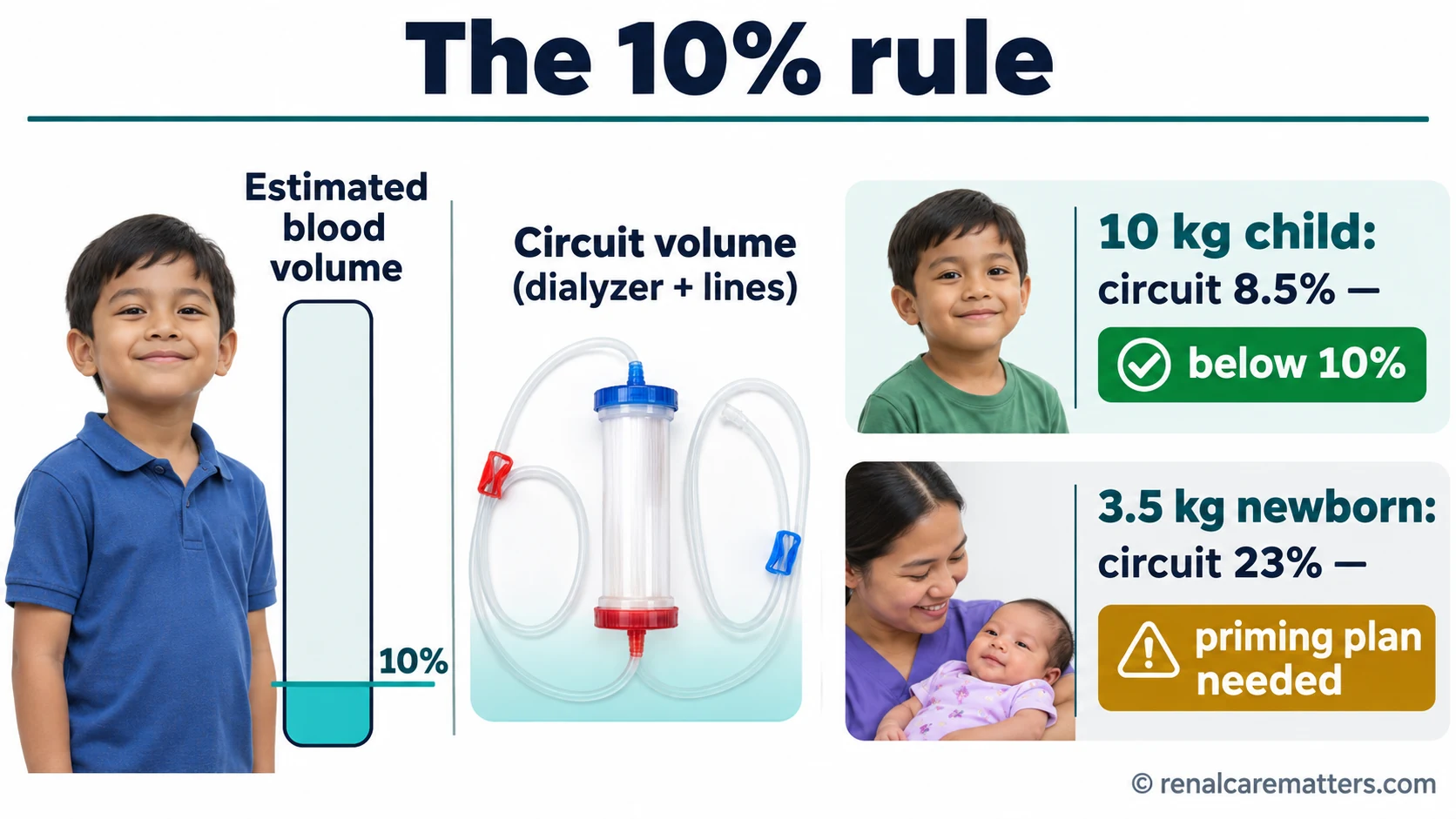
The ESPN practical guidelines state that the total extracorporeal volume (needles, tubing and dialyzer) should be, approximately, less than 10% of the child’s total blood volume.1 Estimating blood volume is a teaching approximation: about 80 mL per kilogram in children, and somewhat higher per kilogram in infants and newborns.
Figure 2. The 10% rule. Total extracorporeal volume should stay below about 10% of the child’s blood volume.
Estimated blood volume (mL) ≈ weight (kg) × 80 (children; higher per kg in infants) ECV share (%) = circuit volume (mL) ÷ estimated blood volume (mL) × 100 Example: 20 kg child → about 1,600 mL; a 68 mL circuit = about 4%. 10 kg child → about 800 mL; 68 mL = about 8.5%. 3.5 kg newborn at about 85 mL/kg → about 300 mL; 68 mL = about 23%.
Circuit volumes in these examples are illustrative; use the volumes printed for your lines and dialyzer. The share, not the absolute volume, tells you how hard the start will be for the child.
RememberKnow the circuit as a share of the child’s blood volume. Under about 10% is the usual aim; above it, the priming plan must be explicit.
Lesson · part 2
Priming decisions
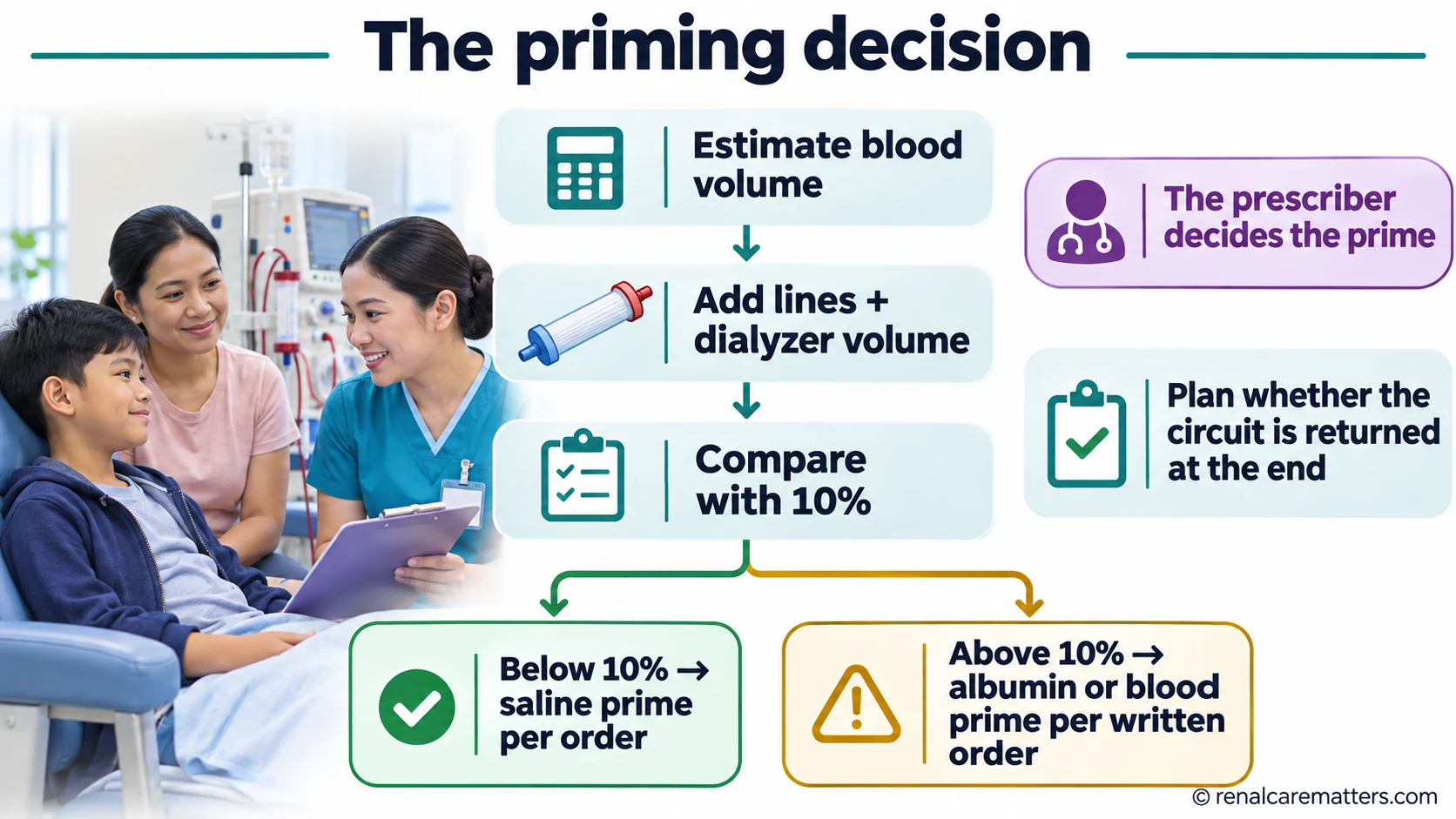
When the circuit would take too large a share, the team primes it with something that keeps blood volume and oxygen-carrying capacity steady. The guidelines describe priming with saline, albumin and sometimes blood in the first sessions with babies and small infants.1 Blood primes bring their own risks: stored blood can carry potassium, acid and citrate, and the team’s protocol sets how the prime is prepared and checked.
Figure 3. The priming decision. The nurse calculates and confirms; the prescriber decides the prime.
Step
Who
Calculate estimated blood volume and ECV share
Nurse, with independent check
Decide saline, albumin or blood prime, and whether to return the circuit blood at the end
Pediatric nephrologist (and transfusion service for blood)
Prepare and verify the prime per protocol, including blood-product checks
Nurse, with a second checker
Monitor blood pressure, heart rate and temperature closely during the first minutes
Nurse
Very small infants are also at risk of hypothermia, because dialysate and blood lines exchange heat; machines with temperature control and warming plans help.1 Keep blood sampling to the minimum ordered, and record every milliliter taken: in a newborn, small repeated samples add up to a meaningful blood loss.
RememberThe nurse calculates and confirms; the prescriber decides the prime. No connection until the plan is written and checked.
Lesson · part 3
Water and dialysate release
A child’s blood meets dozens of liters of dialysate across the dialyzer in every session, so water quality matters as much as for adults, and high-flux dialyzers and hemodiafiltration require ultrapure dialysate.1 In the Philippines, Department of Health Administrative Order 2013-0003 sets the water-analysis and monitoring requirements that testing laboratories report against, and the Philippine Society of Nephrology (PSN) guidelines describe professional expectations.2,3
Before the first treatment of the day, confirm that the water system log shows the required daily checks were done and passed, per unit procedure.
Confirm the machine passed its self-test and disinfection is recorded.
Check dialysate composition against the order before connection; conductivity and temperature alarms are not optional.
If a water result fails or a check is missing, do not start: report to the charge nurse and the water treatment technician.
On the floor · Preparing for Baby Girl Torres
Ben estimates her blood volume at about 300 mL (3.5 kg × 85 mL/kg). The 68 mL circuit is about 23%, more than twice the usual aim. He asks a colleague to recalculate, then calls the pediatric nephrologist: “The circuit is about 23% of her blood volume. What prime do you want, and do we return the circuit at the end?” The nephrologist orders a blood prime per protocol. Ben arranges a warming plan and a minimum-sample schedule.
Saying the share out loud turned an abstract volume into a clear decision for the right person.
Illustrative scenario. Names and details are invented.
RememberNo treatment starts on water or a machine that has not been released. A missing check is a failed check.
On the floor
Real situations: problems and solutions
These are fictional but typical. For each one, cover the answer, decide what you would do, then compare. Where a step depends on local rules, your unit’s procedure and your supervisor’s direction come first.
The big circuit
What you see
Only adult lines are available for a 12-kg child.
What is likely going on
Circuit share far above 10%.
What to do
Calculate the share and call the nephrologist for the priming plan.
Why it matters
Large circuits drop blood pressure at the start.
Cold baby
What you see
An infant’s temperature falls during treatment.
What is likely going on
Heat loss through the circuit.
What to do
Use the warming plan and machine temperature control; report.
Why it matters
Hypothermia is a pediatric risk.
Missing water check
What you see
Today’s water log is blank.
What is likely going on
Check not done.
What to do
Do not start; report to the charge nurse and technician.
Why it matters
A missing check is a failed check.
Field notes
Say the circuit share out loud.
Record every milliliter drawn from an infant.
Case review
Back to the case: The new baby on the schedule
The share. About 3.5 kg × 85 mL/kg ≈ 300 mL; 68 mL is about 23% of her blood volume, far above about 10%.
The priming question. Saline, albumin or blood prime, and whether to return the circuit blood at the end. The pediatric nephrologist decides, with the transfusion service for blood products. Ben calculates, double-checks and prepares per protocol.
Other threats. Hypothermia from heat exchange, blood loss from sampling, hypotension at connection, electrolyte loads from a blood prime, and a fluid load at the end. Ben monitors closely in the first minutes and records every milliliter drawn.
Skills lab · with your preceptor
Skills checklist: The small-circuit check
Use fictional children and printed circuit volumes. Your preceptor rates each step as satisfactory, needs practice, or not observed. Steps marked Critical must all be satisfactory before sign-off. This checklist supports supervised learning; your unit’s own procedure and competency form are the authority. A printable version of every checklist is on the trainer page.
CriticalEstimates blood volume and calculates the ECV share with an independent check
CriticalStates the priming question to the prescriber and documents the order
Prepares a warming plan and a minimum-sample plan for an infant
CriticalConfirms water log, machine self-test, disinfection and dialysate checks before connection
CriticalWithholds treatment when a water or machine check is missing or failed
Self-assessment
Check your understanding
Each visit draws 5 questions at random from this module’s 15-question bank. Choose the single best answer for each, then select Check answers; an explanation appears under the best answer. Select New set of questions for a different mix. A good target is 4 of 5 on two different sets. Nothing you select is sent anywhere; scoring happens in your browser.
Fischbach, M., Edefonti, A., Schröder, C., & Watson, A. (2005). Hemodialysis in children: General practical guidelines. Pediatric Nephrology, 20(8), 1054–1066. https://doi.org/10.1007/s00467-005-1876-y
Department of Health. (2013). Implementing guidelines in the analysis, monitoring and maintenance of water used in dialysis facilities pursuant to Administrative Order No. 2012-0001 (Administrative Order No. 2013-0003). https://elibrary.judiciary.gov.ph/thebookshelf/showdocs/10/69036
Educational material for registered nurses. Completing it is an Academy learning record only. It does not confer CPD units, PSN or National Kidney and Transplant Institute (NKTI) training recognition, PhilHealth staffing credit, or clinical privileges, and it does not replace your facility’s protocols, device instructions, or written orders.