Nephrology Nursing specialty subtrack for pediatric dialysis
This module is study material for registered nurses in pediatric dialysis. It explains the reasoning behind common nursing decisions; it is not a procedure. Exact steps follow your unit’s pediatric protocol and the device instructions; treatment parameters follow the written order of the pediatric nephrologist. Nurses assess, verify, teach, document and escalate; they do not prescribe, choose antibiotics, change doses or adjust anticoagulation. Every case is fictional and every value in a case is illustrative. Pending review by a pediatric nephrologist and a senior pediatric dialysis nurse.
Learning objectives
After this module you should be able to
Explain why and when children receive hemodialysis, and how the prescription scales blood flow and dose to body size.
Describe the pediatric vascular access options and the principle of venous preservation.
Apply the tunneled catheter care bundle and relate it to the Standardizing Care to Improve Outcomes in Pediatric End-Stage Kidney Disease collaborative (SCOPE) results.
Summarize what the hemodiafiltration (HDF), Heart and Height study shows, and what it cannot.
Classroom 2 hSkills lab 2 hSupervised placement 4 h
Pre-testBefore you read, answer the 5 self-assessment questions and note your score. After the module, select New set of questions and compare. The difference is what you learned; the questions you still miss are what to reread.
Start here
The big picture, in plain words
Hemodialysis in children uses the same machine principles as in adults, but every setting is scaled to a smaller body and a longer future. A child’s blood flow, dialyzer and lines are sized to their body; their vascular access must last, or be replaceable, for decades.
Your work in this module is to understand the logic of the prescription well enough to verify it, and to protect the child’s veins and catheter as a lifetime asset.
In plain wordsThink of a child’s veins as a savings account that must last a lifetime. Every line placed, every blood draw from a protected vein, is a withdrawal. Some withdrawals are necessary; none should be careless.
The picture has a limit. Money can be earned back. A damaged central vein usually cannot. Narrowing from repeated catheters can close off the veins a child would need for a fistula or even a transplant later. That is why the account must be protected even when today’s need is urgent.
Figure 1 · Key terms for this module
Central venous line (CVL)A tunneled catheter in a large central vein used for hemodialysis.
Arteriovenous fistula (AVF)A surgical connection of an artery to a vein in the arm.
Blood flow rate (QB)How fast the pump moves blood through the circuit, in mL/min.
Venous preservationProtecting veins from needles and lines that are not needed.
Hemodiafiltration (HDF)Hemodialysis with added convection using large replacement-fluid volumes.
Opening case · fictional
Case: The phlebotomist and the left arm
Carlo Mendoza, 13, 38 kilograms, has a tunneled central line for hemodialysis and is scheduled for an arm vein assessment for a future fistula. In the ward, a phlebotomist prepares to draw blood from his left forearm, the arm the vascular surgeon has marked for the fistula. His mother says, “They always use that arm, his veins are good there.” Nurse Jessa walks in.
Before reading on, decide:
Why does the choice of arm matter?
What should Jessa do right now?
What would make a fistula a better or worse plan for Carlo?
Keep your answers in mind. The lesson gives you what you need, and the case review near the end shows one sound response.
Lesson · part 1
Why hemodialysis, and how the prescription scales
Hemodialysis is often preferred for children over about five years of age when peritoneal dialysis (PD) is not suitable or not chosen; PD is more often used in younger children and those under about 10 kilograms.1 Hemodialysis in children should be delivered in a pediatric unit with a multidisciplinary team, because nutrition, growth and schooling are part of the treatment.
Element
Pediatric practice described by the ESPN guidelines (2005)
Your check
Blood flow
150–200 mL/min/m², or 5–7 mL/min/kg, often sufficient; in small children (weight + 10) × 2.5 mL/min as a rule of thumb
Ordered QB in mL/min/kg and mL/min/m²
Sessions
Usually three per week, 3 to 4 hours; more often for infants or some adolescents
Session time matches the order
Dose
A minimum Kt/V of 1.2 to 1.4, with recognition that urea is only one measure
Monthly adequacy results in the record
Dialyzer and lines
Sized to the child, with blood volume in mind (Module 13)
Correct sizes per the order
These figures come from practical guidelines written in 2005 and are expert guidance, not trial evidence.1 Your unit’s pediatric protocol and the written order decide. Kt/V is a surrogate measure of small-solute removal; it is not growth, well-being or survival.
Worked check. A 20-kilogram child with body surface area (BSA) 0.8 m² and an ordered QB of 120 mL/min: 120 ÷ 20 = 6 mL/min/kg; 120 ÷ 0.8 = 150 mL/min/m². Both sit in the described ranges. A QB of 250 mL/min would be 12.5 mL/min/kg, a reason to confirm the order.
RememberConvert the ordered blood flow to mL/min/kg and mL/min/m². A value far outside the range is a question, not a setting.
Lesson · part 2
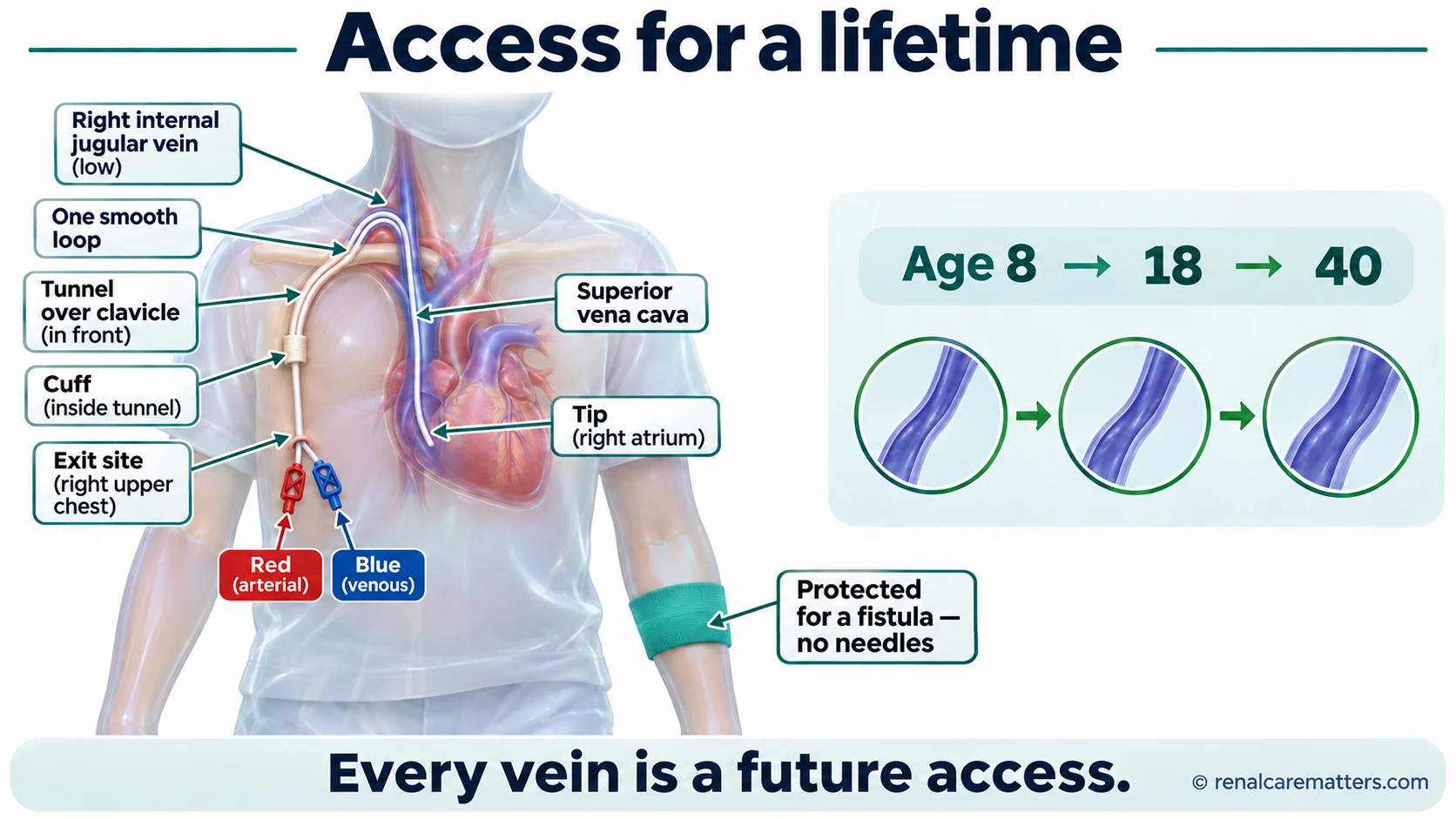
Access for a lifetime
The European Society for Paediatric Nephrology (ESPN) Dialysis Working Group consensus, graded with the GRADE system, reviewed three access types: tunneled central lines, AVFs and arteriovenous grafts. Observational studies and the International Paediatric Haemodialysis Network registry associate central lines with significantly more infection, dysfunction and need for replacement. Despite this, AVFs are used in only about 25% of children on hemodialysis. The consensus emphasizes the right access for the right child at the right time, with venous preservation at all times; fistulas may not suit very young children or those expecting a short dialysis course before transplant.2
Figure 2. Access for a lifetime. Every vein used today is one a child may need as an adult; protect them all.
Protect the arm planned for a fistula: no needles, no cuffs, no intravenous cannulas. Mark it and tell everyone.
Draw blood from the dialysis access at the session when ordered, rather than from protected veins.
Report any arm or facial swelling in a child with a central line; it may signal central vein narrowing.
RememberEvery vein is a future access. Protect the fistula arm as if it were already a fistula.
Lesson · part 3
Catheter care and the bundle
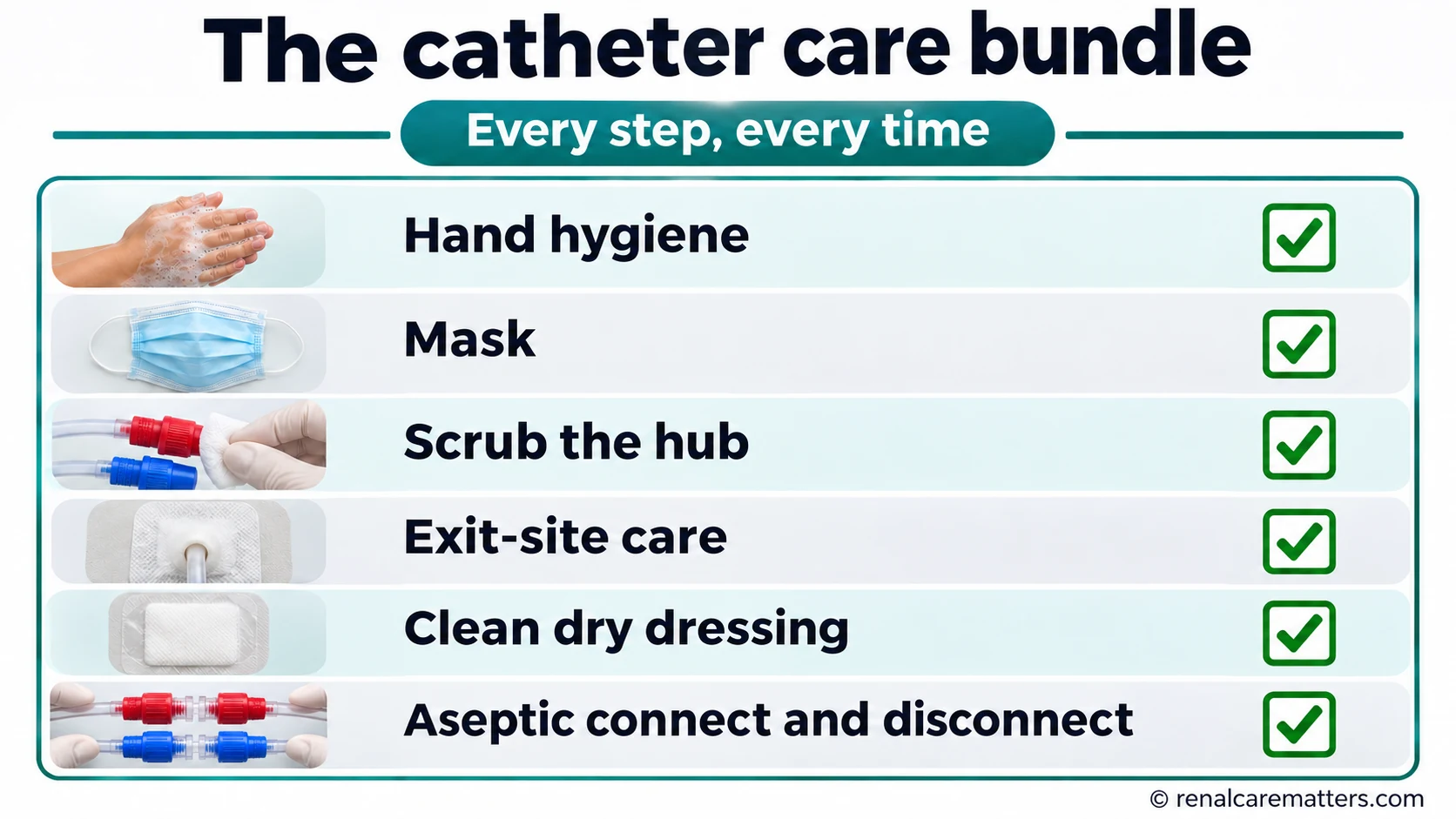
A tunneled central line is a direct path to the bloodstream. The SCOPE collaborative’s catheter care bundle (hand hygiene, mask, scrub-the-hub, exit-site care, dressing, and aseptic connection and disconnection) was followed by a fall in catheter-associated bloodstream infection from 3.3 to 0.8 per 100 patient-months over 48 months in 325 children.3 The design was pre–post, so it supports the bundle without proving each step.
Figure 3. The catheter care bundle. Every step, every time, observed and recorded.
Lock solutions, dressing types and exit-site agents follow the unit protocol. The SCOPE cohort’s observational association between mupirocin at the hemodialysis catheter exit and more infection is a reason not to improvise.4
Hemodiafiltration in children
The HDF, Heart and Height study compared conventional hemodialysis with online postdilution HDF in 190 children from 28 centers; 78 and 55 completed one year. HDF was associated with no progression in carotid intima-media thickness, a gain in height standard deviation score, lower beta-2-microglobulin, and fewer headaches, dizziness and cramps.5 The study was nonrandomized, and its main outcomes are surrogates; the authors call for randomized confirmation.
RememberThe catheter bundle works when every step is done every time. HDF looks promising in children, but the evidence is observational.
On the floor
Real situations: problems and solutions
These are fictional but typical. For each one, cover the answer, decide what you would do, then compare. Where a step depends on local rules, your unit’s procedure and your supervisor’s direction come first.
Blood from the fistula arm
What you see
A ward nurse starts an intravenous (IV) in the arm marked for a fistula.
What is likely going on
Protection not communicated.
What to do
Stop it, explain, mark the arm, add a chart alert.
Why it matters
Damaged veins limit future access.
Swollen face
What you see
A child with a central line has facial swelling.
What is likely going on
Possible central vein narrowing or thrombosis.
What to do
Report urgently.
Why it matters
Central veins are hard to replace.
Fast blood flow
What you see
An order’s blood flow equals 12 mL/min/kg.
What is likely going on
Possible error.
What to do
Convert, compare with the range, confirm with the prescriber.
Why it matters
Unusual numbers are questions.
Field notes
Convert QB to mL/min/kg.
Every bundle step, every time.
Case review
Back to the case: The phlebotomist and the left arm
Why the arm matters. The left forearm is planned for a fistula. Repeated needling can damage those veins and reduce the chance of a working fistula, which the ESPN consensus associates with fewer infections than central lines.
Right now. Jessa politely stops the draw, explains the plan to the phlebotomist and the mother, and arranges for blood to be drawn from the dialysis line at the next session or from another site as the team directs. She marks the arm and adds an alert to the chart.
Fistula fit. Carlo is 13, 38 kilograms, with suitable veins and an uncertain wait for transplant, all favoring a fistula. A living donor ready within months might change the plan; the team decides.
Skills lab · with your preceptor
Skills checklist: Prescription check and access protection
Use fictional orders and access models. Your preceptor rates each step as satisfactory, needs practice, or not observed. Steps marked Critical must all be satisfactory before sign-off. This checklist supports supervised learning; your unit’s own procedure and competency form are the authority. A printable version of every checklist is on the trainer page.
CriticalConverts ordered blood flow to mL/min/kg and mL/min/m² and compares with the described ranges
CriticalMarks and protects a planned fistula arm and communicates it to the team
CriticalPerforms tunneled catheter care using every bundle element
Recognizes and reports arm or facial swelling in a child with a central line
Explains in plain words why veins are protected
Self-assessment
Check your understanding
Each visit draws 5 questions at random from this module’s 15-question bank. Choose the single best answer for each, then select Check answers; an explanation appears under the best answer. Select New set of questions for a different mix. A good target is 4 of 5 on two different sets. Nothing you select is sent anywhere; scoring happens in your browser.
Fischbach, M., Edefonti, A., Schröder, C., & Watson, A. (2005). Hemodialysis in children: General practical guidelines. Pediatric Nephrology, 20(8), 1054–1066. https://doi.org/10.1007/s00467-005-1876-y
Shroff, R., Calder, F., Bakkaloğlu, S., Nagler, E. V., Stuart, S., Stronach, L., Schmitt, C. P., Heckert, K. H., Bourquelot, P., Wagner, A. M., Paglialonga, F., Mitra, S., & Stefanidis, C. J. (2019). Vascular access in children requiring maintenance haemodialysis: A consensus document by the European Society for Paediatric Nephrology Dialysis Working Group. Nephrology Dialysis Transplantation, 34(10), 1746–1765. https://doi.org/10.1093/ndt/gfz011
Marsenic, O., Rodean, J., Richardson, T., Swartz, S., Claes, D., Day, J. C., Warady, B., & Neu, A. (2020). Tunneled hemodialysis catheter care practices and blood stream infection rate in children: Results from the SCOPE collaborative. Pediatric Nephrology, 35(1), 135–143. https://doi.org/10.1007/s00467-019-04384-7
Ruebner, R. L., De Souza, H. G., Richardson, T., Bedri, B., Marsenic, O., Iorember, F., Warejko, J. K., Warady, B. A., & Neu, A. M. (2022). Epidemiology and risk factors for hemodialysis access-associated infections in children: A prospective cohort study from the SCOPE collaborative. American Journal of Kidney Diseases, 80(2), 186–195.e1. https://doi.org/10.1053/j.ajkd.2021.11.008
Shroff, R., Smith, C., Ranchin, B., Bayazit, A. K., Stefanidis, C. J., Askiti, V., Azukaitis, K., Canpolat, N., Ağbaş, A., Aitkenhead, H., Anarat, A., Aoun, B., Aofolaju, D., Bakkaloglu, S. A., Bhowruth, D., Borzych-Dużałka, D., Bulut, I. K., Büscher, R., Deanfield, J., . . . Schaefer, F. (2019). Effects of hemodiafiltration versus conventional hemodialysis in children with ESKD: The HDF, Heart and Height study. Journal of the American Society of Nephrology, 30(4), 678–691. https://doi.org/10.1681/ASN.2018100990
Educational material for registered nurses. Completing it is an Academy learning record only. It does not confer CPD units, PSN or National Kidney and Transplant Institute (NKTI) training recognition, PhilHealth staffing credit, or clinical privileges, and it does not replace your facility’s protocols, device instructions, or written orders.