Alarm at 2 a.m.
- What you see
- Low-drain alarms every night at the same time.
- What is likely going on
- Position or constipation.
- What to do
- Download the log, address bowels and position, report the pattern.
- Why it matters
- Patterns have causes.
Cycling small volumes, alarms as clinical signals, the night with a cycler at home, and the treatment record.

This module is study material for registered nurses in pediatric dialysis. It explains the reasoning behind common nursing decisions; it is not a procedure. Exact steps follow your unit’s pediatric protocol and the device instructions; treatment parameters follow the written order of the pediatric nephrologist. Nurses assess, verify, teach, document and escalate; they do not prescribe, choose antibiotics, change doses or adjust anticoagulation. Every case is fictional and every value in a case is illustrative. Pending review by a pediatric nephrologist and a senior pediatric dialysis nurse.
Automated PD lets a cycler run exchanges overnight while the child sleeps, freeing the day for school and play. That is why it is common in children. The cost is that a machine now measures, times and alarms, and small fill volumes push some cyclers close to their limits. A cycler that alarms all night wakes the whole family, and tired families start bypassing alarms.
Your work in this module is to make sure the cycler does what the order says, to help families understand alarms, and to read the treatment record for trouble before it becomes an emergency.
The picture has a limit. A babysitter can tell you why she called. A cycler gives a code. The meaning of the code lives in the device’s instructions and in the child: a “low drain” may be a kinked line, constipation, a catheter problem or fluid absorbed by a child who is dehydrated.
Figure 1 · Key terms for this module
Andrea Lim, 10, 28 kilograms, has been on APD for two months. Her mother, Grace, says the cycler alarms “low drain” almost every night around 2 a.m., and she has learned to press “bypass” so everyone can sleep. Andrea is tired at school. The clinic nurse, Mark, downloads the treatment record before the monthly visit.
Before reading on, decide:
Keep your answers in mind. The lesson gives you what you need, and the case review near the end shows one sound response.
The cycler program translates the order into machine settings: fill volume, number of cycles, dwell time, total therapy time, last fill, and sometimes tidal settings. Before the first night, two people check the program against the written order, field by field, using the child’s current weight and body surface area (BSA) as in Module 7.
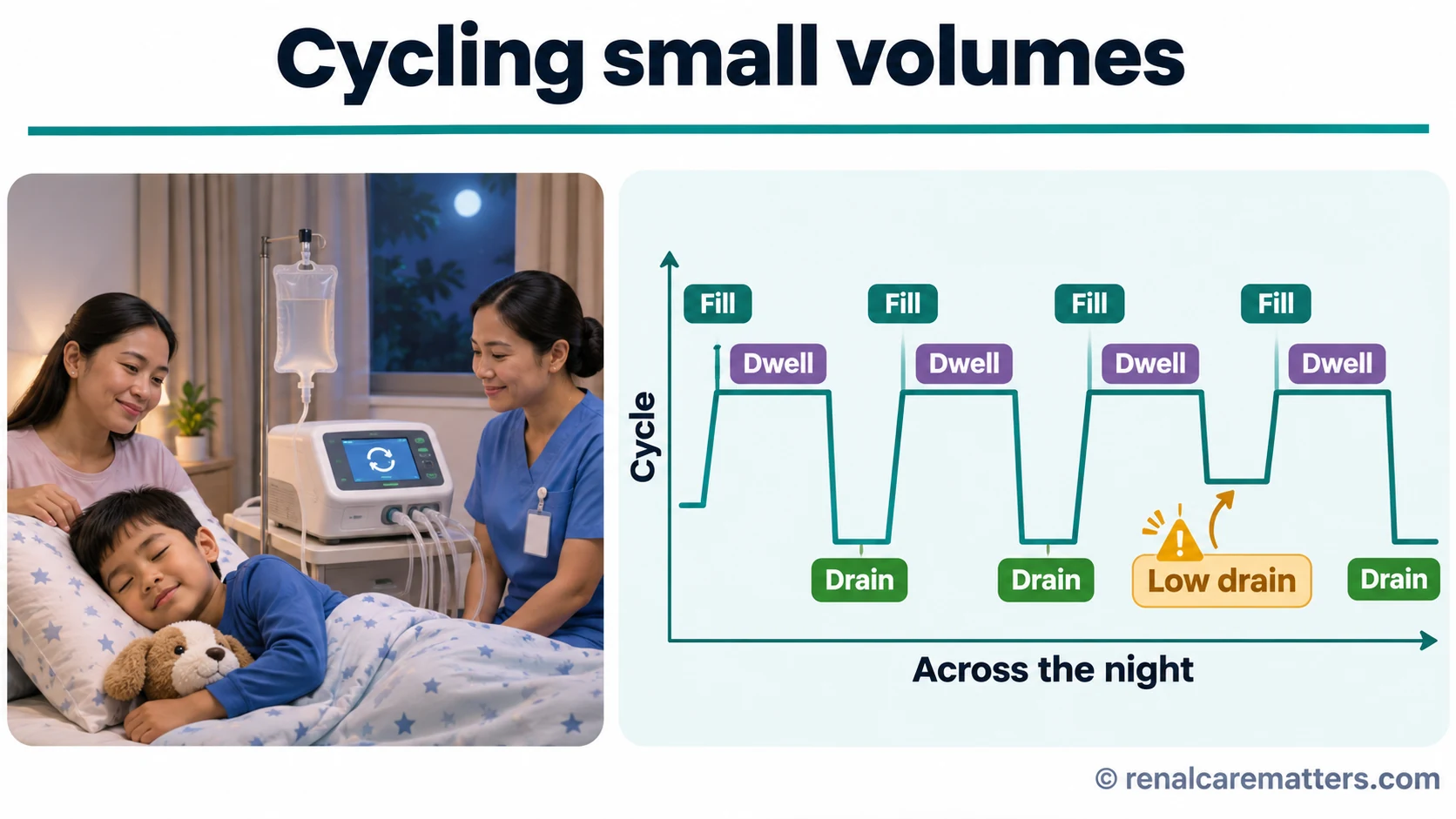
Small fills interact with the machine in predictable ways. Each cycler has a minimum fill volume, and the 2020 International Society for Peritoneal Dialysis (ISPD) pediatric guideline notes that automated PD is not suitable for newborns because their fill volumes are too small for current machines (1D).1 In small children, short dwells mean many drain phases per night, and each drain is a chance for an alarm. Tidal settings, ordered by the nephrologist, can reduce drain pain and alarms by leaving a reserve volume.
Line length and bed height matter. The cycler measures by weight or pressure, and the child’s position relative to the machine affects flow, as the device instructions describe.
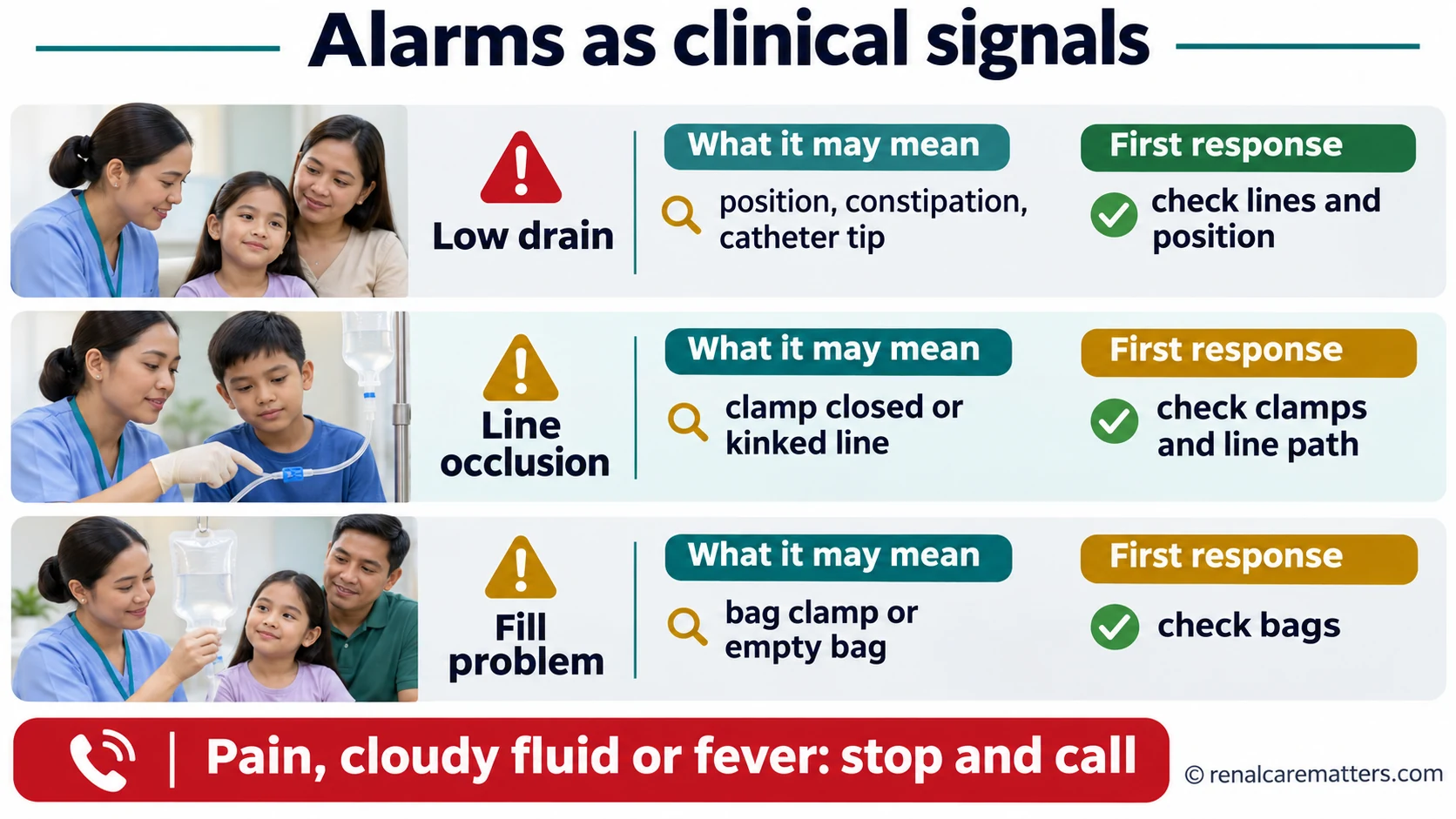
Treat every repeated alarm as information about the child, not only about the machine.
| Alarm type | Possible meaning in the child | First response |
|---|---|---|
| Low drain or slow drain | Kinked line, position, constipation, catheter tip position, fibrin; occasionally fluid absorbed in a dehydrated child | Check lines and position; follow the device steps; report a pattern |
| Line occlusion or patient line | Clamp closed, line kinked under the child, catheter problem | Check clamps and the line path |
| Fill or supply problem | Bag clamp closed, empty bag, wrong bag | Check bags and clamps against the setup |
Repeated bypassing of drain alarms can leave fluid in the abdomen that adds to the next fill. In a small child, that overfill raises intraperitoneal pressure, causing pain, breathing difficulty or leaks. Overrides are allowed only as the device instructions and the family’s training permit, and a pattern of alarms is always reported.
The cycler’s log and the family’s chart together show what actually happened at home. Read them monthly and whenever something changes.
Missed or shortened therapy is not a moral failing to scold. It is usually a sign that the plan does not fit the family: work shifts, power cuts, alarm fatigue, a child who resists. Bring it to the team as a problem to solve (Module 18).
Mark sees drain alarms at about 2 a.m. on 24 of 30 nights, each followed by a bypass, and lower ultrafiltration on those nights. Andrea’s chart notes hard stools. He asks Grace whether Andrea sleeps on one side, reviews constipation with the nephrologist, asks about a tidal setting, and retrains Grace on what a bypass leaves behind.
The pattern in the log turned a nuisance into a fixable problem.
Illustrative scenario. Names and details are invented.
These are fictional but typical. For each one, cover the answer, decide what you would do, then compare. Where a step depends on local rules, your unit’s procedure and your supervisor’s direction come first.
Meaning. Clustering at the same hour suggests a position or catheter-tip problem, often worsened by constipation; the log and history support that.
Risks of bypassing. Retained fluid adds to the next fill and raises intraperitoneal pressure; therapy is reduced; real problems are missed. Andrea’s tiredness may reflect disturbed sleep and less dialysis.
The record. Alarm timing and frequency, bypasses, ultrafiltration per night, missed therapy, and notes on stools and pain. Mark brings a specific pattern and a proposed fix to the nephrologist.
Use a training cycler or the device simulator. Your preceptor rates each step as satisfactory, needs practice, or not observed. Steps marked Critical must all be satisfactory before sign-off. This checklist supports supervised learning; your unit’s own procedure and competency form are the authority. A printable version of every checklist is on the trainer page.
Each visit draws 5 questions at random from this module’s 15-question bank. Choose the single best answer for each, then select Check answers; an explanation appears under the best answer. Select New set of questions for a different mix. A good target is 4 of 5 on two different sets. Nothing you select is sent anywhere; scoring happens in your browser.
Module 10 of 2010 modules to go

Internal Medicine · Nephrology · Nutrition · Philippines · PRC 0105184
Educational material for registered nurses. Completing it is an Academy learning record only. It does not confer CPD units, PSN or National Kidney and Transplant Institute (NKTI) training recognition, PhilHealth staffing credit, or clinical privileges, and it does not replace your facility’s protocols, device instructions, or written orders.

Scan and save