Nephrology Nursing specialty subtrack for pediatric dialysis
This module is study material for registered nurses in pediatric dialysis. It explains the reasoning behind common nursing decisions; it is not a procedure. Exact steps follow your unit’s pediatric protocol and the device instructions; treatment parameters follow the written order of the pediatric nephrologist. Nurses assess, verify, teach, document and escalate; they do not prescribe, choose antibiotics, change doses or adjust anticoagulation. Every case is fictional and every value in a case is illustrative. Pending review by a pediatric nephrologist and a senior pediatric dialysis nurse.
Learning objectives
After this module you should be able to
Explain how the causes of kidney failure in children differ by age and region, and why that matters at the chair.
Describe how chronic kidney disease (CKD) acts on a growing body: water and salt handling, growth, bone, blood and blood pressure.
Estimate kidney function in a child with the bedside Chronic Kidney Disease in Children study (CKiD) equation and explain its limits.
Support a fair modality conversation about peritoneal dialysis (PD), hemodialysis and preemptive transplant.
Classroom 2 hSkills lab 2 hSupervised placement 4 h
Pre-testBefore you read, answer the 5 self-assessment questions and note your score. After the module, select New set of questions and compare. The difference is what you learned; the questions you still miss are what to reread.
Start here
The big picture, in plain words
Adults usually reach kidney failure through diabetes or high blood pressure, after decades. Children usually reach it through kidneys that formed differently, inherited disease, or glomerular disease. Many of these children still pass large volumes of urine. That single fact changes how you think about fluid, salt and growth at every session.
Your work in this module is to understand why this child’s kidneys failed, because the cause predicts the urine output, the salt losses, the bone problems and the questions the family will ask.
In plain wordsPicture two leaky buckets. The adult bucket has lost its holes; it fills between sessions and must be emptied. Many children with kidneys that formed abnormally have a bucket full of holes: they pour out dilute urine and salt, and run dry if fluid or salt is restricted the adult way.
The picture has a limit. A child who passes a lot of urine can still retain potassium, phosphate, acid and waste, because the failing kidney cannot concentrate them. Volume and clearance are different jobs. A child may lose too much water and salt while keeping too much potassium.
Figure 1 · Key terms for this module
CAKUTCongenital anomalies of the kidney and urinary tract: kidneys or drainage that formed abnormally.
PolyuriaPassing large volumes of dilute urine.
GlomerulopathyDisease of the glomerulus, the kidney’s filter.
Preemptive transplantA kidney transplant before dialysis starts.
Residual kidney functionThe work the child’s own kidneys still do.
Opening case · fictional
Case: The toddler who drinks all day
Gab Villanueva, 3, was born with posterior urethral valves and has CKD stage 5. He weighs 12 kilograms. His mother, Liza, says he drinks constantly, soaks a diaper every hour, and cries for water at night. A relative told her to stop giving water “because his kidneys are weak”.
The pediatric nephrologist is discussing starting dialysis. Liza asks the nurse, Ana, whether PD or hemodialysis is “better”, and whether Gab can have her kidney instead.
Before reading on, decide:
Why might restricting Gab’s water be dangerous?
What makes PD, hemodialysis or transplant more or less suitable for him?
What is Ana’s role in Liza’s questions, and what is not?
Keep your answers in mind. The lesson gives you what you need, and the case review near the end shows one sound response.
Lesson · part 1
Causes change with age and region
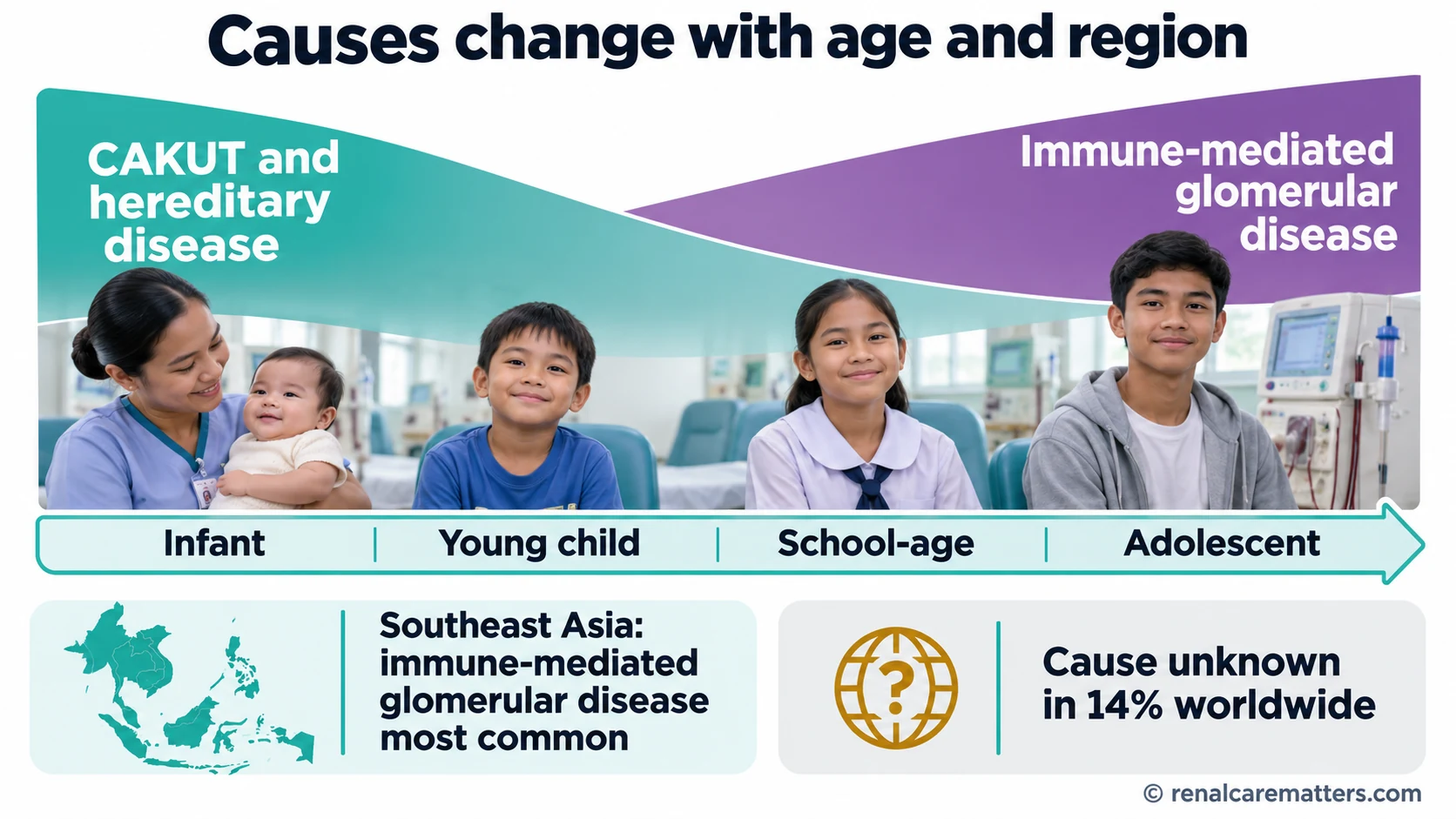
A registry analysis of 23,620 children starting maintenance kidney replacement therapy in 80 countries found that the causes differ by age and by region.1 In younger children, CAKUT and hereditary kidney diseases predominate. Adolescents more often have immune-mediated glomerular disease. In Southeast Asia, immune-mediated glomerulopathy was the most common cause overall, and in 14% of children worldwide the cause was unknown.
Figure 2. Causes change with age and region. Congenital and hereditary diseases lead in young children; immune-mediated glomerular disease is the most common cause in Southeast Asia.
Group of causes
Typical age
What you may notice at the chair
CAKUT (dysplasia, valves, reflux)
Infancy and early childhood
High urine output, salt loss, urinary infections, bladder care needs
Hereditary disease (for example cystinosis, nephronophthisis)
Childhood
Polyuria, growth failure, extra medicines; siblings may be affected
Immune-mediated glomerulopathy (for example nephrotic syndrome, lupus)
Later childhood and adolescence
Low urine output, edema, high blood pressure, immunosuppression history
Philippine pediatric data are scarce. One tertiary government hospital described 86 children with leptospirosis and acute kidney injury; 62% were oliguric, and PD was started in 36% of the oliguric children.2 Acute causes like this matter for Module 16; chronic causes shape everything else.
RememberAsk what caused this child’s kidney failure. The answer predicts urine output, salt losses and what the family fears.
Lesson · part 2
CKD in a growing body
In an adult, CKD damages an organ. In a child, it also interferes with growth. The failing kidney does several jobs at once, and each failure has a bedside sign.
Normal job
What breaks in CKD
What you may see
Balance water and salt
Concentrating ability fails (polyuric causes) or excretion fails (oliguric causes)
Dehydration or edema; thirst; blood pressure changes
Remove acid
Acid accumulates; bone buffers it
Poor appetite, poor growth, fast breathing when severe
Make active vitamin D and handle phosphate
Phosphate rises, calcium and parathyroid hormone are disturbed
Bone pain, bowed legs, slow growth
Make erythropoietin
Anemia
Pallor, tiredness, poor school stamina
Clear waste
Uremia
Nausea, poor feeding, poor concentration
Estimating kidney function in a child
Adult equations do not work for children. The bedside CKiD equation, derived in 349 children aged 1 to 16 years with CKD, estimates glomerular filtration rate (GFR) as 0.413 × height in centimeters ÷ serum creatinine in mg/dL.3 It needs an accurate height, which is one more reason to measure height carefully. It is an estimate with error; trends matter more than one value.
Worked example. A 120 cm child with creatinine 2.0 mg/dL: 0.413 × 120 ÷ 2.0 = about 25 mL/min/1.73 m². The Kidney Disease: Improving Global Outcomes (KDIGO) 2024 guideline stages CKD by GFR and albuminuria in children as well as adults.4
RememberA child with kidney failure may pass plenty of urine and still need dialysis. Volume is not clearance.
Lesson · part 3
Choosing a modality with the family
There is no single best modality for every child. PD is often chosen for infants and young children because it avoids needles and repeated blood loss, can be done at home overnight, and preserves the veins a child may need later. Hemodialysis is often chosen when PD is not possible (abdominal surgery, no caregiver able to do PD, membrane failure) or for older children and adolescents. Preemptive transplant, when a suitable donor is available and the child is ready, avoids dialysis altogether.5
Figure 3. Choosing a modality with the family. Age and size, the home, school, distance and who can provide care all shape the choice.
Factor
Leans toward PD
Leans toward hemodialysis
Age and size
Infants and small children
Older children and adolescents, if access is feasible
Home and caregivers
A trained, available caregiver; space and clean water
No caregiver able to do PD reliably
Distance
Far from a pediatric hemodialysis unit
Lives near the unit
Abdomen
Intact peritoneum
Previous major surgery, ostomies, hernias
School and activity
Daytime free with overnight cycling
Can attend sessions without losing school
In the Philippines, Philippine Health Insurance Corporation (PhilHealth) piloted a pediatric automated PD benefit at the National Kidney and Transplant Institute (NKTI), the University of the Philippines–Philippine General Hospital (UP-PGH) and the Philippine Children’s Medical Center (PCMC), extended to July 31, 2026.6,7 Its status after that date was not verified for this track. Never promise a family a benefit you have not confirmed.
On the floor · Clinic room, Tuesday
Liza asks Ana which is better. Ana answers: “Both can keep Gab well. The doctor will help you choose. Can I tell you what each one asks of your family, so you can bring your questions?” She describes nightly cycling at home and three trips a week to the unit, and she notes that Liza could be evaluated as a donor.
The nurse explains what each option asks of the family; the nephrologist and family make the choice.
Illustrative scenario. Names and details are invented.
RememberThe best modality is the one this family can do safely, that keeps the child growing, and that keeps options open.
On the floor
Real situations: problems and solutions
These are fictional but typical. For each one, cover the answer, decide what you would do, then compare. Where a step depends on local rules, your unit’s procedure and your supervisor’s direction come first.
The thirsty toddler
What you see
A relative tells a mother to restrict water in a polyuric child.
What is likely going on
Adult fluid rules applied to a salt-losing child.
What to do
Advise against restriction and ask the nephrologist to counsel the family.
Why it matters
Polyuric children dehydrate fast.
“Which is better?”
What you see
A father asks you to choose between PD and hemodialysis.
What is likely going on
He wants reassurance and practical facts.
What to do
Describe what each asks of the family; pass the choice to the nephrologist and family.
Why it matters
Informed families choose sustainable modalities.
The promised benefit
What you see
A neighbor told a family that pediatric automated peritoneal dialysis (APD) is free everywhere.
What is likely going on
Information about a pilot has spread without its dates.
What to do
Explain that the pilot status after July 31, 2026 must be confirmed with PhilHealth.
Why it matters
Unconfirmed promises break trust.
Field notes
Ask the cause of kidney failure at the first meeting.
Write height in the chart every visit; estimated glomerular filtration rate (eGFR) needs it.
Case review
Back to the case: The toddler who drinks all day
Why restricting water is dangerous. Gab’s kidneys formed abnormally. Like many children with CAKUT, he passes large volumes of dilute urine and loses salt. Withholding water could dehydrate him quickly. Ana tells Liza not to restrict fluids and asks the nephrologist to address the relative’s advice directly.
Modality fit. At 12 kilograms, Gab is a typical PD candidate: no needles, care at home, veins preserved. His valves history means the team will check his bladder and abdomen. Hemodialysis would need a central line and a small-volume circuit. Liza’s offer to donate is a reason to start the transplant evaluation early.
Ana’s role. She explains what each option demands, answers practical questions, and passes the clinical choice and the donor question to the nephrologist and transplant team. She does not choose for the family.
Skills lab · with your preceptor
Skills checklist: Cause, function and modality
Use fictional charts. Your preceptor rates each step as satisfactory, needs practice, or not observed. Steps marked Critical must all be satisfactory before sign-off. This checklist supports supervised learning; your unit’s own procedure and competency form are the authority. A printable version of every checklist is on the trainer page.
Identifies the cause of kidney failure and states its expected urine output pattern
CriticalCalculates bedside CKiD eGFR with units and an independent check
Explains in plain words what PD and hemodialysis each ask of a family
CriticalRefers the modality decision and donor questions to the nephrologist and transplant team
Self-assessment
Check your understanding
Each visit draws 5 questions at random from this module’s 15-question bank. Choose the single best answer for each, then select Check answers; an explanation appears under the best answer. Select New set of questions for a different mix. A good target is 4 of 5 on two different sets. Nothing you select is sent anywhere; scoring happens in your browser.
Borzych-Dużałka, D., Bonthuis, M., Ali, U., Yap, Y. C., Manno, M., Zhai, Y., Loza, R., Hashmi, S., Choi, N., Soulami, K., Exantus, J., Al Riyami, M. S., Mabrouk, S., Angeles, M. M., Zelaya-Camacho, C., Puspitasari, H. A., Huque, S. S., Cano, F., Ng, K. H., . . . Schaefer, F. (2026). Regional variation of underlying kidney diseases in children undergoing chronic kidney replacement therapy around the globe. Pediatric Nephrology, 41(5), 1451–1463. https://doi.org/10.1007/s00467-025-07096-3
Anacleto, F. E., Collado, A. B., & Wyson, A. M. (2014). Profile of acute kidney injury in pediatric leptospirosis. Renal Failure, 36(7), 1090–1094. https://doi.org/10.3109/0886022X.2014.917766
Schwartz, G. J., Muñoz, A., Schneider, M. F., Mak, R. H., Kaskel, F., Warady, B. A., & Furth, S. L. (2009). New equations to estimate GFR in children with CKD. Journal of the American Society of Nephrology, 20(3), 629–637. https://doi.org/10.1681/ASN.2008030287
Kidney Disease: Improving Global Outcomes (KDIGO) CKD Work Group. (2024). KDIGO 2024 clinical practice guideline for the evaluation and management of chronic kidney disease. Kidney International, 105(4S), S117–S314. https://doi.org/10.1016/j.kint.2023.10.018
Fischbach, M., Edefonti, A., Schröder, C., & Watson, A. (2005). Hemodialysis in children: General practical guidelines. Pediatric Nephrology, 20(8), 1054–1066. https://doi.org/10.1007/s00467-005-1876-y
Philippine Health Insurance Corporation. (2025). PhilHealth Advisory No. 2025-0074 [Pilot implementation of the Z benefits package for peritoneal dialysis covering automated PD in children]. https://www.philhealth.gov.ph/advisories/2025/PA2025-0074.pdf
Educational material for registered nurses. Completing it is an Academy learning record only. It does not confer CPD units, PSN or National Kidney and Transplant Institute (NKTI) training recognition, PhilHealth staffing credit, or clinical privileges, and it does not replace your facility’s protocols, device instructions, or written orders.