Nephrology Nursing specialty subtrack for pediatric dialysis
This module is study material for registered nurses in pediatric dialysis. It explains the reasoning behind common nursing decisions; it is not a procedure. Exact steps follow your unit’s pediatric protocol and the device instructions; treatment parameters follow the written order of the pediatric nephrologist. Nurses assess, verify, teach, document and escalate; they do not prescribe, choose antibiotics, change doses or adjust anticoagulation. Every case is fictional and every value in a case is illustrative. Pending review by a pediatric nephrologist and a senior pediatric dialysis nurse.
Learning objectives
After this module you should be able to
Distinguish the four separate authorizations behind pediatric dialysis work: license, modality training, facility authorization by age and size band, and clinical privileges.
Describe the pediatric kidney team and who decides what, so that every question reaches its owner.
Map a child’s kidney journey from diagnosis to transition and name the nurse’s job at each stage.
Write a learning agreement that sets supervision, scope and escalation before your first clinical shift.
Classroom 2 hSkills lab 2 hSupervised placement 4 h
Pre-testBefore you read, answer the 5 self-assessment questions and note your score. After the module, select New set of questions and compare. The difference is what you learned; the questions you still miss are what to reread.
Start here
The big picture, in plain words
Most of what you know from adult dialysis still applies to children. The membrane, the machine and the physiology of diffusion are the same. What changes is the size of the margins, the people in the room, and the length of the road ahead. A child may be on dialysis for months before a transplant, then need care for sixty more years.
Your work in this track is to keep a child safe on dialysis today while protecting what the child still has to do: grow, learn, play and, usually, receive a kidney. This first module sets the ground rules: who authorizes you, who decides what, and how you start without guessing.
In plain wordsThink of an adult dialysis nurse as a pilot who flies a large passenger plane. A pediatric dialysis nurse flies a small plane in the same sky. The instruments look familiar, but every gust moves the small plane more, and there is less fuel to spare.
The picture has a limit. A small plane carries no one else; a child never travels alone. Parents, grandparents and siblings come with every child, and they will do much of the care at home. The pediatric dialysis nurse is also a teacher, and the child is also a learner who will one day take over.
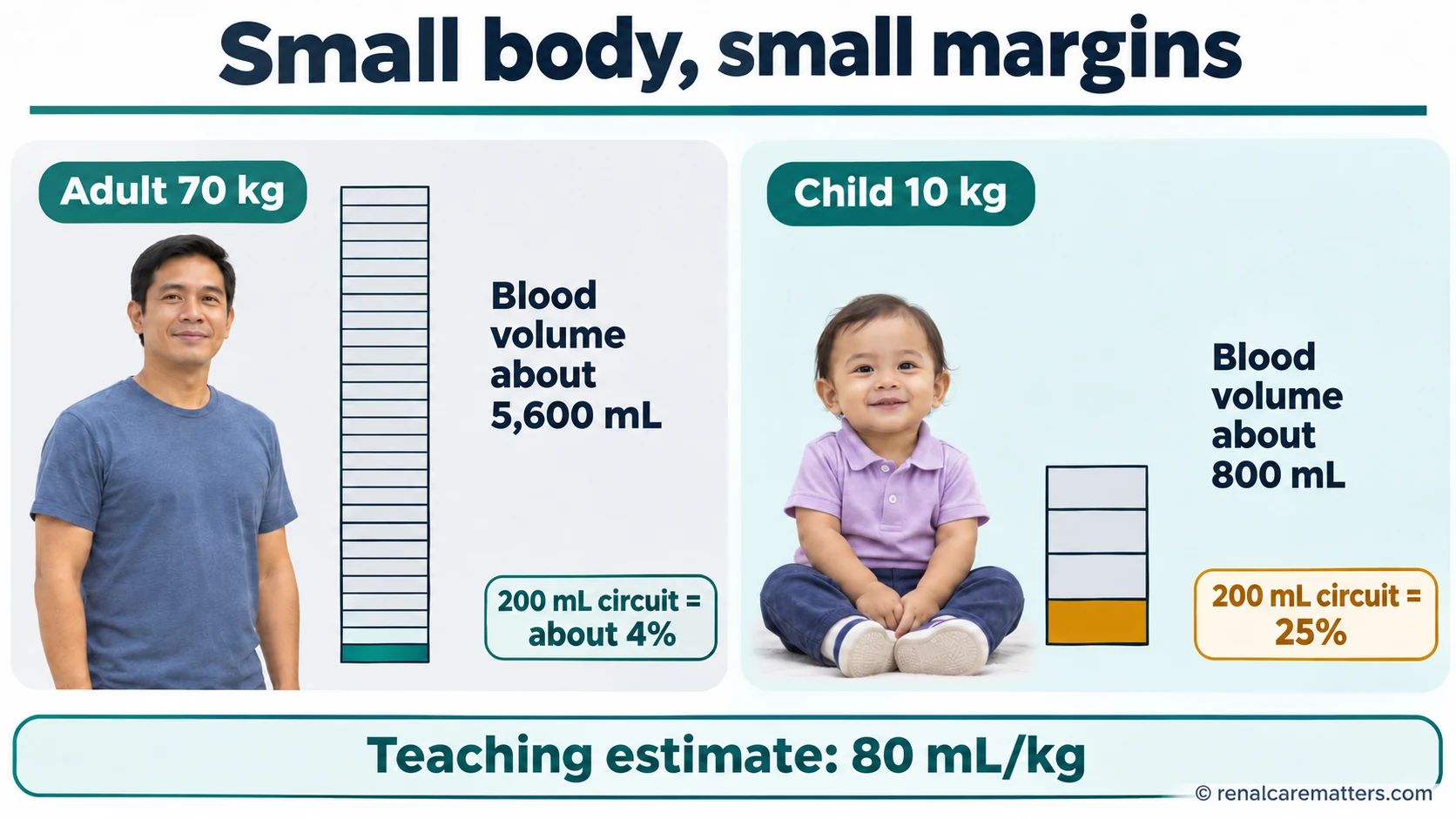
Figure 1. Small body, small margins. The same 200 mL outside the body is about 4% of an adult’s blood volume and a quarter of a 10-kilogram child’s (teaching estimate of 80 mL/kg).
Figure 2 · Key terms for this module
AuthorizationPermission from a body with the power to grant it: the Professional Regulation Commission (PRC), the facility, the medical staff.
Age and size bandThe range of ages or weights a nurse is signed off to treat, for example “over 20 kilograms”.
Scope of practiceWhat a registered nurse may do under the law and the facility’s policy.
Learning agreementA written plan naming your preceptor, supervision level, tasks and review date.
EscalationPassing a problem to the person who can decide, quickly and clearly.
Opening case · fictional
Case: The adult nurse who was asked to cover
Nurse Joanna Reyes, 31, has dialyzed adults for six years in a hospital unit in Quezon City. On a Saturday the pediatric dialysis nurse is sick, and the charge nurse asks Joanna to “just watch” Migo Santos, 8, who is due for hemodialysis through a tunneled catheter at 7 a.m. Migo weighs 22 kilograms. His mother has brought his school workbook.
Joanna has never set up the pediatric blood lines. The order sheet lists a blood flow and a fluid-removal goal in units she rarely uses. The pediatric nephrologist is reachable by phone.
Before reading on, decide:
What is Joanna authorized to do this morning, and what is she not?
Who decides whether Migo is dialyzed today, and by whom?
What should Joanna say to the charge nurse, and when?
Keep your answers in mind. The lesson gives you what you need, and the case review near the end shows one sound response.
Lesson · part 1
Four separate authorizations
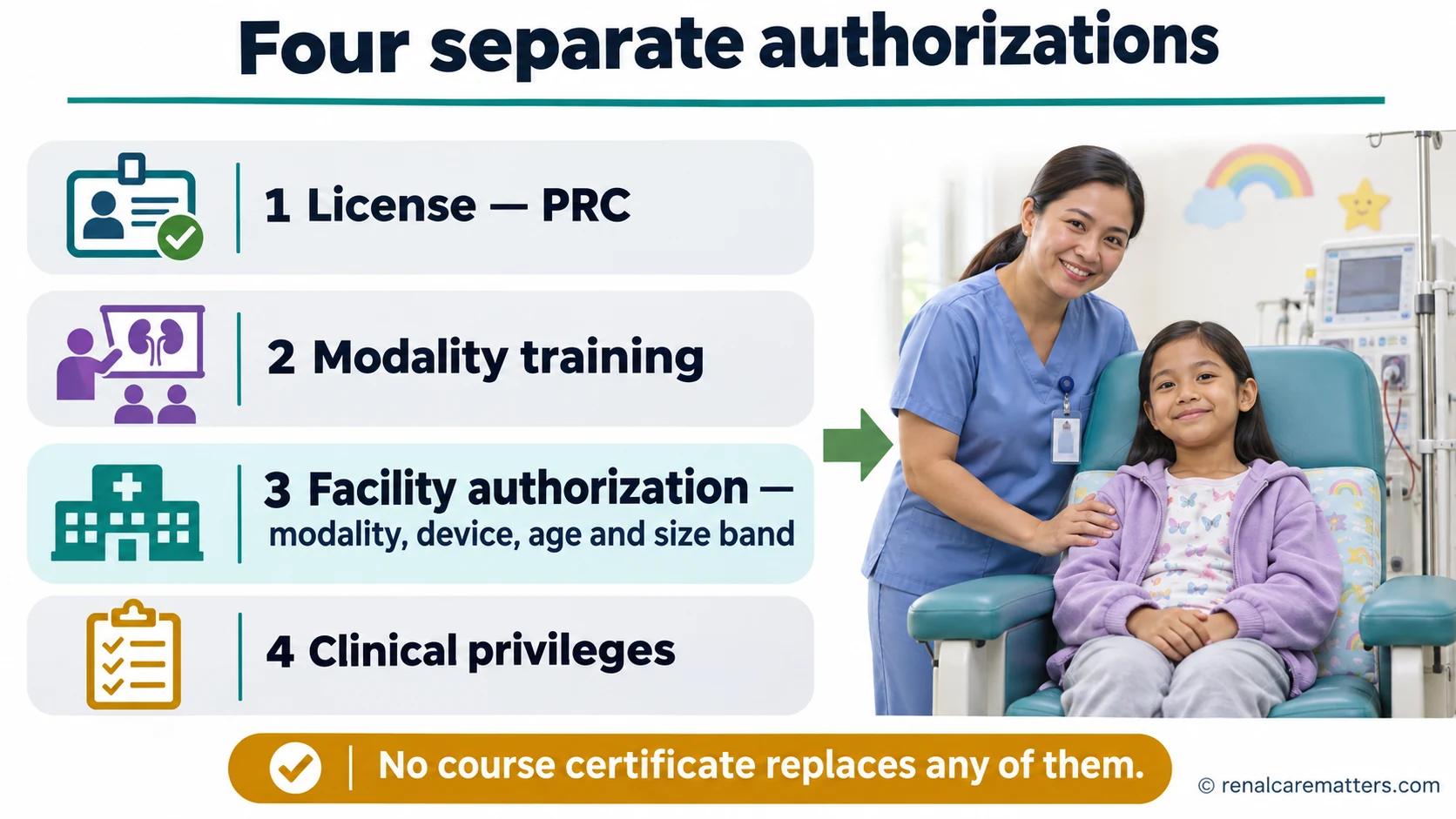
Your Philippine nursing license is the first authorization, and it covers the care of children and families.1 It does not, by itself, make you competent or authorized to dialyze a child. Three more layers sit on top of it.
Figure 3. Four separate authorizations. Each answers a different question; no course certificate replaces any of them.
Layer
Question it answers
Who grants it
What to keep
License
May this person practice nursing?
Professional Regulation Commission (PRC)
Current license
Modality training
Has this nurse been trained in the modality?
A recognized program; for hemodialysis, structured renal training as Philippine Society of Nephrology (PSN) guidance describes2
Certificates with dates and hours
Facility authorization
May this nurse perform this task, on this device, for children of this age and size?
The facility, after observed practice
Signed competency record with age and size band and review date
Clinical privileges
May this nurse work in this unit and setting?
The hospital’s nursing service and medical staff rules
Privilege record
The review behind this track found no separate Philippine license, fixed training duration or nurse-to-patient ratio specific to pediatric dialysis.3,4 That does not make pediatric work unregulated. It means the facility’s own authorization carries more weight, and a nurse authorized for adults is not automatically authorized for children.
RememberA license lets you practice. A facility authorization by modality, device and age band lets you dialyze this child. You need both.
Lesson · part 2
The pediatric kidney team, and who decides what
Children on dialysis are cared for by a team larger than most adult units. The team exists because a child’s problems cross organ systems and life domains: growth, bone, blood pressure, school, family income, mood.
Play, preparation for procedures, schooling during treatment
The child’s fears and interests
When you do not know who owns a question, ask it of the nephrologist first. A question routed to the wrong person costs time; a question never asked can cost the child.
RememberYou coordinate many decisions and own a few. Name the owner of each before you act.
Lesson · part 3
The child’s kidney journey
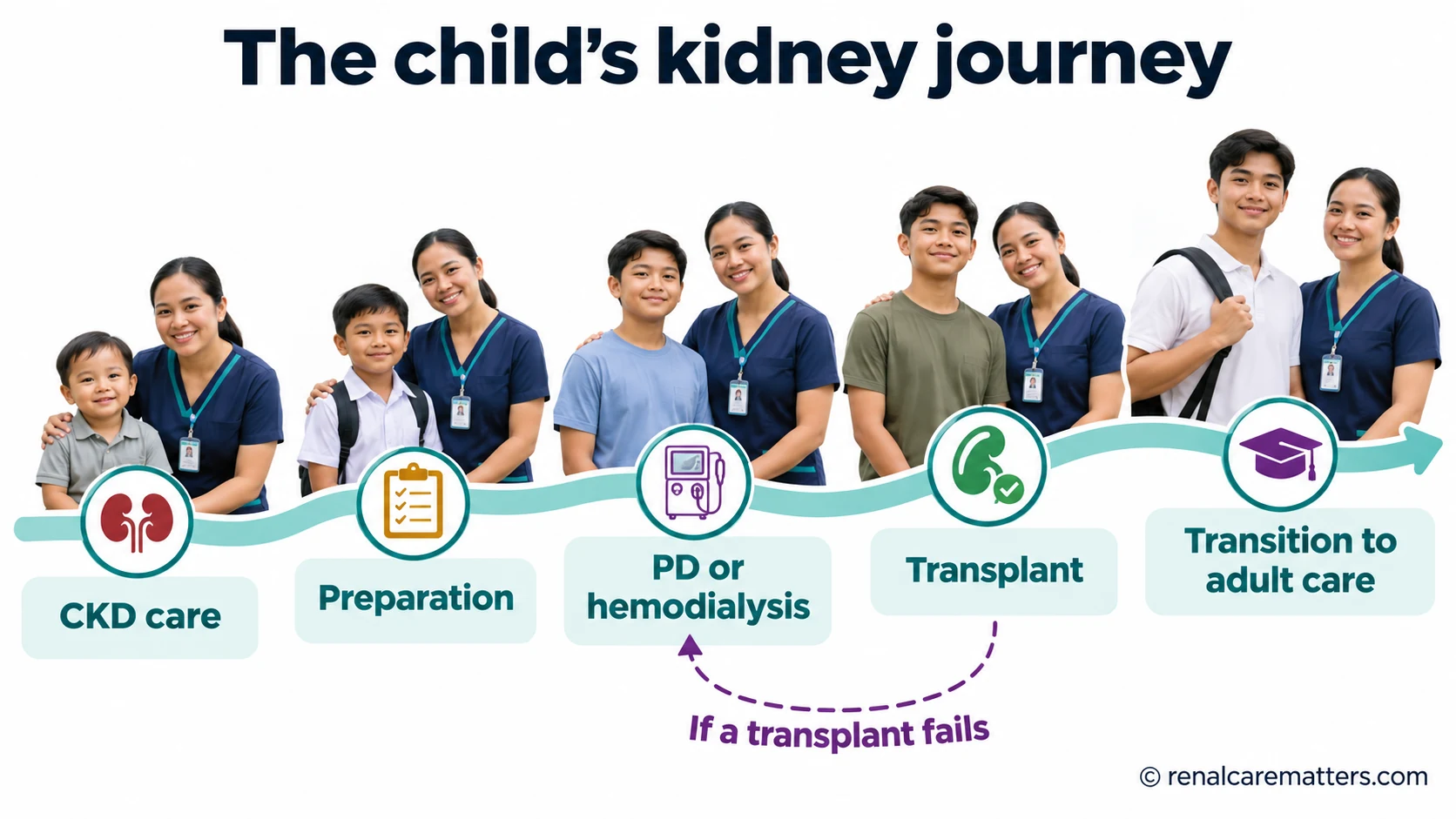
A child’s kidney story usually runs through five stages: chronic kidney disease (CKD) care, preparation for kidney replacement, dialysis, transplant, and transition to adult care. Some children receive a kidney before ever needing dialysis; some return to dialysis when a transplant fails. The nurse appears at every stage.
Figure 4. The child’s kidney journey. Dialysis is one stage of a path that usually leads to transplant and, later, adult care.
Outcomes on pediatric dialysis are better than many families fear, and they depend heavily on resources. In the International Pediatric Peritoneal Dialysis Network (IPPN) registry of 2,956 children, the probability of death after three years on maintenance PD was 5% overall, from 2% in North America to 9% in Eastern Europe, and country income explained about half of the difference between regions.5 A European registry found the same pattern: public health spending explained most of the variation in mortality between countries.6 Both are observational. They tell you that systems matter, and that the nurse’s reliability is part of the system.
On the floor · Saturday, 6:40 a.m.
Back to Joanna. She reads Migo’s chart and finds the written plan: pediatric lines, a specific dialyzer, a blood flow in mL per minute and a goal in mL. She has never primed those lines.
She tells the charge nurse before Migo is connected: “I am authorized for adults only. I can weigh him, take his vital signs and keep him company, but I should not set up or run his treatment. Can we call the pediatric nephrologist now?”
Saying it before the connection, in one clear sentence, is the safe moment. After the pump starts, the same sentence is much harder to say.
Illustrative scenario. Names and details are invented.
RememberDialysis is one stage of a long road. Every decision today should leave the child’s options open for tomorrow.
Lesson · part 4
Starting safely: the learning agreement
New pediatric dialysis nurses fail most often not from lack of knowledge but from unclear limits. A learning agreement fixes the limits in writing before the first shift.
Preceptor: a named senior pediatric dialysis nurse, and who covers when they are away.
Supervision level by task: observe, assist, perform with direct supervision, perform with the preceptor nearby.
Age and size band: start with older, larger, stable children; small infants come later and need separate sign-off.
Escalation: whom to call, for what, at what hour, with phone numbers that work.
Readiness: pediatric resuscitation preparation as your employer requires, and orientation to the emergency cart.
Review date: when the agreement is reassessed.
Keep your agreement and competency records in the facility’s system. The Academy is self-study; it never records competence.
RememberWrite the limits down before the first shift. A limit you never stated is a limit nobody will protect.
On the floor
Real situations: problems and solutions
These are fictional but typical. For each one, cover the answer, decide what you would do, then compare. Where a step depends on local rules, your unit’s procedure and your supervisor’s direction come first.
“You’re a dialysis nurse, right?”
What you see
You are asked to take a pediatric patient because you know adult hemodialysis.
What is likely going on
Staffing pressure treats adult authorization as pediatric authorization.
What to do
State your authorization in one sentence, offer what you can safely do, and ask for the nephrologist and charge nurse to decide.
Why it matters
Authorization is by modality, device and age band.
The unknown number
What you see
At 2 a.m. the on-call number on the wall rings out.
What is likely going on
Escalation contacts were never tested.
What to do
Use the backup route in the learning agreement; report the dead number in the morning.
Why it matters
An escalation plan that fails at night is no plan.
The proud preceptor
What you see
Your preceptor says, “Just watch me for a week, then you’re on your own.”
What is likely going on
Supervision levels were never written.
What to do
Ask to write the learning agreement together, with tasks, supervision levels and a review date.
Why it matters
Unwritten limits are not protected.
Field notes
Carry a card with your authorization and escalation numbers.
Start with older, stable children.
Case review
Back to the case: The adult nurse who was asked to cover
What Joanna may do. She is licensed, and she is authorized for adult hemodialysis. She is not authorized to set up or run pediatric treatment on that equipment. She may weigh Migo, take age-appropriate vital signs, comfort him and his mother, and help a qualified nurse.
Who decides. The pediatric nephrologist decides whether Migo is dialyzed today, how, and by whom; the charge nurse and the facility decide staffing. Options include a qualified nurse from another area, a short delay with close monitoring, or transfer, depending on Migo’s potassium, fluid status and symptoms.
What Joanna says, and when. She speaks before connection, states her authorization in one sentence, offers what she can safely do, and asks for the nephrologist to be called. She documents the conversation and the decision. Afterward she asks to start a pediatric learning agreement.
Skills lab · with your preceptor
Skills checklist: Starting safely in pediatric dialysis
Complete these with your preceptor in your first week. Your preceptor rates each step as satisfactory, needs practice, or not observed. Steps marked Critical must all be satisfactory before sign-off. This checklist supports supervised learning; your unit’s own procedure and competency form are the authority. A printable version of every checklist is on the trainer page.
CriticalStates own authorization by modality, device and age band in one sentence
Names the owner of five common decisions (target weight, antibiotic choice, fill volume, feeding plan, school letter)
CriticalLocates the pediatric emergency cart and checks its log with the preceptor
CriticalLists escalation contacts with working numbers for day, night and weekend
Drafts a learning agreement with supervision levels and a review date
Placement activity. Shadow a pediatric dialysis shift from setup to the last disconnection. Note every moment a decision passed from one person to another.
Self-assessment
Check your understanding
Each visit draws 5 questions at random from this module’s 15-question bank. Choose the single best answer for each, then select Check answers; an explanation appears under the best answer. Select New set of questions for a different mix. A good target is 4 of 5 on two different sets. Nothing you select is sent anywhere; scoring happens in your browser.
Ploos van Amstel, S., Noordzij, M., Borzych-Duzalka, D., Chesnaye, N. C., Xu, H., Rees, L., Ha, I. S., Antonio, Z. L., Hooman, N., Wong, W., Vondrak, K., Yap, Y. C., Patel, H., Szczepanska, M., Testa, S., Galanti, M., Kari, J. A., Samaille, C., Bakkaloglu, S. A., . . . Schaefer, F. (2021). Mortality in children treated with maintenance peritoneal dialysis: Findings from the International Pediatric Peritoneal Dialysis Network registry. American Journal of Kidney Diseases, 78(3), 380–390. https://doi.org/10.1053/j.ajkd.2020.11.031
Chesnaye, N. C., Schaefer, F., Bonthuis, M., Holman, R., Baiko, S., Baskın, E., Bjerre, A., Cloarec, S., Cornelissen, E. A. M., Espinosa, L., Heaf, J., Stone, R., Shtiza, D., Zagozdzon, I., Harambat, J., Jager, K. J., Groothoff, J. W., & van Stralen, K. J. (2017). Mortality risk disparities in children receiving chronic renal replacement therapy for the treatment of end-stage renal disease across Europe: An ESPN-ERA/EDTA registry analysis. Lancet, 389(10084), 2128–2137. https://doi.org/10.1016/S0140-6736(17)30063-6
Educational material for registered nurses. Completing it is an Academy learning record only. It does not confer CPD units, PSN or National Kidney and Transplant Institute (NKTI) training recognition, PhilHealth staffing credit, or clinical privileges, and it does not replace your facility’s protocols, device instructions, or written orders.