Patients & Care Partners · Peritoneal dialysis at home · Module P03

Organize home dialysis routines and reassessment

Home dialysis gives freedom and responsibility in the same box.

PublishedNailathalaGipatikPepalwal: ReferencesMga SanggunianMga TinubdanReng Reperensya: 3 Audience: People living with kidney disease and the people who support them Read timeOras ng pagbasaOras sa pagbasaOras ning pamamasa:
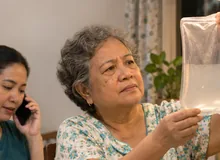
Tatay Nestor watches his grandson Kevin practice a peritoneal dialysis connection under a nurse's supervision.
Renal Care Academy›Renal Patients and Care Partners›Module P03
🤝

For patients and care partners

This course helps you understand your care and prepare questions. It does not give individual fluid limits, food limits, blood pressure targets, medicine doses or machine settings: those come from your own care team. Practical home dialysis training happens with your treatment service. No website, quiz or chat is watched in real time; in an emergency, get help now. Every person in the stories is fictional.

When to get urgent helpSevere breathlessness, chest pain, fainting, heavy bleeding, new confusion: get emergency help now. No website or chat is watched in real time.

After this module you should be able to

Suggested earlier modules: C01, C03, C04, C07, C08, C12. You may read any module in any order; the suggestion only helps the lessons build on each other.

The everyday picture

In plain wordsHome dialysis gives freedom and responsibility in the same box. The unit staff are no longer in the room, so the home becomes a small clinic: supplies must arrive on time and stay dry, records must be kept, and skills must stay sharp. Skills fade quietly with time, illness and shortcuts, the way a driver who once passed the test can slowly pick up bad habits. Planned reassessment keeps the freedom safe.

Records help the home team

Keep the records your team asks for, using their forms and units, such as daily weight, blood pressure, the appearance of drained fluid, and how much fluid comes out. Bring them to every clinic visit. Report unusual findings according to your written action plan. Recording information does not authorize you to change your prescription; the team decides changes.

Make supplies manageable

Store boxes off the floor in a clean, dry, cool place, use the oldest stock first, and check bags for damage and expiry before use. Plan deliveries around holidays and typhoon season, and tell the team early about travel. Follow the unit's waste disposal instructions. Ask how to report damaged or questionable supplies, and never use a bag that looks wrong.

A clean home exchange table with mask and hand rub, supply boxes off the floor with the oldest first, a bag checked for damage and expiry, and a record sheet for the home team. Ask for a skills review after an infection, after a hospital stay, with a new helper, with new equipment, when eyesight, hands or memory change, or whenever you feel unsure.

A safe home routine. A clean home exchange table with mask and hand rub, supply boxes off the floor with the oldest first, a bag checked for damage and expiry, and a record sheet for the home team. Ask for a skills review after an infection, after a hospital stay, with a new helper, with new equipment, when eyesight, hands or memory change, or whenever you feel unsure.

Ask for a skills review

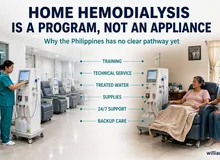
Request reassessment after a hospital stay, an infection, a change in helper, new equipment, or whenever you feel unsure. Needing a refresher is a reason to ask, not a failure to hide. Note: if you are exploring home hemodialysis, this module covers only general home organization; home hemodialysis needs its own device-specific training through an authorized program.

A new helper, an old habit

What happened

Tatay Nestor, 72, has done peritoneal dialysis (PD) for three years with his wife's help. She is hospitalized, and his grandson Kevin, 22, offers to help after watching a few exchanges.

Before reading on: what would you do, and whom would you call?

What happened next, and why it mattersNestor calls the PD team, who schedule a training session for Kevin and a technique check for Nestor. The trainer notices Nestor has started skipping his hand-washing timer. Both receive a refresher; Kevin is assessed before helping alone. Three years of experience made Nestor confident, but the review made him safe again.

How sure are we? Moderate evidence

The International Society for Peritoneal Dialysis (ISPD) 2022 peritonitis guideline recommends PD retraining after peritonitis, catheter infection, hospitalization, change in dexterity, vision or cognition, change in equipment, or interruption of PD. United States home dialysis regulations also require facility-based training and reassessment, which this course adapts as good practice rather than as Philippine law.1,2,3

Questions to ask your team

Try it, then say it in your own words

Practice. Use W16 to plan a fictional week of deliveries, records and backup support; no exchange steps are assessed online. Worksheet W16: My home treatment organization is ready to print. Use invented details when practicing; keep your real health information on paper, not online.

Teach backExplain how you would arrange retraining when a new care partner joins. If a nurse educator is with you, they can record this on the teach-back record. Reading and quizzes never count as a hands-on skill check.

Three quick questions

Choose the best answer for each, then select Check answers. An explanation appears under the best answer. Try again as often as you like. Nothing you select is sent anywhere.

Question 1 of 3A different person will now help with home dialysis. What is needed?
Question 2 of 3A box of PD bags arrives damp and one bag looks damaged. What should you do?
Question 3 of 3When is it a good idea to ask for a PD technique review?

Read next on this site

Choose your own path on the course home. Last checked November 29, 2026.

Glossary & abbreviationsTalahulugan at mga daglatTalaan sa mga pulong ug daglatTalatinigan ampo reng daglat terms used on this page

Abbreviations

ISPD
International Society for Peritoneal Dialysis.
PD
Peritoneal dialysis.
ReferencesMga SanggunianMga TinubdanReng Reperensya 3 sources
  1. Conditions for coverage for end-stage renal disease facilities: Care at home, 42 C.F.R. § 494.100 (2024). https://www.govinfo.gov/content/pkg/CFR-2024-title42-vol5/pdf/CFR-2024-title42-vol5-sec494-100.pdf
  2. Chow, J. S., Brunier, G., Figueiredo, A. E., Hurst, H., Moran, D. P., Neumann, J. L., Mehrotra, R., Mushahar, L., Fuge, T., Avesani, C. M., Yee Chow, N., & Johnson, D. W. (2025). Teaching peritoneal dialysis: A position paper for the International Society for Peritoneal Dialysis. Peritoneal Dialysis International, 45(6), 327–343. https://doi.org/10.1177/08968608251375512
  3. Li, P. K., Chow, K. M., Cho, Y., Fan, S., Figueiredo, A. E., Harris, T., Kanjanabuch, T., Kim, Y. L., Madero, M., Malyszko, J., Mehrotra, R., Okpechi, I. G., Perl, J., Piraino, B., Runnegar, N., Teitelbaum, I., Wong, J. K., Yu, X., & Johnson, D. W. (2022). ISPD peritonitis guideline recommendations: 2022 update on prevention and treatment. Peritoneal Dialysis International, 42(2), 110–153. https://doi.org/10.1177/08968608221080586
Dr. William Gregory M. Rivero, MD

William Gregory Rivero, MD, FPCP, DPSN

Internal Medicine · Nephrology · Nutrition · Philippines · PRC 0105184

Patient and care-partner education from the Renal Care Academy. It supports, and never replaces, the advice of your own kidney team, your unit’s written instructions, and supervised treatment training. Completing it is a self-reported learning record, not a qualification of any kind.

QR code — scan to save Dr. Rivero's contact info

Scan and save