Patients & Care Partners · Peritoneal dialysis at home · Module P02

Recognize PD infection and contamination concerns

Used PD fluid should look clear enough that you could read a newspaper through the bag.

PublishedNailathalaGipatikPepalwal: ReferencesMga SanggunianMga TinubdanReng Reperensya: 3 Audience: People living with kidney disease and the people who support them Read timeOras ng pagbasaOras sa pagbasaOras ning pamamasa:
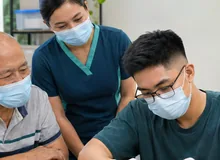
Aling Merly holds a drained peritoneal dialysis bag up to the lamp while her daughter phones the team.
Renal Care Academy›Renal Patients and Care Partners›Module P02
🤝

For patients and care partners

This course helps you understand your care and prepare questions. It does not give individual fluid limits, food limits, blood pressure targets, medicine doses or machine settings: those come from your own care team. Practical home dialysis training happens with your treatment service. No website, quiz or chat is watched in real time; in an emergency, get help now. Every person in the stories is fictional.

When to get urgent helpSevere breathlessness, chest pain, fainting, heavy bleeding, new confusion: get emergency help now. No website or chat is watched in real time.

After this module you should be able to

Suggested earlier modules: C01, C07, C08, P01. You may read any module in any order; the suggestion only helps the lessons build on each other.

The everyday picture

In plain wordsUsed PD fluid should look clear enough that you could read a newspaper through the bag. When germs reach the peritoneum, white blood cells rush in to fight them, and the fluid turns cloudy, sometimes before pain or fever appear. That is why cloudy fluid is the earliest alarm of peritonitis, an infection of the abdominal lining. Treated early, most episodes clear with antibiotics; delayed, they can damage the membrane or end PD.
Newsprint is readable through a clear drained bag but not through a cloudy one, which holds white blood cells. Call your peritoneal dialysis team now, day or night; keep the cloudy bag; and if you cannot reach them, go to the emergency department with the bag. Check the exit site too for redness, swelling, crust or pus, and pain.

Clear or cloudy. Newsprint is readable through a clear drained bag but not through a cloudy one, which holds white blood cells. Call your peritoneal dialysis team now, day or night; keep the cloudy bag; and if you cannot reach them, go to the emergency department with the bag. Check the exit site too for redness, swelling, crust or pus, and pain.

Know the warning signs

Cloudy drained fluid, abdominal pain or tenderness, fever, chills, nausea or vomiting can signal peritonitis. Redness, pain, swelling, crusting or pus at the catheter exit site can signal an exit-site infection, which can spread inward. Contact your PD team immediately for any of these, day or night, even if you feel fairly well. Keep the cloudy bag; the team will usually want it for testing.

Report a break in clean technique

If a connection touches something unclean, a cap falls off, a line cracks, or you are unsure whether a step was sterile, follow the response your trainer taught, and call the PD team promptly. Contamination does not always lead to infection, but reporting it lets the team decide whether you need preventive treatment. Never improvise a repair, and never add antibiotics or other medicines to a bag on your own.

If a tip touched something, a cap fell off or a line cracked: stop and follow the step your trainer taught you, call the peritoneal dialysis team promptly, and let the team decide about preventive treatment. Never repair it yourself and never add medicine to a bag.

If a connection may be contaminated. If a tip touched something, a cap fell off or a line cracked: stop and follow the step your trainer taught you, call the peritoneal dialysis team promptly, and let the team decide about preventive treatment. Never repair it yourself and never add medicine to a bag.

Know the backup route

Keep the PD team's number and an after-hours or backup emergency contact on the wall near your exchange area and in your phone. If you are severely unwell, have severe abdominal pain, or cannot get urgent advice, go to the emergency department and bring your cloudy bag and your PD details. The clinical team directs tests, sample handling and treatment.

Cloudy on a Saturday night

What happened

Aling Merly, 61, on continuous ambulatory peritoneal dialysis (CAPD) in Pampanga, sees a slightly cloudy bag at 10 p.m. on Saturday. Her belly feels only mildly sore, and she does not want to disturb the nurse on a weekend.

Before reading on: what would you do, and whom would you call?

What happened next, and why it mattersHer daughter insists they call. The PD nurse asks them to bring the bag to the hospital that night; the fluid count confirms peritonitis, and antibiotics start before midnight. Merly recovers within days and stays on PD. Reviewing her technique, the trainer finds she had stopped wearing a mask during exchanges while she had a cold. Calling early protected both her health and her PD.

How sure are we? Strong evidence

The International Society for Peritoneal Dialysis (ISPD) 2022 peritonitis guideline recommends that PD programs keep overall peritonitis rates no higher than 0.40 episodes per patient-year at risk and that more than 80% of patients stay peritonitis-free each year. It also updates advice on managing contamination and on training and retraining. Centers for Disease Control and Prevention (CDC) guidance lists cloudy effluent, abdominal pain, fever and exit-site changes as signs to report.1,2,3

Questions to ask your team

Try it, then say it in your own words

Practice. Rehearse a cloudy-drainage call using W07: symptoms, timing, current location and treatment type. Worksheet W07: My urgent help card is ready to print. Use invented details when practicing; keep your real health information on paper, not online.

Teach backSay what you would do if drained fluid became cloudy even without severe pain. If a nurse educator is with you, they can record this on the teach-back record. Reading and quizzes never count as a hands-on skill check.

Three quick questions

Choose the best answer for each, then select Check answers. An explanation appears under the best answer. Try again as often as you like. Questions marked Safety question (2 here) must be answered correctly before the module counts as complete; the explanation shows you why. Nothing you select is sent anywhere.

Question 1 of 3Drained PD fluid looks cloudy but you feel fairly well. What should you do?Safety question
Question 2 of 3The tip of a connection touches the table during an exchange. What should you do?Safety question
Question 3 of 3Why does PD fluid turn cloudy during peritonitis?

Read next on this site

Choose your own path on the course home. Last checked November 29, 2026.

Glossary & abbreviationsTalahulugan at mga daglatTalaan sa mga pulong ug daglatTalatinigan ampo reng daglat terms used on this page

Abbreviations

CAPD
Continuous ambulatory peritoneal dialysis.
CDC
Centers for Disease Control and Prevention.
ISPD
International Society for Peritoneal Dialysis.
PD
Peritoneal dialysis.
ReferencesMga SanggunianMga TinubdanReng Reperensya 3 sources
  1. Centers for Disease Control and Prevention. (2026). Infection control for peritoneal dialysis. https://www.cdc.gov/dialysis-safety/hcp/infection-control/peritoneal-dialysis.html
  2. National Institute of Diabetes and Digestive and Kidney Diseases. (n.d.). Peritoneal dialysis. https://www.niddk.nih.gov/health-information/kidney-disease/kidney-failure/peritoneal-dialysis
  3. Li, P. K., Chow, K. M., Cho, Y., Fan, S., Figueiredo, A. E., Harris, T., Kanjanabuch, T., Kim, Y. L., Madero, M., Malyszko, J., Mehrotra, R., Okpechi, I. G., Perl, J., Piraino, B., Runnegar, N., Teitelbaum, I., Wong, J. K., Yu, X., & Johnson, D. W. (2022). ISPD peritonitis guideline recommendations: 2022 update on prevention and treatment. Peritoneal Dialysis International, 42(2), 110–153. https://doi.org/10.1177/08968608221080586
Dr. William Gregory M. Rivero, MD

William Gregory Rivero, MD, FPCP, DPSN

Internal Medicine · Nephrology · Nutrition · Philippines · PRC 0105184

Patient and care-partner education from the Renal Care Academy. It supports, and never replaces, the advice of your own kidney team, your unit’s written instructions, and supervised treatment training. Completing it is a self-reported learning record, not a qualification of any kind.

QR code — scan to save Dr. Rivero's contact info

Scan and save