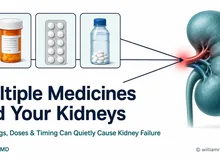
After this module you should be able to
- Keep one complete, current medicine list
- Check any new medicine, herbal product or supplement before taking it
- Know whom to ask when a dose is missed or you are sick
Suggested earlier modules: none. You may read any module in any order; the suggestion only helps the lessons build on each other.
The everyday picture

Why the same dose can build up. Medicines shown as cars on a road with two exits, the liver and the kidney. With healthy kidneys both exits flow; with weak kidneys the kidney exit narrows and medicine builds up. A dose that was right for healthy kidneys may need changing.
One list to bring everywhere
Write every medicine you take: its name, what it is for, how much, and when. Include vitamins, herbal teas and capsules, creams, eye drops, injections such as insulin or erythropoietin, and anything bought without a prescription. Add your allergies and what happened. Bring the list, or a photo of it, to every appointment and every hospital visit, and update it the same day anything changes. After a hospital stay, lists often disagree; a pharmacist or your doctor can reconcile them so you follow one clear plan instead of two conflicting ones.
Ask before adding a product
Some everyday products are hard on kidneys. Pain relievers called NSAIDs (non-steroidal anti-inflammatory drugs, such as ibuprofen, mefenamic acid and naproxen) reduce blood flow into the kidney's filters and can cause sudden kidney injury, especially when you are dehydrated. Many herbal "kidney cleansers," detox teas and imported supplements are not tested for people with kidney disease; some contain potassium, heavy metals or hidden drugs. Before taking anything new, show the label to your pharmacist or kidney team and say: "I have kidney disease and I am on [your treatment]. Is this safe for me?"

Ask before adding a product. Three warning cards: pain relievers called NSAIDs (ibuprofen, mefenamic acid, naproxen) reduce blood flow into the filters; herbal kidney cleansers and detox teas are not tested for kidney disease; imported supplements may hide potassium, metals or drugs. A patient asks the pharmacist, "I have kidney disease. Is this safe for me?"
Make a routine that survives real life
Link medicines to things you already do every day: breakfast, the morning news, brushing your teeth. A pill organizer or a phone alarm helps. Ask your team now, while you are well, what to do if you miss a dose, vomit, or have diarrhea or a fever, because some medicines should be paused on sick days and others must never be stopped. Write the answer down. Never double a dose to catch up or copy a friend's schedule. If cost, side effects or difficulty swallowing makes the plan hard, tell the team; there is often a cheaper or easier option.
Let reminders and records do the remembering
A good list and routine work best with three supports: a reminder that goes off at the right time, a habit of asking before anything new, and a folder that keeps the list current.
- Phone reminders: set one labeled alarm for each time of day you take medicines, with separate days if your dialysis-day schedule differs. Module D02 shows the steps on iPhone and Android.
- Ask first: pain relievers, cold tablets, antacids, laxatives, bowel preparations, herbal products and star fruit (balimbing) can all harm weak kidneys. Module D03 lists them and gives a short script to use with any doctor, dentist or pharmacist.
- Keep it current: update the list the same day anything changes, keep the newest copy in your health folder, and show it at every visit (Modules D01 and D04).
The pain reliever from the sari-sari store
Tito Boy, 63, has chronic kidney disease (CKD) and high blood pressure. After helping move furniture for a fiesta, his back aches, so he buys mefenamic acid from the corner store and takes it three times a day for a week. It is hot, he drinks little water, and his legs begin to swell. His next blood test shows his kidney function has dropped.
Before reading on: what would you do, and whom would you call?
How sure are we? Moderate evidence
Medicine safety is one of the most practical skills in kidney care. The Kidney Disease: Improving Global Outcomes (KDIGO) 2024 guideline advises reviewing every medicine for kidney dosing and avoiding nephrotoxic drugs such as NSAIDs where possible in people with CKD. Philippine kidney specialists have publicly warned about the uncritical use of food supplements (press-reported). Evidence linking herbal products to kidney injury comes mainly from case reports and observational studies, which is enough to justify asking first.1,2,3
Questions to ask your team
- Which of my medicines need a different dose because of my kidneys?
- What should I do with each medicine if I am vomiting or have diarrhea?
- Which pain reliever is safest for me?
Try it, then say it in your own words
Practice. Use W04 to practice a medicine list with fictional entries, one allergy and a refill reminder. Worksheet W04: My medicine conversation is ready to print. Use invented details when practicing; keep your real health information on paper, not online.
Three quick questions
Choose the best answer for each, then select Check answers. An explanation appears under the best answer. Try again as often as you like. Nothing you select is sent anywhere.
Read next on this site
- Multiple Medicines and Your KidneysHow kidney disease changes medicines.
- NSAID-Induced Kidney InjuryPain relievers and kidney injury.
Choose your own path on the course home. Last checked November 29, 2026.
Module 4 of 4036 modules to go