After this module you should be able to
- Describe in plain words what healthy kidneys do
- Tell the difference between estimated glomerular filtration rate (eGFR) and urine albumin and why both matter
- Prepare one question about the trend in your results
Suggested earlier modules: none. You may read any module in any order; the suggestion only helps the lessons build on each other.
The everyday picture
What kidneys do
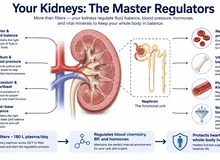
Each kidney holds about a million tiny filters called nephrons. Blood enters each filter under pressure; water and small waste molecules pass through, and the tubule that follows reclaims almost all of the water, salt and sugar the body still needs. What remains becomes urine. Kidneys also help control blood pressure, keep blood from becoming too acidic, activate vitamin D for strong bones, and make a hormone (erythropoietin) that tells the bone marrow to produce red blood cells. That is why kidney disease can show up as high blood pressure, weak bones, tiredness from anemia or swelling, not only as changes in urine.
Two tests that tell different stories
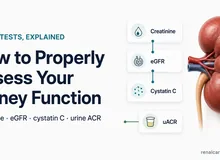
eGFR (estimated glomerular filtration rate) estimates how much blood your filters clean each minute. It is calculated from a blood test, creatinine, together with your age and sex. Think of it as how much water the plant can process. Urine albumin, usually reported as a urine albumin-to-creatinine ratio (uACR), measures a protein that should mostly stay in the blood. Albumin leaking into urine means the filters are damaged, like a strainer whose holes are stretching. A person can have a normal eGFR but leaking albumin, or a low eGFR with little leak. International guidelines use both numbers together to judge risk, because together they predict what happens next far better than either alone.

Two tests, two stories. Left: a nephron, with the glomerulus filtering blood into the tubule, and a gauge for eGFR, how much your filters clean. Right: a magnified filter wall with albumin leaking into urine, shown by urine albumin (uACR). A normal eGFR can still leak albumin; both tests together show risk.
Use results without guessing treatment
Keep a dated list of your results with the units printed on the report, because laboratories do not all use the same units. One result is a snapshot; the trend is the story. Creatinine can rise a little after a big meal of meat, heavy exercise, dehydration or certain medicines, so your team looks at the pattern and repeats tests before drawing conclusions. Ask: "How does this compare with last time? What would make you worried? Which change should make me call before my next visit?" Do not change medicines or diet on your own because of one number.

One result is a snapshot; the trend is the story. A nurse shows a couple a simple line of five dated results. One high dot after a big meat meal or dehydration stands out. Use the same units every time, keep a dated list, and ask whether the trend is stable, improving or getting worse.
Aling Cora's "normal" result
Aling Cora, 52, has had diabetes for ten years. Her eGFR came back in the normal range, so she skipped her follow-up visit. Months later her doctor points to another line on the same report: urine albumin, clearly raised, and higher than the year before.
Before reading on: what would you do, and whom would you call?
How sure are we? Strong evidence
Chronic kidney disease is common. The Global Burden of Disease 2023 study estimated that 788 million adults worldwide had chronic kidney disease in 2023, about one in seven adults, and that it was the ninth leading cause of death. In the Philippines, health officials and kidney specialists have reported more than seven million affected people, most of them undiagnosed (press-reported figures). The Kidney Disease: Improving Global Outcomes (KDIGO) 2024 guideline recommends testing both eGFR and urine albumin, because the two together classify risk.1,2,3,4
Questions to ask your team
- What do my eGFR and urine albumin results mean together?
- Is the trend stable, improving or getting worse?
- Which result, if it changes, should make me call before my next visit?
Try it, then say it in your own words
Practice. On W02, copy a fictional date, eGFR and urine albumin result, keeping the units exactly as printed; then write one question about change over time. Worksheet W02: My results questions is ready to print. Use invented details when practicing; keep your real health information on paper, not online.
Three quick questions
Choose the best answer for each, then select Check answers. An explanation appears under the best answer. Try again as often as you like. Nothing you select is sent anywhere.
Read next on this site
- Your Kidneys: The Master Regulators of Your BodyWhat healthy kidneys do, in more depth.
- How to Properly Assess Your Kidney Function: Creatinine, eGFR, Cystatin C & Urine albumin-to-creatinine ratio (ACR)How kidney function is measured.
Choose your own path on the course home. Last checked November 29, 2026.
Module 2 of 4038 modules to go