One patient, every skill: a near fall, fatigue, a new fistula and a PhilHealth question, assessed through your profession’s stations.
PublishedNailathalaGipatikPepalwal:Audience: Philippine-registered occupational therapists and physical therapists who see people with kidney disease · rehabilitation leads, physiatrists and renal teams who refer to them · students on an observer pathwayRead timeOras ng pagbasaOras sa pagbasaOras ning pamamasa:
Renal rehabilitation track for licensed occupational and physical therapists
Study material for licensed occupational therapists (RA 11241) and physical therapists (RA 5680) working with people who have kidney disease. It explains the reasoning behind renal rehabilitation; it is not a hospital protocol. It never authorizes changes to dialysis settings, handling of a needled access or catheter, medicine decisions or benefit promises. Exercise parameters come from the referring physician and your unit’s agreed sheet: per unit protocol, but always ask the attending nephrologist’s guidance. Every case, name and number in the cases is fictional and illustrative.
Learning objectives
After this module you should be able to
Integrate authority, screening, access safety, assessment, intervention, documentation and benefits navigation in one case.
Prioritize problems with the patient and family, and agree a single shared plan across occupational therapist (OT) and physical therapist (PT).
Demonstrate your profession’s six practical stations to the pass standard with no critical failure.
Hand over the plan to the renal team with Situation, Background, Assessment, Recommendation (SBAR) and measurable review points.
Reflect on your own scope and the next steps in your development.
Classroom 2 hSkills lab 2 hSupervised placement 1 h
Pre-testBefore you read, answer the 5 self-assessment questions and note your score. After the module, select New set of questions and compare. The difference is what you learned; the questions you still miss are what to reread.
Start here
The big picture, in plain words
In plain wordsThe capstone is a rehearsal for a real week. One patient arrives with several problems at once, the way patients do, and you have to decide what comes first, who does what, and how you will know it worked.
The picture has a limit. A rehearsal can be stopped and repeated. Your patients’ weeks cannot. That is why the capstone is scored with critical failures that are never averaged away: proceeding past a red flag, compressing or pulling an access, changing a dialysis setting, unsafe lifting, or promising a benefit. Every other mistake is a lesson; those are stops.
The case below draws on every module. Work through it alone first, then with a partner from the other profession, then present it to your preceptor.
Figure 1 · How the capstone is scored
Written planA shared OT and PT plan with prioritized problems, goals, measures and owners.
Six stationsYour profession’s set of practical stations, 8 of 10 or better each, no critical failure.
Examination20 questions, one from each module; pass 16.
PortfolioEvery module’s artifact, deidentified.
ReflectionA one-page reflection on scope and next learning steps.
Opening case · fictional
Case: Mang Pedring’s week
Monday. Mr. Pedro “Mang Pedring” Salvador, 68, a retired fisherman from Bataan, has been on hemodialysis for 18 months (Monday, Wednesday, Friday mornings) and has type 2 diabetes. A new left forearm fistula was created four weeks ago; he still dialyzes through a right internal jugular catheter. Last Friday he nearly fell walking out of the unit after 3 kilograms of fluid removal. He is exhausted on dialysis afternoons and has stopped visiting his kumpare at the pier. His wife asks if Philippine Health Insurance Corporation (PhilHealth) will pay for “therapy and a walker.”
Findings at a non-dialysis-day assessment: Short Physical Performance Battery (SPPB) 6; gait speed 0.62 m/s; five-times sit-to-stand 19 seconds; six-minute walk 245 meters; numb feet with a small blister on the left heel; recovery time “until the next morning”; Patient Health Questionnaire-9 (PHQ-9) of 11 on the team’s screen. He wants “to walk to the pier again and sit with my friends on Saturdays.” The pier is 400 meters from his house.
Before reading on, decide:
What are the immediate safety issues, and who must hear about each today?
What is the prioritized shared plan, and who leads each part?
How will you answer his wife, and what will you send to whom?
Keep your answers in mind. The lesson gives you what you need, and the case review near the end shows one sound response.
Lesson · part 1
Step 1: the safety issues that come before any plan
Before any goal, close the safety loops. Each has an owner.
Issue
Why it matters
Owner and action today
Near fall after 3 kg removal
Post-dialysis hypotension plus neuropathy; fracture risk
Nurse and nephrologist informed; PT fall assessment; he waits until steady before leaving
Heel blister in a numb foot
A pre-ulcer in a person with diabetes on dialysis
Same-day nurse and physician review; foot-care referral; offload during training
PHQ-9 of 11
Possible depression; motivation
Physician and mental-health referral; ask about self-harm thoughts
New fistula (4 weeks) and a neck catheter
Maturing access; catheter infection risk
No pressure or loads on the left forearm; basic hand exercise only if the surgeon approves; catheter dressing kept dry
Long recovery time
Associated with worse outcomes in Dialysis Outcomes and Practice Patterns Study (DOPPS)
Reported to the nephrologist with the fluid removal data
Lesson · part 2
Step 2: one shared plan, two professions
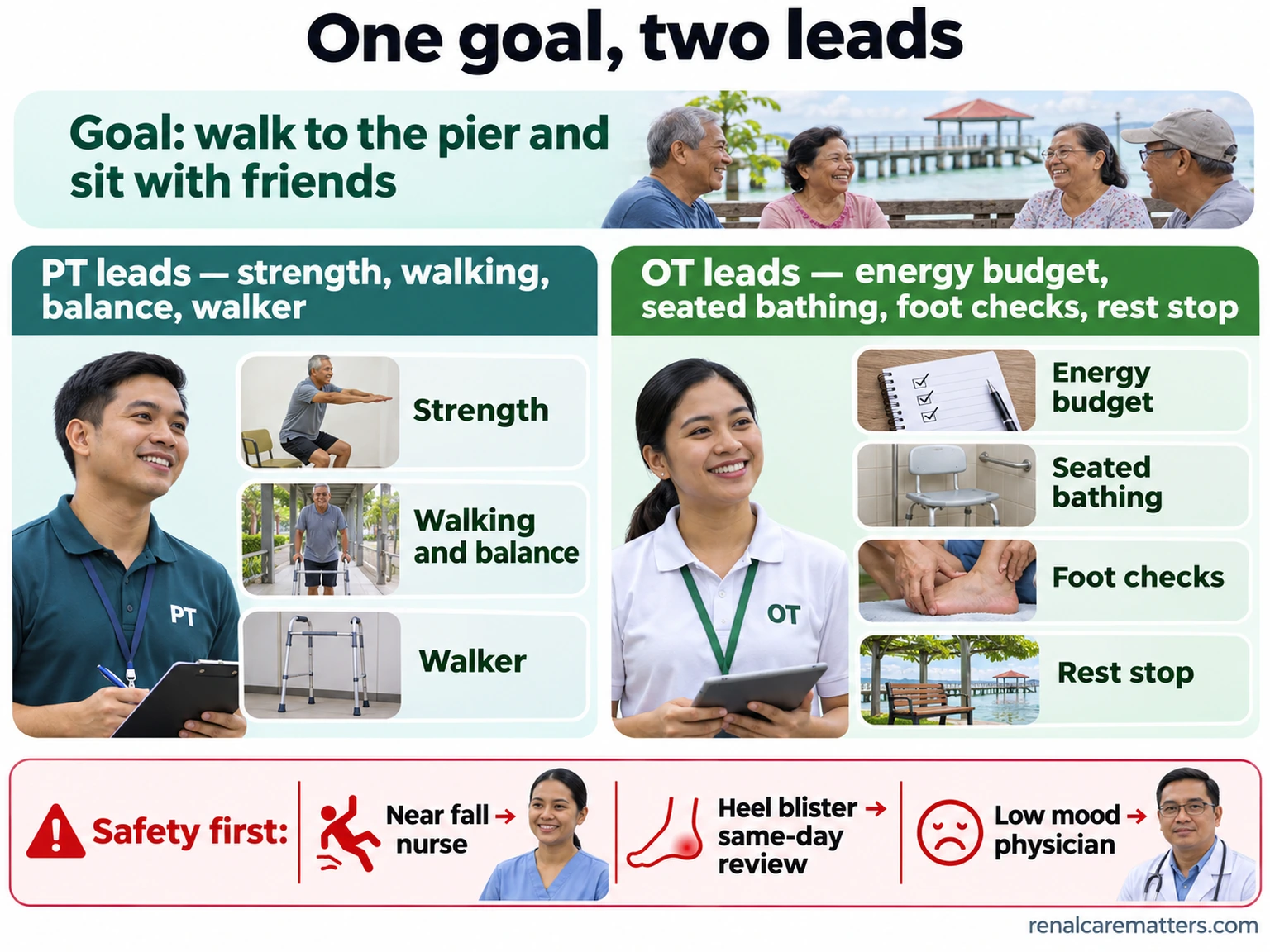
Illustrative shared plan, agreed with Mang Pedring and his wife. Goal: “Walk to the pier (400 m) with one rest and sit with my friends on Saturdays, in 12 weeks.” PT (lead: capacity). Non-dialysis days Tue, Thu, Sat: sit-to-stand, step-ups, ankle-weight knee extensions (no left forearm loading), balance progression; walking from 10 to 30 minutes at rating of perceived exertion (RPE) 12 to 13 once the heel is cleared; a correctly fitted walker for distances, then a cane if balance allows. Intradialytic leg cycling in the first half of sessions when the nurse agrees. OT (lead: demand and participation). Energy budget: dialysis afternoons protected for rest; Saturday morning kept free for the pier. Seated bathing; footwear and daily foot checks with his wife; a folding stool for a rest point at the halfway mark to the pier; a plan for the tricycle home if tired. Measures: SPPB, gait speed, five-times sit-to-stand, six-minute walk test (6MWT), recovery time, falls, PHQ-9 at 12 weeks; pier walk as the goal test. Review: 4, 8 and 12 weeks with the renal team.
Figure 2. One goal, two leads. Safety items go to their owners first; then the OT and PT each lead their part of one plan.
RememberOne goal, one plan, two leads. The patient should be able to say who is doing what.
Lesson · part 3
Step 3: handover, documentation and the PhilHealth question
Illustrative SBAR to the renal team.S: Mang Pedring, 68, hemodialysis (HD) M-W-F, nearly fell after last Friday’s session (3 kg ultrafiltration (UF)), has a heel blister in a numb foot and a PHQ-9 of 11. B: Diabetes; left forearm arteriovenous fistula (AVF) 4 weeks; right IJ catheter; recovery time until next morning. A: High fall risk on dialysis days; pre-ulcer; possible depression; moderate functional impairment (SPPB 6, gait 0.62 m/s, 6MWT 245 m). R: Please review fluid removal and post-dialysis pressure, the heel today, and refer for mood assessment. We propose a 12-week OT/PT plan (attached) and ask for exercise parameters and approval for intradialytic leg cycling.
To his wife: “I can’t promise PhilHealth will pay. There is a rehabilitation and mobility device pathway with its own rules, a doctor’s assessment and a contracted provider. I’ll write up what he needs and why, and connect you with the person who can check.” Then send a dated functional summary and the walker justification to the physiatrist and coordinator (Module 18).
Stop and reportCritical failures in the capstone and in practice: proceeding past an unresolved red flag; compressing or pulling an access, or loading the new fistula arm; changing any dialysis setting; unsafe lifting or moving without needed help; promising a benefit. Any one stops the station.
On the floor
Real situations: problems and solutions
These are fictional but typical. For each one, cover the answer, decide what you would do, then compare. Where a step depends on local rules, your unit’s procedure and your supervisor’s direction come first.
Everything at once
What you see
A patient has a near fall, a heel blister and low mood on the same day.
What is likely going on
Competing priorities.
What to do
Safety first: route each issue to its owner today, then plan.
Why it matters
Unsafe problems cannot wait for the plan.
Two plans
What you see
OT and PT write separate goals that conflict on dialysis afternoons.
What is likely going on
No shared plan.
What to do
Agree one goal and one weekly schedule.
Why it matters
Patients follow one plan, not two.
The high score with a critical failure
What you see
A learner scores 9 of 10 but pulls the access arm during a transfer.
What is likely going on
A critical failure.
What to do
Stop the station, debrief, retrain, reassess on a new case.
Why it matters
Critical failures are never averaged away.
Field notes
List safety issues before goals.
Name a lead for every part of the plan.
Rehearse your SBAR.
Know your profession’s six stations.
Case review
Back to the case: Mang Pedring’s week
Immediate safety. The near fall (nurse and nephrologist today), the heel blister (same-day review), the PHQ-9 of 11 (physician and mental-health referral, with a question about self-harm), the new fistula and catheter precautions, and the long recovery time (nephrologist).
The shared plan. One goal in his words, a PT capacity plan and an OT demand and participation plan, measures repeated under the same conditions, and reviews at 4, 8 and 12 weeks.
His wife and the paperwork. No promise; an explanation of the pathway; a dated functional summary and walker justification to the physiatrist and authorized coordinator; an SBAR and the plan to the renal team. Then the stations: OT learners take OS01, OS02, OS03, OS04, OS05 and OS08; PT learners take OS01, OS02, OS03, OS06, OS07 and OS08, each scored 0 to 2 per item, pass 8 of 10, no critical failure.
Skills lab · with your preceptor
Skills checklist: Integrated capstone
Present the integrated case to your preceptor, then complete your profession’s six practical stations (listed on the trainer page). Your preceptor rates each step as satisfactory, needs practice, or not observed. Steps marked Critical must all be satisfactory before sign-off. This checklist supports supervised learning; your unit’s own procedure and competency form are the authority. A printable version of every checklist is on the trainer page.
CriticalIdentifies every immediate safety issue and names its owner and same-day action.
Agrees one patient-chosen goal and a shared OT/PT plan with named leads.
CriticalProtects the new fistula and the catheter throughout simulation.
CriticalGives a complete SBAR and requests parameters and approvals instead of assuming them.
CriticalAnswers the benefits question without a promise and routes it correctly.
CriticalPasses the six profession-specific stations at 8 of 10 or better with no critical failure.
Submits a one-page reflection on scope and next learning steps.
Placement activity. Complete the capstone with a real or simulated patient under supervision and submit the full portfolio.
Self-assessment
Check your understanding
Each visit draws 5 questions at random from this module’s 10-question bank. Choose the single best answer for each, then select Check answers; an explanation appears under the best answer. Select New set of questions for a different mix. A good target is 4 of 5 on two different sets. Nothing you select is sent anywhere; scoring happens in your browser.
Educational material for licensed occupational and physical therapists. Completing it is an Academy learning record only. It is not a PRC, DOH, PhilHealth or PSN credential, not CPD units, and not a workplace privilege. Your license, your referral or prescription, your employer’s privileges and the renal team’s plan govern what you may do.