Ancillary Staff Track · Module 19 of 20

Documentation, Quality and International Service Models

Notes that carry the decision, measures that show improvement, and what to borrow from the United States, United Kingdom, Australia and Canada.

PublishedNailathalaGipatikPepalwal: ReferencesMga SanggunianMga TinubdanReng Reperensya: 7 Audience: Philippine-registered occupational therapists and physical therapists who see people with kidney disease · rehabilitation leads, physiatrists and renal teams who refer to them · students on an observer pathway Read timeOras ng pagbasaOras sa pagbasaOras ning pamamasa:
Two therapists reviewing a run chart of patient sit-to-stand scores on a monitor in a quiet office.
Renal Care Academy›Ancillary Staff Track›Occupational and Physical Therapist›Module 19 of 20 Renal rehabilitation track for licensed occupational and physical therapists
🦵

Renal rehabilitation track for licensed occupational and physical therapists

Study material for licensed occupational therapists (RA 11241) and physical therapists (RA 5680) working with people who have kidney disease. It explains the reasoning behind renal rehabilitation; it is not a hospital protocol. It never authorizes changes to dialysis settings, handling of a needled access or catheter, medicine decisions or benefit promises. Exercise parameters come from the referring physician and your unit’s agreed sheet: per unit protocol, but always ask the attending nephrologist’s guidance. Every case, name and number in the cases is fictional and illustrative.

After this module you should be able to

Classroom 2 hSkills lab 2 hSupervised placement 1 h
Pre-testBefore you read, answer the 5 self-assessment questions and note your score. After the module, select New set of questions and compare. The difference is what you learned; the questions you still miss are what to reread.

The big picture, in plain words

In plain wordsA note is a baton in a relay (Module 1). A quality program is the coach watching the whole race from the stands, noticing that the team always drops the baton at the same corner.

The picture has a limit. A coach can see the race. You usually cannot see your whole service: you see one patient at a time. So you need a few measures, collected the same way, plotted over time, to see the corner where the baton drops. This module is about writing each note well and then stepping back to look at the pattern.

What should you measure? Choose what matters to patients and what your service can change. Gait speed and sit-to-stand performance are good candidates because they are quick, repeatable, sensitive to rehabilitation, and associated with outcomes in kidney disease and older adults.1,2 Adherence and safety events tell you whether the program is being delivered (Module 10).
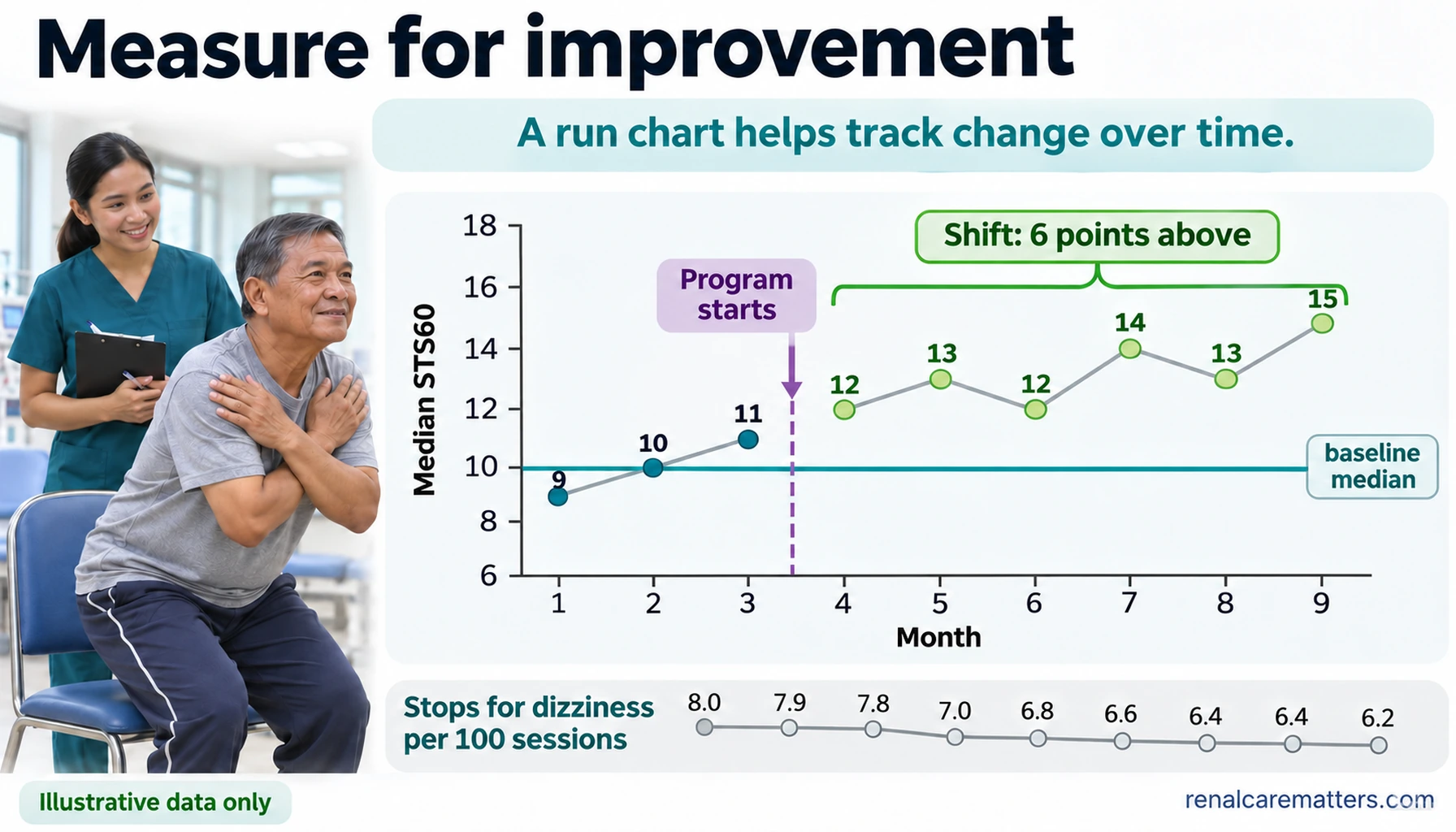
A run chart of the median 60-second sit-to-stand score across 12 months in a dialysis unit, with a median line, an annotation where an exercise program started, and a shift of points above the median afterward.
Figure 1. Measure for improvement. A run chart shows whether a change made a difference.

Figure 2 · Key terms for this module

Process measureWhether the service did what it planned (screens done, sessions delivered).
Outcome measureWhether patients changed (60-second sit-to-stand test (STS60), gait speed, goal attainment).
Balancing measureAn unintended effect to watch (falls, hypotension during sessions).
Run chartData plotted over time with a median line, to see change.
AuditA structured review of practice against a standard.

Case: Is the program working?

Friday, 2:00 p.m. Six months after starting intradialytic exercise on the morning shift (Module 10), Dr. Ramon Uy asks physical therapist (PT) Carlo Dizon and occupational therapist (OT) Bea Santiago: “Is it working? The hospital wants to know whether to buy four more bikes.”

They have monthly records: number of eligible patients, sessions offered and done, median STS60 for patients tested that month, and stops for dizziness. They also have a folder of session notes in which several deferrals say only “not done.”

Before reading on, decide:

Keep your answers in mind. The lesson gives you what you need, and the case review near the end shows one sound response.

Documentation that the next clinician can use

A therapy note in renal care should answer six questions (Module 1): under what authority, with what consent, after what handoff, what was found, what was decided and why, and what happens next. Two common failures make notes useless: recording an activity without the decision (“cycling 10 min”), and recording a deferral without the reason (“not done”).

Weak noteUseful note
“Not done.”“Deferred: dizzy on standing after 3.1 kg ultrafiltration (UF); nurse informed; blood pressure (BP) per nurse; rebooked Thursday, non-dialysis day.”
“Exercise done, tolerated.”“Pedal cycle 18 min at rating of perceived exertion (RPE) 12, minutes 40–58 of hemodialysis (HD); leg band 2 × 12; no symptoms; access undisturbed per nurse.”
“Improving.”“STS60 15 (baseline 12, 3 months ago, same chair, non-dialysis morning); goal: rise from bleachers without help.”
RememberIf it is not written with its reason, the next clinician cannot trust it and the audit cannot learn from it.

Choosing measures and reading a run chart

Pick a few measures and define them exactly: who is counted, when, how.

A run chart plots a measure over time with its median. Common rules of thumb for a non-random signal include six or more consecutive points above or below the median (a shift) and five or more consecutive points going up or down (a trend). The site’s run chart tool applies such rules. Annotate the chart with changes you made, so you can see whether a shift followed a change.

Illustrative interpretation. Median STS60 on the morning shift was 12 to 13 for the three months before the program (baseline median 12.5). After the program started, the monthly median ran 13, 14, 14, 15, 15, 16: six consecutive points above the baseline median, a shift. Sessions done were 70 percent of those offered; stops for dizziness were 2 per 100 sessions and did not rise. The shift is consistent with a real improvement, although patients joining and leaving the shift could also move the median; report who was tested each month.
RememberPlot over time, annotate the changes, and count who was measured. A median that moves because the population changed is not an improvement.

International service models: what to borrow

No country has a universal renal OT or PT credential, and models differ.

SystemWhat the sources showWhat may transferWhat needs separate checking
United StatesFederal conditions for dialysis facilities require comprehensive assessment including physical and functional status and referral for rehabilitation as needed; OT and PT are not listed as minimum team members.3Functional assessment built into the dialysis care plan; rehabilitation referral as a routine stepState licensing, direct-access rules, payer rules
United KingdomHealth and Care Professions Council standards for occupational therapists (OTs) and physiotherapists; some kidney units employ specialist renal OTs.4,5Integrated frailty, symptom and rehabilitation work within the renal teamRegistration, banding and referral pathways
AustraliaGovernment recognition of OTs and physiotherapists depends on board registration.6Clear separation of registration and payment eligibilityCurrent board and payer conditions
CanadaA provincial renal program described an OT service covering home safety, mobility equipment, positioning and coping (a historical example).7Home and community focus within renal programsProvincial registration and current staffing

Borrow ideas, not rules. A practice that works in another system still has to pass Philippine law, local resources and the renal team’s judgment.

Real situations: problems and solutions

These are fictional but typical. For each one, cover the answer, decide what you would do, then compare. Where a step depends on local rules, your unit’s procedure and your supervisor’s direction come first.

“Not done”

What you see
Half of the deferral notes say only “not done.”
What is likely going on
Missing reasons.
What to do
Add a reason field; audit monthly.
Why it matters
Reasons show which problems are fixable.

A median that moved

What you see
The unit’s median STS60 jumped after five strong patients joined.
What is likely going on
A change in who was measured.
What to do
Report the number and turnover of patients tested.
Why it matters
Population change can mimic improvement.

Copying a foreign model

What you see
A manager wants to copy a US staffing model.
What is likely going on
A different legal and payer context.
What to do
Borrow the idea; check Philippine law and resources.
Why it matters
Rules do not transfer between systems.
Field notes
  • Define each measure exactly.
  • Annotate run charts with changes.
  • Track balancing measures.
  • Report denominators.

Back to the case: Is the program working?

What to present. A run chart of monthly median STS60 with the program start annotated; adherence (sessions done as a share of offered, minutes); and balancing measures (stops for symptoms, falls, access events). One slide, with definitions and the number of patients tested each month.

Confidence that change is real. Standard test conditions; the same patients tracked where possible; a shift or trend on the run chart; stable or explained changes in who was tested; and no rise in harms. That supports a decision about more bikes, while being honest that a single unit’s data are not a trial.

The deferral notes. “Not done” hides whether the deferral was for safety, staffing, refusal or equipment. Carlo and Bea add a short reason field to the session template (for example: symptoms, observations outside parameters, patient declined, staff unavailable, equipment) and audit it monthly. Staffing and equipment deferrals are fixable service problems; symptom deferrals tell the renal team something about the sessions.

Skills checklist: Documentation and a service measure

Rewrite weak notes and build a run chart from a simulated data set with your preceptor. Your preceptor rates each step as satisfactory, needs practice, or not observed. Steps marked Critical must all be satisfactory before sign-off. This checklist supports supervised learning; your unit’s own procedure and competency form are the authority. A printable version of every checklist is on the trainer page.

Placement activity. Collect three months of one measure in your service and present a run chart to your team.

Check your understanding

Each visit draws 5 questions at random from this module’s 10-question bank. Choose the single best answer for each, then select Check answers; an explanation appears under the best answer. Select New set of questions for a different mix. A good target is 4 of 5 on two different sets. Nothing you select is sent anywhere; scoring happens in your browser.

Question 1 of 10A record says only exercise tolerated. What should be added?
Question 2 of 10Two falls become one after training without exposure counts. What is appropriate?
Question 3 of 10How should UK or US models be used locally?
Question 4 of 10What should a quality measure define?
Question 5 of 10Under the cited US end-stage renal disease (ESRD) rule, what is true of rehabilitation?
Question 6 of 10Which note best documents a deferral?
Question 7 of 10On a run chart, six consecutive points above the baseline median most likely indicates:
Question 8 of 10Which is a balancing measure for an intradialytic exercise program?
Question 9 of 10Under US federal dialysis rules, how are OTs and physical therapists (PTs) treated?
Question 10 of 10Why must you report how many patients were tested each month?

Read next on this site

Glossary & abbreviationsTalahulugan at mga daglatTalaan sa mga pulong ug daglatTalatinigan ampo reng daglat terms used on this page

Abbreviations

BP
Blood pressure.
ESRD
End-stage renal disease — Kidney failure treated with dialysis or transplant.
HD
Hemodialysis.
OT
Occupational therapist — Also occupational therapy: the profession that helps people do the daily activities that matter to them.
OTs
Occupational therapists.
PhilHealth
Philippine Health Insurance Corporation.
PT
Physical therapist — Also physical therapy: the profession that restores movement, strength, balance and endurance.
PTs
Physical therapists.
RPE
Rating of perceived exertion — How hard the person feels they are working, usually on the 6 to 20 Borg scale.
STS60
60-second sit-to-stand test — How many full chair rises a person makes in one minute.
UF
Ultrafiltration.

Terms in plain words

Run chart
A measure plotted over time with its median.
Shift
Several consecutive points on one side of the median.
Balancing measure
An unintended effect monitored alongside the main measure.
Audit
A structured review against a standard.
ReferencesMga SanggunianMga TinubdanReng Reperensya 7 sources
  1. Roshanravan, B., Robinson-Cohen, C., Patel, K. V., Ayers, E., Littman, A. J., de Boer, I. H., Ikizler, T. A., Himmelfarb, J., Katzel, L. I., Kestenbaum, B., & Seliger, S. (2013). Association between physical performance and all-cause mortality in CKD. Journal of the American Society of Nephrology, 24(5), 822–830. https://doi.org/10.1681/ASN.2012070702
  2. Studenski, S., Perera, S., Patel, K., Rosano, C., Faulkner, K., Inzitari, M., Brach, J., Chandler, J., Cawthon, P., Connor, E. B., Nevitt, M., Visser, M., Kritchevsky, S., Badinelli, S., Harris, T., Newman, A. B., Cauley, J., Ferrucci, L., & Guralnik, J. (2011). Gait speed and survival in older adults. JAMA, 305(1), 50–58. https://doi.org/10.1001/jama.2010.1923
  3. United States Government Publishing Office. (2025). 42 CFR Part 494: Conditions for coverage for end-stage renal disease facilities (§§ 494.80, 494.90). https://www.govinfo.gov/content/pkg/CFR-2025-title42-vol5/xhtml/CFR-2025-title42-vol5-part494.html
  4. Health and Care Professions Council (HCPC). (2023). Standards of proficiency: Occupational therapists. https://www.hcpc-uk.org/standards/standards-of-proficiency/occupational-therapists/
  5. Health and Care Professions Council (HCPC). (2023). Standards of proficiency: Physiotherapists. https://www.hcpc-uk.org/standards/standards-of-proficiency/physiotherapists/
  6. Services Australia. (2026). Specific criteria for allied health and primary care professionals. Retrieved November 25, 2026, from https://www.servicesaustralia.gov.au/specific-criteria-for-allied-health-and-primary-care-professionals?context=20
  7. Manitoba Renal Program. (2013). Renal occupational therapy. https://www.kidneyhealth.ca/renal-occupational-therapy/
Dr. William Gregory M. Rivero, MD

William Gregory Rivero, MD, FPCP, DPSN

Internal Medicine · Nephrology · Nutrition · Philippines · PRC 0105184

Educational material for licensed occupational and physical therapists. Completing it is an Academy learning record only. It is not a PRC, DOH, PhilHealth or PSN credential, not CPD units, and not a workplace privilege. Your license, your referral or prescription, your employer’s privileges and the renal team’s plan govern what you may do.

QR code — scan to save Dr. Rivero's contact info

Scan and save