“Not done”
- What you see
- Half of the deferral notes say only “not done.”
- What is likely going on
- Missing reasons.
- What to do
- Add a reason field; audit monthly.
- Why it matters
- Reasons show which problems are fixable.
Notes that carry the decision, measures that show improvement, and what to borrow from the United States, United Kingdom, Australia and Canada.

Study material for licensed occupational therapists (RA 11241) and physical therapists (RA 5680) working with people who have kidney disease. It explains the reasoning behind renal rehabilitation; it is not a hospital protocol. It never authorizes changes to dialysis settings, handling of a needled access or catheter, medicine decisions or benefit promises. Exercise parameters come from the referring physician and your unit’s agreed sheet: per unit protocol, but always ask the attending nephrologist’s guidance. Every case, name and number in the cases is fictional and illustrative.
The picture has a limit. A coach can see the race. You usually cannot see your whole service: you see one patient at a time. So you need a few measures, collected the same way, plotted over time, to see the corner where the baton drops. This module is about writing each note well and then stepping back to look at the pattern.
What should you measure? Choose what matters to patients and what your service can change. Gait speed and sit-to-stand performance are good candidates because they are quick, repeatable, sensitive to rehabilitation, and associated with outcomes in kidney disease and older adults.1,2 Adherence and safety events tell you whether the program is being delivered (Module 10).
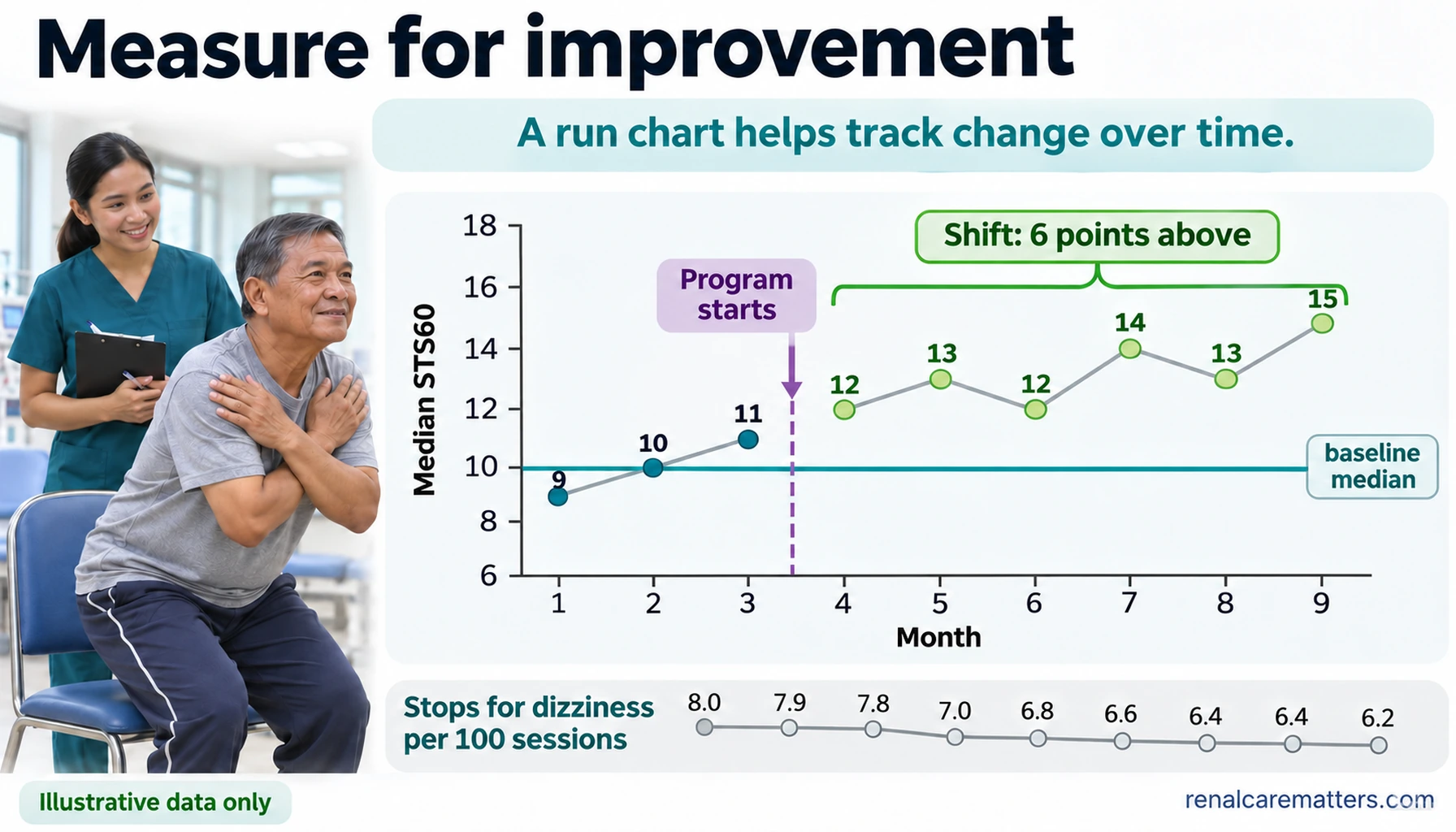
Figure 2 · Key terms for this module
Friday, 2:00 p.m. Six months after starting intradialytic exercise on the morning shift (Module 10), Dr. Ramon Uy asks physical therapist (PT) Carlo Dizon and occupational therapist (OT) Bea Santiago: “Is it working? The hospital wants to know whether to buy four more bikes.”
They have monthly records: number of eligible patients, sessions offered and done, median STS60 for patients tested that month, and stops for dizziness. They also have a folder of session notes in which several deferrals say only “not done.”
Before reading on, decide:
Keep your answers in mind. The lesson gives you what you need, and the case review near the end shows one sound response.
A therapy note in renal care should answer six questions (Module 1): under what authority, with what consent, after what handoff, what was found, what was decided and why, and what happens next. Two common failures make notes useless: recording an activity without the decision (“cycling 10 min”), and recording a deferral without the reason (“not done”).
| Weak note | Useful note |
|---|---|
| “Not done.” | “Deferred: dizzy on standing after 3.1 kg ultrafiltration (UF); nurse informed; blood pressure (BP) per nurse; rebooked Thursday, non-dialysis day.” |
| “Exercise done, tolerated.” | “Pedal cycle 18 min at rating of perceived exertion (RPE) 12, minutes 40–58 of hemodialysis (HD); leg band 2 × 12; no symptoms; access undisturbed per nurse.” |
| “Improving.” | “STS60 15 (baseline 12, 3 months ago, same chair, non-dialysis morning); goal: rise from bleachers without help.” |
Pick a few measures and define them exactly: who is counted, when, how.
A run chart plots a measure over time with its median. Common rules of thumb for a non-random signal include six or more consecutive points above or below the median (a shift) and five or more consecutive points going up or down (a trend). The site’s run chart tool applies such rules. Annotate the chart with changes you made, so you can see whether a shift followed a change.
No country has a universal renal OT or PT credential, and models differ.
| System | What the sources show | What may transfer | What needs separate checking |
|---|---|---|---|
| United States | Federal conditions for dialysis facilities require comprehensive assessment including physical and functional status and referral for rehabilitation as needed; OT and PT are not listed as minimum team members.3 | Functional assessment built into the dialysis care plan; rehabilitation referral as a routine step | State licensing, direct-access rules, payer rules |
| United Kingdom | Health and Care Professions Council standards for occupational therapists (OTs) and physiotherapists; some kidney units employ specialist renal OTs.4,5 | Integrated frailty, symptom and rehabilitation work within the renal team | Registration, banding and referral pathways |
| Australia | Government recognition of OTs and physiotherapists depends on board registration.6 | Clear separation of registration and payment eligibility | Current board and payer conditions |
| Canada | A provincial renal program described an OT service covering home safety, mobility equipment, positioning and coping (a historical example).7 | Home and community focus within renal programs | Provincial registration and current staffing |
Borrow ideas, not rules. A practice that works in another system still has to pass Philippine law, local resources and the renal team’s judgment.
These are fictional but typical. For each one, cover the answer, decide what you would do, then compare. Where a step depends on local rules, your unit’s procedure and your supervisor’s direction come first.
What to present. A run chart of monthly median STS60 with the program start annotated; adherence (sessions done as a share of offered, minutes); and balancing measures (stops for symptoms, falls, access events). One slide, with definitions and the number of patients tested each month.
Confidence that change is real. Standard test conditions; the same patients tracked where possible; a shift or trend on the run chart; stable or explained changes in who was tested; and no rise in harms. That supports a decision about more bikes, while being honest that a single unit’s data are not a trial.
The deferral notes. “Not done” hides whether the deferral was for safety, staffing, refusal or equipment. Carlo and Bea add a short reason field to the session template (for example: symptoms, observations outside parameters, patient declined, staff unavailable, equipment) and audit it monthly. Staffing and equipment deferrals are fixable service problems; symptom deferrals tell the renal team something about the sessions.
Rewrite weak notes and build a run chart from a simulated data set with your preceptor. Your preceptor rates each step as satisfactory, needs practice, or not observed. Steps marked Critical must all be satisfactory before sign-off. This checklist supports supervised learning; your unit’s own procedure and competency form are the authority. A printable version of every checklist is on the trainer page.
Each visit draws 5 questions at random from this module’s 10-question bank. Choose the single best answer for each, then select Check answers; an explanation appears under the best answer. Select New set of questions for a different mix. A good target is 4 of 5 on two different sets. Nothing you select is sent anywhere; scoring happens in your browser.

Internal Medicine · Nephrology · Nutrition · Philippines · PRC 0105184
Educational material for licensed occupational and physical therapists. Completing it is an Academy learning record only. It is not a PRC, DOH, PhilHealth or PSN credential, not CPD units, and not a workplace privilege. Your license, your referral or prescription, your employer’s privileges and the renal team’s plan govern what you may do.

Scan and save