Why frailty matters before a transplant, prehabilitation while waiting, and safe lifting and return to activity after surgery.
PublishedNailathalaGipatikPepalwal:ReferencesMga SanggunianMga TinubdanReng Reperensya:2Audience: Philippine-registered occupational therapists and physical therapists who see people with kidney disease · rehabilitation leads, physiatrists and renal teams who refer to them · students on an observer pathwayRead timeOras ng pagbasaOras sa pagbasaOras ning pamamasa:
Renal rehabilitation track for licensed occupational and physical therapists
Study material for licensed occupational therapists (RA 11241) and physical therapists (RA 5680) working with people who have kidney disease. It explains the reasoning behind renal rehabilitation; it is not a hospital protocol. It never authorizes changes to dialysis settings, handling of a needled access or catheter, medicine decisions or benefit promises. Exercise parameters come from the referring physician and your unit’s agreed sheet: per unit protocol, but always ask the attending nephrologist’s guidance. Every case, name and number in the cases is fictional and illustrative.
Learning objectives
After this module you should be able to
Explain why physical function and frailty matter before kidney transplantation.
Summarize the evidence on prehabilitation before transplant and exercise after it, including its limits.
Design a prehabilitation program for a waiting candidate that fits the dialysis week.
Apply post-operative lifting and wound precautions set by the transplant surgeon, and plan a graded return to activity and work.
Respect the boundary: transplant eligibility belongs to the transplant team, not to a rehabilitation score.
Classroom 2 hSkills lab 2 hSupervised placement 1 h
Pre-testBefore you read, answer the 5 self-assessment questions and note your score. After the module, select New set of questions and compare. The difference is what you learned; the questions you still miss are what to reread.
Start here
The big picture, in plain words
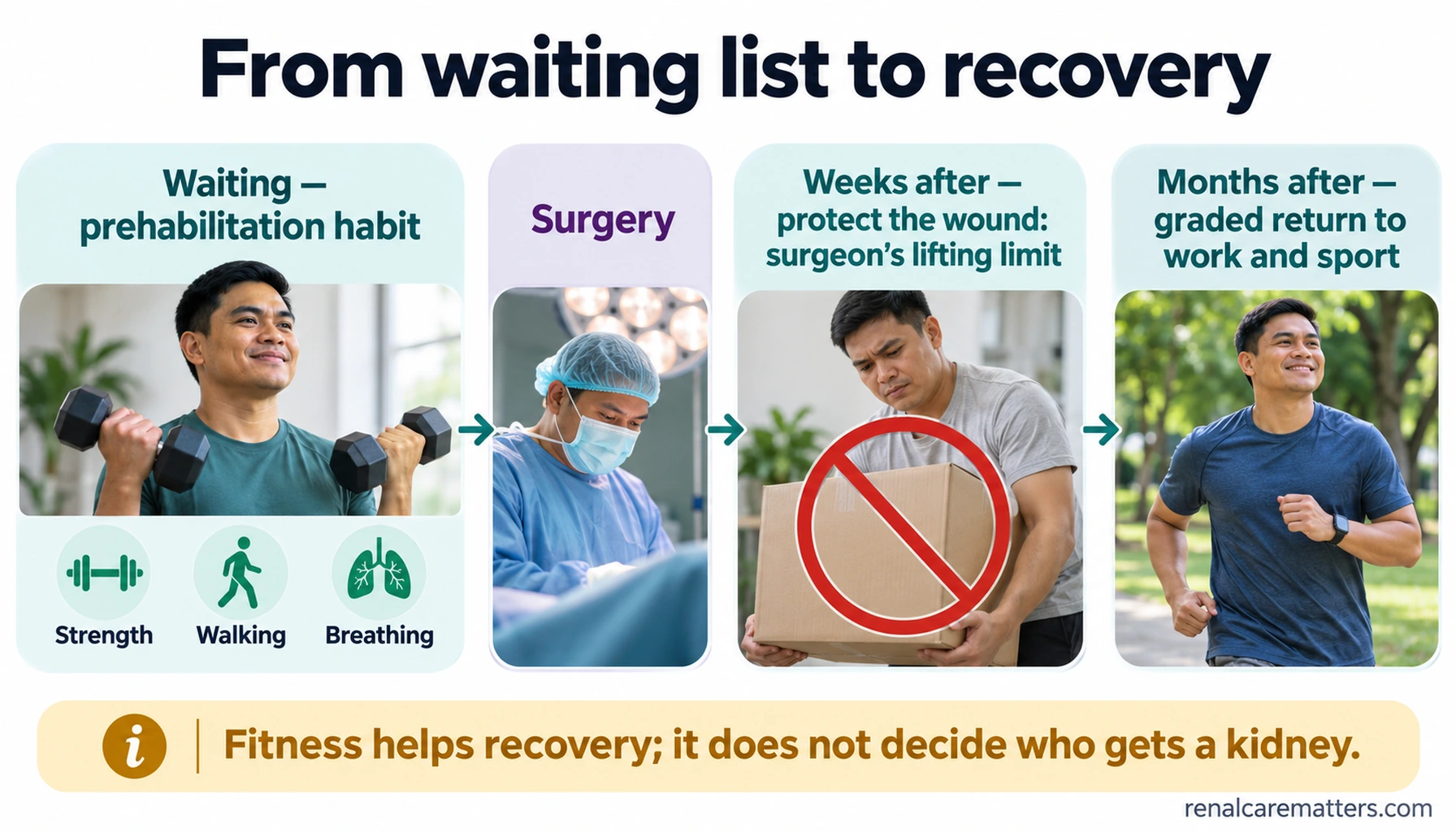
In plain wordsA transplant operation is like a long climb: the fitter you are at the start, the more you have left at the top, and the faster you recover on the way down. Prehabilitation is training for the climb before it begins.
The picture has a limit. A climber chooses the day. A transplant candidate on a deceased-donor list may get the call at any time, after months or years of waiting on dialysis, losing fitness all the while. So prehabilitation is not a short course before a fixed date; it is a habit kept through the wait. And fitness is not a ticket: a transplant team weighs many factors, and no single frailty score decides eligibility.
Evidence is still early. In a pilot study, 24 kidney transplant candidates were enrolled in weekly outpatient physical therapy with home exercise; 18 took part. Their physical activity rose by 64 percent within two months, and among five who were transplanted during the study, hospital length of stay was shorter than for matched controls (5 versus 10 days).1 A pilot this small suggests feasibility and a possible benefit; it does not prove that prehabilitation improves transplant outcomes. After transplantation, a randomized trial of 167 recipients found that a home exercise program started one month after surgery produced greater gains in peak oxygen uptake and muscle strength at one year than usual care, although only 95 completed testing.2
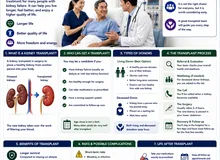
Figure 1. From waiting list to recovery. Fitness before surgery, protection after, a graded return.
Figure 2 · Key terms for this module
PrehabilitationTraining before surgery to improve fitness for the operation and recovery.
FrailtyLow physiological reserve (Module 2).
Lifting restrictionThe surgeon’s limit on lifting after abdominal surgery, to protect the wound.
GraftThe transplanted kidney.
ImmunosuppressionMedicines that prevent rejection; they raise infection risk and affect bone and muscle.
Opening case · fictional
Case: Waiting fit
Tuesday, 3:30 p.m. Mrs. Lourdes Navarro, 61, has been on hemodialysis for four years and is listed for a deceased-donor kidney. Her transplant nephrologist referred her for prehabilitation after scoring her as frail; her daughter asks physical therapist (PT) Carlo Dizon, “If her score gets better, will she get a kidney sooner?”
Baseline: Short Physical Performance Battery (SPPB) 6; five-times sit-to-stand 18.9 seconds; six-minute walk 260 meters. She dialyzes Monday, Wednesday and Friday afternoons and lives on the second floor.
A second patient, Mr. Victor Lim, 38, received a living-donor kidney five weeks ago. He is a warehouse supervisor and asks when he can “go back to lifting at work and play basketball.”
Before reading on, decide:
How do you answer the daughter?
What would a prehabilitation plan for Mrs. Navarro look like?
What do you need from the transplant surgeon before advising Mr. Lim?
Keep your answers in mind. The lesson gives you what you need, and the case review near the end shows one sound response.
Lesson · part 1
Why function matters before a transplant
A kidney transplant is major abdominal surgery followed by powerful medicines. Patients with low physical reserve recover more slowly, stay in hospital longer and are more vulnerable to complications. Frailty is common on the waiting list, and the long wait on dialysis tends to deepen it. Prehabilitation aims to raise reserve before the operation, so the person arrives at surgery with more to spend.
It is important to say what prehabilitation is not. A rehabilitation score does not decide who receives a kidney. Eligibility, listing and allocation belong to the transplant team and the national allocation rules. Your role is to help the candidate be as fit as possible, to report function honestly to the team, and to avoid any message that suggests effort can buy priority.
RememberPrehabilitation prepares the body for surgery. It never decides who gets a kidney.
Lesson · part 2
Designing prehabilitation for a waiting candidate
Illustrative prehabilitation plan for Mrs. Navarro. Sessions on non-dialysis mornings (Tuesday, Thursday) with the PT; home program on Saturday and Sunday. Strength: sit-to-stand from a raised chair, progressing to standard height; step-ups on her own stairs, holding the rail; band exercises for the legs and the non-fistula arm. 2 sets of 8 to 12, progressing. Endurance: walking 10 minutes, building to 30 minutes on most days, rating of perceived exertion (RPE) 12 to 13. Balance: SPPB stands progressing to tandem, near a counter. Breathing and core: deep breathing and supported coughing practice, which she will use after surgery. occupational therapist (OT): a hospital bag and home set-up for after surgery: a chair with arms, items at waist height, help with laundry for the first weeks. Review every 8 weeks with the same tests; send results to the transplant team.
Keep the program sustainable for a wait that may last years. Short, frequent sessions that fit the dialysis week beat ambitious programs that collapse after a month.
Lesson · part 3
After the transplant: protect, then rebuild
The surgeon sets the post-operative rules, and you work within them. The incision is in the lower abdomen and the new kidney sits in the pelvis, close to the surface. Typical concerns are lifting (to protect the healing wound from hernia), contact to the graft site, and infection risk from immunosuppression. Ask the transplant surgeon or nephrologist for the specific lifting limit and its duration, and for any restrictions on driving and contact sport.
Early: walking from the first days as the team allows; breathing exercises; no lifting above the surgeon’s limit; supported coughing.
Weeks after: progressive walking and leg strengthening; core control without straining; gradual return to daily tasks.
Later: when the surgeon clears it, graded lifting practice and task-specific work training; discuss contact sport and graft protection with the transplant team.
Immunosuppressants can cause tremor, muscle weakness and bone loss, and steroids raise blood sugar and appetite. Long-term activity helps weight, blood pressure and bone. Infection precautions matter in shared gyms: clean equipment, and keep patients with fresh transplants away from people who are visibly unwell.
Stop and reportReport to the transplant team at once: fever, pain or swelling over the graft, a sharp drop in urine output, a wound that opens or leaks, or new breathlessness or leg swelling. Do not continue exercise until they have reviewed.
RememberAfter transplant, the surgeon’s lifting limit is the first line of your plan. Ask for it in writing.
On the floor
Real situations: problems and solutions
These are fictional but typical. For each one, cover the answer, decide what you would do, then compare. Where a step depends on local rules, your unit’s procedure and your supervisor’s direction come first.
Training for priority
What you see
A candidate trains hard because “fitter patients get kidneys first.”
What is likely going on
A misunderstanding.
What to do
Explain that fitness helps recovery, not allocation.
Why it matters
False beliefs lead to disappointment and distrust.
Lifting at week three
What you see
A recipient lifts a 20-kilogram rice sack three weeks after surgery.
What is likely going on
A breach of the surgeon’s limit.
What to do
Explain the risk; report to the transplant team; review the home plan.
Why it matters
Hernias after transplant may need surgery.
Fever after transplant
What you see
A recipient has a fever before an exercise session.
What is likely going on
Possible infection under immunosuppression.
What to do
Do not exercise; tell the transplant team now.
Why it matters
Infections progress fast in recipients.
Field notes
Get the lifting limit in writing.
Keep prehabilitation short and sustainable.
Send function results to the transplant team.
Keep unwell people away from new recipients.
Case review
Back to the case: Waiting fit
The daughter’s question. “No. Getting fitter won’t move her up the list; the transplant team and the allocation rules decide that. What fitness can do is help her come through the operation and recover more easily when the call comes, and help her feel better while she waits.”
Mrs. Navarro’s plan. As above: twice-weekly supervised sessions on non-dialysis mornings, a short home program, leg strength, endurance, balance and breathing, an OT set-up for after surgery, and eight-weekly reassessment shared with the transplant team.
Mr. Lim. Before advising, Carlo needs the surgeon’s written lifting limit and its duration, wound status, and the team’s view on contact sport with a pelvic graft. Then he builds a graded return: walking and leg strength now, core control without straining, task-specific lifting when cleared, and a discussion with the team about basketball and graft protection.
Skills lab · with your preceptor
Skills checklist: Prehabilitation and post-transplant planning
Plan prehabilitation for a simulated candidate and a return-to-activity plan for a simulated recipient. Your preceptor rates each step as satisfactory, needs practice, or not observed. Steps marked Critical must all be satisfactory before sign-off. This checklist supports supervised learning; your unit’s own procedure and competency form are the authority. A printable version of every checklist is on the trainer page.
CriticalStates that rehabilitation scores do not determine transplant eligibility or priority.
Designs a sustainable prehabilitation program that fits the dialysis week.
Includes breathing and supported coughing practice for after surgery.
CriticalObtains the surgeon’s lifting limit, its duration and other restrictions before post-operative advice.
Plans a graded return to work and activity within those limits.
CriticalStates the post-transplant symptoms that require immediate team review.
Placement activity. Follow one transplant candidate or recipient for four weeks and report function changes to the transplant team in a short structured note.
Self-assessment
Check your understanding
Each visit draws 5 questions at random from this module’s 10-question bank. Choose the single best answer for each, then select Check answers; an explanation appears under the best answer. Select New set of questions for a different mix. A good target is 4 of 5 on two different sets. Nothing you select is sent anywhere; scoring happens in your browser.
McAdams-DeMarco, M. A., Ying, H., Van Pilsum Rasmussen, S., Schrack, J., Haugen, C. E., Chu, N. M., González Fernández, M., Desai, N., Walston, J. D., & Segev, D. L. (2019). Prehabilitation prior to kidney transplantation: Results from a pilot study. Clinical Transplantation, 33(1), e13450. https://doi.org/10.1111/ctr.13450
Painter, P. L., Hector, L., Ray, K., Lynes, L., Dibble, S., Paul, S. M., Tomlanovich, S. L., & Ascher, N. L. (2002). A randomized trial of exercise training after renal transplantation. Transplantation, 74(1), 42–48. https://doi.org/10.1097/00007890-200207150-00008
Educational material for licensed occupational and physical therapists. Completing it is an Academy learning record only. It is not a PRC, DOH, PhilHealth or PSN credential, not CPD units, and not a workplace privilege. Your license, your referral or prescription, your employer’s privileges and the renal team’s plan govern what you may do.