Screen Before Movement and Respond to Deterioration
Why blood pressure falls on standing after dialysis, why a normal pulse can mislead, the unit parameter sheet, and stopping with SBAR.
PublishedNailathalaGipatikPepalwal:ReferencesMga SanggunianMga TinubdanReng Reperensya:2Audience: Philippine-registered occupational therapists and physical therapists who see people with kidney disease · rehabilitation leads, physiatrists and renal teams who refer to them · students on an observer pathwayRead timeOras ng pagbasaOras sa pagbasaOras ning pamamasa:
Renal rehabilitation track for licensed occupational and physical therapists
Study material for licensed occupational therapists (RA 11241) and physical therapists (RA 5680) working with people who have kidney disease. It explains the reasoning behind renal rehabilitation; it is not a hospital protocol. It never authorizes changes to dialysis settings, handling of a needled access or catheter, medicine decisions or benefit promises. Exercise parameters come from the referring physician and your unit’s agreed sheet: per unit protocol, but always ask the attending nephrologist’s guidance. Every case, name and number in the cases is fictional and illustrative.
Learning objectives
After this module you should be able to
Explain why blood pressure can fall on standing after dialysis and why heart rate can mislead.
Perform a structured pre-session screen using the unit’s agreed parameter sheet.
Decide to proceed, adapt, defer or stop, and state the reason.
Stop immediately and summon help for red-flag symptoms, staying with the patient.
Hand over a deterioration with Situation, Background, Assessment, Recommendation (SBAR) and record who authorized any restart.
Classroom 2 hSkills lab 2 hSupervised placement 1 h
Pre-testBefore you read, answer the 5 self-assessment questions and note your score. After the module, select New set of questions and compare. The difference is what you learned; the questions you still miss are what to reread.
Start here
The big picture, in plain words
In plain wordsA pilot runs a checklist before every takeoff, even on a clear day with a plane that flew perfectly yesterday. Not because something is usually wrong, but because the one day something is wrong, the checklist is what catches it.
The picture has a limit. A plane’s checklist has fixed numbers. Your patients do not. A systolic pressure that is normal for one person on dialysis is dangerously low for another, and the same person can be stable at 9 a.m. and unstable at 2 p.m. after losing three liters in the chair. So your checklist asks questions and compares numbers with the person’s own baseline and the limits the physician has set, rather than with one universal threshold.
This track gives no universal exercise-clearance numbers. The handoff that built it warns against inventing them, and the right numbers differ by patient. Instead, your unit agrees a parameter sheet with the nephrologist: which observations to take, at what values to adapt or defer, and whom to call. This module teaches the reasoning that makes the sheet work.
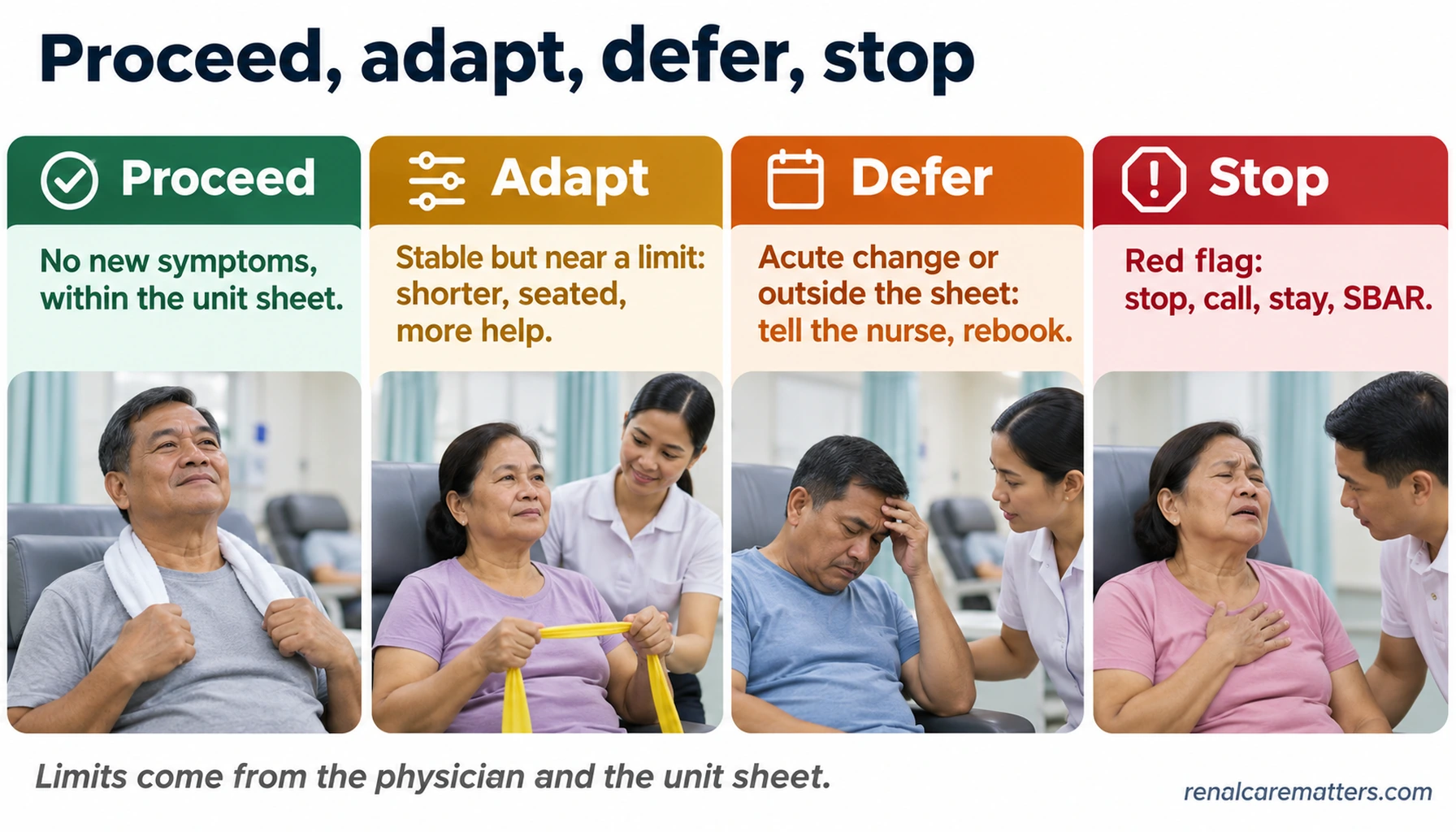
Figure 1. Proceed, adapt, defer or stop. The parameters come from the unit’s agreed sheet; the reasoning comes from you.
Figure 2 · Key terms for this module
Orthostatic hypotensionA fall in blood pressure on standing, often with dizziness or blurred vision.
Parameter sheetThe unit’s physician-approved list of observations and limits for therapy sessions.
Proceed / adapt / defer / stopThe four decisions at every session.
SBARSituation, Background, Assessment, Recommendation: a structured handover.
Red flagA symptom that means stop now and get help.
Opening case · fictional
Case: The final minute
Monday, 1:35 p.m. Mrs. Corazon Reyes, 71, finished her morning hemodialysis at 11:30 with 2.8 kilograms removed. She is seated in the rehabilitation gym doing arm exercises with an elastic band when she becomes pale and clammy. She says her chest feels “heavy, like a sack of rice.” Her pulse on the finger oximeter reads 74.
“One more minute,” she says. “I want to finish. I always finish.”
physical therapist (PT) Carlo Dizon is alone with her. The dialysis unit is two corridors away.
Before reading on, decide:
What do you do in the next 60 seconds, in order?
Why does a pulse of 74 not reassure you?
What will you say when help arrives, and what must happen before she exercises again?
Keep your answers in mind. The lesson gives you what you need, and the case review near the end shows one sound response.
Lesson · part 1
Standing up after dialysis: the physiology
When anyone stands, about half a liter of blood shifts into the legs and belly. Pressure sensors in the neck and chest detect the drop and, within seconds, tighten the blood vessels and speed the heart. Pressure recovers before the brain notices.
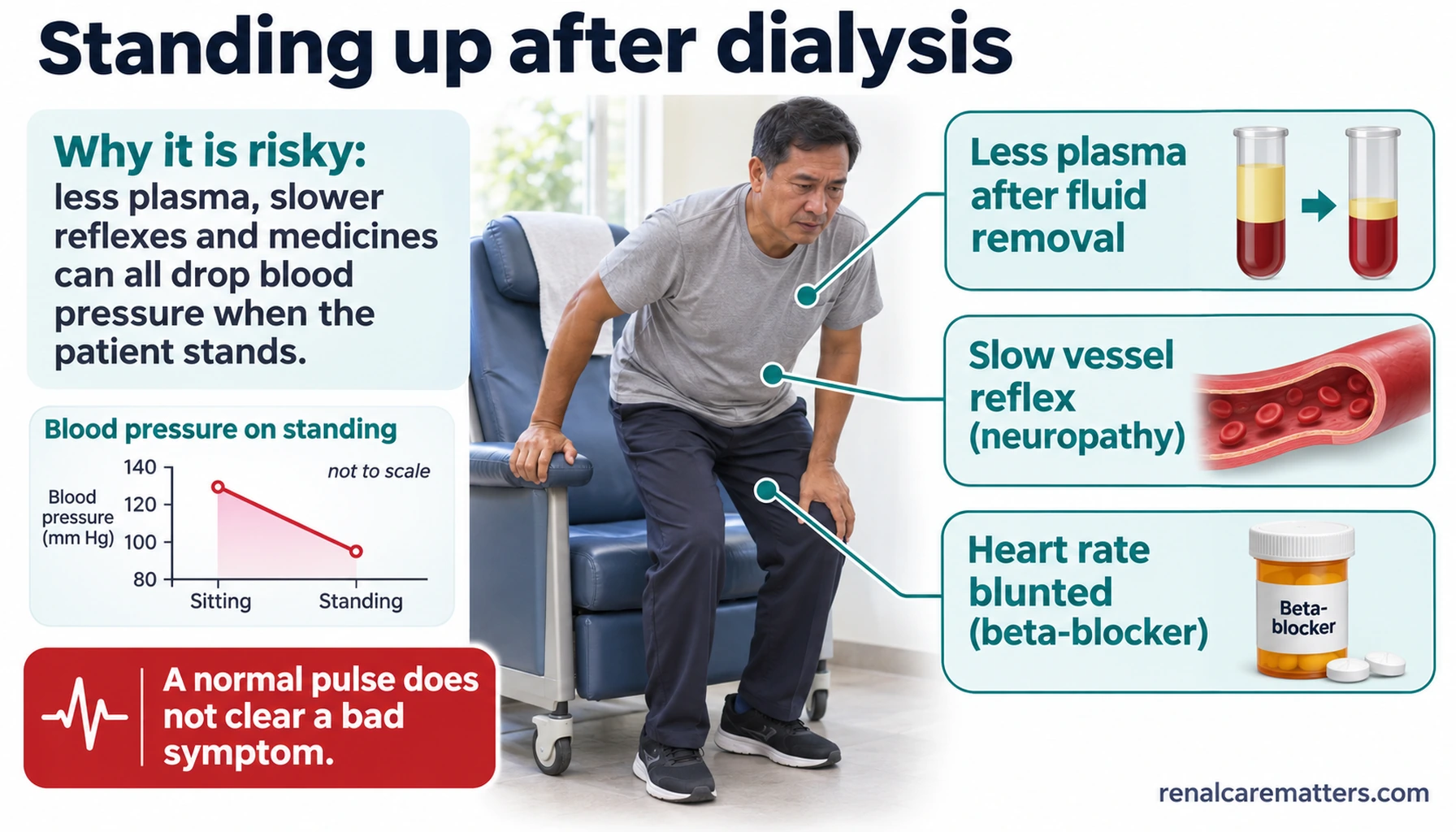
Figure 3. Why standing after dialysis is risky. Less plasma, slower reflexes and medicines can all drop blood pressure when the patient stands.
After hemodialysis that reflex is working against three handicaps. First, ultrafiltration has removed fluid from the blood faster than it refills from the tissues, so there is less volume to shift. Second, many patients have autonomic neuropathy from diabetes or uremia, so the vessels tighten slowly. Third, beta-blockers and other antihypertensives blunt the heart-rate response. The result is a pressure that falls on standing, sometimes minutes later, sometimes only in a warm bathroom.
The same handicaps make heart rate a poor alarm. A patient on metoprolol can be in shock with a pulse of 70. A pulse that looks normal never cancels a worrying symptom.
RememberAfter dialysis, check symptoms and pressure on standing, and never let a normal pulse overrule a bad symptom.
Lesson · part 2
A screen at every session
Screen every time, briefly, and write it down. The questions are the same for occupational therapist (OT) and PT.
Figure 4 · Pre-session screen
AskChest discomfort, breathlessness, dizziness or fainting, fever, new pain, bleeding, falls, missed dialysis, new medicines, and how they feel today compared with usual.
Check the handoffWith the nurse: today’s session, fluid removed, symptoms in the chair, access, any new restrictions or parameters.
ObserveThe observations on your unit’s sheet, taken with approved technique, never on the access arm: often blood pressure sitting and standing, pulse, oxygen saturation, temperature when indicated.
CompareWith the person’s baseline and with the physician’s parameters, not with a textbook number.
DecideProceed, adapt or defer, and record why.
Timing matters. Many units prefer therapy on non-dialysis days, or before a session, or during the first half of a session under the nurse’s eye (Module 10). Straight after a session with a large fluid removal is the riskiest time for standing tasks.
RememberThe screen is quick when all is well and life-saving when it is not. Never skip it because the patient “was fine yesterday.”
Lesson · part 3
Four decisions, and when each applies
Decision
When
What you do
Proceed
No new symptoms; observations within the agreed parameters and close to baseline
Deliver the planned session; keep watching
Adapt
Stable but tired, mildly dizzy on standing that settles, or observations near a limit
Shorten, sit instead of stand, add help, lower intensity; recheck
Defer
An unresolved acute change, or observations outside the agreed parameters
No therapy today; tell the nurse; ask for review; book the next try
Stop
A red flag during activity
Stop at once, make the patient safe, call for help, stay
Stop and callStop at once and summon immediate help for chest pain or pressure, fainting or near-fainting, severe or new breathlessness, new weakness, numbness, facial droop or confusion, significant bleeding (including from the access), a disrupted or dislodged access, palpitations with dizziness, or any rapid deterioration. Activate your facility’s emergency response when indicated. Do not leave the patient.
What you do not do matters as much. Do not diagnose hyperkalemia from symptoms, do not “walk off” an arrhythmia, and do not give water, salt, sugar, medicines or oxygen outside your authority and the emergency protocol.
Is exercise in this population dangerous? In a randomized trial of early physical and occupational therapy in mechanically ventilated patients, there was one serious adverse event in 498 therapy sessions (a desaturation), and sessions were stopped for instability in 4 percent.1 In the largest trial of exercise during dialysis, adverse events during sessions were similar in the exercise and usual-care groups.2 Supervised activity with screening is safe for most patients. The screen is what keeps it safe.
RememberCompletion targets never override a concerning change. The session that stops early is the session that went right.
Lesson · part 4
SBAR, and a restart that is authorized
When you call for help, the first 30 seconds of what you say decide how fast help comes. Use SBAR (Situation, Background, Assessment, Recommendation):
Illustrative SBAR.Situation: “This is Carlo, PT, rehab gym. Mrs. Reyes, 71, has chest heaviness and is pale and clammy during seated arm exercise. I stopped at 1:35.” Background: “Hemodialysis this morning, 2.8 kilograms removed, finished 11:30. On metoprolol.” Assessment: “Pulse 74 on the oximeter, saturation 95 percent. I don’t have a pressure yet. She is alert.” Recommendation: “I need a nurse and a doctor here now. I’ve activated the emergency response.”
Do not guess the diagnosis; give the facts. Afterward, document what you saw, what you did and when, who came, and what they decided. Exercise resumes only after a clinician has reviewed the event and authorized a restart, with any revised parameters written down. If your unit requires an incident report, complete it separately; the clinical note and the incident report do different jobs.
RememberA restart is a decision, not a default. Record who authorized it and the parameters they set.
On the floor
Real situations: problems and solutions
These are fictional but typical. For each one, cover the answer, decide what you would do, then compare. Where a step depends on local rules, your unit’s procedure and your supervisor’s direction come first.
“I feel fine”
What you see
A patient says she feels fine but is pale and sweaty after standing.
What is likely going on
Possible post-dialysis hypotension.
What to do
Sit her down, call the nurse, defer standing activity.
Why it matters
Signs can outrun symptoms.
The normal pulse
What you see
A patient on a beta-blocker has new breathlessness; his pulse is 72.
What is likely going on
Blunted heart-rate response hides distress.
What to do
Stop, call for review, and document symptoms over numbers.
Why it matters
A normal pulse never clears a red flag.
No parameter sheet
What you see
Your unit has no agreed therapy parameters.
What is likely going on
A system gap.
What to do
Ask the nephrologist and head nurse to agree a sheet; until then, get session-specific parameters for each patient.
Why it matters
Without agreed limits, decisions become guesses.
Field notes
Screen every session, even for regulars.
Never take pressure on the access arm.
Practice your SBAR aloud.
Record who authorized every restart.
Case review
Back to the case: The final minute
The next 60 seconds. Carlo stops the exercise at once, despite her wish to finish. He keeps her seated and supported, loosens the band, and stays with her. He calls for immediate help: the emergency button or code in the gym, or by phone to the dialysis unit and the responding physician, per the facility pathway. He checks responsiveness and breathing and prepares to start basic life support if she collapses.
Why the pulse does not reassure. She takes metoprolol, which blunts the heart-rate response; she had fluid removed hours earlier; and she has a red-flag symptom. Chest heaviness with pallor and sweating may be a cardiac event or a pressure drop. Either needs a clinician now.
The handover and the restart. Carlo gives SBAR as above, then documents the times, observations and actions. Mrs. Reyes does not exercise again until the physician has reviewed the event, any tests are done, and a restart with written parameters is authorized. Carlo also reviews whether 2 hours after a 2.8-kilogram session was the right time for her therapy, and proposes a non-dialysis-day slot.
Skills lab · with your preceptor
Skills checklist: Screen, decide and escalate
Screen a simulated patient, make a proceed, adapt or defer decision, then respond to a scripted deterioration. Your preceptor rates each step as satisfactory, needs practice, or not observed. Steps marked Critical must all be satisfactory before sign-off. This checklist supports supervised learning; your unit’s own procedure and competency form are the authority. A printable version of every checklist is on the trainer page.
Asks all screening questions, including missed dialysis, falls and new medicines.
CriticalObtains the nurse’s handoff and locates the unit’s parameter sheet.
CriticalTakes observations with approved technique, never on the access arm, including sitting and standing pressure when indicated.
States a proceed, adapt or defer decision with a reason tied to the screen.
CriticalStops immediately at a red flag and keeps the patient safe.
CriticalSummons help through the facility pathway and stays with the patient.
Gives a complete SBAR without guessing a diagnosis.
CriticalDocuments the event and the name of the clinician who authorized any restart.
Placement activity. For two weeks, record your screen and decision for every session. Review the deferrals with your preceptor: were the reasons sound, and was a review obtained each time?
Self-assessment
Check your understanding
Each visit draws 5 questions at random from this module’s 10-question bank. Choose the single best answer for each, then select Check answers; an explanation appears under the best answer. Select New set of questions for a different mix. A good target is 4 of 5 on two different sets. Nothing you select is sent anywhere; scoring happens in your browser.
Schweickert, W. D., Pohlman, M. C., Pohlman, A. S., Nigos, C., Pawlik, A. J., Esbrook, C. L., Spears, L., Miller, M., Franczyk, M., Deprizio, D., Schmidt, G. A., Bowman, A., Barr, R., McCallister, K. E., Hall, J. B., & Kress, J. P. (2009). Early physical and occupational therapy in mechanically ventilated, critically ill patients: A randomised controlled trial. The Lancet, 373(9678), 1874–1882. https://doi.org/10.1016/S0140-6736(09)60658-9
Anding-Rost, K., von Gersdorff, G., von Korn, P., Ihorst, G., Josef, A., Kaufmann, M., Huber, M., Bär, T., Zeißler, S., Höfling, S., Breuer, C., Gärtner, N., Haykowsky, M. J., Degenhardt, S., Wanner, C., & Halle, M. (2023). Exercise during hemodialysis in patients with chronic kidney failure. NEJM Evidence, 2(9), EVIDoa2300057. https://doi.org/10.1056/EVIDoa2300057
Educational material for licensed occupational and physical therapists. Completing it is an Academy learning record only. It is not a PRC, DOH, PhilHealth or PSN credential, not CPD units, and not a workplace privilege. Your license, your referral or prescription, your employer’s privileges and the renal team’s plan govern what you may do.