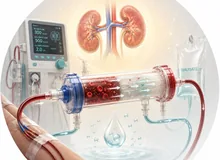
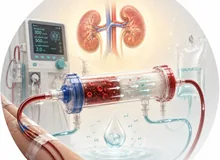
The capacity–demand gap: how muscle wasting, anemia, acidosis, fluid shifts, neuropathy and bone disease turn into slow walking and hard stairs.
PublishedNailathalaGipatikPepalwal:ReferencesMga SanggunianMga TinubdanReng Reperensya:6Audience: Philippine-registered occupational therapists and physical therapists who see people with kidney disease · rehabilitation leads, physiatrists and renal teams who refer to them · students on an observer pathwayRead timeOras ng pagbasaOras sa pagbasaOras ning pamamasa:
Renal rehabilitation track for licensed occupational and physical therapists
Study material for licensed occupational therapists (RA 11241) and physical therapists (RA 5680) working with people who have kidney disease. It explains the reasoning behind renal rehabilitation; it is not a hospital protocol. It never authorizes changes to dialysis settings, handling of a needled access or catheter, medicine decisions or benefit promises. Exercise parameters come from the referring physician and your unit’s agreed sheet: per unit protocol, but always ask the attending nephrologist’s guidance. Every case, name and number in the cases is fictional and illustrative.
Learning objectives
After this module you should be able to
Explain the capacity–demand gap and use it to describe a renal patient’s functional problem.
Trace how muscle protein breakdown, anemia, acidosis, fluid shifts, neuropathy and bone disease each reduce function.
Link common renal findings in the chart to functional signs you can observe and measure.
Recognize frailty and its prevalence in people on dialysis, and what it predicts.
Explain why the dialysis schedule itself shapes when and how a person can be active.
Classroom 2 hSkills lab 2 hSupervised placement 1 h
Pre-testBefore you read, answer the 5 self-assessment questions and note your score. After the module, select New set of questions and compare. The difference is what you learned; the questions you still miss are what to reread.
Start here
The big picture, in plain words
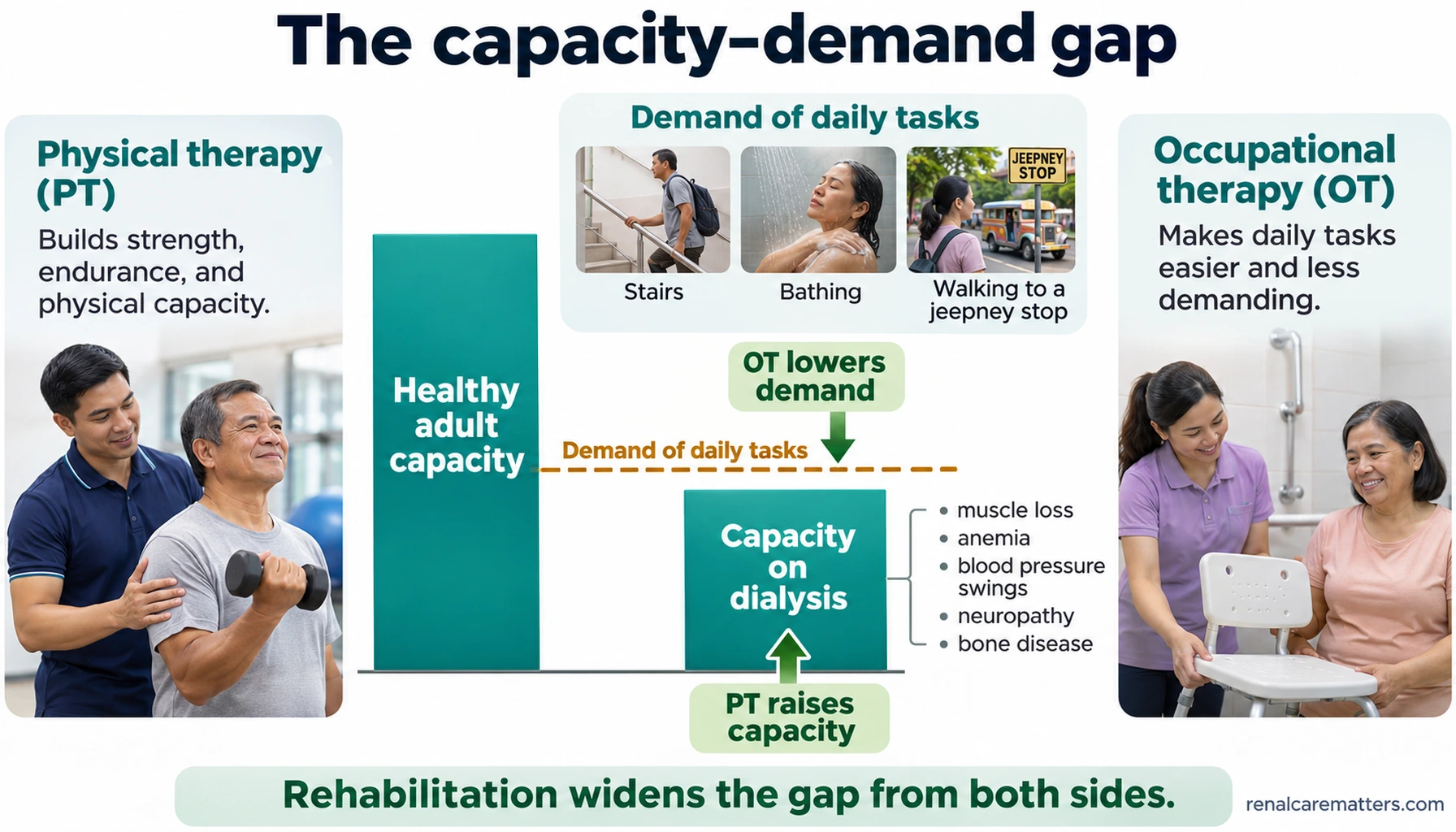
In plain wordsEvery task has a price, and every person has a budget. Climbing one flight of stairs costs a healthy 60-year-old a small part of what their legs and heart can give. For a 60-year-old on dialysis, the same flight may cost most of it. Nothing about the stairs changed. The budget shrank.
Figure 1. The capacity–demand gap. Kidney failure lowers capacity toward the demand of ordinary tasks. Physical therapy raises capacity; occupational therapy lowers demand.
The picture has a limit. The budget is not one number. Aerobic capacity, muscle strength, balance and blood pressure control each run their own account, and kidney failure drains them at different rates. A man may walk 300 meters on the flat yet fail to rise from a low bangko without his arms. Your assessment finds which account is short, because each one is fixed differently.
This module gives you the physiology behind the shrinking budget. You do not need to manage these problems medically; the nephrologist does. You need to recognize them, because each one changes what is safe and what will work.
Figure 2 · Key terms for this module
CapacityThe maximum a person can do: aerobic capacity, strength, balance.
DemandWhat a task requires of that capacity.
SarcopeniaLoss of muscle mass and strength beyond normal aging.
FrailtyReduced physiological reserve, so a small stress causes a large decline.
UremiaThe toxic state of advanced kidney failure, from retained waste products.
Opening case · fictional
Case: Four findings, four problems
Thursday, 2:10 p.m. occupational therapist (OT) Bea Santiago and physical therapist (PT) Carlo Dizon review the chart of Mr. Ernesto Villanueva, 64, on hemodialysis for two years, before seeing him together.
His most recent results and notes list: hemoglobin 92 g/L; serum bicarbonate 18 mmol/L; serum albumin 33 g/L; average interdialytic weight gain 3.2 kilograms; “postural dizziness after hemodialysis (HD)”; “burning feet, decreased vibration sense”; and a wrist fracture last year after a minor slip. He takes metoprolol.
His wife says he now sits most of the day, “because everything tires him.”
Before reading on, decide:
Which functional problem does each finding most likely contribute to?
Which of these findings changes how you will screen and test him?
Which problems belong to the renal team to treat, and which can rehabilitation address directly?
Keep your answers in mind. The lesson gives you what you need, and the case review near the end shows one sound response.
Lesson · part 1
Muscle in kidney failure: breakdown outpaces building
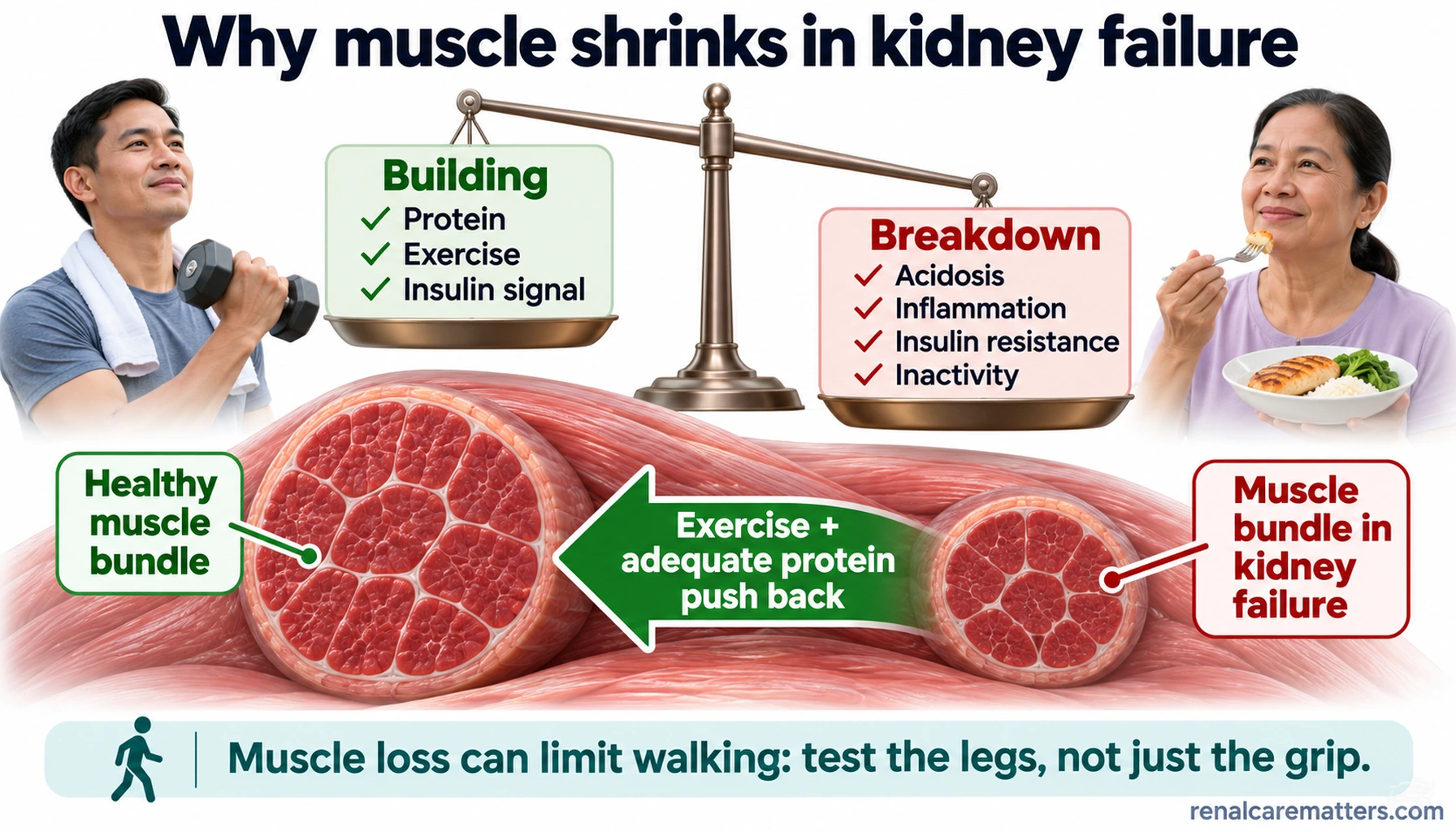
Muscle is never fixed. It is rebuilt every day, with protein synthesis on one side and protein breakdown on the other. In kidney failure the balance tips toward breakdown. Metabolic acidosis activates the cell’s protein-recycling machinery (the ubiquitin–proteasome pathway). Chronic inflammation and insulin resistance blunt the signals that build muscle. Poor appetite and dietary restrictions reduce the protein supply, and dialysis itself removes amino acids. Add inactivity, the strongest driver of all, and muscle shrinks.
Figure 3. Why muscle shrinks in kidney failure. Breakdown outpaces building; exercise and protein push the balance back.
What you see is weakness in the large leg muscles first: a slow, arm-assisted rise from a chair, difficulty with stairs, a shorter step. In a cohort of adults with chronic kidney disease (CKD) stages 2 to 4, lower-extremity performance was at least 30 percent below predicted while handgrip was relatively preserved.1 That is why handgrip alone can miss the problem; test the legs.
RememberIn kidney failure, test the legs, not just the grip. Leg strength fails first.
Lesson · part 2
Less oxygen delivered, less stable pressure
Anemia. The failing kidney makes too little erythropoietin, so red cells fall. Less hemoglobin means less oxygen carried to working muscle, so the same walk demands a higher heart rate and feels harder. Breathlessness and early fatigue on exertion are expected; a sudden change is not, and goes to the nurse.
The heart. Many people on dialysis have a thickened left ventricle and vascular stiffness from years of high blood pressure and fluid load. The heart fills less easily and tolerates fast swings in volume poorly.
Fluid and pressure swings. Between sessions, fluid accumulates; during dialysis, ultrafiltration removes it, often two to three liters in four hours. Plasma volume falls faster than it can refill from the tissues. Add autonomic neuropathy (common with diabetes) and medicines such as beta-blockers, and the reflex that keeps blood pressure up when a person stands is weak. That is why dizziness after dialysis is common, and why Module 3 makes screening on standing a habit.
RememberA breathless walk can be anemia; a dizzy stand can be fluid removal. Neither is a reason to stop rehabilitation, but both change when and how you test.
Lesson · part 3
Balance, bones and thinking
Peripheral neuropathy. Uremia and diabetes damage long nerves first: burning or numb feet, lost vibration and position sense. Without accurate signals from the feet, balance depends on vision and slow conscious correction. People with neuropathy walk with a wider base, look down, and fall when lighting is poor or the ground is uneven.
Bone disease. CKD–mineral and bone disorder (CKD-MBD) disturbs calcium, phosphate, parathyroid hormone and vitamin D, weakening bone. In a United States Renal Data System analysis, the relative risk of hip fracture in people on dialysis was about 4.4 times that of the general population of the same sex.2 A fall that bruises a healthy person can break a dialysis patient’s hip.
Cognition. Many people on hemodialysis have unrecognized cognitive impairment (Module 7). It affects how they learn an exercise, follow a plan, and judge risk.
RememberNeuropathy and fragile bones turn a stumble into a fracture. Balance training and fall prevention are not optional extras in this population.
Lesson · part 4
Frailty: when reserve runs out
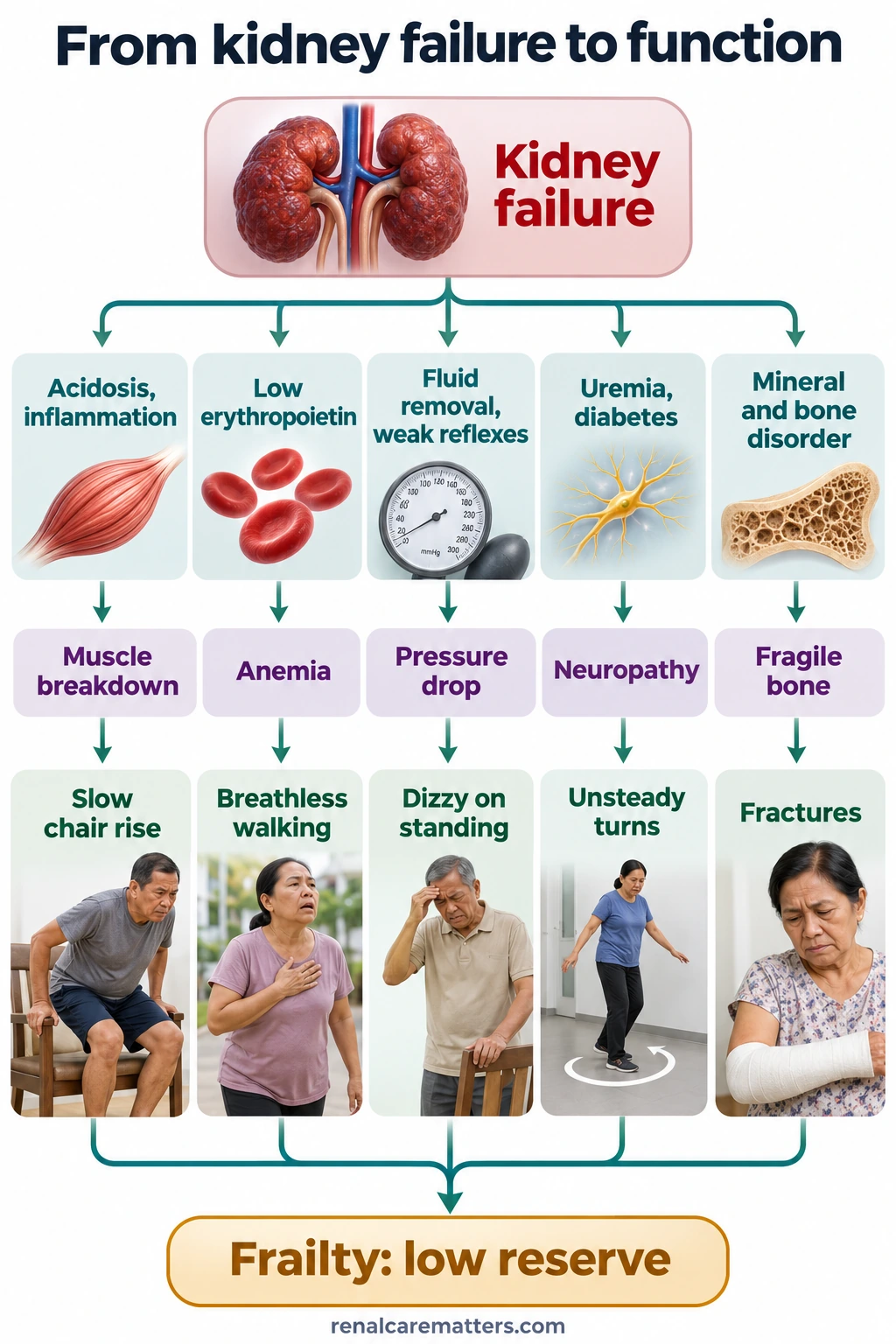
Figure 4. From kidney failure to function. Each mechanism has a bedside sign you can measure.
Frailty is what happens when all these accounts run low together. A frail person may manage a quiet day, but a small stress—a missed session, an infection, a hospital stay—tips them into a large and lasting loss of function.
Frailty is common in dialysis. A meta-analysis pooled its prevalence in hemodialysis at 34.3 percent, ranging from 6 to 82 percent depending on the tool and the population.3 In a large United States cohort of people starting dialysis, 67.7 percent were frail by that study’s definition, and frailty was associated with death (adjusted hazard ratio 2.24) and with death or hospitalization.4 Both are observational: frailty marks risk; it does not prove that treating frailty changes survival. The Kidney Disease: Improving Global Outcomes (KDIGO) 2024 guideline asks clinicians to fit physical activity advice to each person’s cardiovascular health, tolerance and frailty, and to consider referral to rehabilitation professionals.5
Two quick screens are useful on the floor: the Clinical Frailty Scale (CFS), a 1 to 9 judgment based on function,6 and the Strength, Assistance with walking, Rise from a chair, Climb stairs, Falls (SARC-F) questionnaire for sarcopenia. Neither replaces your performance tests (Module 5).
RememberFrailty is a reserve problem. The question is not only what the person can do today, but how much a bad week will cost them.
Lesson · part 5
How the schedule shapes the week
A person on hemodialysis three times a week spends about 12 hours a week sitting in the chair, plus travel and waiting, often 20 hours or more. After a session, many feel washed out for hours; the time to recover varies widely between people (Module 6). The long weekend gap leaves the most fluid on board before the first session of the week.
For you, this means three practical rules. Test at a consistent point in the week so results can be compared. Plan more demanding work on non-dialysis days or early in a session (Module 10). And never judge a person’s capacity by how they look straight after dialysis.
RememberAlways record which day of the dialysis week, and how long after a session, you measured.
On the floor
Real situations: problems and solutions
These are fictional but typical. For each one, cover the answer, decide what you would do, then compare. Where a step depends on local rules, your unit’s procedure and your supervisor’s direction come first.
Strong grip, weak legs
What you see
A patient has a good handgrip but cannot rise from a chair without using his arms.
What is likely going on
Lower-limb weakness, typical in CKD, missed by grip testing.
What to do
Test leg function (sit-to-stand, gait speed) and target leg strength.
Why it matters
Leg performance falls first and predicts outcomes.
Breathless on the stairs
What you see
A patient whose anemia was recently worse is breathless on one flight of stairs.
What is likely going on
Reduced oxygen delivery from anemia.
What to do
Report the change to the nurse; adapt intensity; continue lower-level activity if cleared.
Why it matters
A sudden change in exercise tolerance may be a medical change.
The Monday slump
What you see
Patients perform worst on Monday mornings before the first session of the week.
What is likely going on
The long weekend gap: most fluid on board.
What to do
Test at a consistent point in the week; avoid comparing Monday with Thursday.
Why it matters
Inconsistent timing creates false changes.
Field notes
Note the dialysis day and hours since the last session with every test.
Score the Clinical Frailty Scale at baseline.
Link each chart finding to a functional sign.
Report, do not treat, medical findings.
Case review
Back to the case: Four findings, four problems
Mapping findings to function. Hemoglobin of 92 g/L (anemia) contributes to breathlessness and early fatigue. Bicarbonate of 18 mmol/L (acidosis) and albumin of 33 g/L point toward muscle breakdown and poor nutritional reserve, feeding leg weakness. Large interdialytic weight gains and postural dizziness after dialysis, with metoprolol blunting the heart-rate response, raise the risk of blood pressure falling on standing. Burning feet and lost vibration sense mean neuropathy and poor balance. A wrist fracture after a minor slip suggests fragile bone.
What changes the screen and tests. The dizziness and beta-blocker mean Carlo checks symptoms and blood pressure on standing, never relies on heart rate alone for intensity, and avoids testing straight after dialysis. Neuropathy and the fracture history mean close guarding for balance tests.
Who treats what. Anemia, acidosis, fluid gains and bone disease are the renal team’s to treat; Carlo and Bea report what they see (for example, worsening dizziness). Rehabilitation directly addresses leg weakness, endurance, balance, transfers, the bathing routine and the “everything tires him” spiral of inactivity.
Skills lab · with your preceptor
Skills checklist: Chart-to-function mapping
Review a deidentified renal chart and present a functional problem list to your preceptor. Your preceptor rates each step as satisfactory, needs practice, or not observed. Steps marked Critical must all be satisfactory before sign-off. This checklist supports supervised learning; your unit’s own procedure and competency form are the authority. A printable version of every checklist is on the trainer page.
Identifies treatment modality, schedule and access from the chart.
Links at least four renal findings to plausible functional consequences, explaining the mechanism of each.
CriticalIdentifies findings that change screening or testing safety (for example, postural symptoms, beta-blocker, neuropathy, fracture).
CriticalDistinguishes problems the renal team treats from those rehabilitation addresses directly.
Scores a Clinical Frailty Scale and explains the score in function terms.
Presents a three-line functional problem list in the patient’s own goal language.
Placement activity. Map the charts of three patients on your caseload to functional problem lists and compare them with what the patients say limits them.
Self-assessment
Check your understanding
Each visit draws 5 questions at random from this module’s 10-question bank. Choose the single best answer for each, then select Check answers; an explanation appears under the best answer. Select New set of questions for a different mix. A good target is 4 of 5 on two different sets. Nothing you select is sent anywhere; scoring happens in your browser.
Roshanravan, B., Robinson-Cohen, C., Patel, K. V., Ayers, E., Littman, A. J., de Boer, I. H., Ikizler, T. A., Himmelfarb, J., Katzel, L. I., Kestenbaum, B., & Seliger, S. (2013). Association between physical performance and all-cause mortality in CKD. Journal of the American Society of Nephrology, 24(5), 822–830. https://doi.org/10.1681/ASN.2012070702
Alem, A. M., Sherrard, D. J., Gillen, D. L., Weiss, N. S., Beresford, S. A., Heckbert, S. R., Wong, C., & Stehman-Breen, C. (2000). Increased risk of hip fracture among patients with end-stage renal disease. Kidney International, 58(1), 396–399. https://doi.org/10.1046/j.1523-1755.2000.00178.x
Zhao, Y., Liu, Q., & Ji, J. (2020). The prevalence of frailty in patients on hemodialysis: A systematic review and meta-analysis. International Urology and Nephrology, 52(1), 115–120. https://doi.org/10.1007/s11255-019-02310-2
Johansen, K. L., Chertow, G. M., Jin, C., & Kutner, N. G. (2007). Significance of frailty among dialysis patients. Journal of the American Society of Nephrology, 18(11), 2960–2967. https://doi.org/10.1681/ASN.2007020221
Kidney Disease: Improving Global Outcomes (KDIGO) CKD Work Group. (2024). KDIGO 2024 clinical practice guideline for the evaluation and management of chronic kidney disease. Kidney International, 105(4S), S117–S314. https://doi.org/10.1016/j.kint.2023.10.018
Rockwood, K., Song, X., MacKnight, C., Bergman, H., Hogan, D. B., McDowell, I., & Mitnitski, A. (2005). A global clinical measure of fitness and frailty in elderly people. CMAJ, 173(5), 489–495. https://doi.org/10.1503/cmaj.050051
Educational material for licensed occupational and physical therapists. Completing it is an Academy learning record only. It is not a PRC, DOH, PhilHealth or PSN credential, not CPD units, and not a workplace privilege. Your license, your referral or prescription, your employer’s privileges and the renal team’s plan govern what you may do.