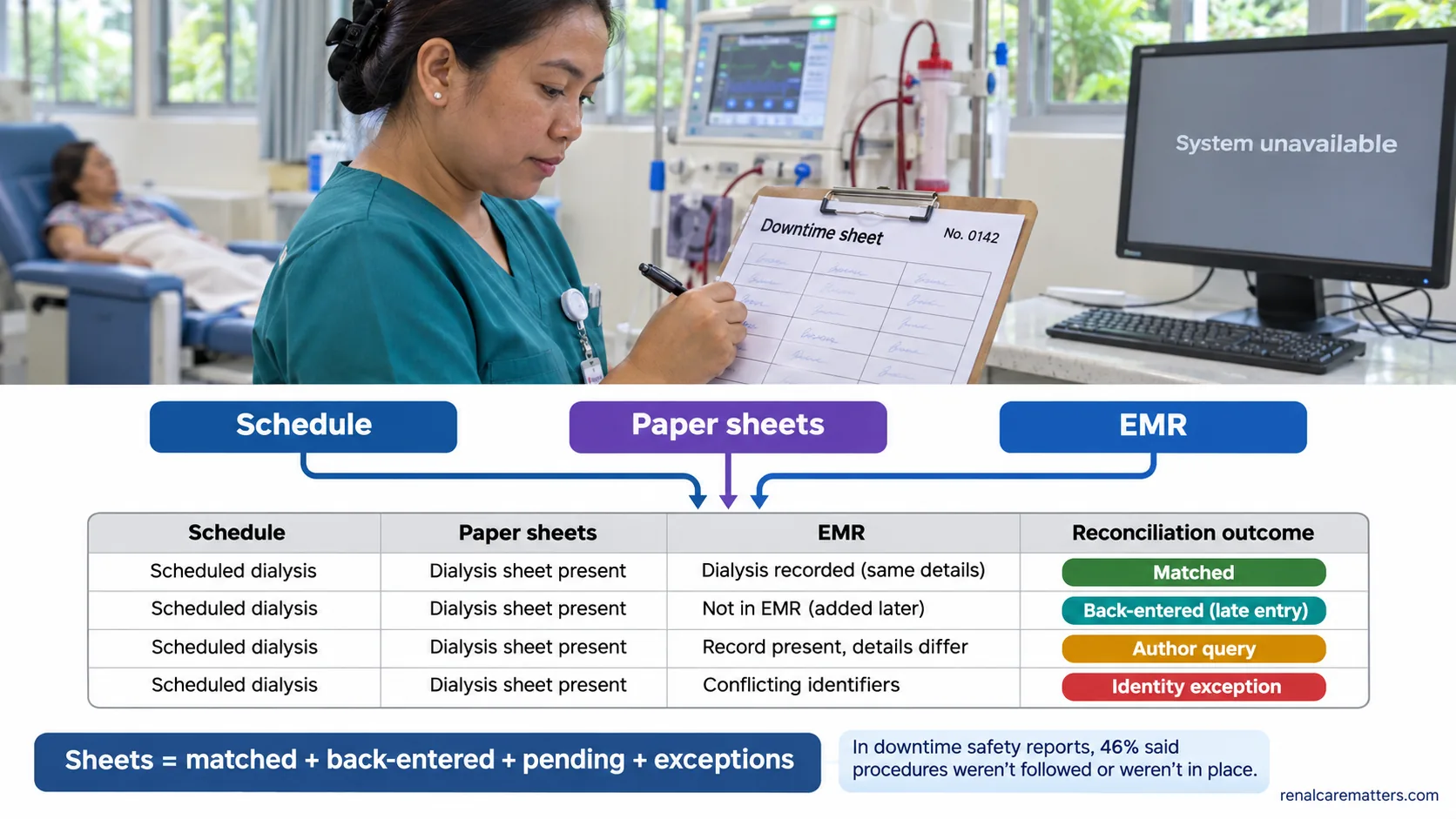
Downtime kits, numbered paper sheets, reconciling schedule, paper, and electronic records, and balancing the counts.
PublishedNailathalaGipatikPepalwal:ReferencesMga SanggunianMga TinubdanReng Reperensya:4Audience: Designated medical records officers, custodians, and deputies in standalone and hospital-based hemodialysis units · hospital health information management staff assigned to dialysis · unit managers who supervise recordsRead timeOras ng pagbasaOras sa pagbasaOras ning pamamasa:
Training track for the records officers of hemodialysis units
This module is study material for the records officers of hemodialysis units. It explains the reasoning behind common records decisions; it is not a records manual and not legal advice. Regulations change: confirm every rule against the current text and your facility’s approved policy before you rely on it. Clinical content belongs to its clinical author; questions about a patient’s care go to the attending nephrologist. Every case, name, and identifier is fictional.
Learning objectives
After this module you should be able to
Summarize what published studies show about patient safety during electronic record downtime.
Prepare a downtime kit and check its currency before an outage.
State what every paper downtime document must carry.
Reconcile the schedule, the paper sheets, and the electronic record after recovery, and balance the counts.
Hold downtime sessions from claims until they are authenticated and back-entered.
Pre-testBefore you read, answer the 8 self-assessment questions and note your score. After the module, select New set of questions and compare. The difference is what you learned; the questions you still miss are what to reread.
Start here
The big picture, in plain words
In plain wordsWhen the power fails at home, you light candles and carry on. The trouble comes later: food spoiled in the refrigerator, clocks blinking the wrong time, something forgotten in the dark. Downtime in a dialysis unit is the same. The treatments carry on. The trouble is what the dark leaves behind.
The picture is useful, and it has one limit. At home, the clocks are reset in a minute. In a dialysis unit, every session treated during the outage now exists in two places that do not agree: on paper, and partly or not at all in the electronic record. Until someone reconciles them, the unit does not know for certain who was treated, with what, and by whom.
Dialysis cannot stop because a server did. When the electronic record goes down, the unit keeps treating patients on paper. The danger lies less in the outage than in the improvisation that follows: sheets without identifiers, values remembered later, and sessions entered twice. The records officer’s job is to make sure the paper created during downtime is complete enough to reconcile, and then to reconcile it entry by entry.
Figure 1 · Key terms for this module
DowntimeA period when the electronic system is fully or partly unavailable, planned or unplanned.
Downtime kitThe printed forms, lists, orders, and contacts kept ready at each station for an outage.
Downtime IDA pre-printed serial number on each paper sheet, so every sheet can be counted.
Back-entryEntering paper-documented care into the electronic record after recovery, as an attributable late entry.
ReconciliationMatching records from different sources until every item is accounted for.
Electronic medical record (EMR)The digital record of patient care within the unit.
Opening case · fictional
Case: Six hours dark
On a Saturday, the electronic medical record (EMR) goes down at 6:15 a.m. and comes back at 12:20 p.m. Both morning shifts dialyze on paper. On Monday, four completed downtime sheets reach your desk.
DT-01, for Mr. Victor Mercado, matches an entry already in the EMR exactly. The nurse had started the electronic entry at 6:05 a.m., before the outage.
DT-02, for Mrs. Adelaida Flores, is complete and signed. There is no electronic entry.
DT-03, for Mr. Ronaldo Uy, is complete except for the nurse’s signature.
DT-04 says only “Rodriguez, F.” Two patients match: Felipe Rodriguez and Fernando Rodriguez, brothers who dialyze on the same Saturday shift.
Mr. Boyet Ramos from claims stops by. “Can I bill all four Saturday sessions today? The batch closes this afternoon.”
Before reading on, decide:
What is the disposition of each sheet?
Do the counts balance?
What do you tell Mr. Ramos?
Keep your answers in mind. The lesson gives you what you need, and the case review near the end shows one sound response.
Lesson · part 1
What downtime studies show
Downtime is not rare, and the evidence says it is dangerous mainly because procedures are missing or not followed.
In an analysis of 76 patient-safety reports tied to electronic health record downtime, 46% said downtime procedures were either not followed or not in place, and only 27.6% described a procedure carried out successfully. Patient identification and communication of clinical information were the main hazards.1 In a two-hospital study, laboratory results were delayed by an average of 62% during downtime, and the paper downtime records were themselves incomplete.2 Downtime is also common: one hospital logged 204 events over four and a half years, 96% of them unplanned.3
These studies come from hospitals, and safety reports capture only what someone chose to report, so the true picture may be worse. The same hazards apply to a dialysis unit, where every patient is treated on a fixed schedule: sheets with no identifiers, sessions entered twice, and values filled in from memory days later.
At national scale, the 2023 ransomware attack on the Philippine Health Insurance Corporation (PhilHealth) forced the payer itself into manual operations.4 If the payer can go dark, so can any dialysis unit.
On the floor · Four hours at a Saturday unit
A power fluctuation knocks out the server at a Saturday unit for four hours. The nurses switch to paper without trouble; they drilled it two months earlier.
What goes wrong is smaller: one laboratory result arrives by phone, is written on a sticky note, and is found three days later on a monitor. The patient’s potassium was high. Nothing happened, but the next drill adds a rule: phoned results go on the downtime results log, with two identifiers, before anything else.
Downtime research says procedures fail, not people. The fix is a better procedure.
Illustrative scenario. Names and details are invented.
Lesson · part 2
Readiness and downtime documentation
Before
Keep a printed downtime kit at each station. It should hold:
blank run sheets with pre-numbered downtime IDs;
the current patient list with two identifiers for each patient;
current standing orders, printed at a set interval such as every shift, so they are never more than a day old;
the contact list: IT, the charge nurse, the attending nephrologist, the records officer;
the downtime procedure, short enough to read in two minutes.
Check the kit monthly. A kit with last quarter’s standing orders is worse than none, because it looks trustworthy. Run a drill at least yearly, and use it to check documentation quality: did every drill sheet carry its ID, two identifiers, a time, and a signature?
During
Every paper document carries its downtime ID, the patient’s two identifiers, the date and time, and the author’s signature. “Rodriguez, F.” is one identifier, and an ambiguous one. Sheets are collected and secured each shift. A downtime log tracks each sheet: issued, completed, collected. Clinical questions go to the clinical team. The records officer never reconstructs missing values.
Usual improvisation
Safer practice
Writing on whatever paper is at hand
Using the numbered sheets from the kit
Surname only, or chair number
Two person-level identifiers on every sheet (Module 3)
“I’ll fill in the times later”
Times written as events happen
Sheets left at stations overnight
Collected and secured each shift
Sharing one emergency password
The approved, logged emergency-access procedure
Stop and callA shared emergency password to speed up recovery destroys attribution. Use the approved, logged emergency-access procedure, and report any pressure to do otherwise. If an outage affects a patient’s treatment, the clinical decisions belong to the charge nurse and the attending nephrologist, per unit protocol.
On the floor · The kit that saved an hour
When the electronic record fails at 5:50 a.m. on a Monday, the charge nurse opens the downtime kit at each station. Inside are numbered run sheets, a patient list printed the previous evening, and current standing orders.
The first patients are connected by 6:10 a.m. on paper. A unit across the province without a kit spends its first hour phoning physicians for prescriptions.
A kit is checked on a quiet day so that it works on a loud one.
Illustrative scenario. Names and details are invented.
Lesson · part 3
Three lists, one truth
Figure 2. Three lists, one truth. Downtime paper is a parallel record that must be reconciled, not just filed.
For every expected encounter during the outage, compare three lists: the schedule, the paper sheets, and the electronic record, including entries started just before the outage. Each sheet ends up in exactly one of these situations.
Situation
Action
Paper matches an existing electronic entry
Record as matched; do not create a second session
Signed paper, no electronic entry
Back-enter as an attributable late entry; keep the paper per policy
Paper lacks the clinician’s signature
Query the author; hold
Ambiguous identity
Identity exception (Module 3)
Expected encounter, no paper, no electronic entry
Ask the clinical team whether the treatment occurred; document the answer
The last row of the table is the easiest to miss. A patient who was scheduled, has no paper sheet, and has no electronic entry may have been sent home, sent to the emergency room, or treated on a sheet that was lost. Only the clinical team can say which. The pre-numbered downtime IDs are what make a lost sheet visible: a gap in the sequence is a question.
A two-person reconciliation, one reading and one checking, is a strong local control. Close the event with a short report: duration, encounters affected, counts, open exceptions, and lessons for the next drill. Sessions captured on paper are claimable only after they are authenticated and back-entered.
RememberDowntime paper is a parallel record. Reconcile it; do not just file it.
On the floor · The sequence with a gap
After an outage, sheets DT-101 to DT-118 come back, except DT-109. The records officer asks the charge nurse about DT-109.
It was issued to Mr. Celso Agbayani, whose session was stopped after 40 minutes when he became short of breath and was sent to the emergency room. The nurse had sent the sheet with him. The emergency room returns it, and the session is recorded as started and stopped, with the reason.
Pre-numbered sheets turned a missing page into a question someone could answer.
Illustrative scenario. Names and details are invented.
On the floor
Real situations: problems and solutions
These are fictional but typical. For each one, cover the answer, decide what you would do, then compare. Where a step depends on local rules, your unit’s procedure and your supervisor’s direction come first.
The kit with last quarter’s orders
What you see
During a drill, you find that the station 4 downtime kit holds standing orders from three months ago.
What is likely going on
A kit that was never refreshed.
What to do
Replace them with current printed orders and add the kit check to the monthly routine.
Why it matters
An outdated kit looks trustworthy, which makes it dangerous.
Sheets written on bond paper
What you see
After an outage, two sessions were documented on plain paper with no downtime ID.
What is likely going on
The kit ran out of numbered sheets.
What to do
Reconcile them like any other sheet, ask the authors to add identifiers and signatures, and restock the kit with more numbered sheets.
Why it matters
Unnumbered sheets cannot be counted, so a lost one is invisible.
The scheduled patient with no sheet
What you see
Reconciliation shows a patient scheduled during the outage with no paper sheet and no electronic entry.
What is likely going on
Sent home, sent to the emergency room, or a lost sheet.
What to do
Ask the charge nurse whether the treatment happened and document the answer before closing the event.
Why it matters
A missing sheet may be a missing patient.
“I’ll enter them all tonight”
What you see
A nurse offers to back-enter all downtime sheets herself after her shift, without reconciling them first.
What is likely going on
Helpful, and likely to create duplicates.
What to do
Thank her, and ask her to help with the reconciliation first, so only unmatched, signed sheets are back-entered.
Why it matters
Back-entry before reconciliation duplicates sessions.
The partial outage
What you see
The laboratory interface fails for a day, but the rest of the record works.
What is likely going on
A partial downtime: results arrive on paper or by phone.
What to do
Treat it as downtime for results: log each paper result, file it with two identifiers, and reconcile when the interface returns.
Why it matters
Partial outages cause the same gaps, with less warning.
Field notes
Check every station’s downtime kit monthly.
Number every downtime sheet before an outage, not during one.
Reconcile with two people: one reads, one checks.
Hold downtime sessions from claims until back-entered.
Write a short report after every outage, even a one-hour one.
Case review
Back to the case: Six hours dark
Dispositions. DT-01: matched; record it as such and create no new session. DT-02: back-entered as an attributable late entry by the authorized person, carrying both the service date and the entry date. DT-03: author query to Mr. Uy’s nurse; held. DT-04: identity exception. With the brothers on the same shift, the charge nurse and the nurse who wrote the sheet must establish which Rodriguez it describes before it is filed anywhere.
Counts. Four sheets = 1 matched + 1 back-entered + 1 pending query + 1 identity exception. Balanced. Then check the other way: were any patients scheduled on Saturday morning with no sheet and no electronic entry? Check the downtime IDs for gaps.
Mr. Ramos. DT-01 is already in the record. DT-02 can be claimed once it is back-entered. DT-03 and DT-04 stay on hold until they are resolved; the batch can close without them, and they go in the next one.
The easy mistake would have been to back-enter all four sheets on Monday morning, creating a duplicate session for Mr. Victor Mercado and possibly giving one brother’s treatment to the other. Part of your role is to make the dark hours add up before anyone bills for them.
Skills lab · with your preceptor
Skills checklist: Downtime reconciliation
Reconcile a fictional set of downtime sheets against a schedule and a restored record while your preceptor observes. Your preceptor rates each step as satisfactory, needs practice, or not observed. Steps marked Critical must all be satisfactory before sign-off. This checklist supports supervised learning; your unit’s own procedure and competency form are the authority. A printable version of every checklist is on the trainer page.
Checks a downtime kit for current patient lists and standing orders.
Checks that each sheet has a downtime ID, two identifiers, time, and signature.
CriticalRecords a match without creating a duplicate session.
CriticalBack-enters only authenticated sheets as attributable late entries.
CriticalRoutes an ambiguous identity to the identity exception workflow.
Balances the counts, checks for gaps in downtime IDs, and lists open exceptions.
CriticalHolds downtime sessions from claims until authenticated and back-entered.
Placement activity. Open your unit’s downtime kit. Check that the patient list and standing orders are current, and that the sheets are pre-numbered.
Self-assessment
Check your understanding
Each visit draws 8 questions at random from this module’s 15-question bank. Choose the single best answer for each, then select Check answers; an explanation appears under the best answer. Select New set of questions for a different mix. A good target is 7 of 8 on two different sets. Nothing you select is sent anywhere; scoring happens in your browser.
Larsen, E., Fong, A., Wernz, C., & Ratwani, R. M. (2018). Implications of electronic health record downtime: An analysis of patient safety event reports. Journal of the American Medical Informatics Association, 25(2), 187–191. https://doi.org/10.1093/jamia/ocx057
Larsen, E., Hoffman, D., Rivera, C., Kleiner, B. M., Wernz, C., & Ratwani, R. M. (2019). Continuing patient care during electronic health record downtime. Applied Clinical Informatics, 10(3), 495–504. https://doi.org/10.1055/s-0039-1692678
Fang, Q., Liang, J., Xiang, P., Zhao, M., He, Y., Zhang, Z., Wan, H., Hu, Y., Wang, T., & Lei, J. (2025). Electronic health record downtime events of a hospital: A retrospective analysis from adverse event reports. Applied Clinical Informatics, 16(5), 1419–1429. https://doi.org/10.1055/a-2701-5819
Philippine Health Insurance Corporation. (2023, October 2). Urgent notice to the public. https://www.philhealth.gov.ph/ofclstmnts/2023/UN2023-10-03.pdf
Educational material for records staff. Completing it is an Academy learning record only. It does not confer DOH-recognized training credit, a facility designation, or system access, and it does not replace current regulations, your facility’s records manual, or advice from your data protection officer or counsel.