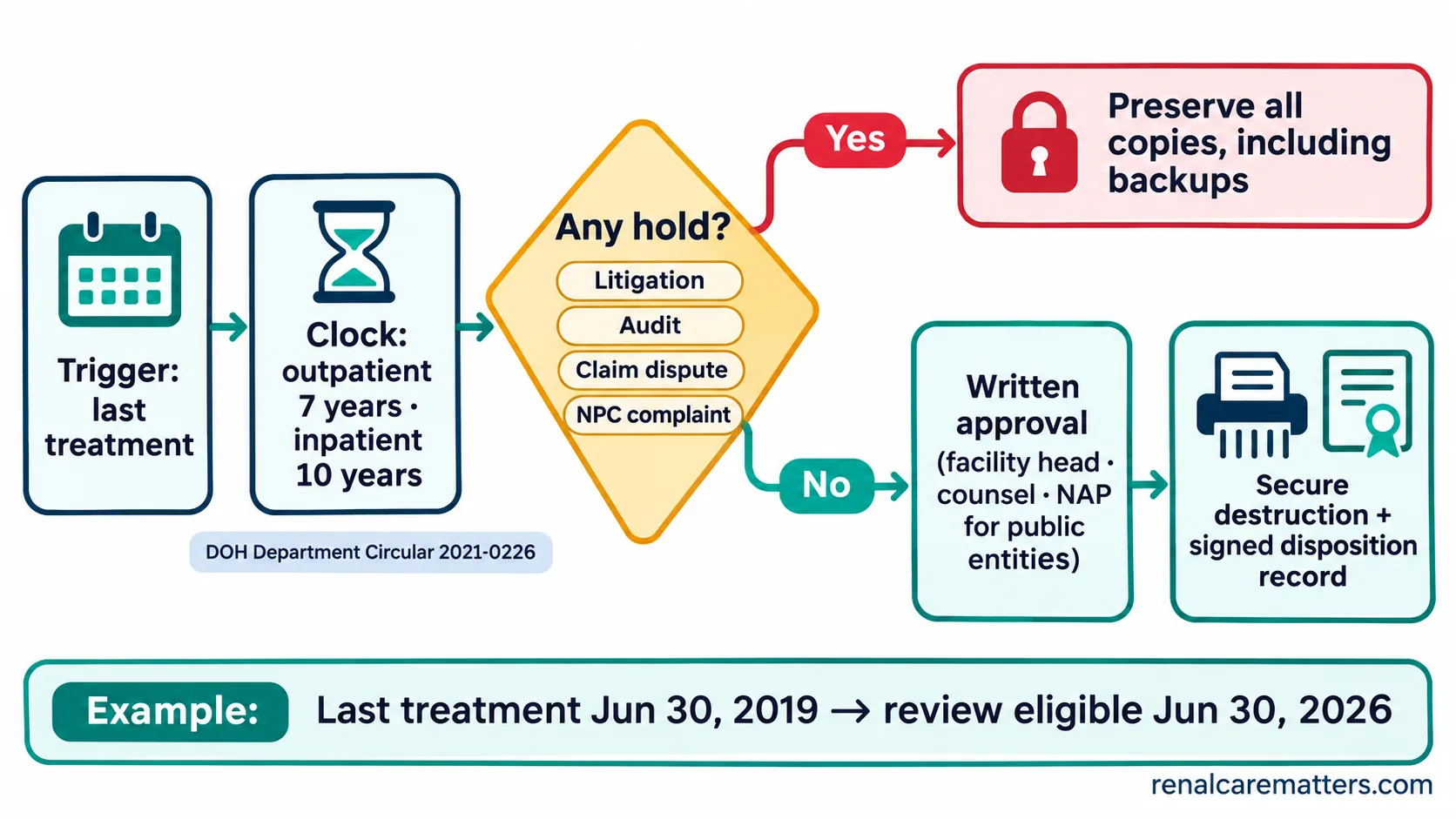
The DOH disposition schedule, the right trigger date, holds that override schedules, and documented destruction.
PublishedNailathalaGipatikPepalwal:ReferencesMga SanggunianMga TinubdanReng Reperensya:4Audience: Designated medical records officers, custodians, and deputies in standalone and hospital-based hemodialysis units · hospital health information management staff assigned to dialysis · unit managers who supervise recordsRead timeOras ng pagbasaOras sa pagbasaOras ning pamamasa:
Training track for the records officers of hemodialysis units
This module is study material for the records officers of hemodialysis units. It explains the reasoning behind common records decisions; it is not a records manual and not legal advice. Regulations change: confirm every rule against the current text and your facility’s approved policy before you rely on it. Clinical content belongs to its clinical author; questions about a patient’s care go to the attending nephrologist. Every case, name, and identifier is fictional.
Learning objectives
After this module you should be able to
State the Philippine default retention periods for outpatient and inpatient health records and their source.
Identify the trigger event that starts the retention clock for a hemodialysis chart.
Compute the date a chart becomes eligible for disposition review.
Apply a legal hold to every copy of an affected record, including backups.
Destroy only eligible, unheld, approved records, and keep a signed disposition record.
Pre-testBefore you read, answer the 8 self-assessment questions and note your score. After the module, select New set of questions and compare. The difference is what you learned; the questions you still miss are what to reread.
Start here
The big picture, in plain words
In plain wordsRecords are like medicines in a pharmacy. Throw them out too early and someone who needs them will find the shelf empty. Keep them forever and the shelves overflow, the old stock gets mixed with the new, and some of it becomes dangerous. Every record needs an expiry date, and every expiry date needs a reason.
The picture is useful, and it has one limit. An expired medicine is simply discarded. An expired record may still be needed if someone has started a lawsuit, a payer has opened an audit, or a patient has filed a privacy complaint. Expiry is the default, and holds override it.
Records kept too briefly can leave a patient, a physician, or the unit unable to prove what happened. Records kept forever pile up risk: every extra year is another year in which a box can flood, a storeroom can be broken into, or a server can be breached. The Data Privacy Act expects personal data to be kept only as long as their purpose and the law require.1 A retention schedule is the facility’s answer to both problems, and the records officer keeps it.
Figure 1 · Key terms for this module
Records disposition scheduleThe approved table of how long each class of record is kept, and what happens to it afterward.
Trigger eventThe event that starts the retention clock.
Eligibility dateThe date a record becomes eligible for disposition review: trigger date plus retention period.
Legal holdAn instruction to preserve records regardless of the schedule.
National Archives of the Philippines (NAP)The agency that approves records schedules and disposal for public entities.
Disposition recordThe signed record of what was destroyed, how, by whom, and when.
Opening case · fictional
Case: The batch due next month
The storeroom at your freestanding unit is full. Mr. Nestor Villareal, the unit manager, asks you to “clear out the old charts” before new shelving arrives in December. Your archive list flags three closed charts.
Mr. Lorenzo Pascual last dialyzed with you on June 30, 2019, then transferred to a unit in Batangas. His chart is under an active legal hold, recorded in the verified hold register, over a claim dispute with Philippine Health Insurance Corporation (PhilHealth).
Mrs. Florencia Dimaculangan last dialyzed with you on June 30, 2019. She died in July 2019. No hold appears in the verified register.
Mr. Ricardo Soriano’s chart was opened in 2015. He still dialyzes with you on Tuesday, Thursday, and Saturday.
Your unit has no local schedule longer than the national default.
Before reading on, decide:
When does each chart become eligible for disposition review?
What happens to Mr. Pascual’s chart, and to its copies?
What has to happen before Mrs. Dimaculangan’s chart is destroyed?
Keep your answers in mind. The lesson gives you what you need, and the case review near the end shows one sound response.
Lesson · part 1
The Philippine default
Department of Health (DOH) Department Circular (DC) 2021-0226, dated May 31, 2021, disseminated the revised Approved Records Disposition Schedule for health facilities. According to the DOH’s own published answer, inpatient health records are kept for 10 years in total before disposal, and outpatient health records for 7 years after the last consultation. Other facility record classes are listed in its annexes.2
Maintenance hemodialysis is outpatient care. For a freestanding unit, the default trigger is the patient’s last treatment encounter with the unit, after death, transfer, transplant, or recovery. It is not the date the chart was opened. A patient who has dialyzed with you for eleven years has a chart that is eleven years old and still has no trigger at all.
Situation
Trigger
Patient still dialyzes with you
None yet; keep
Patient transferred out
The last session at your unit
Patient received a transplant
The last session at your unit
Patient recovered and stopped dialysis
The last session at your unit
Patient died
The last session at your unit
When two schedules apply
A hospital-based unit may follow a hospital schedule approved by the National Archives of the Philippines (NAP) that sets longer periods. Public entities need NAP disposal authority before destroying anything.3 If any applicable schedule is longer, the longer one governs.
You may read about other countries’ rules. The United States federal dialysis rule, for example, keeps records six years from discharge.4 That is a comparison only. It is not a Philippine rule, and it cannot shorten a Philippine one.
Eligibility date = trigger date + retention period. Last treatment June 30, 2019 + 7 years = disposition review from June 30, 2026.
The toolkit’s retention calculator does this arithmetic, including the longer-schedule and hold checks.
On the floor · The chart that never expires
Mr. Ambrosio Velasco has dialyzed with the unit for eleven years. His chart fills two boxes, and a staff member asks whether the first box can be shredded because it is “more than ten years old.”
The records officer explains that the clock has not started: the trigger is his last treatment, and he is still a patient. The first box is scanned, the scans are indexed and checked page by page, and the paper is kept until the schedule says otherwise.
Age is not the trigger. The last treatment is.
Illustrative scenario. Names and details are invented.
Lesson · part 2
Holds override schedules
Figure 2. The retention clock. Eligibility starts a review, holds come first, and destruction needs written approval.
Eligibility is not permission. Before any chart is destroyed, check for holds.
Each of these triggers a hold:
litigation, actual or reasonably anticipated;
a government investigation;
a PhilHealth audit or claim dispute;
a complaint to the National Privacy Commission (NPC);
a records request still in progress.
When a hold arrives, confirm its scope in writing with counsel or the facility head: which patients, which record types, which dates. Then suspend disposition of every affected copy. That includes the paper chart, the scanned images, the electronic record, claims attachments, registry extracts, emailed copies, and backups. IT must be told about backups, because a backup tape rotated on schedule can destroy the one copy a court needs.
Record the acknowledgment of the hold. Review open holds periodically. Release a hold only in writing. When a hold ends, recheck the schedule, any other holds, and approvals before anything proceeds. The end of one hold does not make a chart eligible if another hold or a longer schedule still applies.
Stop and callNever destroy a record because the box is full. Eligibility comes from the schedule, permission comes from the approver, and holds come first. If a manager asks you to clear a shelf, the answer is a list of what is eligible, not a shredder.
On the floor · The tape on rotation
A PhilHealth audit letter arrives covering claims for 2023. The records officer places a hold on the affected charts and tells IT in writing. IT had planned to overwrite the 2023 backup tapes the following week as part of routine rotation.
The tapes are set aside and labeled with the hold number. When the auditors later ask for an electronic record that had been edited after the claim, the backup is the only copy showing the version filed.
A hold on paper alone would have lost the one copy that mattered.
Illustrative scenario. Names and details are invented.
Lesson · part 3
Lawful, documented destruction
Destroy only records that are eligible, unheld, and approved in writing. Use a secure method: cross-cut shredding or pulping for paper; certified wiping or physical destruction for electronic media. Throwing charts into the regular trash, selling them as scrap paper, or burning them in the back lot are all breaches waiting to happen. Paper sold as scrap does not stay private; it can turn up as packaging anywhere.
Keep a signed disposition record: what was destroyed, how many, the method, who witnessed it, and the date. Keep the disposition record itself under its own schedule. It is the proof that the destruction was lawful, and a unit that cannot show it may be unable to prove the records were not simply lost.
RememberEvery copy counts. A chart shredded on paper but still sitting in a scanned folder, a claims attachment, and last year’s backup has not been disposed of; it has been partly destroyed.
On the floor · The disposition record that saved a complaint
Two years after a batch of eligible charts was destroyed, a former patient’s relative complains that the unit “lost” the records.
The records officer retrieves the signed disposition record: the chart number, the schedule and trigger date, the approval, the cross-cut shredding, the witness, and the date. The complaint is closed.
The disposition record is the proof that destruction was a decision, not an accident.
Illustrative scenario. Names and details are invented.
On the floor
Real situations: problems and solutions
These are fictional but typical. For each one, cover the answer, decide what you would do, then compare. Where a step depends on local rules, your unit’s procedure and your supervisor’s direction come first.
The flooded storeroom
What you see
Typhoon rain floods the archive room and soaks a shelf of closed charts.
What is likely going on
Damage to records that may still be within retention.
What to do
Report it to the unit manager and data protection officer (DPO), document which records were affected, recover and dry what you can, and record what was lost. Do not discard damaged charts without approval.
Why it matters
Loss by flood must be documented as carefully as lawful destruction.
The scrap buyer
What you see
A scrap dealer offers to buy old paper from the storeroom.
What is likely going on
A cheap disposal route that is not secure.
What to do
Decline. Old charts go only through approved, secure destruction with a disposition record.
Why it matters
Paper sold as scrap does not stay private.
The hold that ended
What you see
Counsel writes that a hold on five charts is released.
What is likely going on
The charts may now be eligible, or not.
What to do
Recheck each chart’s schedule, any other holds, and approvals before scheduling disposition.
Why it matters
The end of one hold is not permission to destroy.
The backup tape
What you see
IT plans to overwrite last year’s backup tapes as part of normal rotation. One tape contains records under a hold.
What is likely going on
A routine process that could destroy held records.
What to do
Tell IT about the hold in writing today and ask them to set that tape aside.
Why it matters
A hold covers every copy, including backups.
“Keep everything forever”
What you see
The owner says the unit will never destroy anything, to be safe.
What is likely going on
A reasonable fear that creates its own risk.
What to do
Explain that the Data Privacy Act expects data to be kept only as long as needed, and propose following the schedule with secure, documented destruction.
Why it matters
Every extra year is another year of exposure.
Field notes
The trigger for a dialysis chart is the last treatment, not the date it was opened.
Check holds before every disposition, every time.
Tell IT about holds; backups are copies.
Keep disposition records under their own schedule.
When two schedules apply, the longer one wins.
Case review
Back to the case: The batch due next month
Eligibility. Mr. Pascual and Mrs. Dimaculangan: trigger June 30, 2019, eligible for review from June 30, 2026. Mr. Soriano: no trigger yet, however old his chart is. He is still a patient.
Mr. Pascual. Eligible but held. His chart stays, together with its scans, claim attachments, electronic record, and backups, until counsel releases the hold in writing. Make sure IT knows. Then the hold is rechecked before anything happens.
Mrs. Dimaculangan. Route the chart for disposition review and written approval by the facility head. After approval, destroy every copy by a secure method with a witness, and complete a signed disposition record.
And Mr. Villareal’s request? Give him the list: one chart eligible and approved for review, one held, one active. Clearing a shelf is a reasonable goal. Doing it by schedule, not by box, is what keeps the unit out of trouble.
Part of your role is to make sure the oldest box on the shelf is not the one that a court asks for next month.
Skills lab · with your preceptor
Skills checklist: Retention schedule, hold, and disposition
Compute eligibility and process a hold and a disposition request for fictional charts while your preceptor observes. Your preceptor rates each step as satisfactory, needs practice, or not observed. Steps marked Critical must all be satisfactory before sign-off. This checklist supports supervised learning; your unit’s own procedure and competency form are the authority. A printable version of every checklist is on the trainer page.
States the outpatient and inpatient default periods and their source.
Uses the correct trigger: last treatment encounter for an outpatient chart.
Computes the eligibility date and applies the longer schedule when two apply.
CriticalSuspends disposition of every copy under a hold, including backups.
CriticalResponds to a request to clear shelves with an eligibility list, not destruction.
CriticalDestroys nothing without written approval and keeps a signed disposition record.
Placement activity. Find your unit’s retention schedule. Check that it cites DC 2021-0226 and names a trigger for each class.
Self-assessment
Check your understanding
Each visit draws 8 questions at random from this module’s 15-question bank. Choose the single best answer for each, then select Check answers; an explanation appears under the best answer. Select New set of questions for a different mix. A good target is 7 of 8 on two different sets. Nothing you select is sent anywhere; scoring happens in your browser.
National Privacy Commission. (2020). Advisory Opinion No. 2020-009. https://www.privacy.gov.ph/wp-content/uploads/2020/10/Redacted-Advisory-Opinion-No.-2020-009.pdf
Department of Health. (2021). Department Circular No. 2021-0226: Dissemination of the approved records disposition schedule (RDS) [Retention periods as stated in the DOH response to a Freedom of Information request]. Retrieved November 24, 2026, from https://foi.gov.ph/agencies/doh/retention-and-disposal-of-records
Republic Act No. 9470: National Archives of the Philippines Act of 2007. (2007). Congress of the Philippines. https://elibrary.judiciary.gov.ph/thebookshelf/showdocs/2/19575
Conditions for coverage for end-stage renal disease facilities, 42 C.F.R. § 494 (2025).
Educational material for records staff. Completing it is an Academy learning record only. It does not confer DOH-recognized training credit, a facility designation, or system access, and it does not replace current regulations, your facility’s records manual, or advice from your data protection officer or counsel.