Certificates, Clinical Abstracts, and Patient Requests
Preparing drafts from the authenticated chart, dialysis vintage and serology dates, physician authorship, and the request log.
PublishedNailathalaGipatikPepalwal:Audience: Designated medical records officers, custodians, and deputies in standalone and hospital-based hemodialysis units · hospital health information management staff assigned to dialysis · unit managers who supervise recordsRead timeOras ng pagbasaOras sa pagbasaOras ning pamamasa:
Training track for the records officers of hemodialysis units
This module is study material for the records officers of hemodialysis units. It explains the reasoning behind common records decisions; it is not a records manual and not legal advice. Regulations change: confirm every rule against the current text and your facility’s approved policy before you rely on it. Clinical content belongs to its clinical author; questions about a patient’s care go to the attending nephrologist. Every case, name, and identifier is fictional.
Learning objectives
After this module you should be able to
Explain who prepares, who authors, and who releases a certificate, and why the records officer never signs.
List the facts each common request usually needs, drawn from the authenticated chart.
Compute dialysis vintage from the first-ever dialysis date and record its source.
Check the age of serology results against the receiving unit’s requirement and flag them when they are too old.
Keep a request log and release certificates through the five checks.
Pre-testBefore you read, answer the 8 self-assessment questions and note your score. After the module, select New set of questions and compare. The difference is what you learned; the questions you still miss are what to reread.
Start here
The big picture, in plain words
In plain wordsA certificate is a promise written in the physician’s name. The physician signs it, so it is the physician’s statement. But the physician usually writes it from a draft, and the draft is built from the record you keep. If the record is wrong, the promise is broken before anyone signs.
The picture is useful, and it has one limit. A broken promise between friends can be explained. A wrong certificate travels to the payer, to an insurer, to an employer, to another dialysis unit in another city, and the physician whose license number is printed on it cannot explain it to people they will never meet.
People with chronic kidney disease (CKD) on dialysis need paperwork constantly: a clinical abstract for the Philippine Health Insurance Corporation (PhilHealth) or a health maintenance organization (HMO), a certification for a transient unit while traveling, a letter for an employer, support for a person-with-disability (PWD) application, a transplant referral. A wrong start date or an outdated hepatitis result on any of these is a false statement under the physician’s name, and at a transient unit it can be a safety problem too.
Figure 1 · Key terms for this module
Clinical abstractA physician-signed summary of a patient’s condition and care.
Dialysis vintageTime since the first-ever dialysis, wherever it happened.
Transient dialysisTreatment at another unit while the patient is traveling.
SerologyBlood tests for infections such as hepatitis B and hepatitis C, each with a collection date.
Source sheetA list of each fact on a draft, the document it came from, and that document’s date.
Turnaround timeDays from a complete request to release.
Opening case · fictional
Case: Cebu on December 10
Mrs. Gloria Santiago, 63, comes to the records window on Tuesday, November 24, 2026. Her granddaughter is getting married in Cebu, and Mrs. Santiago flies there on December 10 for two weeks. She needs a transient dialysis certification. She hands you a printed checklist from the receiving unit in Cebu: it requires hepatitis serologies collected within 90 days.
You open her chart. The referral packet from her previous unit shows her first-ever hemodialysis on March 3, 2021. Her first session at your unit was January 12, 2024. Her latest hepatitis B surface antigen and anti-hepatitis C results are both negative, collected July 30, 2026.
“Can you just print it today?” she asks. “Dr. Mendoza usually signs these on Thursdays.”
Before reading on, decide:
What dialysis vintage goes on the draft?
Are the serologies acceptable for the receiving unit?
Who signs, and how is the certificate released?
Keep your answers in mind. The lesson gives you what you need, and the case review near the end shows one sound response.
Lesson · part 1
Prepare, author, release
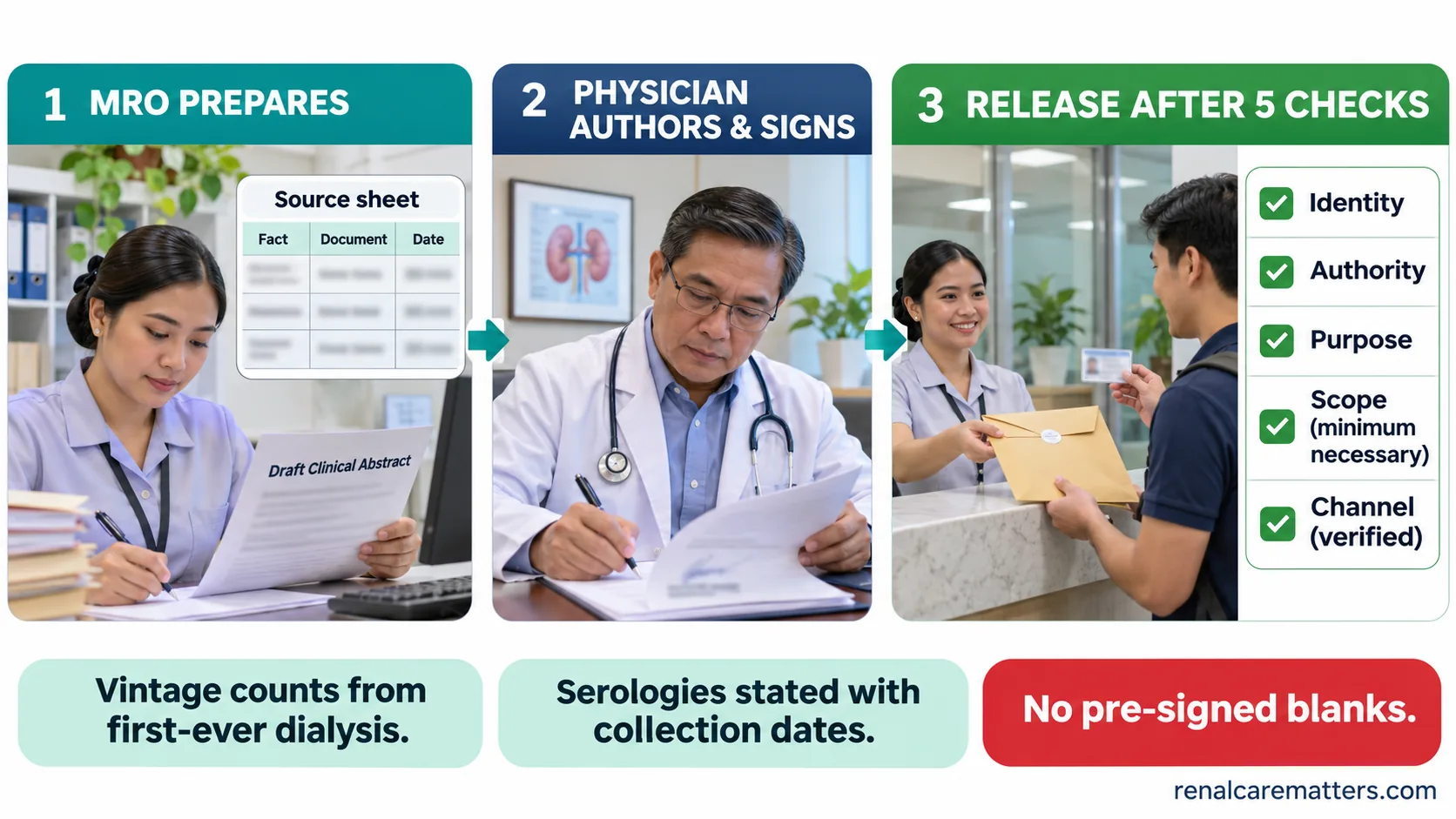
Figure 2. Prepare, author, release. The records officer prepares; the physician authors and signs; release follows the five checks from Module 8.
Every certificate passes through three stages, and each stage belongs to a different person.
Stage
Who
What they do
Prepare
The records officer
Pulls verified facts from the authenticated chart, fills the facility template, attaches a source sheet, and flags gaps
Author
The attending physician
Reviews, edits, decides what is clinically stated, and signs with license and professional tax receipt numbers
Release
The records officer
Releases through identity, authority, purpose, scope, and channel (Module 8), and logs it
The records officer never signs, never stamps a pre-signed form, and never adds a clinical statement the physician did not make. “Fit to travel,” “stable,” “unable to work,” and “no contraindication” are clinical judgments. If the template has a blank for them, it stays blank on the draft for the physician to fill.
Stop and callNo pre-signed blank certificates, ever, not even “for emergencies while the doctor is away.” A signature belongs to a reviewed document. If a certificate is urgent and the physician is unavailable, ask the covering physician on the unit’s escalation list.
On the floor · The certificate in the drawer
A new records officer finds a folder of blank certificate forms, each already signed and stamped by a physician who left the unit last year, “for emergencies.”
She gives the folder to the unit manager, who has the forms destroyed with a witness and a disposition record, and writes to the former physician to explain. The unit’s procedure now names a covering physician for urgent certificates.
A signature belongs to a document someone reviewed. Pre-signed blanks belong to no one.
Illustrative scenario. Names and details are invented.
Lesson · part 2
What each request usually needs
Request
Facts drawn from the chart
Watch for
Clinical abstract for PhilHealth, an HMO, or a registry
Diagnosis with International Classification of Diseases, 10th Revision (ICD-10) code; documented cause of kidney failure; first dialysis date and vintage; modality and frequency; vascular access; medications; latest serologies with dates; isolation status
An unsigned diagnosis (Module 5); a first-at-this-unit date used as the first-ever date
Transient dialysis certification
Current prescription; dry weight; access; latest serologies and dates; allergies; recent events
Serologies older than the receiving unit allows
Employer or school letter
Schedule and frequency; any functional statement only as the physician writes it
Requests for diagnoses or test results the purpose does not need
PWD application support
Diagnosis and chronicity as documented; the physician completes any disability statement
Staff filling in disability wording themselves
Transplant referral
A full clinical summary assembled with the clinical team
Missing access history and transfusion records
An employer letter is a common scope trap. The employer needs to know that the patient dialyzes on Monday, Wednesday, and Friday mornings and cannot work those hours. The employer does not need the hepatitis status or the cause of kidney failure. The physician decides what goes in; your draft should not offer more than the purpose requires.
On the floor · What the employer needed
Mr. Reynaldo Pascua’s employer asks for “a medical certificate” to justify his absences. The draft template includes diagnosis, cause of kidney failure, hepatitis status, and medications.
The records officer prepares a draft limited to his dialysis schedule and the physician’s statement on working hours, and leaves the rest for the physician to decide. The physician signs it as drafted. Mr. Pascua keeps his job, and his hepatitis status stays private.
Scope is set by purpose. An employer needs to plan around a schedule, not to know a diagnosis.
Illustrative scenario. Names and details are invented.
Lesson · part 3
Vintage, serologies, and the request log
Dialysis vintage
Dialysis vintage counts from the first-ever dialysis, not the first session at this unit. This is the same distinction as registry start dates in Module 7, and it is the most common error on Philippine certificates. Take the first-ever date from the referral documents, record its source on the source sheet, and compute vintage as of the certificate date.
Vintage = certificate date − first-ever dialysis date. Example: first-ever dialysis March 3, 2021, certificate dated November 24, 2026: 5 years, 8 months, and 21 days.
Why does it matter so much? Vintage affects how other clinicians judge a patient’s vascular access history, their risks, and in some programs their place on a transplant waiting list. A patient who has dialyzed for five years but is certified as dialyzing for two loses three years of their own history.
Serology dates
State each serology with its collection date, never as a bare “negative.” A hepatitis result is a fact about one day. Receiving units set their own limits on how old a result may be, because a patient who was negative in July could have been infected since. If the latest result is older than the receiving unit requires, flag it for the physician. Do not quietly write “negative” and leave the receiving unit to discover the date.
The toolkit’s vintage and serology-age calculator does both computations.
The request log
Keep a log of every request: date received, requester and authority, purpose, document type, who prepared the draft, the physician, date signed, date released, channel, and copy retained. Turnaround time, from complete request to release, is a service measure worth tracking, because a certificate that arrives after the flight is no help to anyone.
Follow the facility’s posted fee policy. Route any dispute about releasing records needed for continuity of care to the unit manager rather than withholding a document as leverage. A patient who owes the unit money still needs her transfer orders.
RememberAttach a source sheet to every draft. The physician can verify it in minutes, and every fact on the certificate can be traced back to a page in the chart.
On the floor · Five years, not two
Mrs. Corazon Gatdula needs a clinical abstract for a transplant work-up. The unit’s template pulls her “dialysis start” from her first session at this unit, two years ago.
The records officer checks the referral packet: first-ever hemodialysis five years earlier, at a hospital in Quezon City. She corrects the source sheet, the physician signs the corrected vintage, and the transplant program receives an accurate history.
Three missing years would have been three years of her history erased from the decision.
Illustrative scenario. Names and details are invented.
On the floor
Real situations: problems and solutions
These are fictional but typical. For each one, cover the answer, decide what you would do, then compare. Where a step depends on local rules, your unit’s procedure and your supervisor’s direction come first.
The first-ever date nobody has
What you see
A transfer-in patient’s referral does not state when dialysis first started, and he cannot remember.
What is likely going on
A missing source document.
What to do
Ask the referring unit in writing for the first dialysis date and its source, and leave the field marked “to be confirmed” on drafts until it arrives.
Why it matters
A guessed date becomes a false statement on every certificate.
The PWD form with a blank
What you see
A patient brings a person-with-disability form with a disability-type box he wants you to tick.
What is likely going on
A clinical judgment request.
What to do
Prepare the form with the documented diagnosis, leave the disability statement for the physician, and route it.
Why it matters
Only the physician can make a disability statement.
“Copy last year’s abstract”
What you see
A family member asks you to reprint last year’s clinical abstract with today’s date.
What is likely going on
A shortcut that would carry old facts under a new date.
What to do
Prepare a new draft from the current chart for the physician to sign.
Why it matters
A new date promises current facts.
The HMO asking for the whole chart
What you see
An HMO asks for a patient’s complete chart to process a claim.
What is likely going on
A request broader than the purpose may need.
What to do
Check the patient’s authorization and the HMO’s stated requirement, and ask the physician what the abstract should contain.
Why it matters
Scope is part of every release.
The certificate needed tonight
What you see
A patient leaves for Davao tomorrow at dawn and needs a transient certificate. The attending physician is unreachable.
What is likely going on
A real deadline.
What to do
Ask the covering physician on the escalation list to review and sign. Do not use a pre-signed form.
Why it matters
The escalation list exists for exactly this.
Field notes
Vintage counts from the first-ever dialysis, always.
Every serology goes on a certificate with its collection date.
Put a source sheet behind every draft.
Ask patients about travel plans early; serologies take time.
Track turnaround time; a late certificate can be as useless as a wrong one.
Case review
Back to the case: Cebu on December 10
Vintage. From March 3, 2021: 5 years, 8 months, and 21 days as of November 24, 2026, with the referral packet recorded as the source. Not from January 12, 2024, which would cut almost three years from her history.
Serologies. Collected July 30, they will be 133 days old on December 10, well beyond the Cebu unit’s 90-day requirement. Flag this on the draft for Dr. Mendoza, who may order repeat tests. Tell Mrs. Santiago now, so there is time to collect blood and get results before she flies. If repeat results return in early December, update the draft with the new dates.
Signing and release. Not today. Prepare the draft and the source sheet, and give them to Dr. Mendoza on Thursday. After she reviews and signs, release the certificate to Mrs. Santiago in person after checking her ID, or send it through the approved channel to the Cebu unit if she authorizes that. Log the request from receipt to release.
Printing it today would have sent Mrs. Santiago to Cebu with a certificate the receiving unit would reject at the door, two days before a wedding. Part of your role is to find the problem in November, when there is still time to fix it.
Skills lab · with your preceptor
Skills checklist: Certificate preparation and release
Prepare a fictional clinical abstract and a transient certification while your preceptor observes. Your preceptor rates each step as satisfactory, needs practice, or not observed. Steps marked Critical must all be satisfactory before sign-off. This checklist supports supervised learning; your unit’s own procedure and competency form are the authority. A printable version of every checklist is on the trainer page.
Drafts from the authenticated chart and attaches a source sheet.
CriticalLeaves every clinical judgment blank for the physician to complete.
Computes vintage from the first-ever dialysis date and records its source.
CriticalStates each serology with its collection date and flags results older than the receiving unit’s requirement.
Limits an employer letter to what its purpose requires.
CriticalLeaves authorship and signature to the physician; refuses pre-signed blanks.
Releases through the five checks and logs turnaround.
Placement activity. Review your unit’s certificate templates and check that each one names the source of every fact.
Self-assessment
Check your understanding
Each visit draws 8 questions at random from this module’s 15-question bank. Choose the single best answer for each, then select Check answers; an explanation appears under the best answer. Select New set of questions for a different mix. A good target is 7 of 8 on two different sets. Nothing you select is sent anywhere; scoring happens in your browser.
Educational material for records staff. Completing it is an Academy learning record only. It does not confer DOH-recognized training credit, a facility designation, or system access, and it does not replace current regulations, your facility’s records manual, or advice from your data protection officer or counsel.