Privacy, Patient Rights, and Release of Information
Five checks before release, access and correction as rights, and the first hour after a misdirected record.
PublishedNailathalaGipatikPepalwal:ReferencesMga SanggunianMga TinubdanReng Reperensya:6Audience: Designated medical records officers, custodians, and deputies in standalone and hospital-based hemodialysis units · hospital health information management staff assigned to dialysis · unit managers who supervise recordsRead timeOras ng pagbasaOras sa pagbasaOras ning pamamasa:
Training track for the records officers of hemodialysis units
This module is study material for the records officers of hemodialysis units. It explains the reasoning behind common records decisions; it is not a records manual and not legal advice. Regulations change: confirm every rule against the current text and your facility’s approved policy before you rely on it. Clinical content belongs to its clinical author; questions about a patient’s care go to the attending nephrologist. Every case, name, and identifier is fictional.
Learning objectives
After this module you should be able to
Explain why health information is sensitive personal information under Philippine law.
Process a release request through identity, authority, purpose, scope, and channel, then log it.
Recognize requests that must go to the data protection officer or counsel.
Handle access and correction requests as rights, and route corrections to their authors.
Escalate a possible breach within the hour, preserve its evidence, and explain the 72-hour notification clock.
Pre-testBefore you read, answer the 8 self-assessment questions and note your score. After the module, select New set of questions and compare. The difference is what you learned; the questions you still miss are what to reread.
Start here
The big picture, in plain words
In plain wordsA dialysis chart is like a house key. In the right hands it opens the door to good care. In the wrong hands it opens the same door to someone who should never be inside. A copy of a key is just as dangerous as the original, and you cannot take it back once it is cut.
The picture is useful, and it has one limit. A lost key can be replaced by changing the lock. A released chart cannot be recalled. It holds a person’s diagnoses, their hepatitis and human immunodeficiency virus (HIV) status, their finances, their family contacts, and sometimes their address. In the wrong hands it can cost a patient a job, a relationship, an insurance policy, or their safety.
The law treats it accordingly. Under the Data Privacy Act, health information is sensitive personal information, and processing it needs a lawful basis, proportionality, and safeguards.1 Breaches are not hypothetical in Philippine health care: in September 2023 the Philippine Health Insurance Corporation (PhilHealth) itself suffered a ransomware attack that forced manual operations and prompted an investigation by the National Privacy Commission (NPC).2
Figure 1 · Key terms for this module
Sensitive personal informationUnder the Data Privacy Act, a category that includes health information and needs extra protection.
Data subjectThe person the information is about.
Minimum necessaryReleasing only what the stated purpose requires.
Data protection officer (DPO)The person designated to oversee privacy compliance and advise on incidents.
Personal information controller (PIC)The organization that decides how personal data are used, and decides on breach notification.
Data Breach Notification Management System (DBNMS)The NPC’s online system for filing breach notifications.
Opening case · fictional
Case: The sister and the wrong email
It is a Tuesday afternoon. At 1:50 p.m. the phone rings. A woman says she is the sister of Mr. Romeo Garcia, 49, who dialyzes on your Tuesday-Thursday-Saturday shift. “He asked me to handle his insurance. Please send his complete chart to my Gmail. I need it today.” She sounds upset and in a hurry. Nothing in Mr. Garcia’s chart names her or authorizes anyone to receive his records.
At 2:10 p.m., while you are still writing down the call, your colleague Ms. Kristine Bautista comes to your desk, pale. At 2:00 p.m. she emailed a laboratory page for Mrs. Erlinda Torres, with her name, patient number, and hepatitis results, to an outside address. She meant to send it to the hospital’s laboratory; she picked a similar-looking address from the autocomplete list.
Before reading on, decide:
What do you tell the caller, and what do you log?
What do you do about the misdirected email, and by when?
Who decides whether the NPC must be notified, and by when would notification be due?
Keep your answers in mind. The lesson gives you what you need, and the case review near the end shows one sound response.
Lesson · part 1
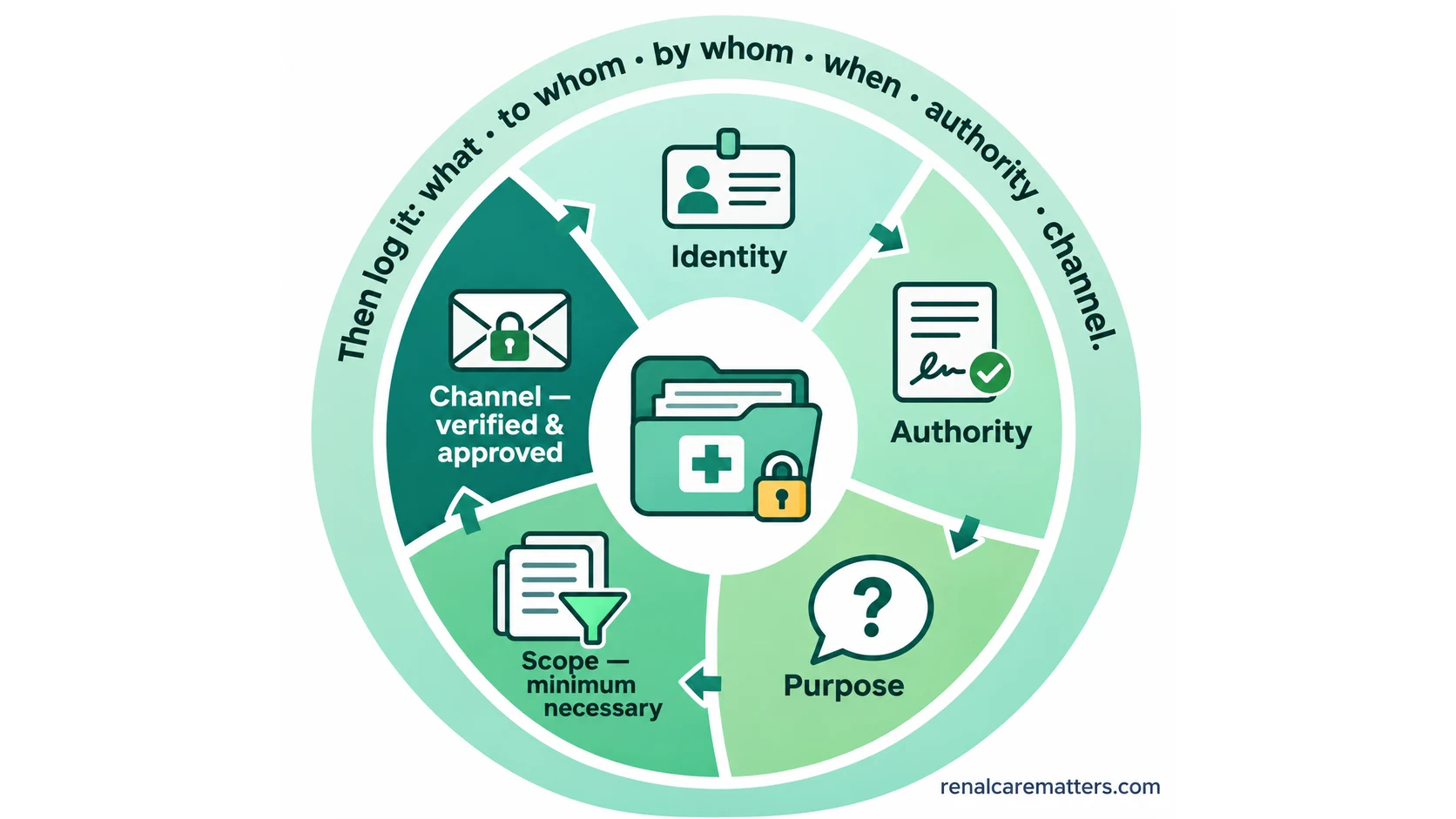
Five checks before any release
Figure 2. Five checks before any release, then log what was sent, to whom, by whom, when, and how.
Every release of a record, whether a single laboratory page or a full chart, passes through the same five checks, in the same order.
Figure 3 · Before you release anything
IdentityIs the requester who they claim to be? Verify with approved identifiers, in person or through an independently trusted channel.
AuthorityOn what basis may they receive it? The patient, a representative with written authority, a receiving facility for continuity of care, PhilHealth for a claim, a court order, or the Department of Health (DOH) for inspection.
PurposeWhy do they need it?
ScopeThe minimum necessary for that purpose.
ChannelA verified, approved route: pickup with ID, the facility’s secure email or portal, or a sealed courier. Never a personal email address or an unapproved messaging app.
The checks work together. A request can pass identity and fail authority: the caller really is the patient’s sister, but the patient never authorized her. A request can pass authority and fail scope: the employer is entitled to know the patient’s dialysis schedule, not their hepatitis status. A request can pass everything and fail the channel: the right document to the right person, sent to a personal email that three other family members can open.
Requester
Usual authority
Usual scope
The patient, in person with ID
Their own right of access
What they ask for
A relative or friend
Only with the patient’s written authorization or documented legal authority
What the authorization covers
A receiving dialysis unit
Continuity of care, on the physician’s authorization
What the receiving team needs to treat (Module 14)
PhilHealth
Claims processing and audit, under its rules
The claim packet and what an audit requests
An employer or school
Only with the patient’s authorization
Schedule and functional statements only (Module 9)
Then log every release: what was sent, to whom, by whom, when, under what authority, and through which channel. The release log is how you will answer the patient who later asks, “Who has seen my records?”
Requests that are not yours to decide
Some requests go straight to the data protection officer (DPO) or counsel. You log them and route them; you do not answer them.
Subpoenas and court orders
Requests from the police, the media, or a lawyer for another party
Relatives without documented authority, especially in a family dispute
Requests about a patient who has died
Anything unfamiliar, or anything that makes you uneasy
Urgency is not authority. A caller who is upset, in a hurry, or claims to be a doctor still passes the same five checks. Pressure to skip them is itself a reason to slow down.
On the floor · The right person, the wrong channel
Mrs. Nenita Robles asks for her latest laboratory results to be sent to her son, a nurse in Saudi Arabia, so he can review them. She signs an authorization at the counter and writes his personal email address.
The identity, authority, purpose, and scope checks all pass. The channel needs care: the unit does not send records to personal email addresses. The records officer gives Mrs. Robles a sealed copy at the counter, logs the release with her authorization, and explains that she can share it with her son herself, or that he can request it through the unit’s secure channel with her written consent.
Passing four checks is not passing five. The channel is part of the release.
Illustrative scenario. Names and details are invented.
Lesson · part 2
Access and correction are rights
Patients may ask for copies of their own records, and they may ask that errors be corrected. These are rights, not favors, and they should be handled promptly and without making the patient explain why they want to see their own chart.
These requests also catch real mistakes. In a survey of 22,889 patients who read their visit notes, 21.1% reported a perceived mistake, and 42.3% of those judged it serious.3 The survey measured what patients perceived; not every reported mistake was confirmed. But it shows that patients who read their records are an error-detection system the unit gets for free.
Figure 4 · A correction request
Log itDate, patient, what they say is wrong.
Verify identityThe same two identifiers as any release.
Route to the authorThrough the clinical correction workflow (Module 4).
Track itThe author agrees and corrects, or disagrees and documents why.
Tell the patientThe outcome, in writing.
Keep the requestWith the record, so a reader sees that the entry was disputed.
Never delete or overwrite a disputed entry yourself, even when the patient is plainly right about a simple fact such as a misspelled name. A spelling correction to an identifier goes through the identity workflow (Module 3). A clinical correction goes to its author.
On the floor · The allergy that was not hers
Reading a copy of her chart, Mrs. Liwayway Dimagiba notices “allergic to sulfa” on her problem list. She has never had a sulfa allergy; her sister has.
The records officer logs the request and routes it to the attending physician, who confirms the error, corrects the problem list through the clinical workflow, and notes the patient’s report. Mrs. Dimagiba receives a written answer, and her disputed-entry request stays with the record.
A patient reading her own chart caught what no audit had.
Illustrative scenario. Names and details are invented.
Lesson · part 3
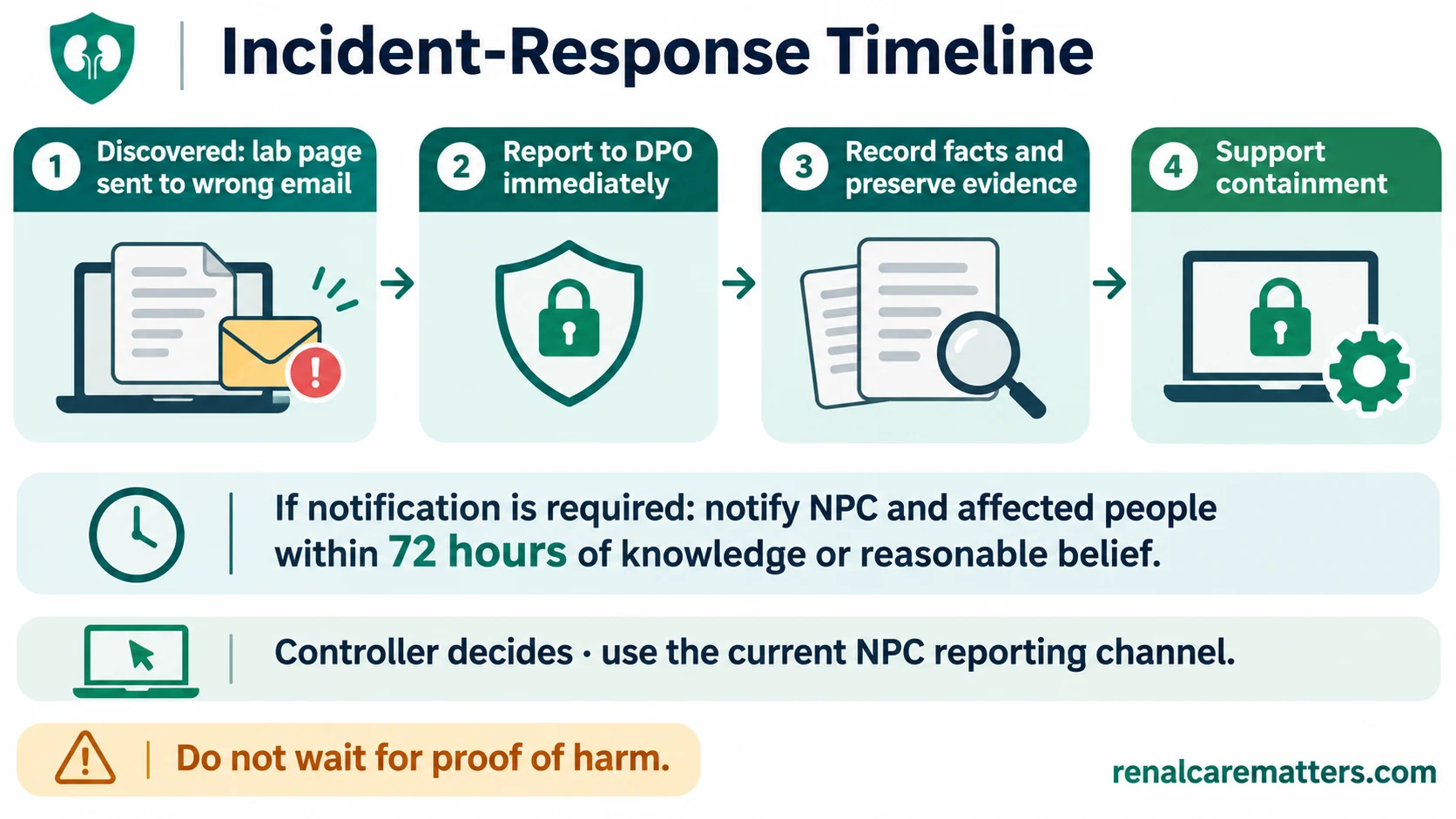
The first hour
Figure 5. The first hour after a misdirected record. Escalate at once; the controller decides on notification.
A misdirected email. A lost logbook. An unlocked records room overnight. A run sheet left at the pharmacy counter. Unexplained access in the audit trail. Any of these may be a breach. You do not need to decide whether it is. You need to report it.
Report internally at once, within the hour of discovery, to the DPO. Write down the facts: what happened, who was involved, when it happened, when and how it was discovered. Protect logs and devices, so the evidence of what happened is not lost. Support containment, such as asking the wrong recipient, through the DPO’s approved wording, to delete the message and confirm in writing.
Do not investigate alone. Do not contact affected patients yourself. Do not reassure anyone that “it is probably fine.” Those steps belong to the people who decide on notification.
Who decides, and how fast
The personal information controller (PIC), through its breach response team and advised by the DPO, decides whether notification is required. Under NPC Circular 16-03, notification to the Commission and to affected data subjects is due within 72 hours of knowledge of, or reasonable belief in, a breach that requires notification. It is based on the information available, even if the full extent is not yet known.4,5 Notifications are filed through the NPC’s Data Breach Notification Management System (DBNMS), and filing a request there does not pause the clock.6
Seventy-two hours sounds like a long time. It is not, once you subtract a weekend, the time to find out what was in the email, the time to reach the facility head, and the time to draft a notice. Every hour lost at the front line is taken from the people who must decide.
Stop and callDo not wait for proof of harm. The 72-hour clock runs from the organization’s knowledge, so an hour lost at the front line is an hour taken from the controller. When unsure whether something is a breach, report it and let the DPO decide.
The toolkit’s 72-hour clock calculator shows the deadline from the moment of awareness.
On the floor · The logbook on the jeepney
A nurse realizes at 7:30 p.m. that she left the unit’s patient contact logbook on a jeepney on her way home. She messages the records officer at 7:40 p.m.
The records officer calls the data protection officer at 7:50 p.m., writes down what the logbook contained, and notes the time of discovery. By the next morning the controller’s breach team has met. The 72 hours run from when the organization knew, so every hour the report had waited until morning would have come off the time the team has to decide.
The fastest part of a breach response is the first message. Make it.
Illustrative scenario. Names and details are invented.
Lesson · part 4
Making it safe to report
Ms. Bautista walked to your desk ten minutes after she made her mistake. That is the best possible outcome of a bad moment, and it happened because she was not afraid to tell you.
Units where staff are punished for reporting their own errors do not have fewer errors. They have fewer reports, and the breaches surface weeks later, when the 72 hours are long gone. Thank the person who reports. Let the DPO and the unit manager handle any follow-up about how it happened. Your role is to make sure the clock starts on time.
Usual reaction
Better reaction
“How could you?”
“Thank you for telling me right away. Let’s write down what happened.”
“Let’s keep this between us.”
“I need to report this to the DPO now. You did the right thing.”
“Email them and ask them to delete it.”
“The DPO will tell us exactly what to send.”
On the floor
Real situations: problems and solutions
These are fictional but typical. For each one, cover the answer, decide what you would do, then compare. Where a step depends on local rules, your unit’s procedure and your supervisor’s direction come first.
The employer on the phone
What you see
A caller from a patient’s company asks whether the patient “really” needs dialysis three times a week.
What is likely going on
An employer verifying absences.
What to do
Confirm nothing by phone. Explain that the patient can request a letter from the unit, and tell the patient about the call.
Why it matters
Even confirming that someone is a patient is a disclosure.
The photo in the group chat
What you see
A nurse posts a photo of the station board, showing patient names, in the staff group chat to ask about a schedule.
What is likely going on
A quick workaround that discloses names to everyone in the chat.
What to do
Ask her to delete it, report it to the DPO, and suggest an approved way to share schedules.
Why it matters
Messaging apps copy data onto many personal phones.
The police officer at the counter
What you see
A police officer asks for a patient’s chart for an investigation.
What is likely going on
A request that may be lawful but needs proper authority.
What to do
Be courteous, ask for the written request or order, and route it to the DPO or counsel without releasing anything.
Why it matters
Requests from authorities still pass the authority check.
The patient who wants everything
What you see
A patient asks for a copy of her entire chart.
What is likely going on
Her right of access.
What to do
Verify her identity, log the request, prepare the copy per the facility’s procedure and fee policy, and release it to her.
Why it matters
Patients do not need to explain why they want their own records.
The logbook left at the pharmacy
What you see
The release logbook is found at the hospital pharmacy counter after lunch.
What is likely going on
Possible exposure of everyone listed in it.
What to do
Retrieve it, note the time it was missing and where it was, and report to the DPO within the hour.
Why it matters
You report possible breaches; the DPO decides whether they are breaches.
Field notes
Urgency is not authority.
Never release to a personal email address or a messaging app.
Log every release, including refusals.
Thank the colleague who reports a mistake.
Start the 72-hour clock from awareness, not from proof.
Case review
Back to the case: The sister and the wrong email
The caller. Explain politely that the unit must verify identity and authority before releasing any records, and that records are released only through approved channels, never to a personal email address. Ask her to bring Mr. Garcia’s signed written authorization and her own ID, or to come with him on Thursday. Offer to let Mr. Garcia know she called. Log the request, including that nothing was released. She may be exactly who she says she is. The checks protect him either way.
The email. Escalate to the DPO immediately, by 2:15 p.m. Record the facts with Ms. Bautista: sent at 2:00 p.m., reported at 2:10 p.m., what the page contained, the exact recipient address. Preserve the sent item; do not delete it. Follow the DPO’s instructions on asking the recipient to delete and confirm. Thank Ms. Bautista.
Who decides, and by when? The personal information controller, through its breach response team, advised by the DPO. If notification is required, the 72-hour window from the organization’s knowledge, which began when the report reached your desk, ends at about 2:10 p.m. on Friday. Hepatitis results with a name and patient number are sensitive personal information, so this needs a decision quickly.
Two requests reached your desk in twenty minutes: one to release something you should not, one about something released by mistake. Part of your role is to slow down the first and speed up the second.
Skills lab · with your preceptor
Skills checklist: Release decision and breach escalation
Role-play a release request and a misdirected disclosure with your preceptor and a role player. Your preceptor rates each step as satisfactory, needs practice, or not observed. Steps marked Critical must all be satisfactory before sign-off. This checklist supports supervised learning; your unit’s own procedure and competency form are the authority. A printable version of every checklist is on the trainer page.
CriticalVerifies identity and authority before any disclosure.
CriticalDeclines an urgent request politely without releasing anything, and offers a lawful route.
Releases only the minimum necessary through an approved channel and logs it.
Routes subpoenas, police, media, and unfamiliar requests to the DPO or counsel.
Routes a patient’s correction request to the author and tells the patient the outcome.
CriticalEscalates a possible breach to the DPO within the hour and preserves evidence.
Computes the 72-hour notification deadline from the moment of awareness.
Does not contact affected patients or investigate alone.
Placement activity. Find your unit’s release log and DPO contact. Check that both are current, and that the release log has an entry for every release in the last month.
Self-assessment
Check your understanding
Each visit draws 8 questions at random from this module’s 15-question bank. Choose the single best answer for each, then select Check answers; an explanation appears under the best answer. Select New set of questions for a different mix. A good target is 7 of 8 on two different sets. Nothing you select is sent anywhere; scoring happens in your browser.
Republic Act No. 10173: Data Privacy Act of 2012. (2012). Congress of the Philippines.
Philippine Health Insurance Corporation. (2023, October 2). Urgent notice to the public. https://www.philhealth.gov.ph/ofclstmnts/2023/UN2023-10-03.pdf
Bell, S. K., Delbanco, T., Elmore, J. G., Fitzgerald, P. S., Fossa, A., Harcourt, K., Leveille, S. G., Payne, T. H., Stametz, R. A., Walker, J., & DesRoches, C. M. (2020). Frequency and types of patient-reported errors in electronic health record ambulatory care notes. JAMA Network Open, 3(6), e205867. https://doi.org/10.1001/jamanetworkopen.2020.5867
National Privacy Commission. (2016). NPC Circular No. 16-03: Personal data breach management. https://privacy.gov.ph/?p=553
National Privacy Commission. (2016). Implementing rules and regulations of Republic Act No. 10173, known as the Data Privacy Act of 2012. https://privacy.gov.ph/implementing-rules-regulations-data-privacy-act-2012/
National Privacy Commission. (2026). NPC Advisory No. 2026-02 [Guidelines on submitting breach notifications through the Data Breach Notification Management System], as summarized by Baker McKenzie. https://www.bakermckenzie.com/en/insight/publications/2026/06/philippines-data-breach-notification-procedure-further-clarified
Educational material for records staff. Completing it is an Academy learning record only. It does not confer DOH-recognized training credit, a facility designation, or system access, and it does not replace current regulations, your facility’s records manual, or advice from your data protection officer or counsel.