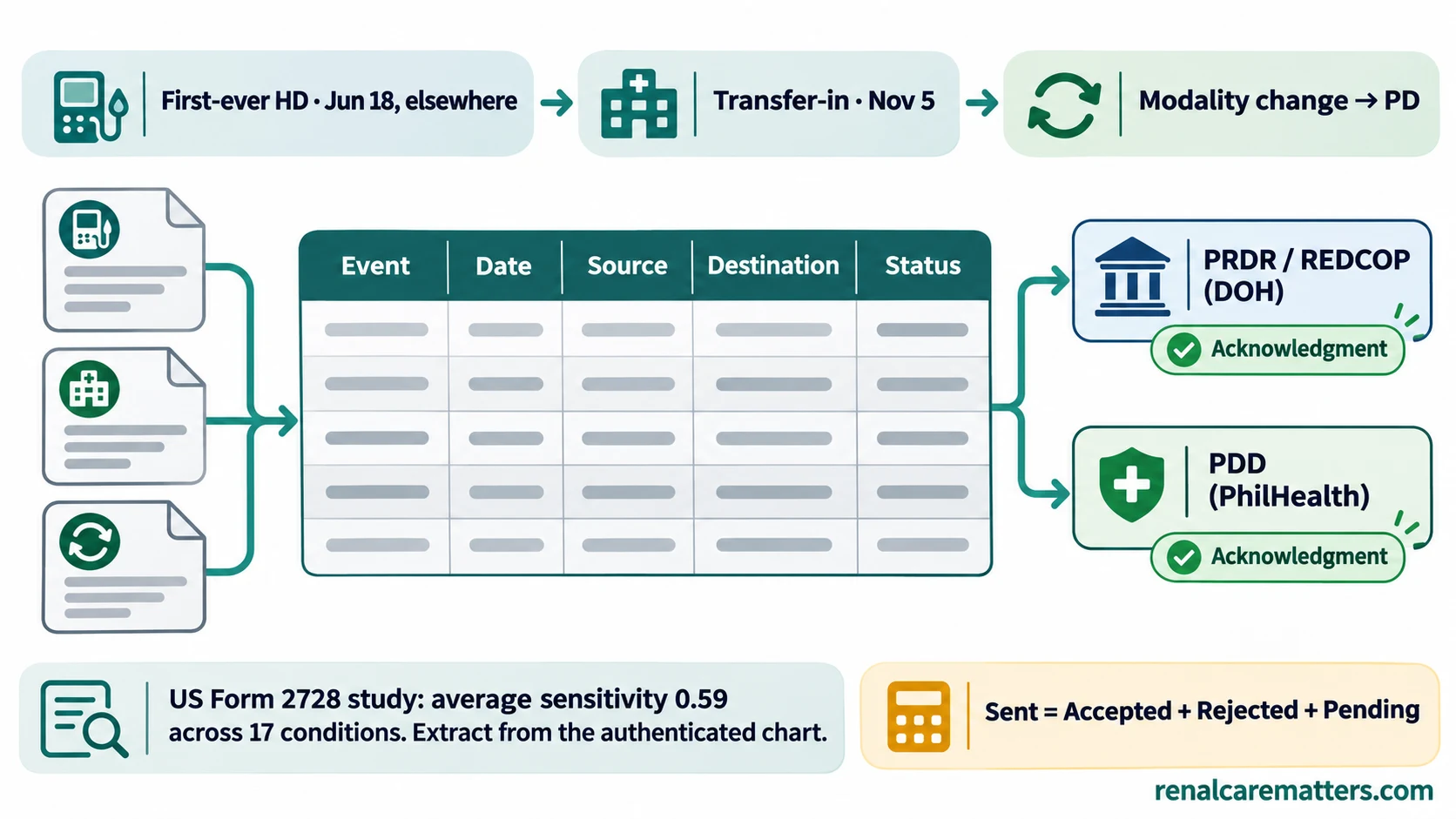
Two different registries, event definitions, the event ledger, balancing a batch, and why registries inherit the chart's gaps.
PublishedNailathalaGipatikPepalwal:ReferencesMga SanggunianMga TinubdanReng Reperensya:3Audience: Designated medical records officers, custodians, and deputies in standalone and hospital-based hemodialysis units · hospital health information management staff assigned to dialysis · unit managers who supervise recordsRead timeOras ng pagbasaOras sa pagbasaOras ning pamamasa:
Training track for the records officers of hemodialysis units
This module is study material for the records officers of hemodialysis units. It explains the reasoning behind common records decisions; it is not a records manual and not legal advice. Regulations change: confirm every rule against the current text and your facility’s approved policy before you rely on it. Clinical content belongs to its clinical author; questions about a patient’s care go to the attending nephrologist. Every case, name, and identifier is fictional.
Learning objectives
After this module you should be able to
Distinguish reporting to the Philippine Renal Disease Registry from registration in the Philippine Health Insurance Corporation (PhilHealth) Dialysis Database.
Explain, using published evidence, why registry forms filled from memory miss conditions.
Record first-ever dialysis, transfer-in, and modality change as distinct events with their sources.
Keep an event ledger, remove duplicates before sending, and balance every batch.
Close a rejection only with corrected, source-backed data and both receipts.
Pre-testBefore you read, answer the 8 self-assessment questions and note your score. After the module, select New set of questions and compare. The difference is what you learned; the questions you still miss are what to reread.
Start here
The big picture, in plain words
In plain wordsA registry is how a country counts its dialysis patients: how many start each year, how they fare, and where services are missing. Imagine a census taker who writes down only the people who happen to be home when he knocks. The numbers look complete. They are not.
The picture is useful, and it has one limit. A census taker can come back. A registry row, once accepted, is usually counted, published, and used to plan services, and few people ever check it against the chart again. An error at your desk becomes a national statistic.
A registry form filled from memory, or from the scheduler, quietly drops what the chart would have shown. The records officer’s remedy is to extract from the authenticated chart, field by field, and to chase every row until the receiver confirms it.
Figure 1 · Key terms for this module
Philippine Renal Disease Registry (PRDR)The national registry of people with kidney failure on dialysis or with a transplant.
Renal Disease Control Program (REDCOP)The Department of Health program the registry supports.
PhilHealth Dialysis Database (PDD)The payer’s eligibility database for the hemodialysis package.
EventSomething that changes a patient’s registry status: first-ever dialysis, transfer-in, transfer-out, modality change, transplant, recovery, death.
Transfer-inArrival of a patient already on dialysis elsewhere.
AcknowledgmentThe receiver’s confirmation of what it accepted or rejected.
End-stage renal disease (ESRD)The older term for kidney failure treated with dialysis or transplant, still used in some registries.
Opening case · fictional
Case: Three events, four rows
It is the end of the month and you are sending your registry batch. Your event queue holds three patients.
Mr. Arnel Domingo started his first-ever maintenance hemodialysis (HD) with you on November 2.
Mrs. Virginia Salazar transferred in on November 5. Her referral packet shows she started dialysis at a hospital in Pampanga on June 18.
Mr. Jose Manalo changed from hemodialysis to peritoneal dialysis (PD) on November 11. A second row for Mr. Manalo repeats the same event; a staff member entered it again when the first entry seemed not to save.
Two days after you send four rows, the receiver’s acknowledgment arrives: two accepted, one rejected. Mrs. Salazar’s November 5 date had been entered in the “original start of dialysis” field.
Before reading on, decide:
How many rows should have been sent?
How do you correct Mrs. Salazar’s row?
Four rows were sent and three acknowledged. What happened to the fourth, and when is this cycle closed?
Keep your answers in mind. The lesson gives you what you need, and the case review near the end shows one sound response.
Lesson · part 1
Two destinations, two rulebooks
Dialysis units in the Philippines report to two different databases that are easy to confuse.
PRDR
PDD
Owner
Department of Health (DOH) program, coordinated with the Philippine Society of Nephrology (PSN)
Philippine Health Insurance Corporation (PhilHealth)
Purpose
Public health: counting patients, outcomes, and service gaps
The DOH assessment tool calls for registration in the Philippine Renal Disease Registry (PRDR) in support of the Renal Disease Control Program (REDCOP), coordinated with PSN.1 The PhilHealth Dialysis Database (PDD) is PhilHealth’s eligibility database for the hemodialysis package.2 They differ in purpose, owner, fields, and timing. Reporting to one does not satisfy the other.
For each destination, write down the population it covers, its event definitions, its required fields, who may submit, the channel, the signatory, the cadence, and how acknowledgment arrives. Confirm them with the receiving authority, because registry definitions change and a field that meant one thing last year may mean another now.
Figure 2. Event ledger to acknowledgment. A sent file is not a closed cycle.
On the floor · Reported once, counted nowhere
A unit proudly reports that every patient is “registered.” On inspection, every patient is in the PhilHealth Dialysis Database, and none of the year’s new starts appear in the Philippine Renal Disease Registry.
The clerk had assumed one submission covered both. The records officer builds two extracts, each to its own specification, and adds both destinations to the event ledger.
Two databases, two purposes, two rulebooks. One list does not serve both.
Illustrative scenario. Names and details are invented.
Lesson · part 2
Registries inherit the chart’s gaps
How accurate are registry forms? The best-known validation study comes from the United States. Investigators compared the national end-stage renal disease (ESRD) Medical Evidence Report, the form filed when a patient starts dialysis, against the clinical records of 1,005 new dialysis patients.
Averaged across 17 conditions, the form captured only 59% of the conditions actually present (sensitivity 0.59, 95% confidence interval 0.43 to 0.75). Specificity was above 0.95 for 16 of the 17.3 In plain terms: conditions were left out far more often than they were made up. When the form said a patient had heart failure, they almost always did. When it said nothing, it was often wrong.
That pattern is what you would expect when forms are completed from memory, from the referral letter alone, or by someone who never opened the full chart. It is not a United States problem. It is what happens anywhere a form is easier to fill than a chart is to read.
The most common Philippine error
The error most often seen in Philippine units is confusing first-ever dialysis with first treatment at this center. A patient who transfers in after starting elsewhere is a transfer-in event, with the original start date carried over from the referring facility’s documents. Recording the transfer date as the start date makes the patient look newer than they are, which corrupts survival statistics and, as Module 9 explains, every certificate that states their dialysis vintage.
Event
Date to record
Source
First-ever dialysis at your unit
The first session date
Your run sheet
Transfer-in
The arrival date, plus the original start date in its own field
Your run sheet; the referring facility’s documents
Modality change
The first treatment on the new modality
The order and the first treatment record
Transfer-out, transplant, recovery, death
The event date
The documented event
On the floor · The diabetes that was missing
A registry form for Mr. Teodoro Navarro, completed from his referral letter, lists hypertension as his only condition. His chart shows type 2 diabetes for twelve years, heart failure, and a below-knee amputation.
The records officer redoes the form from the authenticated chart and problem list. The corrected entry now describes a patient at much higher risk than the first form suggested.
The form was not false. It was incomplete in exactly the way the research predicts: conditions left out, not made up.
Illustrative scenario. Names and details are invented.
Lesson · part 3
Build, balance, and close
From the master patient index and the authenticated charts, keep one row per event with these columns: patient identifier, event, event date, source document, destination, deduplication key, field validation, batch, status, rejection reason, correction, and acknowledgment.
Before sending, validate identifiers, modality, and dates, and look for duplicates. The deduplication key is usually patient, event type, and event date together. Two rows with the same key are one event entered twice.
Sent = accepted + rejected + pending. Any row without a disposition is a variance to investigate.
A row can go missing in silence. The receiver may drop it as a duplicate without saying so, or fail to process it. The balance equation is how you notice. If you sent four rows and the acknowledgment accounts for three, one row has no disposition, and you need to know which one and why.
A rejected row closes only when corrected, source-backed data are resubmitted and accepted, with both receipts kept. Export only the fields the destination requires, through the approved channel. A registry does not need a patient’s full chart, and sending more than it needs is a privacy problem (Module 8).
RememberA sent file is not a closed cycle. Keep the acknowledgment, and chase every row that lacks one.
The toolkit’s batch reconciliation calculator does the balance for you.
On the floor · Twelve sent, ten heard from
A batch of 12 registry rows returns an acknowledgment for 10. The balance check shows two rows with no disposition.
The records officer calls the receiving office. One row was held because a date field was blank; the other had been silently dropped as a duplicate of a row sent the month before. She corrects the first, documents the second as withdrawn, and the batch balances.
Without the balance check, the blank date would have stayed blank for a year.
Illustrative scenario. Names and details are invented.
On the floor
Real situations: problems and solutions
These are fictional but typical. For each one, cover the answer, decide what you would do, then compare. Where a step depends on local rules, your unit’s procedure and your supervisor’s direction come first.
The death not reported
What you see
You learn from a relative that a patient who transferred out died in September. Your registry still shows him as active at your unit.
What is likely going on
An event that happened after he left your care.
What to do
Record the transfer-out you already know about. Report the death only if the registry’s rules say your unit should, and otherwise tell the receiving unit.
Why it matters
Each event belongs to the unit the registry assigns it to.
Comorbidities from memory
What you see
A colleague fills a registry form’s comorbidity section from memory to save time.
What is likely going on
The exact pattern the evidence warns about: conditions left out.
What to do
Fill the section from the authenticated chart, problem list, and referral documents.
Why it matters
Forms filled from memory miss conditions far more often than they invent them.
The modality that changed back
What you see
A patient went from hemodialysis to peritoneal dialysis in March and back to hemodialysis in October.
What is likely going on
Two modality-change events.
What to do
Record both, each with its own date and source document.
Why it matters
A registry needs the full history, not just the current state.
Silent acceptance
What you see
Your batch of 12 rows comes back with 10 accepted and nothing about the other 2.
What is likely going on
Rows dropped without a message.
What to do
Ask the receiving office about the two missing dispositions and record their answer.
Why it matters
Sent must equal accepted plus rejected plus pending.
“Use the PhilHealth list”
What you see
A colleague suggests sending the registry the same list you send PhilHealth.
What is likely going on
Two databases confused.
What to do
Explain that PRDR and PDD have different definitions and fields, and build each extract to its own specification.
Why it matters
One list cannot satisfy two rulebooks.
Field notes
Record first-ever dialysis and first-at-this-unit dates in separate fields, always.
Extract from the chart, never from memory.
Use patient, event, and date as the duplicate check.
Keep every acknowledgment, rejections included.
Send only the fields the registry requires.
Case review
Back to the case: Three events, four rows
How many rows? Three, one per event. The second row for Mr. Manalo was a duplicate with the same patient, event, and date, and should have been removed before sending.
Mrs. Salazar. Record her original start as June 18, from the Pampanga hospital’s referral documents, in the original-start field, and the transfer-in as November 5. Resubmit, and keep both the rejection and the new acknowledgment.
The fourth row. The duplicate was probably dropped silently by the receiver. Confirm that with the receiving office rather than assuming it, record the answer, and mark the row as a withdrawn duplicate so that sent equals accepted plus rejected plus pending.
Closed when all three unique events are accepted, the first rejection and the corrected acceptance are both filed, the duplicate is explained, and nothing remains without a disposition.
Mrs. Salazar’s wrong date would have made her five months newer to dialysis than she is, in a national registry, for years. Part of your role is to send the country the same truth your charts hold.
Skills lab · with your preceptor
Skills checklist: Registry event ledger and batch reconciliation
Build and close a fictional registry batch while your preceptor observes. Your preceptor rates each step as satisfactory, needs practice, or not observed. Steps marked Critical must all be satisfactory before sign-off. This checklist supports supervised learning; your unit’s own procedure and competency form are the authority. A printable version of every checklist is on the trainer page.
Distinguishes PRDR reporting from PDD registration.
Extracts registry fields from the authenticated chart, not from memory or the schedule.
CriticalRecords a transfer-in with the original start date and its source.
Removes duplicate event rows before submission using a deduplication key.
Balances sent against accepted, rejected, and pending, and investigates any variance.
CriticalCloses a rejection only with corrected, source-backed data and both receipts.
Placement activity. Find last cycle’s registry acknowledgments and check that every sent row has a disposition.
Self-assessment
Check your understanding
Each visit draws 8 questions at random from this module’s 15-question bank. Choose the single best answer for each, then select Check answers; an explanation appears under the best answer. Select New set of questions for a different mix. A good target is 7 of 8 on two different sets. Nothing you select is sent anywhere; scoring happens in your browser.
Department of Health, Cordillera Administrative Region. (2015). Assessment tool for licensing a dialysis clinic (Revision 03). Retrieved November 23, 2026, from https://caro.doh.gov.ph/wp-content/uploads/2022/08/LICENSING-A-DIALYSIS-CLINIC-8-31-2022.pdf
Longenecker, J. C., Coresh, J., Klag, M. J., Levey, A. S., Martin, A. A., Fink, N. E., & Powe, N. R. (2000). Validation of comorbid conditions on the end-stage renal disease medical evidence report: The CHOICE study. Journal of the American Society of Nephrology, 11(3), 520–529. https://doi.org/10.1681/ASN.V113520
Educational material for records staff. Completing it is an Academy learning record only. It does not confer DOH-recognized training credit, a facility designation, or system access, and it does not replace current regulations, your facility’s records manual, or advice from your data protection officer or counsel.