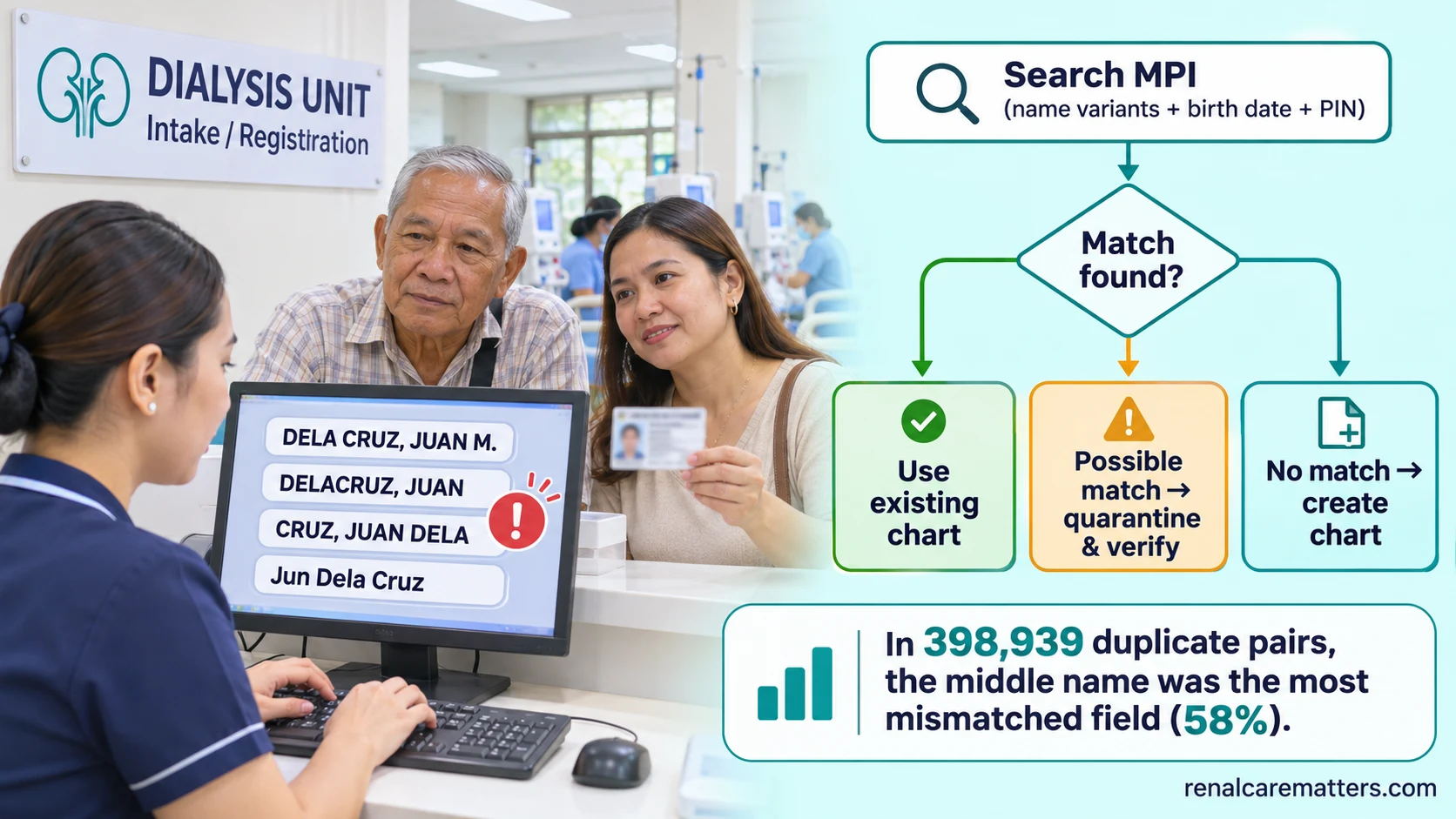
Two person-level identifiers, search before create, how duplicates are really made, and resolving a suspected misfile safely.
PublishedNailathalaGipatikPepalwal:ReferencesMga SanggunianMga TinubdanReng Reperensya:4Audience: Designated medical records officers, custodians, and deputies in standalone and hospital-based hemodialysis units · hospital health information management staff assigned to dialysis · unit managers who supervise recordsRead timeOras ng pagbasaOras sa pagbasaOras ning pamamasa:
Training track for the records officers of hemodialysis units
This module is study material for the records officers of hemodialysis units. It explains the reasoning behind common records decisions; it is not a records manual and not legal advice. Regulations change: confirm every rule against the current text and your facility’s approved policy before you rely on it. Clinical content belongs to its clinical author; questions about a patient’s care go to the attending nephrologist. Every case, name, and identifier is fictional.
Learning objectives
After this module you should be able to
Identify a patient with two person-level identifiers and explain why a chair or shift number never counts.
Search the master patient index with name variants before creating a chart.
Describe how duplicate records and wrong-patient errors usually happen, using published evidence.
Quarantine a contested document and resolve it through an independently verified channel.
List every downstream record that must be checked after an identity correction.
Pre-testBefore you read, answer the 8 self-assessment questions and note your score. After the module, select New set of questions and compare. The difference is what you learned; the questions you still miss are what to reread.
Start here
The big picture, in plain words
In plain wordsA misfiled document is like a letter put in the wrong mailbox. The letter itself is correct. The address on the envelope is wrong. Whoever opens it next will read it, believe it, and act on it, because nothing inside the letter says it was meant for someone else.
The picture is useful, and it has one limit. A wrong letter is usually noticed and returned. A wrong page in a dialysis chart often is not. It looks exactly like a right page. Every later step, from the claim to the registry row to the transfer packet, inherits whatever identity the page was filed under. Attach the wrong person at intake and every later step is wrong in a way that looks right.
Dialysis units carry particular risk. The same patients return three times a week for years, so staff feel they know everyone and stop checking. Relatives with the same surname often dialyze on the same shift. Filipino naming habits add variety: a maternal surname used as a middle name, a married surname, a nickname such as “Jun” or “Baby” that everyone uses but no document shows. And reprocessed dialyzers must return to exactly one person.
Figure 1 · Key terms for this module
Master patient index (MPI)The unit’s list that links each person to exactly one chart number.
Person-level identifierA fact about who the patient is, such as full name and date of birth, never where they sit.
DuplicateTwo records for one person.
MisfileA correct document placed in the wrong patient’s chart.
OverlayOne person’s information written into another person’s record, so two people share one chart.
MergeCombining two records that belong to one person, through a controlled, authorized workflow.
Philippine Health Insurance Corporation (PhilHealth) Identification Number (PIN)The member number issued by the Philippine Health Insurance Corporation.
Opening case · fictional
Case: Two Marias
At 9:40 a.m. a fax arrives from a hospital in Quezon City. It is a referral for “Maria Reyes,” born 1972, with no full birth date, asking you to schedule her for dialysis and attaching a hepatitis B surface antigen result marked reactive.
Your master patient index has two candidates. Maria Lourdes Reyes, born February 4, 1972, dialyzes on Monday, Wednesday, and Friday afternoons. Maria Luisa Reyes, born May 8, 1972, dialyzes on Tuesday, Thursday, and Saturday mornings. Both are hepatitis B negative on file.
The phone number printed on the fax does not match the hospital’s number in your verified directory. It is Wednesday. Maria Lourdes Reyes is due at 1 p.m.
Before reading on, decide:
Where does the referral go right now?
How will you verify which Maria it belongs to, and through which channel?
Who else needs to know before 1 p.m., and why?
Keep your answers in mind. The lesson gives you what you need, and the case review near the end shows one sound response.
Lesson · part 1
Two identifiers, both about the person
Use two approved person-level identifiers every time a document is filed, a chart is pulled, or a copy is released. Typically these are the full name and the date of birth, with the institutional patient number or the PhilHealth Identification Number (PIN) where your policy allows.
A station number, chair, shift, bed, or room describes where the patient is today. It does not describe who they are. Patients change chairs. Staff say “the patient in chair 7” and mean two different people on two different shifts. A location never counts as an identifier.
Acceptable identifiers
Never identifiers
Full name, as written on a government ID
Station, chair, bed, or room number
Date of birth
Shift or day pattern (“the MWF morning lady”)
Institutional patient number
Nickname alone
PIN, where policy allows
“The one with the fistula on the left”
Search before you create
Before assigning a new chart number, search the master patient index (MPI) with name variants. A patient who has dialyzed with you before, or whose records arrived from an earlier referral, may already exist under a slightly different name.
Maiden and married surnames (Maria Santos-Reyes, Maria Santos, Maria Reyes)
Middle name present, absent, or reduced to an initial
Swapped first and last names
Spelling variants (Ma. and Maria; Jr. present or absent; Dela Cruz, de la Cruz, Delacruz)
Nicknames (Jun, Boy, Baby, Inday) written as the first name
Date of birth with day and month swapped (04/02 and 02/04)
Record every alias and previous identifier you find, with its source. An alias written in the chart today saves the next records officer from creating a duplicate next year.
Figure 2. Where duplicates are born. Most come from ordinary typing at the front desk, so search before you create.
On the floor · Chair 7
A nurse calls the records room: “Please send up the lab results for chair 7.” On the morning shift, chair 7 is Mr. Isidro Gomez. On the afternoon shift, it is Mrs. Remedios Gomez, no relation.
The records officer asks for the patient’s full name and date of birth before sending anything. It is the afternoon patient. The morning patient’s potassium, which was high, stays in the right chart.
A chair is where a patient sits today. Two identifiers are who the patient is.
Illustrative scenario. Names and details are invented.
Lesson · part 2
How duplicates and wrong-patient errors really happen
It is tempting to assume that duplicate records come from complicated system failures. The evidence says they mostly come from ordinary typing.
In a multisite study of 398,939 confirmed duplicate record pairs, the most frequently mismatched field was the middle name, in 58.3% of pairs. Most name mismatches were plain misspellings or swapped name order.1 Duplicates are mostly made at the front desk, by people in a hurry. The controls that prevent them are equally ordinary:
a written naming convention (full middle name, never an initial when the full name is known; hyphenated surnames written one agreed way);
a required search routine before any new chart number is issued;
a monthly duplicate report, reviewed by a second person.
Some intuitive controls fail when tested
One idea for preventing wrong-patient orders in an electronic record is to let staff open only one patient’s record at a time. It sounds sensible. A randomized trial of 3,356 clinicians and 12.1 million orders tested it. Limiting users to one open record did not reduce wrong-patient orders compared with allowing four: 90.7 compared with 88.0 per 100,000 order sessions (odds ratio 1.03, 95% confidence interval 0.90 to 1.20).2 This was a large, well-designed trial, and it found no benefit. Good intentions are not evidence.
Other controls look more promising. In a large emergency-department cohort, showing the patient’s photograph in the record banner was associated with fewer wrong-patient orders (adjusted odds ratio 0.57).3 The study was observational, so it suggests benefit but does not prove it; units that adopted photographs may also have differed in other ways. A photograph is also personal information. Under the Data Privacy Act, it needs a documented lawful basis and a consent process before you start taking pictures at intake.
Closer to home, nursing teams in hemodialysis clinics name patient-identification errors as their main gap against the international patient-safety goals.4 In other words, the people who work chairside already know this is where things go wrong.
RememberVerify identity at the point of action. Search before you create. Neither step takes more than a minute, and either can prevent a wrong-patient error that takes weeks to unwind.
On the floor · Ma. and Maria
The monthly duplicate report pairs “Ma. Theresa Bautista” and “Maria Theresa Bautista,” with the same date of birth. One chart was made at intake in 2023, the other at a readmission in 2025.
The second reviewer confirms they are one person using the PhilHealth Identification Number on both, and the charts are merged through the controlled workflow. The unit adds a line to its naming convention: “Write Maria in full; never Ma.”
Most duplicates come from ordinary spelling, as the research predicts. The fix is equally ordinary.
Illustrative scenario. Names and details are invented.
Lesson · part 3
Duplicate, misfile, overlay
Identity errors come in three kinds, and they are not equally dangerous.
Error
What happened
Main risk
How hard to undo
Duplicate
One person has two charts
Half the history is invisible; tests are repeated; allergies are missed
Moderate: merge through the controlled workflow
Misfile
One page is in the wrong person’s chart
Someone acts on another person’s result
Moderate: move the page, then check where it traveled
Overlay
Two people now share one chart
Both patients’ care is built on mixed facts
Hard: every entry since the overlay must be sorted, author by author
An overlay usually starts with a confident merge. Someone sees two charts for “Rodel Santos” with the same birth year, decides they must be the same man, and combines them. If they are two men, both now share one chart. That is why the rule below is so strict.
On the floor · The overlay that took a month
A clerk at another unit merged two charts for “Rodel Santos, born 1968,” believing they were one man. They were two: one in Bulacan, one in Pampanga. For three weeks, both men’s results, orders, and allergies sat in one record.
Unwinding it took the records officer, two physicians, and both men’s nurses most of a month, entry by entry. One man’s penicillin allergy had briefly appeared in the other’s chart.
A duplicate hides half a history. An overlay mixes two. That is why a merge always waits for verification.
Illustrative scenario. Names and details are invented.
Lesson · part 4
Suspected duplicate or misfile
Figure 3 · Safe resolution
StopHalt further routing of the contested document.
QuarantinePlace it in a protected exception queue, filed to neither chart.
NotifyTell health information management (HIM) and the clinical owner.
Verify independentlyUse a trusted directory number, not the number printed on the suspicious document.
Resolve through the controlled workflowMerge or reassign only with authorization, preserving both original identifiers.
Check downstreamClaims, registry rows, the dialyzer log, and any released copies.
Two steps deserve more detail.
Verify independently. If a document might be wrong, the contact details printed on it might be wrong too. A fax with a mistyped name may also carry a mistyped return number. In rare cases a request is deliberately false. Look up the sender in your own verified directory, or call the facility’s main switchboard, and ask for the records office. Ask them to read you the identifiers. Do not read your candidates’ details to them.
Check downstream. A document filed to the wrong chart may already have traveled. List every place it could have gone: a claim batch, a registry extract, a released copy, a transfer packet, the station assignment board. Each one needs the same correction.
Stop and callNever merge on a likely match. “Probably the same person” is the exact belief that produces an overlay, which is far harder to undo than a duplicate. If either candidate is scheduled today, alert the charge nurse now, so identity is checked at the bedside while you resolve the record. When the contested document carries a clinically important result, such as a reactive hepatitis test, the attending nephrologist needs to know too.
On the floor · The number on the letterhead
A referral arrives on a hospital letterhead with a phone number for “verification.” The records officer calls the hospital’s switchboard instead, from her own directory, and asks for the records office.
The records office has never heard of the patient. The letterhead number reaches a mobile phone. The referral is quarantined, reported to the data protection officer, and not filed to any chart.
The contact details on a doubtful document are part of the doubt.
Illustrative scenario. Names and details are invented.
On the floor
Real situations: problems and solutions
These are fictional but typical. For each one, cover the answer, decide what you would do, then compare. Where a step depends on local rules, your unit’s procedure and your supervisor’s direction come first.
Jun and Rogelio
What you see
A patient everyone calls “Jun” arrives with a referral for “Rogelio Santos Jr.” Your index has a “Jun Santos” from 2022.
What is likely going on
Probably the same man, recorded once under his nickname.
What to do
Verify with his ID and date of birth. If confirmed, link the records through the controlled merge workflow and record “Jun” as an alias.
Why it matters
Nicknames are a common source of duplicates in Filipino units.
The married name
What you see
A woman you registered as “Ana Cruz” brings a new PhilHealth form under “Ana Cruz-Villanueva.”
What is likely going on
A legitimate name change after marriage.
What to do
Update the name through the identity workflow, keep the previous name as an alias with its source, and check that PhilHealth records match.
Why it matters
A mismatch between your record and PhilHealth’s can delay claims.
The result on the fax
What you see
A laboratory faxes a potassium result with a patient number that belongs to one patient and a name that belongs to another.
What is likely going on
A typing error at the laboratory.
What to do
Quarantine the result, call the laboratory through its known number, and tell the charge nurse if either patient dialyzes today.
Why it matters
A potassium result filed to the wrong person can change someone’s treatment.
Same name, same shift
What you see
Two unrelated patients named Elena Cruz are booked on the same Tuesday shift.
What is likely going on
A coincidence that invites a wrong-patient error.
What to do
Ask the charge nurse to flag both charts with a name alert and to assign them to stations away from each other if possible. Always use two identifiers.
Why it matters
Name alerts work best when the risk is predictable.
“Just merge them, it’s obviously him”
What you see
A colleague finds two charts for “Rodel Santos,” same birth year, and asks you to merge them.
What is likely going on
Possibly one man, possibly two.
What to do
Compare full birth dates, addresses, and PhilHealth numbers. Merge only through the controlled workflow, with authorization, after verification.
Why it matters
A wrong merge creates an overlay that is far harder to undo than a duplicate.
Field notes
Search with at least four name variants before creating any chart.
Write the full middle name, never an initial, when it is known.
Ask the sender to read the identifiers to you; never read yours to them.
Record every alias with its source.
When identity is in doubt and treatment is today, call the charge nurse first and fix the record second.
Case review
Back to the case: Two Marias
Where does the referral go? Into the protected exception queue, marked “pending identity match,” filed to neither Maria’s chart. Do not schedule either Maria on the strength of it.
How will you verify? Call the Quezon City hospital through the switchboard number in your verified directory, not the number on the fax. Ask for the records office, and ask them to give you the patient’s full name, full date of birth, and a second identifier such as the hospital number or PIN. Do not read either Maria’s details to the caller. Write down who confirmed, when, and how.
Who else needs to know? The charge nurse, before 1 p.m. Maria Lourdes Reyes dialyzes this afternoon. If the reactive hepatitis B result turns out to be hers, her station assignment and the unit’s infection-control precautions may need to change today. That is a clinical decision, so the charge nurse and the attending nephrologist need the facts now, labeled clearly as unverified. If the result belongs to neither Maria, the referral is for a new patient, and a new chart is created only after an MPI search confirms she is not already on file.
And afterward? Leave a dated resolution note on whichever chart receives the document, and record both Marias’ full middle names as the way they are always to be filed.
One misfiled hepatitis result could have moved the wrong woman to an isolation station, or left the right woman on a shared machine. Part of your role is to stop a document before it reaches either chart.
Skills lab · with your preceptor
Skills checklist: Identity verification and exception handling
Process a fictional intake and a suspected misfile while your preceptor observes. Your preceptor rates each step as satisfactory, needs practice, or not observed. Steps marked Critical must all be satisfactory before sign-off. This checklist supports supervised learning; your unit’s own procedure and competency form are the authority. A printable version of every checklist is on the trainer page.
CriticalUses two person-level identifiers and rejects location-based identifiers.
CriticalSearches the MPI with at least four name variants before creating a chart.
Explains the difference between a duplicate, a misfile, and an overlay.
CriticalQuarantines a contested document and files it to neither chart.
CriticalVerifies through an independently trusted channel without disclosing either candidate’s details.
CriticalAlerts the charge nurse in parallel when treatment is imminent.
Lists every downstream place a corrected record must be checked.
Placement activity. Run your unit’s duplicate report for last month, or ask IT for one, and review three pairs with your supervisor.
Self-assessment
Check your understanding
Each visit draws 8 questions at random from this module’s 15-question bank. Choose the single best answer for each, then select Check answers; an explanation appears under the best answer. Select New set of questions for a different mix. A good target is 7 of 8 on two different sets. Nothing you select is sent anywhere; scoring happens in your browser.
Just, B. H., Marc, D., Munns, M., & Sandefer, R. (2016). Why patient matching is a challenge: Research on master patient index (MPI) data discrepancies in key identifying fields. Perspectives in Health Information Management, 13(Spring), 1e. https://pubmed.ncbi.nlm.nih.gov/27134610/
Adelman, J. S., Applebaum, J. R., Schechter, C. B., Berger, M. A., Reissman, S. H., Thota, R., Racine, A. D., Vawdrey, D. K., Green, R. A., Salmasian, H., Schiff, G. D., Wright, A., Landman, A., Bates, D. W., Koppel, R., Galanter, W. L., Lambert, B. L., Paparella, S., & Southern, W. N. (2019). Effect of restriction of the number of concurrently open records in an electronic health record on wrong-patient order errors: A randomized clinical trial. JAMA, 321(18), 1780–1787. https://doi.org/10.1001/jama.2019.3698
Salmasian, H., Blanchfield, B. B., Joyce, K., Centeio, K., Schiff, G. B., Wright, A., Baugh, C. W., Schuur, J. D., Bates, D. W., Adelman, J. S., & Landman, A. B. (2020). Association of display of patient photographs in the electronic health record with wrong-patient order entry errors. JAMA Network Open, 3(11), e2019652. https://doi.org/10.1001/jamanetworkopen.2020.19652
Lima, M. M. S., Rocha, F. G. S., Fernandes, C. D. S., Barros, L. M., Galindo Neto, N. M., & Caetano, J. Á. (2023). Patient safety in hemodialysis clinics: Perception of the nursing team. Revista Gaúcha de Enfermagem, 44, e20230022. https://doi.org/10.1590/1983-1447.2023.20230022.en
Educational material for records staff. Completing it is an Academy learning record only. It does not confer DOH-recognized training credit, a facility designation, or system access, and it does not replace current regulations, your facility’s records manual, or advice from your data protection officer or counsel.