After this module you should be able to
- Describe in plain words what happens during a hemodialysis session and why the patient’s blood is outside the body.
- Explain three reasons dialysis patients are more vulnerable to infection, falls and bleeding than most clinic patients.
- Name your supervisors and the nurse on duty, and say which decisions belong to each of them.
- Use the duty and scope matrix to decide whether a task is core, conditional or excluded for your pathway.
- Decline a clinical or technical request politely and redirect it to the right person.
A kitchen where the patient’s blood is on the counter
Picture a busy restaurant kitchen. The cooks prepare the food. The cleaners keep the counters, floors and tools safe, so that what the cooks make does not poison anyone. Nobody eats a meal and thanks the cleaner. But if the cleaner wipes a raw-chicken board with the same cloth he then uses on the salad counter, people get sick, and nobody knows why.
A dialysis unit works the same way, with one big difference. In a kitchen the danger is on the food. In a dialysis unit the danger is the patient’s own blood, which spends four hours outside the body in plastic tubing, a few centimeters from chairs, tables, buttons and floors that you clean. The nurses and technicians run the treatment. You keep the place where it happens safe.
The picture has a limit. A kitchen cleaner can see most dirt. In a dialysis unit the most dangerous dirt is invisible: a tiny smear of dried blood on a chair arm can carry hepatitis B for a week (Module 3). That is why this work follows written steps, exact products and exact times, and why “it looks clean” is never the test.
What happens in the chair, in five steps
Healthy kidneys clean the blood all day and night. They remove waste, extra salt and water, and they keep potassium and acid in balance. When the kidneys fail, the patient needs hemodialysis: a machine cleans the blood instead, usually for about four hours, three times a week.
- AccessThe nurse puts two needles into the patient’s fistula (a strong vein in the arm, joined to an artery by surgery) or connects a catheter in the neck or chest.
- OutA pump draws blood out into plastic tubing, about a cup every minute.
- CleanThe blood passes through the dialyzer, a filter full of tiny hollow fibers. Waste and extra water move out of the blood into a cleaning fluid.
- BackThe cleaned blood returns to the patient through the second needle.
- FinishAt the end, the nurse returns the blood in the tubing, removes the needles and stops the bleeding.
Two facts follow from these steps, and both shape your job. First, at every moment of treatment there is blood in tubing at the station, so any splash, drip or leak means blood on surfaces near you. Second, the machine removes fluid fast. A patient may lose two or three liters of water in four hours, so many patients feel weak, dizzy or crampy at the end. Their blood pressure can drop when they stand up. You will see this every day, and Module 11 explains what to do.

Hemodialysis moves blood out through tubing and a filter and back again; during treatment there is always blood at the station.
Why dialysis patients are easier to harm
Most of the people you will meet in the unit are older adults with diabetes or high blood pressure, and many have heart disease. Three things make them more fragile than ordinary clinic patients.
| What is different | Why it matters | What you may notice |
|---|---|---|
| Their immune defenses are weaker | Kidney failure leaves waste in the blood that dulls the white cells that fight germs. | Infections start quietly and become serious quickly. |
| Their bloodstream is opened three times a week | Every needle or catheter connection is a door that germs can use. Germs from hands, chairs and tools can reach the blood. | Infections of the fistula or catheter; fever during or after dialysis. |
| They share a room, a schedule and staff | Many patients sit side by side, for hours, using the same stations shift after shift. | One lapse can spread to the next patient at the same chair. |
| Fluid is removed quickly | Blood pressure may fall, especially when standing. | Dizziness, slow walking, falls after the session. |
| Bleeding takes longer to stop | Blood thinner (heparin) is often given during treatment, and needle sites are fresh. | Blood on bandages, sleeves, chairs and floors. |
The United States Centers for Disease Control and Prevention (CDC) built its dialysis infection-control rules on exactly this reasoning: patients are treated close together, blood is handled at every station, and germs can move between patients on hands, equipment, supplies and surfaces.1 A review of outbreaks in the United States between 1998 and 2008 found six hepatitis outbreaks in dialysis centers; in each setting reviewed, the likely cause was a failure of basic infection-control practice, not bad luck.2 Outbreak reports show what went wrong. They cannot tell us how often such failures happen in units where nothing was investigated.
The team, and who decides what
A dialysis unit is led by a nephrologist who is the clinical head. The head nurse and the nurse on duty direct the care of each patient. Technicians run and maintain the machines and the water system. The infection prevention and control (IPC) lead decides which cleaning methods and products are used. Your environmental service (EVS) supervisor or unit supervisor assigns and checks your work. Each of these people owns a decision you must not make yourself.
| Person | Decides or does | What you do |
|---|---|---|
| Nurse on duty | Whether a patient is ready to move, whether treatment is finished, when a station is clinically cleared | Ask before you move a patient or start station cleaning; report anything you see |
| Technician | Machine settings, alarms, internal disinfection, repairs, water room | Report faults, leaks and alarms; never touch controls or connections |
| IPC lead | Products, dilutions, contact times, cleaning method, isolation rules | Follow the task card exactly; ask when anything is missing |
| EVS or unit supervisor | Your schedule, assignments, supplies and sign-off | Do assigned work, record it truthfully, report what blocks you |
| Waste and safety leads | Waste categories, containers, routes, storage, chemical safety | Use the posted plan; never improvise a container or route |
The Philippine Society of Nephrology (PSN) guidelines for hemodialysis clinics separate nursing assistants and technicians from housekeeping and other nonmedical staff, and expect each unit to have written policies for infection control, waste, emergencies and the environment.3 Department of Health (DOH) licensing rules for dialysis facilities likewise expect approved policies and trained staff.4 No national license for dialysis orderlies or cleaners was found in the sources reviewed for this course. Your authority comes from your employer’s written task list and the training you have been signed off on.
Two pathways and the scope matrix
This track has two pathways. Everyone studies all fifteen modules. What you practice and get signed off on depends on your job.
| Task | EVS aide | Orderly | Who owns the boundary |
|---|---|---|---|
| Floors, toilets, waiting areas, offices | Core | If assigned and signed off | EVS supervisor; IPC method |
| Chair, bed and station surfaces after the patient leaves | Conditional | Conditional | Nurse clears; IPC method; unit releases |
| Outside surfaces of a dialysis machine | Conditional, machine-specific | Conditional, machine-specific | Clinical and technical owner; no controls or connections |
| Wall box and drain surfaces | Excluded unless separately assigned | Excluded unless separately assigned | Designated team and procedure |
| Small blood spill on the floor or a surface | Conditional | Conditional | Large, active-care or unfamiliar spills go to the designated team |
| Loose needle or sharp | Make the area safe and call | Make the area safe and call | Trained responder retrieves it |
| Closed waste and soiled linen movement | Assigned categories only | Assigned categories only | Waste lead; approved route |
| Wheelchair escort and transfers | Awareness only | Conditional on nurse plan and sign-off | Nurse assesses readiness |
| Vital signs, weighing for treatment, charting, medicines | Excluded | Excluded | Clinical staff |
| Needles, catheters, blood, bloodlines, dialyzers | Excluded | Excluded | Clinical staff |
| Machine settings, alarms, priming, internal disinfection | Excluded | Excluded | Clinical and technical staff |
| Dialyzer reprocessing, concentrate mixing, water room work | Excluded | Excluded | Technician pathways |
| Raising the alarm, clearing routes, fetching assigned equipment | Core | Core | Incident leader |
Conditional means all of these are present: a written procedure, the right supplies, training, two satisfactory observed practices, and your supervisor’s written authorization. If any one is missing, the task is not yours yet, and you may say so.

Core, conditional and excluded tasks at a glance; conditional tasks need written authorization after observed practice.
How to decline clinical work without leaving anyone stranded
Busy units create pressure. A patient asks you to remove the tape on her arm. A relative asks you to turn down the machine’s alarm. A tired colleague says “just disconnect the drain line, it’s easy.” Each request seems small. Each one is outside your role, and each can hurt someone: tape over a fresh needle site can be holding back bleeding; an alarm is the machine telling the nurse something is wrong.
Use three short moves. Acknowledge the person. Redirect the request to the right person, by name. Stay until that person has heard, if the matter could be urgent.
Aling Pacita, 68, is halfway through her treatment. Her machine beeps. Her daughter waves you over. “Kuya, please press that button. The noise is making Mama nervous.”
You do not touch the machine. You say, “I’m not allowed to touch the machine, but I’ll call Nurse Jessa now.” You walk to the nurses’ station, say “Station 4 is alarming, the daughter is worried,” and wait until Jessa nods and heads over.
What this shows. Declining is not refusing to help. You helped by getting the right person there fast, and you did not leave until she was on her way.
The Philippine setting
Philippine dialysis units range from large hospital units to freestanding clinics, and many run three or even four shifts a day. Support staff may be hired directly, outsourced through an agency, or shared with the rest of the hospital. A national kidney hospital’s recent procurement for outsourced utility workers asked for basic literacy and did not specify prior training or experience.5 That is one employer, not a national rule, but it shows why on-the-job training like this track matters: most people start this work without any dialysis background.
Contracted and agency staff need the same unit induction, the same task sign-offs and the same named contacts as directly employed staff. Germs do not check employment contracts. If you are contracted, ask on your first day who your unit supervisor is, who the nurse on duty is, and where the written task list and product cards are kept.
Your employer must also give you the occupational safety orientation required for your work under Philippine occupational safety and health (OSH) law, including a safety seminar for covered workers.6 This track does not replace that seminar, your hepatitis B vaccination check, or your facility’s own induction.
Case: The first-day request
Monday, 9:50 a.m., first week on the job. Jun-jun, 24, has just joined the San Isidro Dialysis Unit as a contracted utility worker. He used to clean a shopping mall. His task list says: floors, toilets, waiting area, waste collection, and “station cleaning after sign-off.” He has not yet been signed off on station cleaning.
At Station 9, a technician he has not met is kneeling behind a machine. “Hoy, pare, hold this tube for me and press the red button when I say.” At the same moment a patient at Station 10 calls out, “Iho, my tape is itchy, can you take it off?” Her arm has a fresh dressing over the needle sites. Nurse Jessa is at the far end of the unit, helping another patient.
Before reading on, decide what you would notice, whom you would tell and what you would say, what you would do within your role, and what would make you call for help at once. Then compare with the debrief below.
Notice
Communicate
Do
Escalate
Jun-jun told the technician he could not help with the machine and offered to call someone. The technician waved him off and called a colleague. Jun-jun then told the patient he would get the nurse, walked over to Jessa and said, “Station 10’s tape is itchy and she wants it off. There’s a little blood on the gauze.”
Jessa checked the dressing: the needle site was oozing slightly. She reinforced the dressing rather than removing it. Later, Ate Lorna told Jun-jun that two years earlier an aide had pulled off a patient’s tape “to be helpful” and the patient had bled onto the floor. “You did the hard thing,” she said. “You said no, and you still helped.”
Submit: A one-paragraph reply that declines again, explains that permission comes from the written task list, and names the person who can authorize the task.
Check your understanding
Each visit draws 5 questions at random from this module’s 15-question bank, in a shuffled order. Choose the single best answer for each, then select Check answers; a rationale appears under every option. Select New set of questions for a different mix. Nothing you select is sent anywhere; scoring happens in your browser and records self-study only.
What this module builds
| Code | The learner can | Course evidence |
|---|---|---|
| S1 | Explain the support role, name the supervisors, and decline clinical or technical work that is not on the written task list. | Task-list teach-back; scope decisions in every station |
Performance evidence for this module: Task-list teach-back naming core, conditional and excluded tasks for your pathway; one observed polite refusal with redirection.
With your preceptor
Use your unit’s own task list and contacts. These are prompts for supervised learning, not a procedure. Use your center’s own protocols, contacts and forms; your preceptor observes and signs off each item on the facility’s competency record.
- Walk the unit with your preceptor and name each area: stations, isolation area, clean supply area, dirty utility, waste holding, water room, emergency exits.
- Find your written task list and read it aloud; mark each task as core, conditional or excluded for you.
- Name the nurse on duty, your supervisor, the technician on duty and the IPC lead for today’s shift.
- Role-play declining three requests (machine, dressing, moving a patient) and redirecting each to the right person.
- Find where the product cards, safety data sheets and spill kit are kept.
Read next on this site
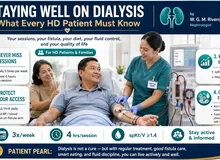
- Staying Well on Dialysis — What Every hemodialysis (HD) Patient Must KnowWhat life on dialysis is like for the people you will meet every day.
- Managing Complications of HemodialysisThe common problems during and after treatment, in plain language.
Back to the Support Staff course home · the Nephrology Nursing course · the infection prevention lesson nurses study, Nephrology Nursing Module 7.