After this module you should be able to
- Lead a simulated 72-hour scenario that combines clinical, technical, staffing, payer and financial pressures.
- Prioritize actions by patient risk and route each to its authorized owner.
- Use at least four track calculators to support decisions.
- Defend a readiness and improvement portfolio before a panel.
The big picture, in plain words
The picture has a limit. A toolbox suggests that every problem has its tool and that skill means choosing well. Choosing matters, but the harder skill is restraint: knowing which problems are not yours to solve, and making sure the person who owns each one knows about it in time. The best capstone responses are not the busiest. They are the ones where every decision has a named owner and a time, and no patient's safety depends on the manager guessing.
The capstone has three parts: a timed simulation, a portfolio defense, and a short independent review.
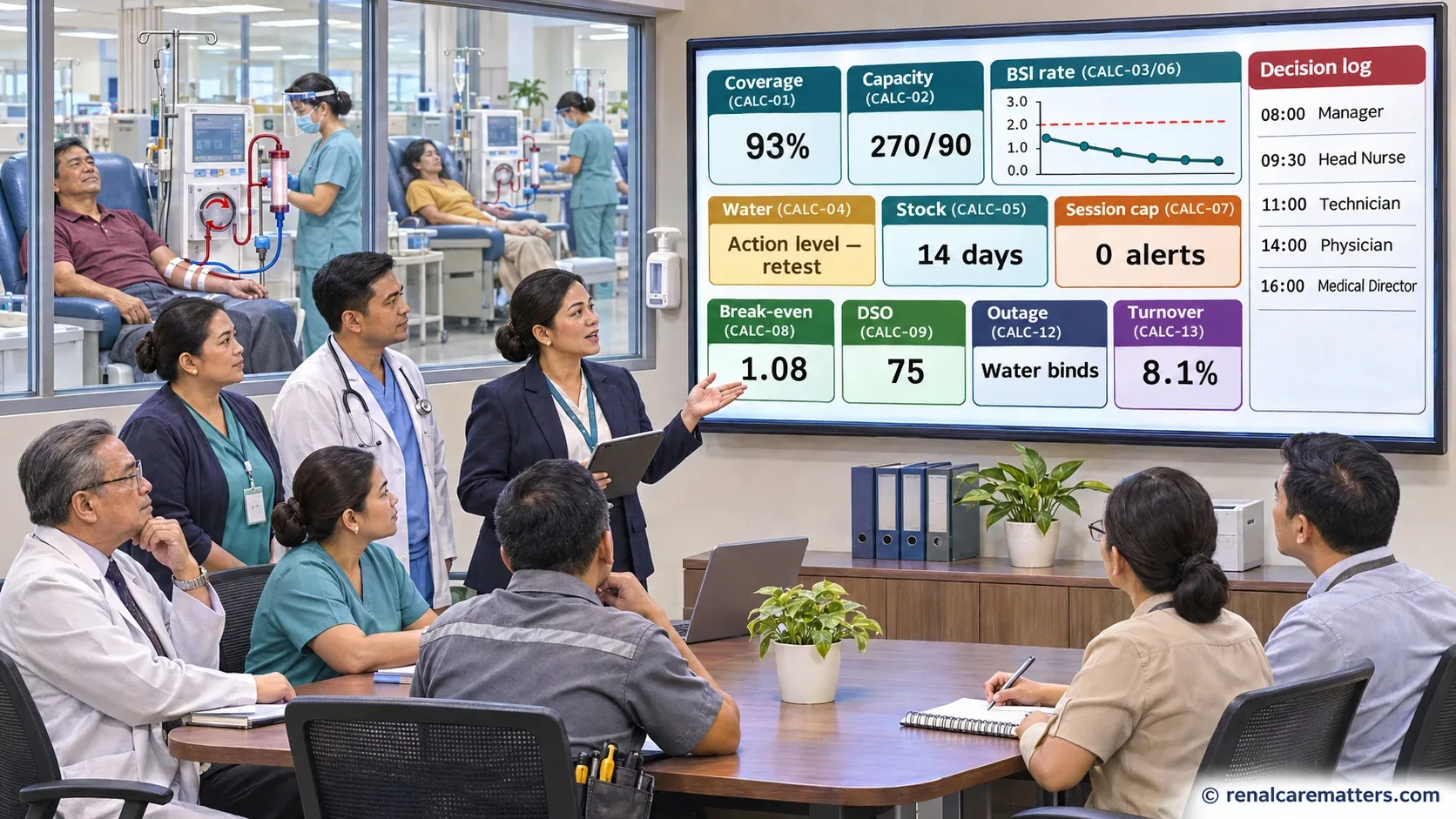
Figure 1 · Key terms for this module
Case: The week before Signal No. 3
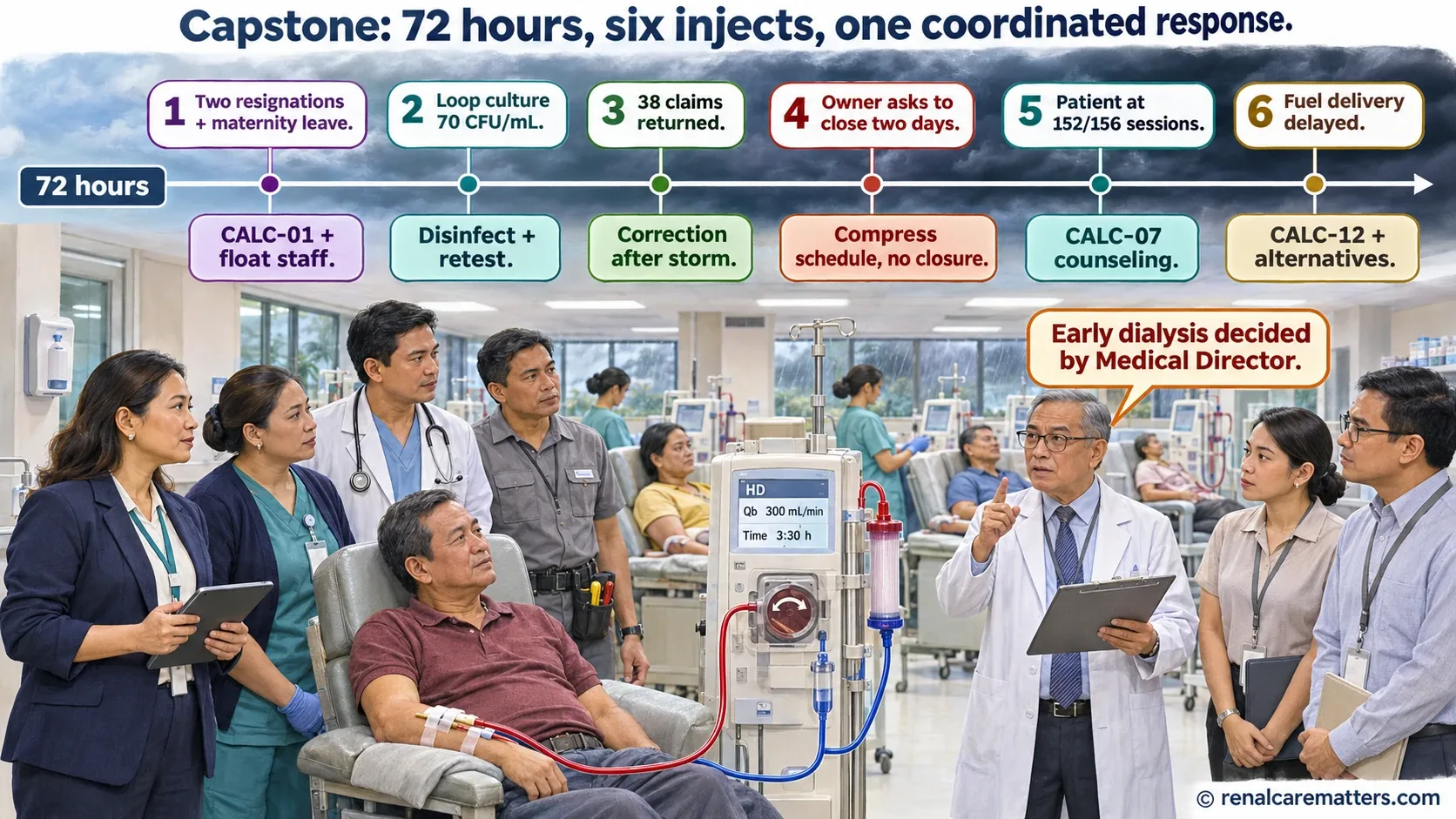
It is Monday, 07:00, at a 15-station freestanding unit in Legazpi City, Albay. PAGASA forecasts a typhoon landfall in the Bicol region in about 72 hours, on Thursday morning. You are the operations manager. The unit treats 84 patients on Monday–Wednesday–Friday and Tuesday–Thursday–Saturday schedules.
Over the next hour, six things land on your desk:
- The head nurse reports that two nurses have resigned effective Friday, and one is on maternity leave.
- The monthly culture from the water distribution loop returns at 70 colony-forming units (CFU)/mL. The facility program sets the action level at 50 and the maximum at 100.
- Billing reports that 38 claims from last month were returned for documentation errors.
- The owner messages: "Can we just close Thursday and Friday to protect the staff?"
- A Tuesday–Thursday–Saturday patient, Mrs. Remedios Bonganay, has used 152 of her 156 Philippine Health Insurance Corporation (PhilHealth) sessions.1
- The generator fuel supplier says delivery may be delayed because of the storm.
Before reading on, decide:
- Which of the six threatens a patient first, and whose decision is it?
- Which items can wait until after the storm, and which cannot?
- Which calculators answer which questions?
Keep your answers in mind. The lesson gives you what you need, and the case review near the end shows one sound response.
How the capstone works
Part A: integrated simulation (60 minutes). The preceptor releases injects every 10 to 15 minutes, like the case above but with a scenario you have not seen. You run the response as manager. Colleagues or the preceptor play the head nurse, Medical Director, water technician, billing officer, and owner.
Part B: portfolio defense (40 minutes). You present your portfolio and answer the panel's questions.
Part C: independent review (35 minutes). Thirteen short-answer questions from the trainer guide, checked against the model key.
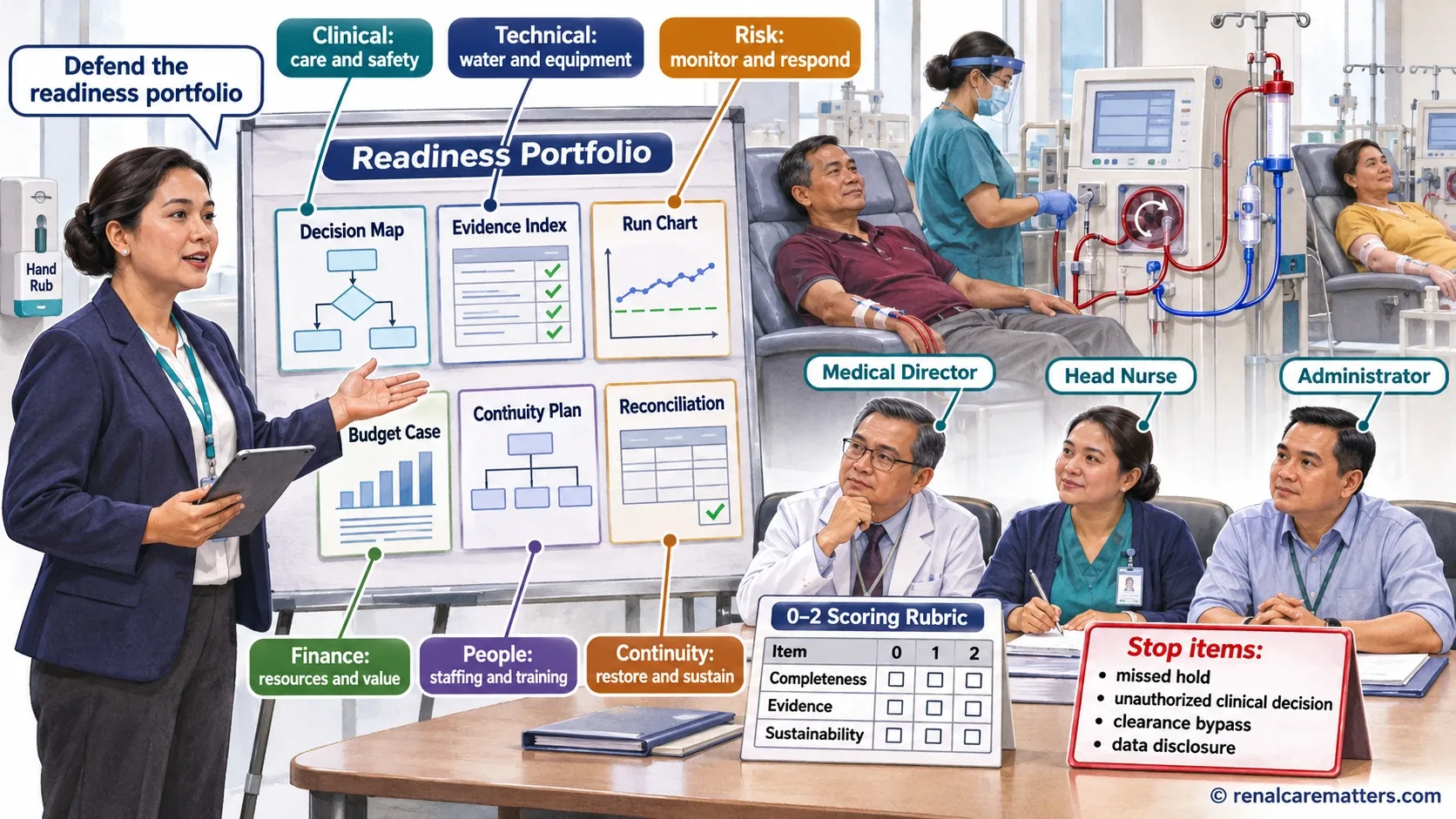
The readiness and improvement portfolio
Each artifact comes from a module. Use fictional or de-identified data throughout.
| Artifact | From module |
|---|---|
| Signed decision-rights map | 01 |
| Evidence index with status colors and two closed corrective and preventive actions (CAPAs) | 02 |
| CALC-01 staffing analysis and competency matrix | 03 |
| Capacity and utilization analysis (CALC-02) and holiday schedule | 04 |
| Infection surveillance report (CALC-03) and one audit with feedback | 05 |
| Water log audit and hold-release drill record | 06 |
| Drill report with timings and just-culture review | 07 |
| Reorder points (CALC-05) and mock recall result | 08 |
| Run chart (CALC-06) and one completed Plan–Do–Study–Act (PDSA) cycle | 09 |
| Claims trace and denial analysis; cap tracker (CALC-07) | 10 |
| Budget case with break-even and cash analysis (CALC-08) | 11 |
| Continuity plan with autonomy calculation (CALC-12) | 12 |
| Setting-specific agreements (freestanding or hospital) | 13 or 14 |
| Turnover analysis (CALC-13), coaching record, grievance closure | 15 |
| Month-end close checklist and aging report (CALC-09) | 16 |
| Cutoff audit and premium recomputation (CALC-10) | 17 |
| Remittance reconciliation and benefits matrix (CALC-11) | 18 |
Example. At a defense in Cebu, a panel member asks a candidate why her evidence index has four red rows. She answers: "Two are staff hepatitis B titers due this month, with appointments booked. One is the fire inspection, scheduled for the 18th. One is our transfer agreement with the second hospital, which their legal office is still reviewing; my deadline to escalate is the 30th." The panel scores her well. A clean index would have been less convincing than an honest one with owners and dates.
Scoring
The trainer uses the 0-to-2 rubric in the trainer guide. A score of 0 on any safety gate stops the capstone and requires supervised reassessment.
Back to the case: The week before Signal No. 3
Clinical priority first. You call the Medical Director, who decides on early dialysis.2 With the head nurse, you prepare the high-risk list: patients coming off the long gap, those with high last potassium, those with catheters, and new starts. Thursday and Friday patients are moved to Tuesday, Wednesday, and early Thursday. No patient goes more than three days without treatment.
The water. A result of 70 CFU/mL is above the action level but below the maximum. It is not "fine." You make sure the water technician disinfects the loop and retests, and that the Medical Director knows. Before the extra sessions start, you confirm the release status. The decision is theirs; the follow-up is yours.
Staffing. You run the staffing calculator (CALC-01) for the compressed schedule. The head nurse brings in float or agency nurses with verified competencies, and approves the roster. You compute overtime and holiday premiums with CALC-10 so the volunteers know what they will be paid.
Continuity. You run the outage calculator (CALC-12) with current fuel and water. Water, not fuel, is the binding constraint. You activate the water tanker contract and a second fuel supplier, alert the partner units in Naga and Sorsogon, and make sure every patient has an emergency information sheet and the dietitian's emergency diet guidance.
The owner. You reply with facts, not argument: closing Thursday and Friday would leave some patients five days without treatment. You propose compressing the schedule instead, with the staffing cost and the premium pay laid out. The owner agrees.
The payer items. The 38 returned claims matter, but they can wait until after the storm. You assign them to billing with a deadline the following week. You use the session-cap tracker (CALC-07) for Mrs. Bonganay: with 4 sessions left and about six weeks to the end of the year, she will run out in about ten days, long before December 31. The social worker counsels her family now, and the attending knows. Her dialysis continues.
Records. You keep a decision log with times and owners, and open corrective actions for the claims errors and the water result.
Skills checklist: Capstone portfolio and safety gates
Assemble each artifact with fictional or de-identified data, then defend it. A zero on any safety gate stops the capstone. Your preceptor rates each step as satisfactory, needs practice, or not observed. Steps marked Critical must all be satisfactory before sign-off. This checklist supports supervised learning; your unit’s own procedure and competency form are the authority. A printable version of every checklist is on the trainer page.
- CriticalSigned decision-rights map (Module 01)
- Evidence index with status colors and two closed CAPAs (Module 02)
- CALC-01 staffing analysis and competency matrix (Module 03)
- Capacity and utilization analysis (CALC-02) and holiday schedule (Module 04)
- Infection surveillance report (CALC-03) and one audit with feedback (Module 05)
- CriticalWater log audit and hold-release drill record (Module 06)
- CriticalDrill report with timings and just-culture review (Module 07)
- Reorder points (CALC-05) and mock recall result (Module 08)
- Run chart (CALC-06) and one completed Plan–Do–Study–Act (PDSA) cycle (Module 09)
- Claims trace and denial analysis; cap tracker (CALC-07) (Module 10)
- Budget case with break-even and cash analysis (CALC-08) (Module 11)
- CriticalContinuity plan with autonomy calculation (CALC-12) (Module 12)
- Setting-specific agreements (freestanding or hospital) (Module 13 or 14)
- Turnover analysis (CALC-13), coaching record, grievance closure (Module 15)
- Month-end close checklist and aging report (CALC-09) (Module 16)
- Cutoff audit and premium recomputation (CALC-10) (Module 17)
- Remittance reconciliation and benefits matrix (CALC-11) (Module 18)
- CriticalNo missed safety hold during the simulation
- CriticalNo clinical decision made outside the manager’s authority
- CriticalNo clearance or release step bypassed
- CriticalNo patient data disclosed outside the need-to-know rule
Check your understanding
Each visit draws 5 questions at random from this module’s 15-question bank. Choose the single best answer for each, then select Check answers; an explanation appears under the best answer. Select New set of questions for a different mix. A good target is 4 of 5 on two different sets. Nothing you select is sent anywhere; scoring happens in your browser.
Read next on this site
- Typhoon and Disaster Preparedness in DialysisThe patient side of the capstone scenario.
- Dialysis Center Quality ManagementTurning findings into improvement.



