After this module you should be able to
- Maintain an asset register and preventive maintenance schedule for dialysis machines and the water system.
- Calculate reorder points, safety stock and days-on-hand for critical supplies.
- Trace a lot from receipt to patient and execute a recall or quarantine.
- Run a transparent procurement that separates requesting, approving, receiving and paying.
The big picture, in plain words
The picture has a limit. Passports are checked at borders; supplies are rarely checked after the receiving dock. A box of dialyzers can sit for months in a hot stockroom, and a machine can be "fixed" by a vendor and put back into service without anyone signing that it passed its checks. The passport is only as good as the habit of writing in it.
This module covers the three things that keep a unit supplied and safe: an asset register that knows every machine's history, a stock system that never runs out and never uses expired items, and a purchasing process that no single person controls.
Figure 1 · Key terms for this module
Case: The cheaper dialyzer
At a 20-station unit in Batangas City, the finance officer, Mr. Rey Panganiban, brings the manager, Ms. Cheryl Mercado, a quotation. A new vendor offers a dialyzer 18% cheaper than the brand the unit has used for six years. With about 1,000 dialyzers a month, the savings would cover most of a nurse's salary. "Let's switch next month," he says. "A dialyzer is a dialyzer."
Ms. Mercado notices that the new dialyzer has a different membrane material and a smaller surface area. The unit reprocesses dialyzers for some patients.
Before reading on, decide:
- Who should decide whether to switch, and on what evidence?
- What could go wrong for patients if the switch happens without review?
- What should Ms. Mercado bring to that decision?
Keep your answers in mind. The lesson gives you what you need, and the case review near the end shows one sound response.
The operating model: assets, consumables, and traceability
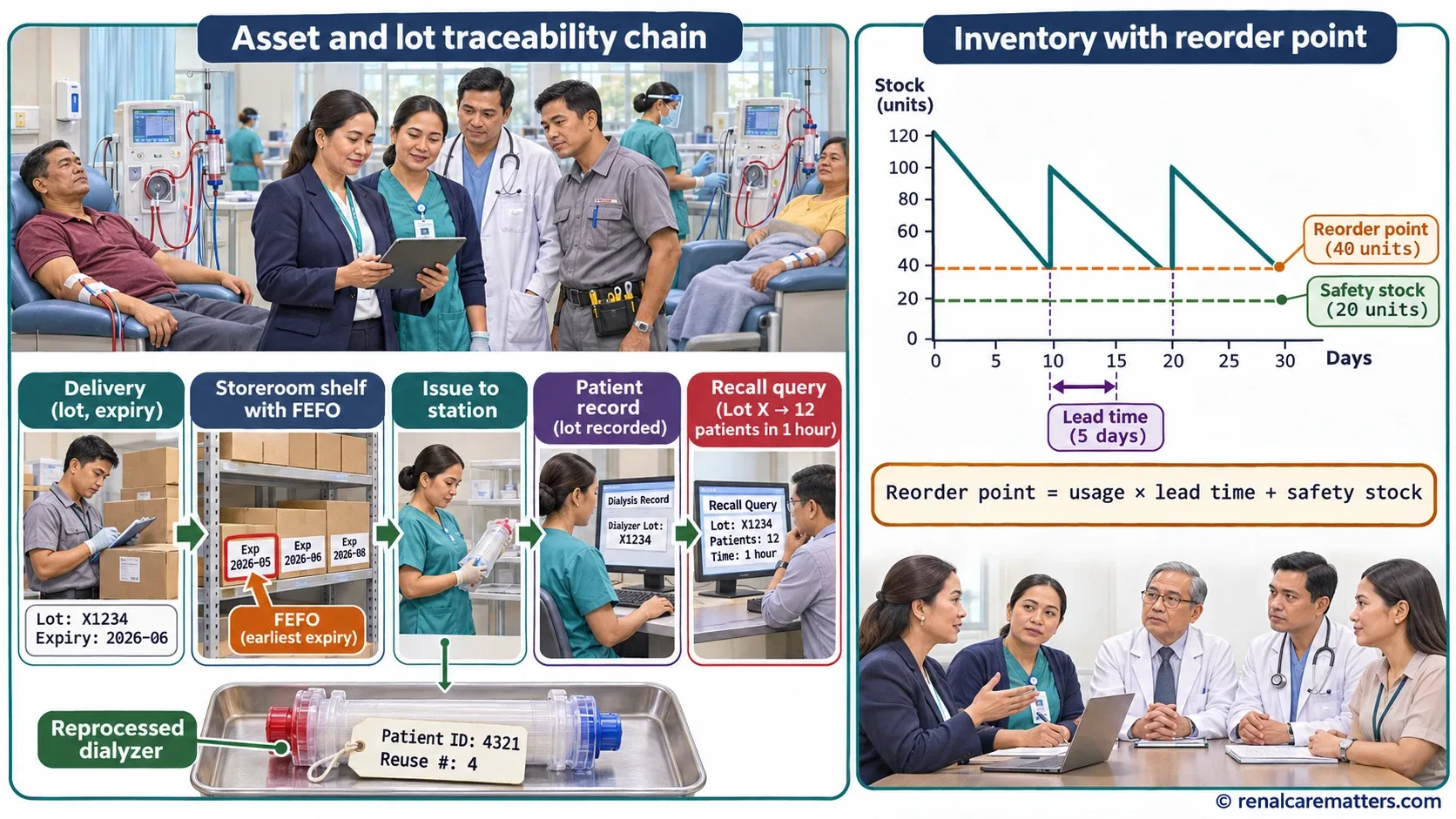
Assets are the machines, the reverse osmosis system, chairs, the defibrillator, and reprocessing equipment. Each one has a life: acceptance testing, scheduled preventive maintenance, repairs, release back to service, and eventual retirement. Each has a unique identifier and a history you can read.
Consumables move: received, stored, issued, used. Two rules matter most.
- First expiry, first out. Use the earliest-expiring lot first. Not first in, first out, because a later delivery can carry an earlier expiry date.
- Lot traceability. Record which lot each patient received for high-risk items: dialyzers, bloodlines, concentrates, and injectable drugs. When a recall arrives, you need a list of patients within an hour, not a week.
Reprocessed dialyzers add a layer. Each reused dialyzer belongs to one patient and carries a label with the patient's identity and reuse number. Before each use it must pass a performance test (total cell volume or an equivalent) and a check that the germicide is present and then fully rinsed out. The reprocessing log is both a quality record and a traceability record. Follow your Philippine Society of Nephrology (PSN) and Department of Health (DOH)-aligned reprocessing policy and the manufacturer's instructions.1
Example. A stockroom in Legazpi receives bloodlines in March with an expiry date in September, and another delivery in May that expires in July. Under first in, first out, the March stock is used first, and in August the clerk finds 240 sets from the May delivery past their date. Under first expiry, first out, the May stock would have been used first, and nothing would have expired.
What the evidence shows
Equipment failures cause harm. Alarm failures, air detector malfunctions, and conductivity errors are recognized causes of injury in dialysis. Scheduled preventive maintenance and documented release are established practice across international standards for hemodialysis equipment and, for the water system, International Organization for Standardization (ISO) 23500.2 No trial compares maintenance intervals, so follow the manufacturer's schedule as the minimum.
Dialyzer reuse depends on process control. Some older United States analyses associated certain germicides and reuse practices with higher mortality. Others found no difference when reprocessing was well controlled. The defensible position is that the safety of reuse depends on validated methods, performance testing, germicide checks, and accurate records.
Supply chains break. Shortages of dialysis supplies, including bloodlines, have forced units in several countries to ration in recent years. Safety stock and a second supplier are the only defense.
Calculator CALC-05: reorder point, days on hand, and machine availability
You need: average daily use, supplier lead time in days, safety stock days, current stock, and, for machines, scheduled treatment hours and hours lost to repair.
Reorder point = (average daily use × lead time) + safety stock.
Days on hand = current stock ÷ average daily use.
Machine availability = (scheduled hours − hours down) ÷ scheduled hours × 100.
Worked example. A unit runs 45 sessions a day using new bloodlines. The supplier's lead time is 10 days. Because the supplier is a single importer, the Medical Director and administrator choose 14 days of safety stock.
- Safety stock = 14 × 45 = 630 sets
- Reorder point = 45 × 10 + 630 = 1,080 sets
- With 1,400 sets on hand, days on hand = 1,400 ÷ 45 = 31 days
Order when stock falls to 1,080. If the supplier warns of a delay at the port, raise the lead time in the calculator, and the reorder point rises with it.
Machine example. Fifteen machines × 18 scheduled hours a day × 26 days = 7,020 hours a month. If machines were down 210 hours, availability is (7,020 − 210) ÷ 7,020 = 97%. Track it per machine. One machine that keeps breaking is a retirement decision, not another repair.
The asset register
| Asset ID | Type | Serial | Location | Accepted | PM interval | Last PM | Next PM | Repairs (12 months) | Status |
|---|---|---|---|---|---|---|---|---|---|
| M-07 | Dialysis machine | XXXX | Station 7 | 2021-03 | 6 months | 2026-09 | 2027-03 | 2 | In service |
| reverse osmosis (RO)-01 | Reverse osmosis system | YYYY | Water room | 2019-11 | Per vendor | 2026-10 | 2026-12 | 1 | In service |
Recall and quarantine
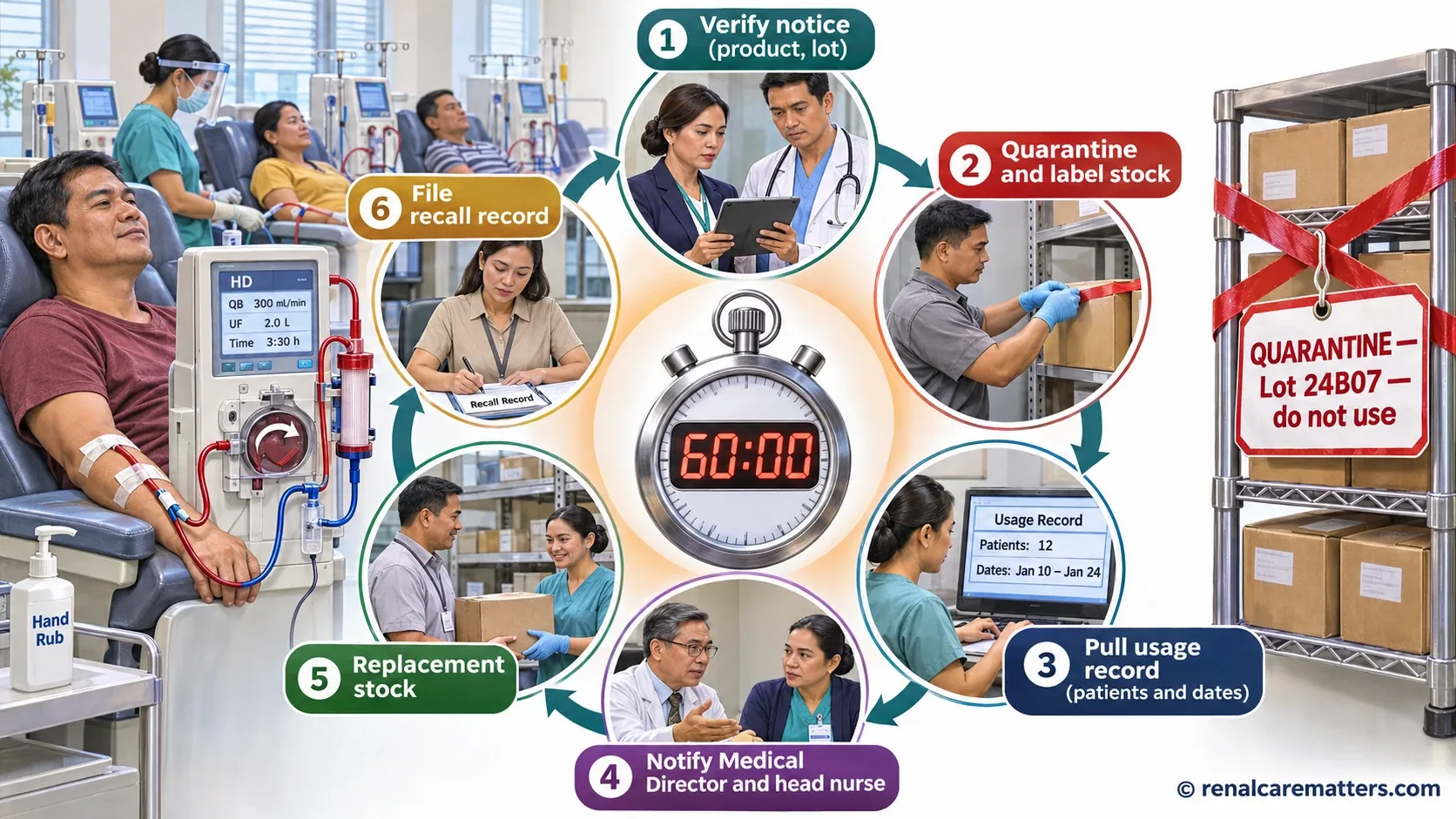
Figure 4 · A recall in one hour
- VerifyConfirm the product, the lot, and the action required.
- QuarantinePhysically separate the stock, label it, and log it.
- TracePull the usage record: which patients received the lot, and when.
- NotifyTell the Medical Director and head nurse. Clinical leads decide on patient follow-up.
- ReplaceArrange replacement stock and record the vendor's return or credit.
- FilePut the recall record in the evidence index (Module 2).
Example. At 10:00 on a Tuesday, a supplier emails a recall for a lot of acid concentrate with a labeling error in its potassium content. The manager in Ormoc finds four cartons of that lot in the stockroom and one on the floor. The lot log shows it was used for 22 treatments since Saturday. By 10:50 the stock is quarantined, the floor carton is removed, and the Medical Director has the list of 22 patients. The attending nephrologists order potassium checks for those still in the unit and call the others. Without lot records, the unit would have had to test every patient who dialyzed in five days.
Procurement with internal controls
Figure 5 · Buying without risk
- RequisitionThe requesting area states the need, quantity, and specification.
- ApprovalSomeone with budget authority approves, separate from the requester where possible.
- QuotationComparable quotes per policy; document the reason for the choice: price, Food and Drug Administration registration, delivery reliability, service support.
- Purchase orderIssued before delivery.
- ReceivingCount, check lot, expiry, and condition; sign the receiving report.
- PaymentFinance pays after the three-way match (Module 16).
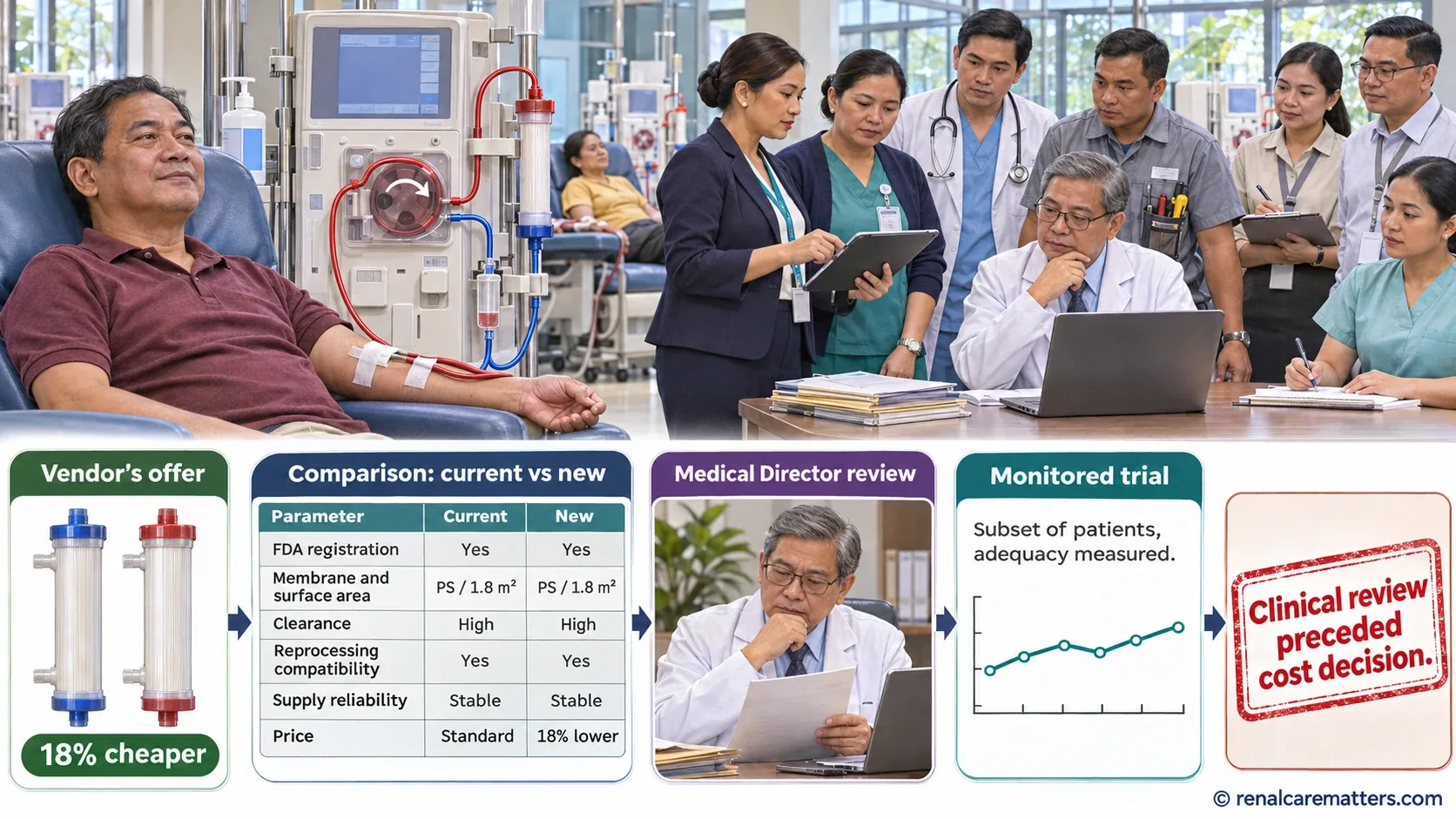
A clinical product change, such as a new dialyzer brand or a different concentrate, needs Medical Director approval, not just a better price.
Common failure modes
- First in, first out. Expired stock found at the back of the shelf.
- No lot per patient. Recalls become guesswork.
- One person does everything. The same person requests, approves, receives, and pays.
- Silent return to service. A machine back in use after repair with no release check.
- Price before prescription. A clinical product switched by finance.
Back to the case: The cheaper dialyzer
Who decides. A dialyzer is part of the prescription. A change in membrane and surface area can change how much waste is cleared each session, and reprocessing compatibility may differ. This is a clinical product decision for the Medical Director, informed by cost, not driven by it.
What she brings. Ms. Mercado prepares a one-page comparison: Philippine Food and Drug Administration registration, membrane type, surface area and published clearance, price per unit and per month, the vendor's supply record and lead time, reprocessing compatibility, and service support.
The decision. The Medical Director approves a monitored trial: twelve patients for six weeks, with dialysis adequacy measured before and after, and the reprocessing team checking performance tests on each reused dialyzer. In week four, two patients' adequacy results fall below target, and the attending nephrologists adjust their prescriptions. The trial shows the new dialyzer works, but some patients need a longer session or a larger size. The final decision includes that cost. The record shows clinical review came before the cost decision.
Skills checklist: Supervised practice
Complete these with your preceptor at your own unit, using fictional or de-identified data. Your preceptor rates each step as satisfactory, needs practice, or not observed. Steps marked Critical must all be satisfactory before sign-off. This checklist supports supervised learning; your unit’s own procedure and competency form are the authority. A printable version of every checklist is on the trainer page.
- Update the asset register and confirm the next preventive maintenance date for every machine.
- Run CALC-05 for the five highest-volume supplies and compare with current reorder practice.
- CriticalConduct a mock recall: pick a dialyzer lot and produce the patient list within one hour.
- Map who requests, approves, receives and pays in your unit and identify any overlap.
Check your understanding
Each visit draws 5 questions at random from this module’s 15-question bank. Choose the single best answer for each, then select Check answers; an explanation appears under the best answer. Select New set of questions for a different mix. A good target is 4 of 5 on two different sets. Nothing you select is sent anywhere; scoring happens in your browser.
Read next on this site
- Dialysis Machine Assignment and Hepatitis IsolationAssigning machines and stations safely.