After this module you should be able to
- List the high-risk emergencies in hemodialysis and the readiness items each one requires.
- Assign incident command roles for a clinical emergency and a facility emergency.
- Run a drill and debrief it with measurable findings.
- Report, disclose and review an adverse event in a just-culture framework.
The big picture, in plain words
The picture has a limit. Plans do not move; people do, and people under stress forget plans they have only read. A plan becomes real only when staff have rehearsed it with their hands: clamping lines, returning blood with the power off, wheeling a patient out of a smoky room. That is why this module asks you to drill, not just to write.
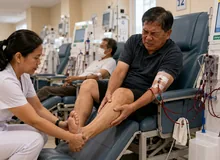
The unit is unusual among clinical areas. Up to 15 patients are connected to machines that move their blood at 300 milliliters a minute or more. In a fire, an earthquake, or a power failure, you cannot simply walk everyone out. Each one must first be safely disconnected.
Figure 1 · Key terms for this module
Case: The silenced alarm
At 14:20 on a Friday at a 16-station unit in Bacoor, Cavite, Nurse Jenny Lim walks past station 11 and sees Mrs. Corazon Reyes, 72, pale and drowsy, with blood soaking the blanket over her arm. The venous needle has slipped out of her fistula. The blood pump is still running.
The venous pressure alarm did not stop the pump. Earlier that week, after repeated nuisance alarms on several machines, staff had widened the alarm limits. Mrs. Reyes had pulled the blanket up because the room was cold, covering the access.
Before reading on, decide:
- In the first two minutes, who does what?
- What is the manager's role, and what should the manager not do?
- After Mrs. Reyes is safe, how would you find out why this happened without driving staff into silence?
Keep your answers in mind. The lesson gives you what you need, and the case review near the end shows one sound response.
The physiology behind the urgency
Venous needle dislodgement. The blood pump keeps running at 300 milliliters a minute or more. If the venous needle slips out, blood can pour onto the floor while a venous pressure alarm set too wide fails to stop the pump. At that rate, a patient can lose a dangerous amount of blood within minutes. Taped, visible access and correct alarm limits are the defense.
High potassium. Rising potassium makes heart cell membranes less negative and slows conduction until the rhythm collapses. The risk peaks before the first session of the week (Module 4).
Low blood pressure during treatment. Fluid is removed from the blood faster than the tissues can refill it. The patient yawns, cramps, feels nauseated, and then loses consciousness.
Air embolism. Air entering the circuit and passing the air detector can lodge in the heart or brain. It is rare with modern machines, and catastrophic.
Dialyzer and drug reactions. Severe allergic-type reactions can start within minutes of beginning treatment.
Facility events. A power failure stops the pumps, and blood must be returned by hand. A fire or an earthquake requires evacuating patients connected to machines, which means a disconnection procedure every staff member knows.
What the evidence shows
Structured communication reduces harm. The I-PASS program was associated with a 30% fall in preventable adverse events in a nine-hospital study.1 Emergency communication with clear roles and read-back applies the same principle.
Preparation changes outcomes in disasters. Before Hurricane Sandy struck the United States in 2012, dialysis patients in New York and New Jersey who received an early session had, in adjusted analyses, about 20% lower odds of an emergency department visit, 21% lower odds of hospitalization, and 28% lower odds of death within 30 days than those who did not.2 The study was observational, but the finding fits the physiology. The authors recommended routine drills of emergency and communication plans.
Drills reveal hidden failures. Simulation research consistently shows that rehearsed teams find equipment and role gaps that never appear on paper checklists. This is reasonable inference from healthcare simulation studies, not from dialysis-specific trials.
Readiness checklist
You own the checklist. Clinicians verify the clinical items.
| Item | Frequency | Verified by |
|---|---|---|
| Emergency cart contents and expiry | Daily seal check; full check monthly | Assigned nurse |
| Defibrillator or automated external defibrillator (AED) | Daily | Assigned nurse |
| Oxygen and suction | Daily | Assigned nurse |
| Emergency drugs per protocol | Per protocol | Head nurse and physician on duty |
| Manual blood return | Competency yearly | Head nurse |
| Generator test under load | Weekly or per policy | Biomedical technician |
| Fire extinguishers and exits | Monthly | Operations manager |
| Hospital transfer agreement and contacts | Quarterly | Operations manager |
| Patient emergency information sheets | Updated quarterly | Nurse in charge |
Example. During a monthly full check at a unit in Naga, the head nurse breaks the cart seal and finds two ampules of epinephrine that expired five weeks earlier. The daily seal checks had all been signed "intact," which was true. The seal proved no one had opened the cart. It did not prove the contents were usable. The unit adds the earliest expiry date to a tag on the outside of the seal.
Incident command for a clinical emergency
| Role | Usually | Does |
|---|---|---|
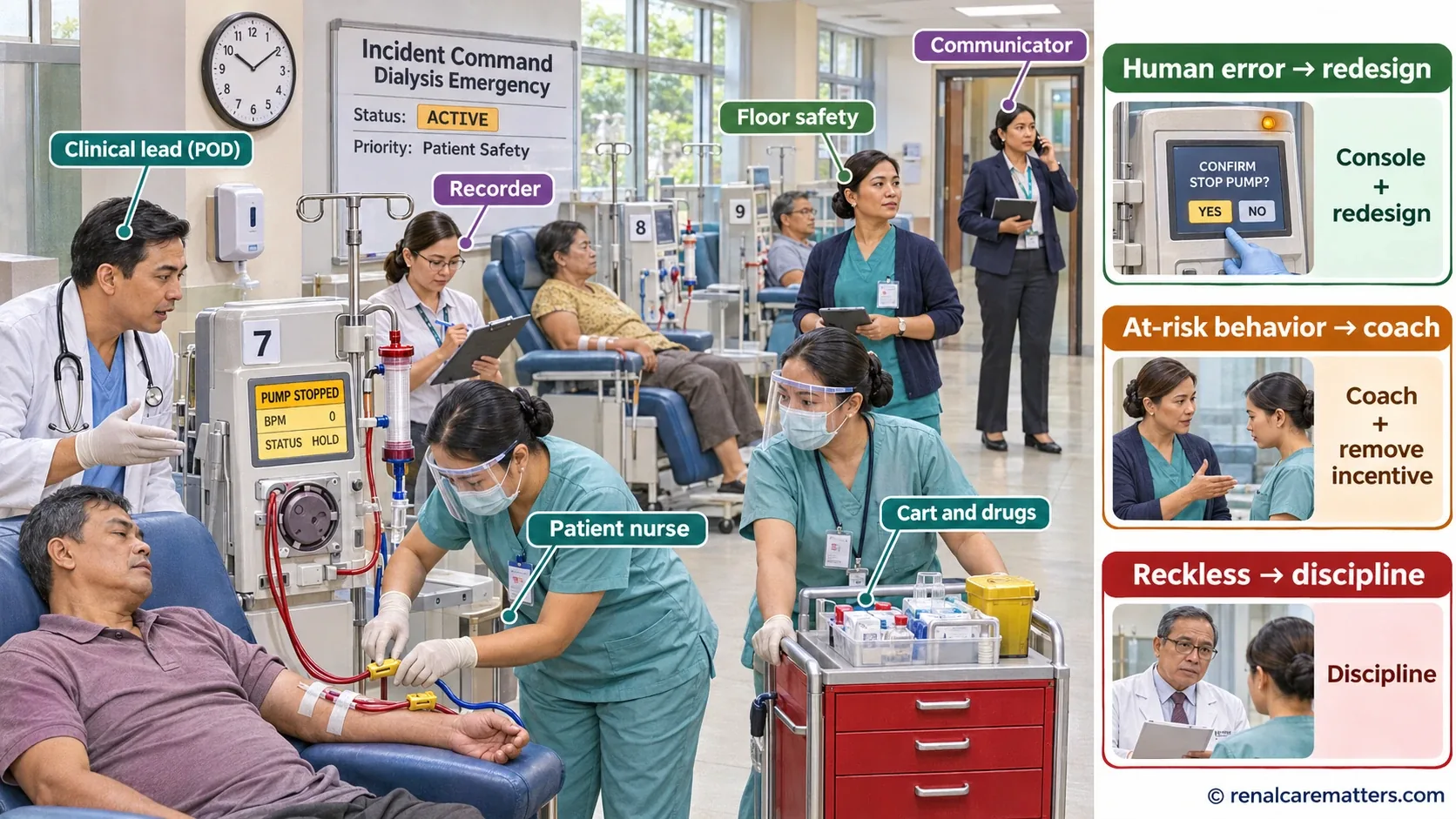
| Clinical lead | Physician on duty | Directs resuscitation and treatment |
| Patient nurse | Assigned nurse | Stops the pump, clamps, returns blood if instructed, monitors |
| Cart and drugs | Second nurse | Brings the cart, prepares drugs, records times |
| Communicator | Operations manager | Calls the ambulance and receiving hospital, notifies the attending and family per policy |
| Floor safety | Charge nurse | Watches the other patients, reassures, controls the area |
| Recorder | Any trained staff | Keeps the timeline of events, drugs, and actions |
Incident command for a facility emergency
Figure 3 · Fire, earthquake, or major outage
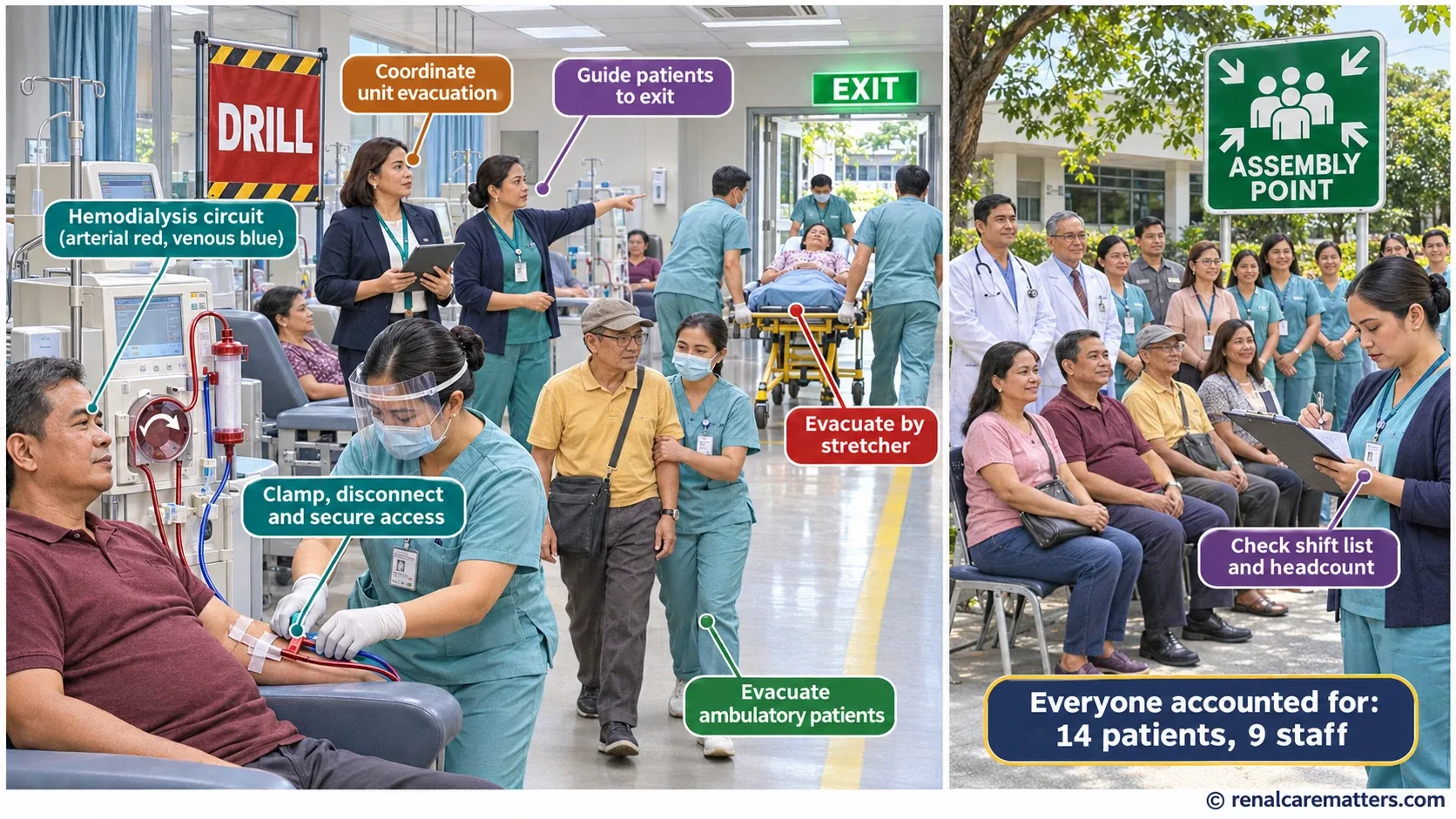
- DeclareName the emergency and the command lead, usually the most senior manager or charge nurse present.
- Protect patients on machinesStop pumps and return blood, or clamp and disconnect by the emergency procedure, as clinical staff direct.
- Evacuate by priorityWalking patients first, then those needing help, then stretcher patients, with staff assigned by name.
- AccountCheck everyone at the assembly point against the shift list.
- CommunicateEmergency services, the Medical Director, the owner, and families.
- RecoverDecide with clinical leads when and where interrupted treatments resume (Module 12).
Example. A unit in Marikina runs its first full evacuation drill on a Saturday afternoon, with staff playing patients connected to machines. The drill takes 19 minutes. The debrief finds three problems: the emergency disconnection kits were in a locked cabinet; the shift list for the headcount was on a computer that had been switched off; and no one was assigned to the patient in the isolation room. The second drill, a month later, takes 11 minutes, with printed shift lists clipped to the exit door and the kits on every machine.
Reporting, disclosure, and review
Report every adverse event and near miss within the shift, using the facility's system. Near misses are free lessons.
Disclose harm to the patient and family honestly and promptly, through the designated clinician: what happened, what is being done, and that the unit is reviewing it. Disclosure is not an admission of liability. It is a professional obligation.
Review serious events with a structured root cause analysis that asks what in the system allowed the event. Just culture separates three kinds of behavior:
- Human error, a slip. Console the person and redesign the system.
- At-risk behavior, a shortcut that drifted into normal. Coach, and remove the incentive for the shortcut.
- Reckless behavior, conscious disregard of a known risk. Discipline is appropriate.
Most events are the first two. Treating every error as reckless drives reporting underground.
Common failure modes
- Drills that skip the hard part. Talking through the evacuation instead of actually disconnecting and moving people.
- Seals instead of checks. Emergency drugs expired because the cart seal was "always intact."
- Everyone at the bedside. No one watching the other patients during a code.
- Blame reviews. Root cause analyses that name a person and stop, so reporting stops too.
Back to the case: The silenced alarm
The first two minutes. Nurse Lim stops the pump, clamps the lines, and presses on the needle site. She calls out. The physician on duty, Dr. Arvin Santos, takes the clinical lead and orders fluids. A second nurse brings the emergency cart and records times. Mrs. Reyes's blood pressure recovers. Dr. Santos arranges her transfer to the hospital for a blood count and observation.
The manager. Ms. Melody Garcia, the manager, does not crowd the bedside. She calls the ambulance and the receiving hospital, notifies the attending nephrologist and, through the designated clinician, the family. She asks the charge nurse to watch the other 15 patients. She tags machine 11 "Do not use" and leaves its settings untouched for review.
The review. The root cause analysis asks what in the system allowed this, not who failed. It finds three things: a batch of needle tubing with loose connectors caused the nuisance alarms; staff widened alarm limits as a workaround, a shortcut that had become normal; and access sites were often covered by blankets. The corrective actions are a new lot of tubing, standard alarm limits locked by the biomedical lead, a "keep the access visible" rule with warm patient gowns instead of blankets over the arm, and weekly audits for a month. No one is disciplined. Reports of near misses rise the following month, which is what a healthy unit should see.
Skills checklist: Supervised practice
Complete these with your preceptor at your own unit, using fictional or de-identified data. Your preceptor rates each step as satisfactory, needs practice, or not observed. Steps marked Critical must all be satisfactory before sign-off. This checklist supports supervised learning; your unit’s own procedure and competency form are the authority. A printable version of every checklist is on the trainer page.
- CriticalRun a clinical emergency drill (needle dislodgement or arrest) and time each role.
- CriticalRun a facility drill including manual blood return and evacuation of one simulated stretcher patient.
- Audit the emergency cart and generator log for the last month.
- Classify three past incidents using just-culture categories and write one system fix for each.
Check your understanding
Each visit draws 5 questions at random from this module’s 15-question bank. Choose the single best answer for each, then select Check answers; an explanation appears under the best answer. Select New set of questions for a different mix. A good target is 4 of 5 on two different sets. Nothing you select is sent anywhere; scoring happens in your browser.
Read next on this site
- Cardiac Arrest Response in a Dialysis UnitRunning a cardiac arrest in a dialysis unit.
- Hemodialysis ComplicationsThe complications staff must recognize during treatment.