After this module you should be able to
- Separate the four authority lines in a hemodialysis service: governance (licensee and owner), medical (Medical Director, attending nephrologist, physician on duty), nursing (head nurse or nursing lead) and operations (you).
- Build a decision-rights map that names an owner, a backup and an escalation deadline for at least ten recurring decisions.
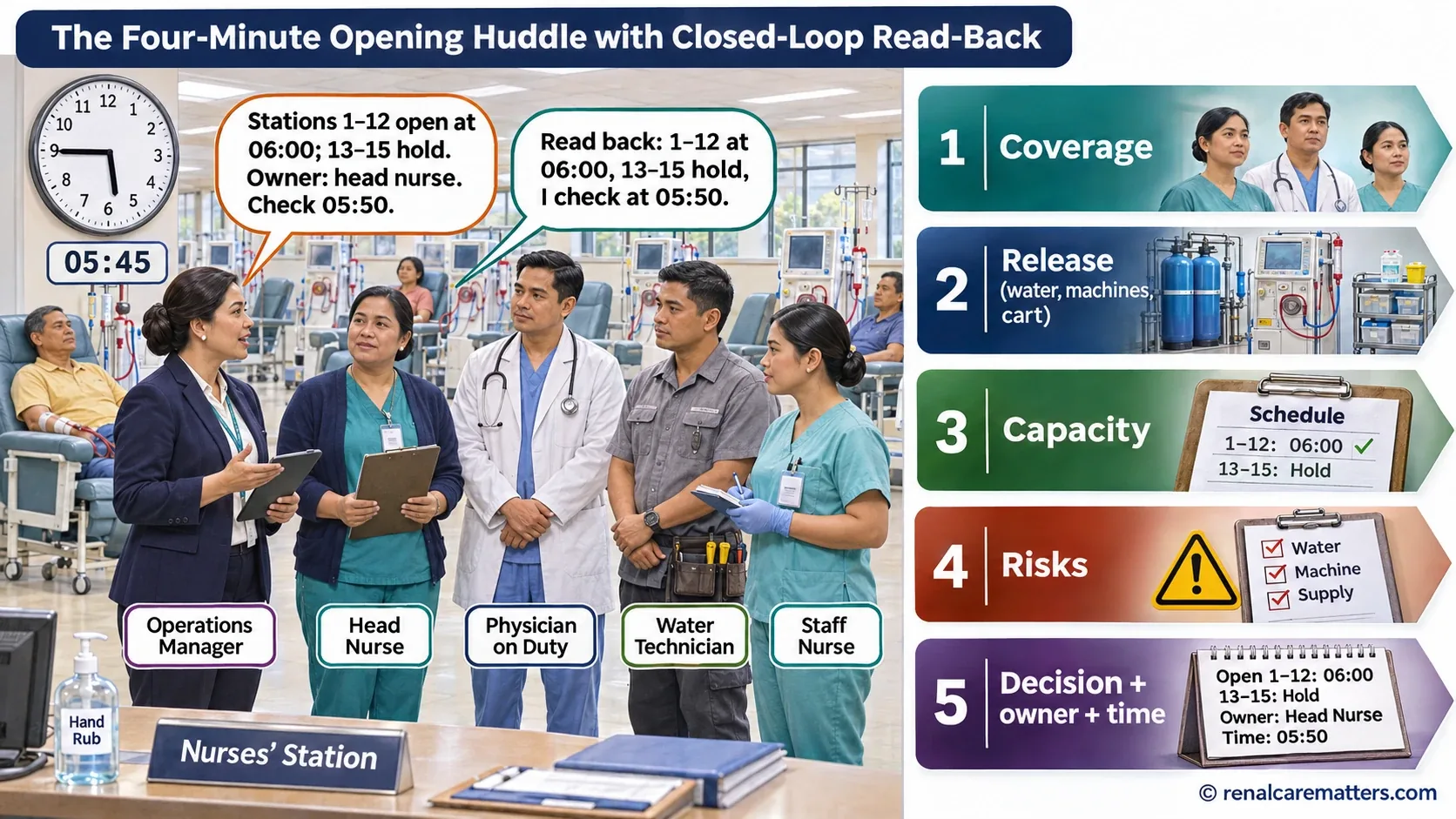
- Run a closed-loop opening huddle in under four minutes and record what was decided and by whom.
- Recognize when a request from an owner, a physician or a patient falls outside your appointment, and route it without delay or conflict.
The big picture, in plain words
The picture has a limit. Wires do not argue, and people do. In a real unit the owner, the Medical Director, the head nurse, and the manager will sometimes want different things at 05:30 on a Monday. The point of the picture is not that the lines never cross. It is that every decision has exactly one owner, a named backup, and a time by which someone must decide.
Most bad mornings in dialysis units are not caused by a lack of skill. They happen because two people each assumed the other had decided, or because the loudest person in the room decided something that was not theirs to decide. This module teaches you to make authority visible before anyone needs it.
Figure 1 · Key terms for this module
Case: The 05:30 phone call
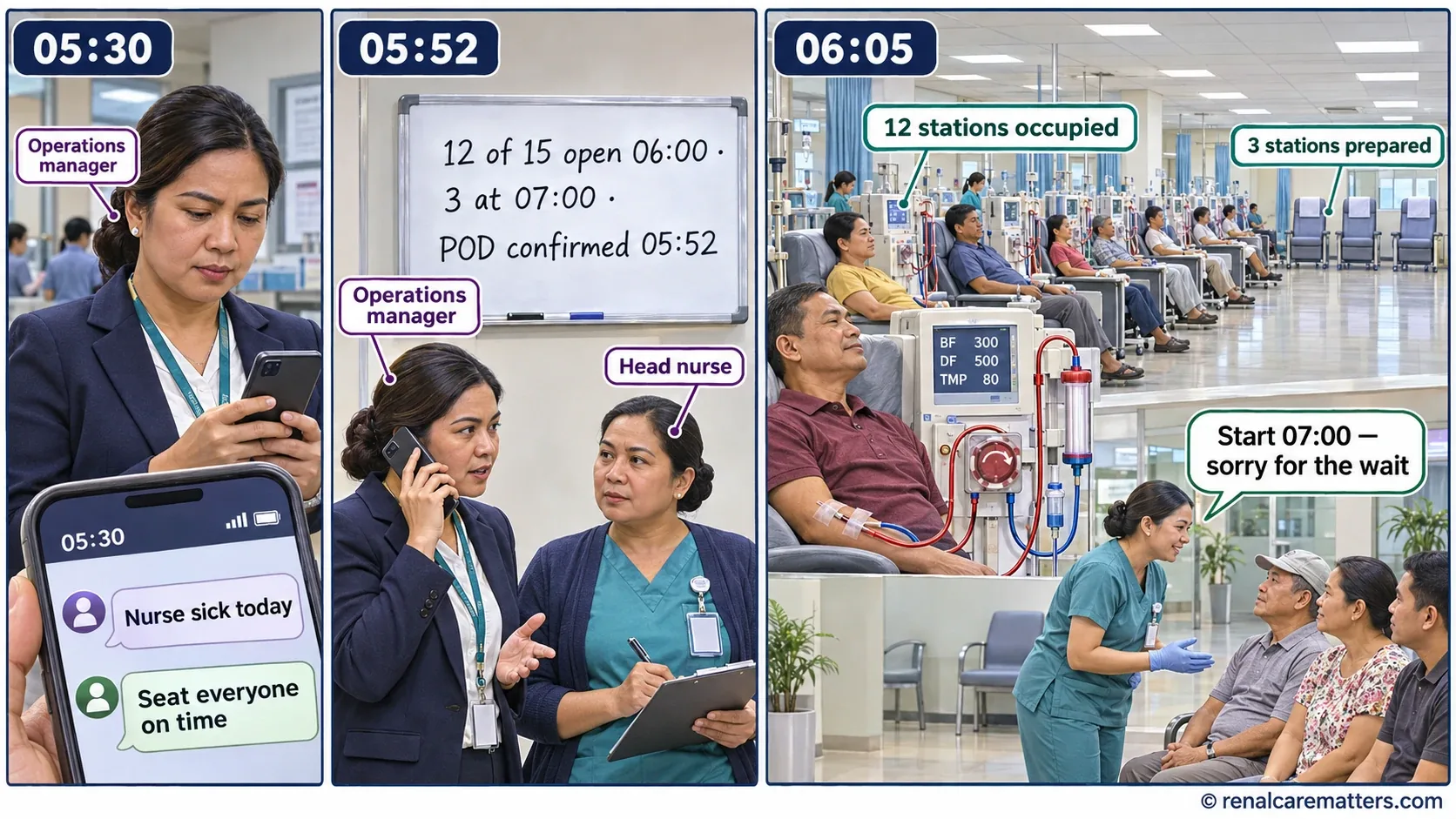
You are Ms. Carla Mendoza, operations manager of a 15-station freestanding unit in Malolos, Bulacan. It is Monday, 05:30. Twenty-four patients are booked across the first two shifts, and twelve of them have been off dialysis since Friday.
Your phone rings. Nurse Joy Santiago has a fever and will not come in. A minute later you see that Dr. Paolo Reyes, the physician on duty for the first shift, has not confirmed his arrival. He usually texts by 05:15.
Then the owner, Mr. Ramon Tan, posts in the staff group chat: "Patients are already outside. Seat everyone on time. We cannot afford complaints this week."
Before reading on, decide:
- How many stations can you open safely at 06:00, and who decides that number?
- Who do you call first, second, and third, and what do you write down?
- What do you tell Mr. Tan, and what do you tell the patients waiting outside?
Keep your answers in mind. The lesson gives you what you need, and the case review near the end shows one sound response.
The operating model: four lines, one patient
Every decision in a dialysis unit belongs to one of four lines of authority. The unit is safe only when everyone can tell which line owns a decision before the decision is needed.
Governance. The licensee, owner, or hospital administration holds the license and the money. It appoints the Medical Director, approves budgets and contracts, and signs the delegations that say what everyone else may do. Under DOH Administrative Order (AO) 2012-0001, the facility, not the individual manager, is accountable for meeting licensing standards.1
Medical. The Medical Director owns medical and technical oversight: protocols, staff education requirements, quality assessment and performance improvement (QAPI), infection surveillance, and water safety. The attending nephrologist owns each patient's prescription. The POD provides delegated medical coverage during the shift. A schedule or a budget never overrides any of them.
Nursing. The head nurse or nursing lead assigns nurses to patients, judges acuity, supervises competency, and owns nursing quality. Republic Act (RA) 9173, Section 29, sets the minimum qualifications for a supervisory nursing position: Philippine registered nurse (RN) registration, at least two years of experience in nursing service administration, a Bachelor of Science in Nursing with at least nine graduate units in nursing administration, and good standing in the accredited professional organization.2 Whether your own job falls under Section 29 is a question for human resources and legal counsel. Get the answer in writing.
Operations. You coordinate people, capacity, supplies, records, vendors, claims, and the building. You make the other three lines work on time. You do not prescribe. You do not assign nurses unless you also hold a nursing appointment. You do not release water or machines.
Example. At a 20-station hospital unit in Pampanga, Ms. Lorna Dizon is both head nurse and unit manager. Her appointment letter names both roles. When she moves a nurse from station 4 to station 9, she says, "As head nurse, I am reassigning Nurse Ben." When she postpones a supply order, she says, "As unit manager, I am holding this order until Friday." It sounds formal. It also means no one argues later about which authority she used.
The safety hold
Every approved policy should give you the authority to stop something that looks unsafe: delay an opening, quarantine a lot of bloodlines, take a station out of service. It should not give you the authority to restart it. Release belongs to the technical and clinical owners.
The asymmetry is deliberate. Stopping is cheap and reversible: at worst, a treatment starts 40 minutes late. Releasing without the right expertise is how patients get hurt.
Example. At 07:20, two nurses report that bloodlines from the same carton leaked at the arterial connector during priming. No patient was harmed. You cannot judge whether the lot is defective, and you do not try. You pull the remaining boxes of that lot, tag them "On hold, do not use," move stock from another lot to the floor, and call the biomedical lead and the head nurse. The supplier's representative and the biomedical lead examine the lines that afternoon. The lot stays on hold until they sign a decision. The hold cost you one stock transfer. Using the lot could have cost a patient a blood loss mid-treatment.
What the evidence shows
No trial has compared organizational charts in dialysis units, so this section reasons from nearby evidence and says so.
Structured communication reduces harm. In a prospective study in nine hospitals, a standardized handoff program called I-PASS was associated with a 23% fall in medical errors and a 30% fall in preventable adverse events, from 4.7 to 3.3 per 100 admissions, without making handoffs longer.3 The study involved pediatric residents, not dialysis units. Treat it as reasonable inference: closed-loop communication reduces harm across settings, and a dialysis opening is a handoff from the night to the day.
Mature systems write the roles down. United States Medicare rules for dialysis facilities separate the governing body, the physician medical director, and the registered nurse manager.4 These are policy choices, not outcome trials. They show that well-regulated systems do not leave role boundaries to chance.
Philippine rules that change the decision
| Rule | What it changes on Monday | Verify locally |
|---|---|---|
| DOH AO 2012-0001 | A Medical Director, a POD during operating hours, and staffing requirements exist in writing. Your map must show them. | Current interpretation from your Center for Health Development |
| PSN 2024 hemodialysis (HD) Guidelines (3rd ed.)5 | Sample Dialysis Clinical Head appointment and training expectations | Current PSN attestation forms |
| RA 9173, Section 29 | Minimum qualifications if your role is a supervisory nursing position | Human resources determination in your file |
| RA 101736 | Health data are sensitive personal information. You decide who sees what. | Contact for your facility's Data Protection Officer (DPO) |
Doing it on Monday: the decision-rights map
Build a one-page map. For each recurring decision, write the owner, the backup, what triggers escalation, and the deadline. Post it where the huddle happens.
| Decision | Owner | Backup | Escalate when | Deadline |
|---|---|---|---|---|
| Nurse-to-patient assignment | Head nurse | Senior charge nurse | Ratio cannot be met | Before first needle |
| Prescription change | Attending nephrologist | POD within protocol | Order unclear or unsafe | Before treatment starts |
| Water system release | Water technician plus Medical Director | Biomedical lead | Missing or failed result | Before opening |
| Machine return to service | Biomedical technician | Vendor engineer | Failed check | Before booking |
| Opening delay | Operations manager | Head nurse | Coverage or release gap | 30 minutes before first shift |
| Patient transfer to hospital | POD | Attending | Instability | Immediate |
| Incident disclosure to family | Medical Director or attending | POD | Any harm event | Per policy, same day |
| Purchase above petty-cash limit | Administrator | Owner | Unbudgeted | Before commitment |
| Data access request | DPO | Administrator | Any third party | Before release |
| Media or social media inquiry | Administrator | Owner | Any | Before any response |
Example. A daughter calls at 14:00 asking you to send her father's last three treatment records to a hospital in Manila "right now, by Viber." The map tells you this is not your call. It belongs to the DPO, and the backup is the administrator. You say: "I want to get this to the hospital quickly and safely. Our privacy officer handles record releases. I am calling her now and she will call you back within the hour." You have not refused. You have routed.
The opening huddle in four minutes
Figure 3 · The four-minute opening huddle
- CoveragePOD present or confirmed? Nurses and technicians by name against the roster?
- ReleaseWater log complete and signed? Machines cleared? Emergency cart checked?
- CapacityBooked patients, isolation needs, anyone who may need a hospital bed?
- RisksOne sentence each from nursing, medical, and technical.
- Decision and ownerSay it aloud, with the owner and the check time, and write it down.
A good decision statement sounds like this: "We open stations 1 to 12 at 06:00. Stations 13 to 15 hold pending the relief nurse. Owner: Ms. Ilagan. Check at 06:45." The head nurse repeats it back. You write it in the log with the time.
Common failure modes
- The group chat as escalation. A message posted is not a message received. Escalation ends with a named person who accepts it.
- Seniority instead of authority. The longest-serving nurse is not the nursing lead unless she is appointed.
- The manager as order relay. A physician phones you a potassium change. You transfer the call to the nurse or POD who can read it back and document it. You never write it on the whiteboard.
- Maps with titles but no names. "Biomedical technician" is not an owner. "Mr. Rico Manalo, backup Mr. Allan Bueno" is.
- Dual roles never written down. The first dispute will be about which hat was on.
Back to the case: The 05:30 phone call
Who decides capacity. Not you, and not Mr. Tan. The head nurse, Ms. Grace Ilagan, decides how many patients the nurses present can safely care for. You call her first: "Joy is out. Who do we have, and how many stations can you cover at your usual ratio?" She answers that she can cover 12 stations now and all 15 when the relief nurse arrives at 07:00.
Who covers the physician gap. You call Dr. Reyes directly. No answer. At 05:40 you call the backup POD on the coverage list, Dr. Liza Cruz, who says she can be there by 06:15. At 05:52 Dr. Reyes calls back: a flat tire on the MacArthur Highway, arriving 06:05. You write all four times in the shift log.
What opens. Twelve stations open at 06:00 with full nurse coverage. The three patients with the longest gap since Friday and the highest weight gains go first, as Ms. Ilagan and the POD decide. Three patients start at 07:00.
What you say. To the patients outside: "We are starting twelve treatments now. Three of you will start at seven because we are waiting for one more nurse. No one will miss a session today." No blame, no staff names. To Mr. Tan, in the same group chat so the record is complete: "Opening 12 of 15 at 06:00 with full nurse coverage. Three start at 07:00 when the relief nurse arrives. POD confirmed 05:52, arriving 06:05. No session will be skipped." Owners rarely argue with a plan that protects both the patients and the license.
What you fix this week. The real failure was not the fever. It was that the unit had no standby nurse and no rule for when a POD must confirm. Put both on the agenda for the weekly review.
Skills checklist: Supervised practice
Complete these with your preceptor at your own unit, using fictional or de-identified data. Your preceptor rates each step as satisfactory, needs practice, or not observed. Steps marked Critical must all be satisfactory before sign-off. This checklist supports supervised learning; your unit’s own procedure and competency form are the authority. A printable version of every checklist is on the trainer page.
- Draft the ten-row decision-rights map for your unit and have the head nurse and Medical Director sign it.
- Lead three opening huddles while your preceptor times you and checks closed-loop statements.
- Rehearse a call to the backup physician on duty (POD) when the primary is unreachable, including what you document.
- Identify one decision in your unit that currently has no named owner and propose one.
Check your understanding
Each visit draws 5 questions at random from this module’s 15-question bank. Choose the single best answer for each, then select Check answers; an explanation appears under the best answer. Select New set of questions for a different mix. A good target is 4 of 5 on two different sets. Nothing you select is sent anywhere; scoring happens in your browser.
Read next on this site
- Dialysis Center Quality ManagementHow dialysis units organize quality assessment and improvement.
- Workforce Issues in Nephrology: Crisis or Opportunity?The people side of running a kidney service.