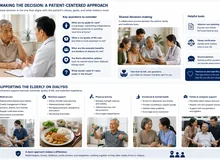
After this module you should be able to
- Give comfort, toileting and positioning help under the patient’s plan, checking with the registered nurse (RN) before food or drink.
- Explain why blood pressure can drop on standing after dialysis and why older patients fall.
- Perform and report a standing blood pressure check using the consensus definition, without interpreting treatment.
- Assist transfers within the RN’s plan, with enough helpers and equipment, never lifting a whole adult by hand.
- Treat departure as a handover: the RN decides readiness, and an unwell patient does not leave.
Climbing out of a half-empty pool
Imagine the blood vessels as a pool, and the heart as a pump drawing from it. During dialysis, the machine has lowered the water level. When the patient lies back, the pump sits low and still draws easily. When the patient stands up quickly, gravity pulls blood down into the legs, and the pump suddenly has less to draw. The brain gets less blood for a few seconds. The patient feels dizzy, the room spins, and they may fall.
The picture has a limit. A healthy body corrects this in seconds: vessels in the legs tighten and the heart speeds up. In many dialysis patients those reflexes are weak because of diabetes, age, heart disease or blood pressure medicines, and the vessels have just lost fluid. So the correction is slow or incomplete.

After fluid removal, standing pools blood in the legs and weak reflexes cannot correct it fast enough, so the brain gets less blood; sit first, stand slowly and stay close.
Comfort with clinical awareness
Help with warmth, positioning, toileting and dignity under the patient’s plan. A person who asks for help deserves a response, even when the task seems small. Report pain, nausea, dizziness, distress, and any red or broken skin over the heels, hips or back.
Ask the RN before offering food or drink. Some patients have fluid or potassium limits, swallowing problems, or diabetes that needs a specific snack at a specific time. Eating during dialysis can also lower blood pressure in some patients. Never persuade someone to drink to fix a symptom, or give a snack as a treatment for a suspected problem.
Falls in dialysis patients
Falls are common and harmful. In a prospective cohort study of 162 hemodialysis patients aged 65 or older, followed for at least a year, 47% fell. The fall rate was 1.60 falls per person-year, about twice the published rate for older people living in the community. Nineteen percent of falls caused injury. Risk factors included age, other illnesses, blood pressure before dialysis and a history of falls.1 The study came from one academic unit, so rates elsewhere may differ, but the pattern is consistent: the dialysis patient you help to stand is at high risk.
A standing blood pressure drop is one cause. A consensus statement defines orthostatic hypotension as a sustained fall in systolic blood pressure of at least 20 mm Hg, or in diastolic pressure of at least 10 mm Hg, within 3 minutes of standing.2 The definition is a description used by clinicians, not a decision rule for you. Your job is to measure as instructed, report, and keep the patient safe.
Sitting: 132/74, pulse 78. Standing at 1 minute: 104/62, pulse 96, “dizzy.”
Fall = 132 − 104 = 28 mm Hg systolic and 74 − 62 = 12 mm Hg diastolic. Either one meets the consensus definition.
Action: help him sit at once (do not complete the 3-minute reading while he is dizzy). Report: “Ma’am Jessa, Mang Rolando: sitting 132 over 74, standing at one minute 104 over 62, pulse 78 to 96, dizzy. He is sitting now.” The toolkit checks the arithmetic.

A fall of at least 20 systolic or 10 diastolic within 3 minutes of standing meets the definition; seat a dizzy patient first, then report the numbers to the RN.
- HD
- Hemodialysis
Moving people safely
Check the RN’s transfer plan: how the patient moves, the aid, the number of helpers, who leads. Lock brakes, clear the route, use non-slip footwear and the patient’s walking aid. One person counts; everyone moves together.
Manual lifting of adults is not safe for patients or staff. A National Institute for Occupational Safety and Health (NIOSH) analysis calculated about 16 kilograms (35 pounds) as the maximum load for patient-handling tasks under good conditions; above that, assistive devices should be used.3 Almost every adult weighs far more. Use slide sheets, transfer boards, gait belts and lifts as the plan says. The Support Staff Toolkit includes a lift check for boxes and bins.
Departure is a handover
Take the assigned post-dialysis observations and weight and report them. The RN decides whether the patient is ready to go. You do not clear a patient who is dizzy, bleeding from the needle sites, confused or unwell.
- Observe and weighAs assigned, with the same scale and tare rules as before dialysis.
- Ask“How do you feel standing up? Any bleeding from your arm?”
- ReportReadings, symptoms, and anything the patient told you.
- RN decidesReadiness to leave, and any instructions.
- Hand overReinforce the RN’s instructions, check belongings, confirm who is taking the patient home, keep information private.

Departure is a handover: observe, ask, report, let the RN decide readiness, then hand over to whoever takes the patient home.
Case: The tricycle is waiting
Monday, 11:00 a.m. Mang Rolando Aquino has finished dialysis; 3.2 liters were removed. His tricycle driver is honking outside; he charges extra for waiting. Mang Rolando stands up quickly from the chair, grabs the armrest, and says, “The room is spinning.” His face is pale. Bea is two steps away, holding his bag. Nurse Jessa is at the next station, removing needles from another patient.
Before reading on, decide what you would notice, whom you would tell and what you would say, what you would do within your role, and what would make you call for help at once. Then compare with the debrief below.
Notice
Communicate
Do
Escalate
The RN assessed him lying back with his legs raised; his pressure recovered within ten minutes. She reviewed his weight trend with the physician, who later adjusted his target weight. Bea told the driver he would need fifteen more minutes; the unit’s social worker later arranged a regular pickup time that allows for a recovery period.
Submit: What you say to the family and what you do.
Check your understanding
Each visit draws 5 questions at random from this module’s 10-question bank, in a shuffled order with shuffled options. Choose the single best answer for each, then select Check answers; a reason appears under every option. The target is 4 of 5 with every question marked safety-critical answered correctly (2 of the 10 are). Select New set of questions for a different mix. Nothing you select is sent anywhere; scoring happens in your browser and records self-study only. It never shows that you are competent at work.
What this module builds
| Code | The learner can | Course evidence |
|---|---|---|
| P9 | Give comfort and mobility help within the RN’s plan, prevent falls, and never let an unwell patient leave unreviewed. | Transfer and departure station |
Performance evidence for this module: Safe transfer within a plan with correct aid and helpers; standing blood pressure check and report; departure handover with RN review.
With your preceptor
Practice transfers with colleagues and training equipment before helping patients under supervision. These are prompts for supervised learning, not a procedure. Use your center’s own procedures, device instructions, contacts and forms; your preceptor observes and signs off each item on the facility’s competency record. Proposed evidence: at least three satisfactory observations across two shifts for each workplace skill that applies to you.
- Check a transfer plan and prepare brakes, route, footwear and aid.
- Assist a transfer with a slide sheet or board with the right number of helpers, one person leading.
- Perform a sitting-and-standing blood pressure check on a colleague and calculate the change.
- Practice guiding a falling person to the floor, protecting the head.
- Complete a departure handover with RN review and reinforced instructions.
Read next on this site
Cross-track and patient-guide reading is background, not practical training for the assistant role.
- Hurt Without Harm: A Guide to Safe Pain Relief in Kidney DiseaseOlder adults on dialysis, frailty and falls.
- Post-Dialysis Fatigue: Why You're Exhausted After Dialysis (And What to Do About It)Why patients feel washed out after dialysis.
Back to the Nurse Assistant / Patient Care Assistant (PCA) course home · the Nephrology Nursing course, where nurses learn the clinical reasoning behind the care you support.