After this module you should be able to
- Recognize a fistula, graft and catheter at an awareness level, and protect each during support care.
- Explain why a dislodged needle is an emergency and why the absence of an alarm is not reassurance.
- Keep the access visible and the patient observed during treatment.
- Report bleeding, displacement concerns, symptoms and alarm messages at once, with the exact facts.
- State what you never touch: needles, tape, dressings, hubs, clamps, lines and machine controls.
A garden hose under a blanket
Imagine a garden hose running at full pressure under a thick blanket. If the hose slips off the faucet, water pours out. But the blanket soaks it up. Nothing looks wrong for a while. By the time the water runs onto the floor, a lot has been lost.
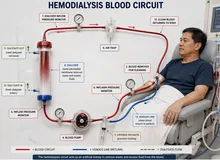
The picture has a limit. In dialysis, the hose is carrying blood. The blood pump moves about a cup or more of blood every minute through the circuit. If the needle that returns blood to the patient slips out, the pump can keep pushing blood onto the bed. The machine watches pressure in the return line, but a needle lying in a pool of blood or a soaked blanket can keep that pressure high enough that the alarm does not sound. Experts describe venous needle dislodgement as one of the most serious accidents in dialysis: if the blood pump is not stopped, a patient can bleed to death within minutes.1

If the venous needle slips out, the pump can keep pushing blood out while line pressure stays high enough that the alarm may not sound; your eyes are the second safety system.
Three kinds of access, one rule
The access is the patient’s lifeline. Without it, there is no dialysis. Kidney teams work hard to create and preserve it; the national vascular access guideline puts great weight on protecting veins and the access over a patient’s whole life.2
| Access | What it is | What you protect |
|---|---|---|
| Arteriovenous fistula (AVF) | An artery joined to a vein, usually in the arm; you can feel a buzz (thrill) | No cuff, tight sleeve, watch or bag strap on that arm; no lying on it; tell the RN if the buzz is gone |
| Arteriovenous graft (AVG) | A soft tube under the skin joining artery and vein | The same as a fistula |
| Central venous catheter | A tube in a large neck or chest vein, covered with a dressing | Never touch the hubs, caps or dressing; keep it dry; report fever or shivering at once |
Follow the RN’s plan for positioning and for which arm to use for blood pressure (Module 5). Never inspect a dressing or connection by moving it.

Fistula, graft and catheter each need protection; the assistant watches and reports but never handles the access.
- AVF
- Arteriovenous fistula
- AVG
- Arteriovenous graft
Keep the access visible
European dialysis nurses’ recommendations for preventing and catching venous needle dislodgement include keeping the needle sites and lines visible throughout treatment, securing the needles and lines well, and regular checks by staff.1 Securing the needles is the RN’s job. Keeping the site in view and noticing is where you help most.
She is cold and pulls the blanket up
- Why it matters
- A blanket over the arm hides blood and soaks it up.
- What you do
- Offer a second blanket for the body and shoulders and fold it back from the access arm. Explain why, kindly.
He is restless and keeps moving the arm
- Why it matters
- Movement can pull a needle; restlessness can also be a sign of low blood pressure or blood loss.
- What you do
- Stay with him and call the RN now. Do not restrain the arm yourself.

Keep patients warm with the blanket on the body while the access arm stays uncovered and visible.
Observe the patient, not only the machine
On your assigned rounds, ask how the patient feels and take the delegated observations. Watch for change. Many problems during dialysis show first in the patient.
| What you notice | What it might mean | What you do |
|---|---|---|
| Yawning, cramps, dizziness, nausea, sweating | Blood pressure falling as fluid is removed | Tell the RN now; stay |
| Wetness or blood near the access; a needle or tape out of place | Bleeding or dislodgement | Call the RN and the emergency route at once (below) |
| Shivering, fever, feeling cold and unwell, often with a catheter | Infection in the blood | Tell the RN now |
| New chest pain, breathlessness, confusion, drowsiness | A serious problem | Call the RN at once; Module 8 |
Write the actual findings and the time. Never write “stable” in place of what you observed; “stable” is an assessment, and assessment is the RN’s.
When an alarm sounds or you see blood
- Look at the patientAwake? Breathing? Any blood or a displaced line?
- CallThe RN, by name, with the station, what you see and the exact screen message if you can read it without touching anything.
- Major bleedingCall the emergency route at once and do exactly what your practical unit training taught you, under the team’s direction.
- StayKeep the access visible, ask the patient to keep still, keep others back.
The RN stops the pump and controls bleeding. Your speed in noticing and calling is what gives the RN time to act.

At an alarm or visible blood: look at the patient, call the RN (or the emergency route for major bleeding), stay with the access in view, and never touch the circuit.
Case: A wet blanket, no alarm
Wednesday, 8:40 a.m. Nanay Lorna Bautista, 77, is in her second hour with a left arm fistula. She complained of the cold and pulled her blanket over both arms. Bea, passing on her round, notices that the blanket near her left elbow looks darker and damp. Nanay Lorna is drowsier than usual and mumbles that she is fine. The machine is quiet. Nurse Jessa is two stations away.
Before reading on, decide what you would notice, whom you would tell and what you would say, what you would do within your role, and what would make you call for help at once. Then compare with the debrief below.
Notice
Communicate
Do
Escalate
The venous needle had partly pulled back. The RN stopped the blood pump and controlled the bleeding; the physician assessed her and ordered a blood count. She recovered. At the review, the unit agreed that blankets go over the shoulders and body, never the access arm, and added a visual check of every access to each assistant round.
Submit: What you report, to whom, and what you do not do.
Check your understanding
Each visit draws 5 questions at random from this module’s 10-question bank, in a shuffled order with shuffled options. Choose the single best answer for each, then select Check answers; a reason appears under every option. The target is 4 of 5 with every question marked safety-critical answered correctly (3 of the 10 are). Select New set of questions for a different mix. Nothing you select is sent anywhere; scoring happens in your browser and records self-study only. It never shows that you are competent at work.
What this module builds
| Code | The learner can | Course evidence |
|---|---|---|
| P7 | Keep the access visible and protected, notice bleeding and symptom change, and report without touching the circuit. | Access concern simulation |
Performance evidence for this module: Detection of simulated bleeding under a blanket and an immediate RN call; correct positioning and covering that keep the access visible; factual recording of observations.
With your preceptor
Practice in simulation with a mock arm and moulage blood, then on supervised rounds. These are prompts for supervised learning, not a procedure. Use your center’s own procedures, device instructions, contacts and forms; your preceptor observes and signs off each item on the facility’s competency record. Proposed evidence: at least three satisfactory observations across two shifts for each workplace skill that applies to you.
- Identify fistula, graft and catheter on a model and name what to protect for each.
- Cover a cold patient while keeping the access arm visible.
- Detect simulated bleeding under a blanket and call the RN with the exact facts.
- Read and relay an alarm message without touching the controls.
- Record observations as facts, without “stable.”
Read next on this site
Cross-track and patient-guide reading is background, not practical training for the assistant role.
- A Hemodialysis Access That Lasts a LifetimeThe access as the patient’s lifeline.
- Dialysis Access Care: Your LifelineHow patients care for their access at home.
- Managing Complications of HemodialysisProblems that can happen during dialysis.
Back to the Nurse Assistant / Patient Care Assistant (PCA) course home · the Nephrology Nursing course, where nurses learn the clinical reasoning behind the care you support.