After this module you should be able to
- Prepare a clean, safe station with working furniture, call access and the correct unopened supplies.
- Inspect every supply for identity, damage, moisture and expiry before it reaches the station.
- Explain why a supply that fits is not proven compatible, and hold any mismatch for authorized review.
- Describe why hands-on machine preparation needs separate device-specific sign-off.
- Respect quarantine and out-of-service labels and hand back exceptions to the registered nurse (RN).
A preflight checklist
Before an airplane takes off, the crew walks through a checklist. They do not fly the plane, but the pilot depends on their checks. A missing life vest or a loose latch is found on the ground, where it is easy to fix, not in the air.
The picture has a limit. On an airplane, the crew can see most problems. At a dialysis station, many hazards are invisible: a pinhole in a sterile pack, a dialyzer that looks like the right one but has a different membrane, a machine that passed its cleaning cycle yesterday but not today. That is why the check is done against a written list and labels, not by eye.
What a ready station needs
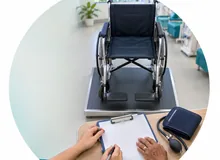
A station is ready for the clinical team when the environment is clean (Module 10), the chair or bed works and its brakes hold, the call bell or call route is within the patient’s reach, the scale and blood pressure equipment are available, and the correct unopened supplies are there, kept off contaminated surfaces.
Check the station and the patient list with the RN at the start. Report shortages early, so the RN can solve them before a patient is waiting.
Identity, integrity, expiry
Sterile supplies are only sterile while the package is intact and dry. A crushed corner, a tear, moisture or a broken seal can let microorganisms in. An expired item may no longer meet the manufacturer’s guarantee. A dialyzer or bloodline of a different model may not match the prescription or the machine, even if the connectors fit. The RN or another authorized person verifies compatibility with the prescription.
| Check | What you look for | If it fails |
|---|---|---|
| Identity | Product name and model or reference number match the list | Hold it; ask the RN to verify |
| Integrity | No tear, crush, hole, moisture or broken seal | Set aside per the unit’s defect route |
| Expiry | Date not passed | Remove from use; report |
| Storage | Kept off the floor, dry, away from direct sun and chemicals | Report the storage problem |
| Traceability | Lot numbers recorded where the unit requires | Ask the RN before using an unrecorded item |
The model number differs
- What happens
- The dialyzer on the shelf has a different reference number from the one on the list. A colleague says it is “the same, just a new box.”
- What you do
- Hold it. Ask the RN to verify. Compatibility is decided from the prescription and the product information, not from the box.
The expiry is last month
- What happens
- A bloodline pack expired three weeks ago. It looks perfect.
- What you do
- Remove it from the station, follow the unit’s expired-stock route, and tell the RN and the person in charge of stock.

Every supply is checked for identity, integrity, expiry, storage and traceability; anything that fails is held and reported, never substituted.
Helping without taking over the machine
You may gather the approved items and watch the authorized person prepare the machine. Hands-on preparation, such as priming, is a separate competency. It needs a written local task list, the manufacturer’s instructions for use (IFU), a demonstrated skill on that model and supervision. This course does not teach a priming sequence, because machines and unit workflows differ.
Some things are never part of your preparation under this course: entering treatment settings, connecting anything to a patient, mixing concentrates, overriding a failed self-test, or releasing a station for treatment. Water treatment is a specialist area governed by its own rules and staff; your role is to notice and report, never to operate or release the water system.1

Around the machine the assistant gathers items, keeps the station ready and reports faults, but never primes, sets, connects, mixes, overrides or removes a quarantine tag.
The readiness handback
Readiness support ends with a handback to the RN: what you prepared, what you checked, and what is unresolved. “Station 7 is set for Mrs. Lim. Supplies match the list, all in date. One dialyzer had a different reference number; I set it aside for you to check. The machine shows no fault.”
Case: Probably interchangeable
Thursday, 5:50 a.m. First shift. Kuya Paolo is setting Station 3 for Mr. Danilo Garcia. The preparation list names one dialyzer model. The shelf holds only a box with a different reference number. The technician, who is busy at the water room door, calls: “Use that one, it’s probably interchangeable. We changed suppliers.” The first patients arrive at 6:00.
Before reading on, decide what you would notice, whom you would tell and what you would say, what you would do within your role, and what would make you call for help at once. Then compare with the debrief below.
Notice
Communicate
Do
Escalate
The RN checked the product information and the prescription. The new model had a larger surface area; the physician confirmed it was acceptable for Mr. Garcia and updated the preparation list. Supply officers added the new reference numbers to every list before the next shift.
Submit: What you do and say.
Check your understanding
Each visit draws 5 questions at random from this module’s 10-question bank, in a shuffled order with shuffled options. Choose the single best answer for each, then select Check answers; a reason appears under every option. The target is 4 of 5 with every question marked safety-critical answered correctly (3 of the 10 are). Select New set of questions for a different mix. Nothing you select is sent anywhere; scoring happens in your browser and records self-study only. It never shows that you are competent at work.
What this module builds
| Code | The learner can | Course evidence |
|---|---|---|
| P6 | Prepare a station from the approved list, spot mismatched, damaged or expired supplies, and respect quarantine. | Station readiness with a planted mismatch |
Performance evidence for this module: Station check (brakes, call access, layout); supplies matched to the list; expiry and packaging inspection; recognition of out-of-service status; handback of exceptions.
With your preceptor
Practice with training supplies at a mock station, then under supervision in the unit. These are prompts for supervised learning, not a procedure. Use your center’s own procedures, device instructions, contacts and forms; your preceptor observes and signs off each item on the facility’s competency record. Proposed evidence: at least three satisfactory observations across two shifts for each workplace skill that applies to you.
- Check station cleanliness, brakes, call access and a safe layout.
- Match unopened supplies to the approved preparation list.
- Inspect expiry, packaging and labels, and set aside a planted defective item.
- Identify an out-of-service tag or an unresolved machine test.
- Hand back preparation status and exceptions to the RN.
Read next on this site
Cross-track and patient-guide reading is background, not practical training for the assistant role.
- Dialysis Machine Assignment by Virus StatusWhy machines are assigned and tracked.
- Hemodialysis Water Treatment SystemsHow dialysis water is made safe, and who is responsible.
Back to the Nurse Assistant / Patient Care Assistant (PCA) course home · the Nephrology Nursing course, where nurses learn the clinical reasoning behind the care you support.