Nephrology Nursing Track · By Role · Module 15 of 18
Delegation, Coaching, and Speaking Up
The five rights of delegation, feedback that works, coaching on the floor, speaking up in a Filipino workplace, and when coaching is not enough.
PublishedNailathalaGipatikPepalwal:ReferencesMga SanggunianMga TinubdanReng Reperensya:3Audience: Experienced hemodialysis nurses who take charge of a shift · nurses being prepared for charge duty · head nurses and educators who orient themRead timeOras ng pagbasaOras sa pagbasaOras ning pamamasa:
This module is study material for charge nurses in hemodialysis units. It explains the reasoning behind common decisions; it is not a protocol. On the floor, follow your unit’s protocol and always ask the attending nephrologist for guidance. Doses, limits, and cut-off values are set by your unit. Every case is fictional.
Learning objectives
After this module you should be able to
Tell exposure from competence, and delegate within the five rights.
Give feedback that is specific, timely, private, and about the act.
Coach a nurse through a skill on the floor without taking over.
Speak up to a senior colleague or physician about a safety concern, and make it easy for others to speak up to you.
Recognize when repeated unsafe practice needs the head nurse.
Pre-testBefore you read, answer the 8 self-assessment questions and note your score. After the module, select New set of questions and compare. The difference is what you learned; the questions you still miss are what to reread.
Start here
The big picture, in plain words
In plain wordsWatching a hundred cooking videos does not make someone a cook. A cook is someone who has made the dish while a chef watched, corrected, and finally stepped back.
On a hemodialysis (HD) floor, exposure is having seen or done something. Competence is having done it correctly while someone qualified watched and signed. A charge nurse who assigns by exposure (“she has seen catheter connections”) instead of competence leaves a learner alone with a high-risk task. Coaching is how exposure becomes competence, one observed task at a time.
Figure 1 · Key terms for this module
DelegationAssigning a task to another person while keeping accountability for the patient.
Five rightsRight task, circumstance, person, communication, and supervision.
FeedbackInformation about a specific act, given to help the next one.
CoachingWatching, asking, letting the learner act, stepping in only for safety, and debriefing.
CUS“I’m Concerned, I’m Uncomfortable, this is a Safety issue.”
Hiya and pakikisamaFilipino values of shame or embarrassment, and of smooth relationships.
Opening case · fictional
Case: “I didn’t want to embarrass her”
Mika, an orientee, sees Liza, a senior nurse, skip hand hygiene between two patients. Mika says nothing. Later she tells the charge nurse, Joy, “I didn’t want to embarrass her; she trained me.”
The same afternoon, Joy notices that the physician on duty has written a heparin bolus ten times the patient’s usual dose. She hesitates: he is senior, and he is busy.
Before reading on, decide:
What stops Mika and Joy from speaking up?
What words could each one use?
What does Joy do about Liza?
Keep your answers in mind. The lesson gives you what you need, and the case review near the end shows one sound response.
Lesson · part 1
The five rights of delegation
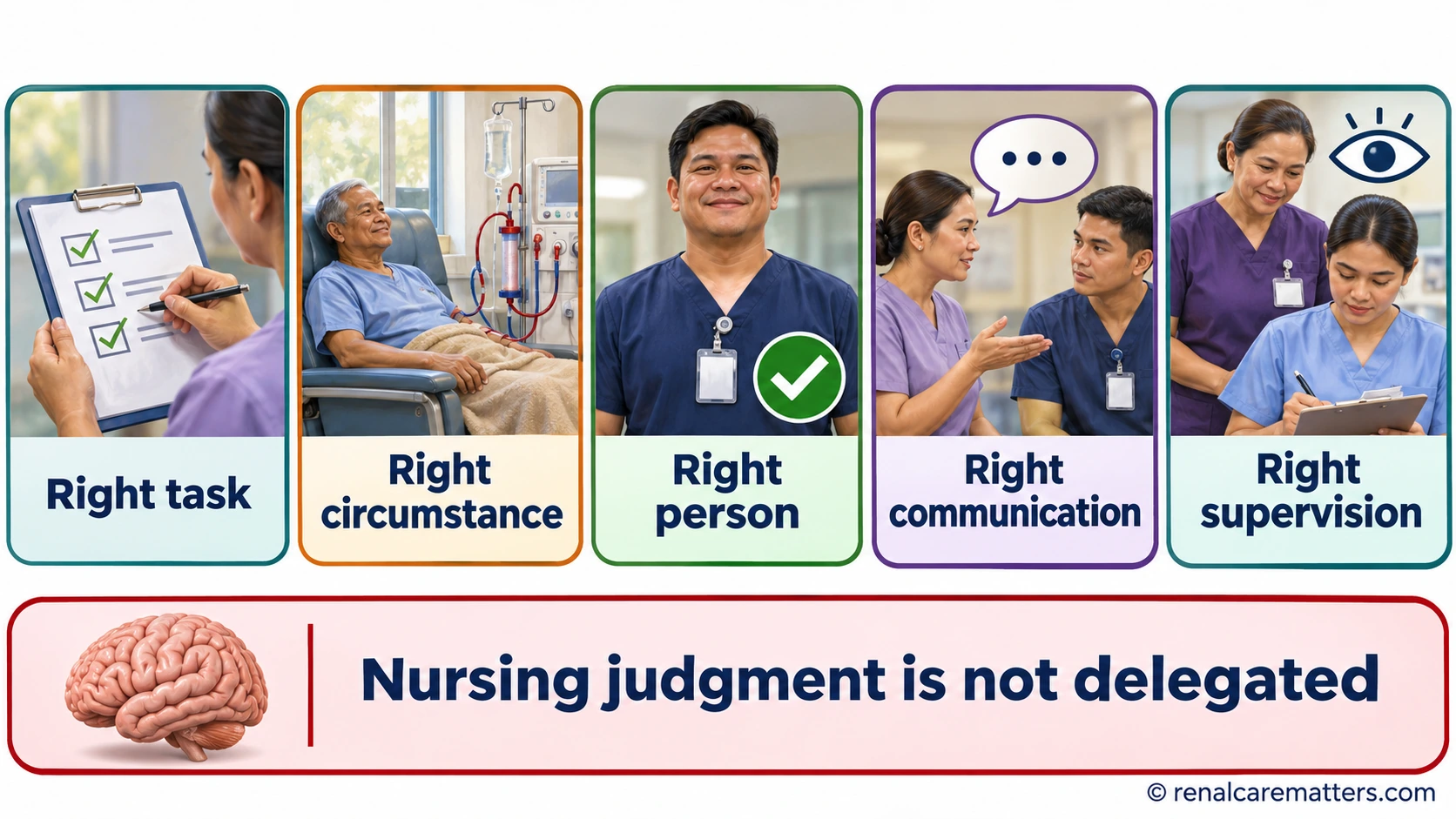
The national guidelines for nursing delegation, from the American Nurses Association and the National Council of State Boards of Nursing, describe five rights: the right task, under the right circumstances, to the right person, with the right directions and communication, and with the right supervision and evaluation.1 The licensed nurse who delegates stays accountable for the patient; the person who accepts the task is responsible for doing it well. Nursing judgment itself is never delegated.
Figure 2. Five rights of delegation. Nursing judgment is never delegated.
Request to an assistant
Delegable?
Why
Weigh patients and record the weights
Yes, with clear instructions
A defined task with a clear result
Take a pressure and report it if below a number you give
Yes, with the number and when to call
The nurse keeps the judgment
Decide whether a patient is well enough to connect
No
That is nursing judgment
Prepare and give heparin
No
A high-alert medicine for licensed staff
Lesson · part 2
Feedback that works
Good feedback is specific (what you saw), timely (today), private, about the act rather than the person, and paired with what to do next. “At Bed 4, gloves went from the catheter to the bed rail without a change. Next time, change gloves and clean your hands before touching the rail” changes practice. “Be careful with infection control” does not.
Lesson · part 3
Coaching on the floor
Watch first. Ask what the learner will do next. Let her do it. Step in only for safety. Debrief for two minutes afterward: what went well, one thing to change. Then write it down. The competence record is how the next charge nurse knows what this nurse can do alone.
On the floor · Stepping in without taking over
Mika is about to connect a catheter with Arnel watching. She opens the cap and turns to answer a patient. Arnel says quietly, “Hub first.” She turns back, scrubs the hub, connects. Afterward: “You did everything in order except turning away with the hub open. What will you do if someone calls you next time?” “Ask them to wait.” Arnel signs the second of three observed connections.
Illustrative scenario. Names and details are invented.
Lesson · part 4
Speaking up in a Filipino workplace
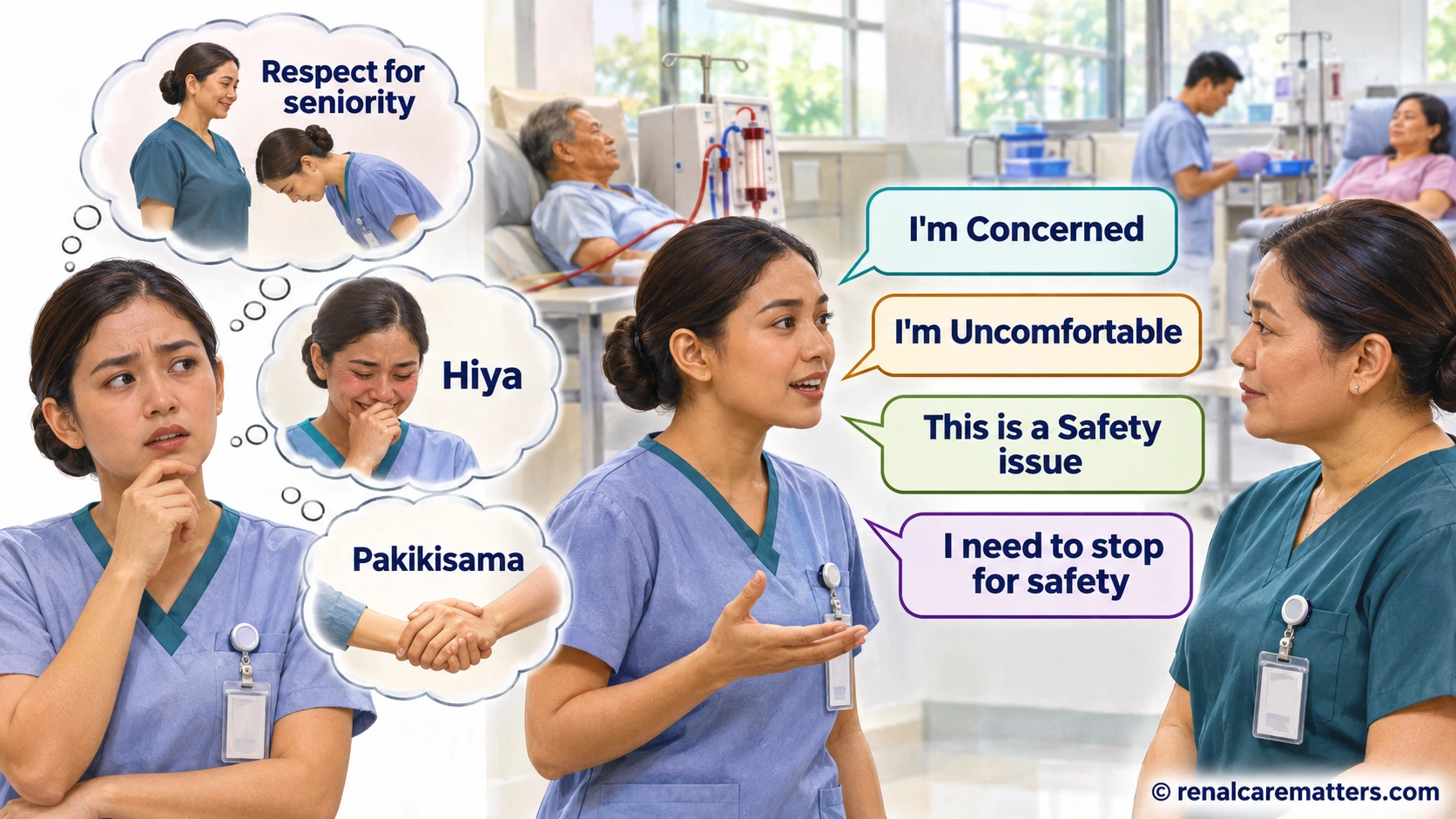
Respect for seniority, hiya (shame or embarrassment), and pakikisama (keeping relationships smooth) are strengths in a team. They can also silence a safety concern, especially from a junior nurse to a senior one, or from a nurse to a physician.
Figure 3. Respect, hiya, and pakikisama can silence a safety concern. Shared words make speaking up easier.
Two tools help. A shared phrase that everyone agrees means “stop and listen,” whoever says it: “I need to stop for safety.” And a structured format such as CUS: “I’m Concerned. I’m Uncomfortable. This is a Safety issue.” Each step is harder to dismiss than the last. The charge nurse makes speaking up safe by thanking anyone who stops her, out loud.
Lesson · part 5
Burnout, engagement, and the charge nurse
In a study of 520 Philippine nurses, burnout was associated with less caring behavior, partly through lower work engagement and motivation.2 In hospital nurses in Central Philippines, higher work engagement was associated with less burnout and less intention to leave.3 Both studies were cross-sectional, so they show association, not cause. A charge nurse cannot fix pay or staffing. Fair assignments, protected breaks, and respectful feedback are within her control, and they are the conditions in which engagement grows.
Lesson · part 6
When coaching is not enough
Repeated unsafe practice after clear feedback goes to the head nurse, with dates, what you saw, and what you already tried. That is not betrayal. It protects patients and gives the nurse a fair process with support, instead of rumors.
On the floor
Real situations: problems and solutions
These are fictional but typical. For each one, cover the answer, decide what you would do, then compare. Where a step depends on local rules, your unit’s procedure and your supervisor’s direction come first.
The assistant and the catheter patient
What you see
You ask an assistant to watch a catheter patient’s pressure.
What is likely going on
A delegable task, if the instructions are clear.
What to do
Tell her the number at which to call you, and how often to check.
Why it matters
You keep the judgment; she does the task.
“Can you give the heparin?”
What you see
A busy nurse asks the assistant to give heparin.
What is likely going on
A high-alert medicine delegated outside the rules.
What to do
Stop it; heparin is given by licensed staff. Do it yourself or reassign.
Why it matters
Delegation has limits for good reasons.
The senior who brushes you off
What you see
A senior nurse waves away your concern about a skipped check.
What is likely going on
Hierarchy is outweighing safety.
What to do
Repeat the concern with CUS, then escalate to the head nurse or physician if needed.
Why it matters
Safety concerns rise until they are heard.
Field notes
Signed off, not seen.
Praise in public, correct in private.
Thank the person who stops you.
Case review
Back to the case: “I didn’t want to embarrass her”
What stops them. Respect, hiya, and pakikisama: Mika does not want to shame the nurse who trained her; Joy does not want to challenge a busy senior physician. Both are good instincts pointing the wrong way at a safety moment.
The words. To the physician: “Doctor, I’m concerned about the heparin bolus. The order says 10,000 units; her usual is 1,000. Can we check it together before I give it?” He looks: a slip of the pen. He corrects it. To Mika, Joy says: “Thank you for telling me. Next time you can say to anyone, even me, ‘I need to stop for safety.’” They practice the phrase.
About Liza. At the end of the shift, privately: “Liza, between Beds 6 and 7 this morning I saw gloves changed without hand hygiene. I know you know the rule. Was something getting in the way?” The sanitizer at Bed 6 was empty and Liza was rushing. Joy has it refilled and notes the observation. If it happens again after this, it goes to the head nurse with dates.
Skills lab · with your preceptor
Skills checklist: Delegation, coaching, speaking up
Role-play three conversations with a facilitator, and coach one real skill on the floor. Your preceptor rates each step as satisfactory, needs practice, or not observed. Steps marked Critical must all be satisfactory before sign-off. This checklist supports supervised learning; your unit’s own procedure and competency form are the authority. A printable version of every checklist is on the trainer page.
CriticalApplies the five rights to two delegation requests and refuses one that is not delegable.
CriticalGives specific, private feedback about an act, with a next step.
Coaches a skill without taking over, and debriefs.
Records the observation in the competence record.
CriticalUses CUS or the stop phrase with a senior colleague or physician.
Thanks a junior colleague who speaks up.
Describes how to escalate repeated unsafe practice with documentation.
Placement activity. For two weeks, note each time someone stopped or questioned you, and how you responded.
Self-assessment
Check your understanding
Each visit draws 8 questions at random from this module’s 15-question bank. Choose the single best answer for each, then select Check answers; an explanation appears under the best answer. Select New set of questions for a different mix. A good target is 7 of 8 on two different sets. Nothing you select is sent anywhere; scoring happens in your browser.
American Nurses Association & National Council of State Boards of Nursing. (2019). National guidelines for nursing delegation. Retrieved November 24, 2026, from https://www.nursingworld.org/globalassets/practiceandpolicy/nursing-excellence/ana-position-statements/nursing-practice/ana-ncsbn-joint-statement-on-delegation.pdf
Labrague, L. J. (2024). The impact of job burnout on nurses' caring behaviors: Exploring the mediating role of work engagement and job motivation. International Nursing Review, 71(3), 653–660. https://doi.org/10.1111/inr.12899
Falguera, C. C., Labrague, L. J., Firmo, C. N., De Los Santos, J. A. A., & Tsaras, K. (2023). Relationship of work engagement with nurse work and patient outcomes among nurses in Central Philippines. Acta Medica Philippina, 57(4), 24–31. https://doi.org/10.47895/amp.vi0.4426
Educational study material for nurses. Does not replace the attending nephrologist’s orders, the unit’s protocols, required training and certification, or supervised practice.