Nephrology Nursing Track · By Role · Module 6 of 18
The Order, the Machine, and the Minutes
What each line of the order does, the read-aloud three-way check, why delivered time decides the dose, and the patient who asks to stop early.
PublishedNailathalaGipatikPepalwal:ReferencesMga SanggunianMga TinubdanReng Reperensya:4Audience: Experienced hemodialysis nurses who take charge of a shift · nurses being prepared for charge duty · head nurses and educators who orient themRead timeOras ng pagbasaOras sa pagbasaOras ning pamamasa:
This module is study material for charge nurses in hemodialysis units. It explains the reasoning behind common decisions; it is not a protocol. On the floor, follow your unit’s protocol and always ask the attending nephrologist for guidance. Doses, limits, and cut-off values are set by your unit. Every case is fictional.
Learning objectives
After this module you should be able to
Explain what each main line of a hemodialysis order does in the body.
Run a two-person, read-aloud check of the order, the machine, and the patient before connection.
Explain why delivered time and blood flow, not prescribed time, decide the dose of dialysis.
Count minutes lost to late starts, early stops, and alarm pauses, and act on them.
Respond to a patient who asks to come off early by finding the reason.
Pre-testBefore you read, answer the 8 self-assessment questions and note your score. After the module, select New set of questions and compare. The difference is what you learned; the questions you still miss are what to reread.
Start here
The big picture, in plain words
In plain wordsA dialysis order is like a recipe. If the oven runs cooler than the dial says, or the cake comes out ten minutes early, it is not the cake on the recipe card, however carefully the ingredients were measured.
The recipe picture holds well. The dose of dialysis depends on the blood actually cleaned: the real blood flow through the dialyzer, the real dialysis fluid flow, and the real minutes on the machine. The machine can display the right numbers while the access sends cleaned blood straight back into the needle (recirculation), or the session is cut short. Prescribed is not the same as delivered.
Figure 1 · Key terms for this module
DialysateThe dialysis fluid on the other side of the membrane; its potassium, sodium, bicarbonate, and calcium are prescribed.
Three-way checkOrder, machine, and patient compared aloud by two people before connection.
Kt/VA measure of the dose of dialysis: how much of the body’s water is cleared of urea in a session.
Delivered timeThe minutes the patient actually spent on the machine with blood flowing.
RecirculationCleaned blood returning straight into the arterial needle, which lowers the real dose.
Opening case · fictional
Case: “She always asks to come off early”
Mrs. Teresita Lim, 58, is prescribed four hours three times a week. Over the last month she has averaged three hours twenty-five minutes: some late arrivals, two early stops for cramps, and frequent alarm pauses. Her last single-pool Kt/V (spKt/V) was 1.12. Her dry weight is 55 kilograms and she often arrives 3.5 kilograms above it.
The staff nurse says, “She signs the refusal form, so it’s fine.”
Before reading on, decide:
How much dialysis has she lost in a month?
What is behind the early stops?
What does the charge nurse do, and who else is involved?
Keep your answers in mind. The lesson gives you what you need, and the case review near the end shows one sound response.
Lesson · part 1
What each line of the order does
Every line of a dialysis order changes something specific in the body. The dialyzer and blood flow set how much blood is cleaned. Time sets for how long. The dialysate potassium sets how fast potassium falls, and how low. Sodium affects thirst and pressure. Bicarbonate corrects acid. Temperature affects pressure stability. The fluid goal sets the ultrafiltration rate (Module 5). Anticoagulation keeps the circuit from clotting.
Figure 2. Each line of the order changes something specific in the body.
The potassium line shows why exact matching matters. In a case-control study of patients who had sudden cardiac arrest in United States dialysis clinics, a dialysate potassium below 2 mmol/L was associated with arrest.1 A bath of 1.0 instead of 2.0, picked by mistake, is not a small difference.
Lesson · part 2
The three-way check
Before connection, two people read the order aloud against the machine screen and the patient’s identity and access. The four lines that most often differ are the dialysate potassium, the fluid goal, the time, and the anticoagulation. A check done by one person reading silently catches less, because the eye sees what it expects.
On the floor · The bath that did not match
Nurse Rhea Gonzales and the charge nurse read Bed 4’s order aloud at 6:20. “Potassium two.” Rhea looks at the screen: the machine is set to 1.0, left over from the previous patient on that machine. They change it before connection and report it as a near miss. At the next huddle, the charge nurse asks everyone to reset the dialysate settings when a machine is turned over between patients.
Illustrative scenario. Names and details are invented.
RememberRead it aloud, two people, before the needle. Silent checks see what they expect.
Lesson · part 3
The dose depends on delivered time
The National Kidney Foundation Kidney Disease Outcomes Quality Initiative (KDOQI) recommends a target spKt/V of 1.4 per thrice-weekly session, with a minimum delivered of 1.2.2 The Hemodialysis (HEMO) Study randomized patients to a higher or a standard dose and found that the higher dose did not improve survival.3 The lesson is not “more is always better.” It is that falling below the standard dose is harm.
In the international Dialysis Outcomes and Practice Patterns Study (DOPPS), shortening sessions was associated with higher mortality, and missing sessions with more.4 These findings are observational: patients who shorten may differ in other ways. The direction is consistent, and the mechanism is simple: less time, less cleaning, faster fluid removal.
Lesson · part 4
Where the minutes go
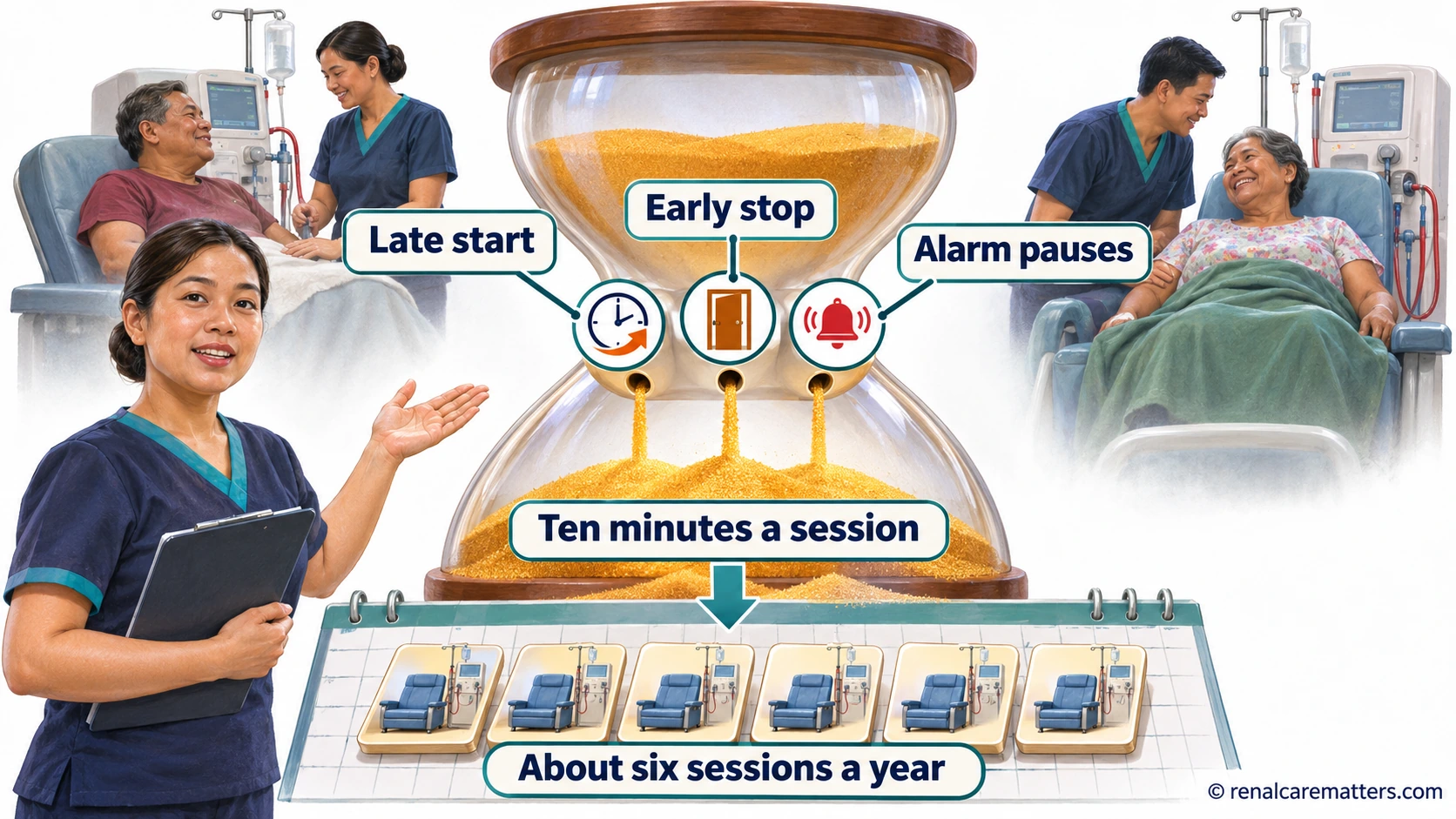
Late starts, early stops, and alarm pauses all subtract. Ten minutes a session is thirty minutes a week, about twenty-six hours a year: more than six full four-hour sessions. The unit sees these losses only if someone counts them.
Figure 3. Where the minutes go. Ten minutes a session adds up to about six full sessions a year.
Put the end time on the board and count minutes lost per chair at each shift. Minutes added back at the end are not lost. Minutes not given back are dialysis that never happened, whatever the record says (Module 17).
Lesson · part 5
The patient who wants to stop early
A request to stop early is a symptom, not a personality. Cramps, low pressure, a wet catheter dressing, a job, a ride that leaves at 10:00, depression, and boredom each have different answers. Ask why, tell the patient what the lost minutes mean in plain words, tell the physician, and record the reason and the minutes.
A signed refusal form records a decision. It does not end the problem, and it does not protect the patient. If the reason is fixable, fix it.
On the floor · The 10:00 tricycle
Mr. Romeo Salazar, 49, comes off twenty minutes early every Wednesday. The charge nurse asks why. His neighbor drives the tricycle to the market at 10:15 and is his only ride home. She asks the head nurse whether he can move to the 5:30 slot on Wednesdays. He can. His Wednesday sessions are now full length, and no form was needed.
Illustrative scenario. Names and details are invented.
On the floor
Real situations: problems and solutions
These are fictional but typical. For each one, cover the answer, decide what you would do, then compare. Where a step depends on local rules, your unit’s procedure and your supervisor’s direction come first.
Bath 1.0, order 2.0
What you see
The machine’s dialysate potassium does not match the order.
What is likely going on
The machine kept the previous patient’s setting.
What to do
Stop, correct before connection, and report a near miss. Ask for a reset step at turnover.
Why it matters
A low-potassium bath has been associated with cardiac arrest.
The alarm that keeps pausing the pump
What you see
A patient’s pump stops every few minutes.
What is likely going on
The access, a kinked line, or the arm position.
What to do
Find the cause with the nurse and count the paused minutes.
Why it matters
Paused minutes are lost dialysis.
The 10:00 ride
What you see
A patient’s only ride home leaves before her session ends.
What is likely going on
Transport, not unwillingness.
What to do
Move her to an earlier slot or arrange transport with the head nurse.
Why it matters
Fix the reason, not the minutes.
Field notes
Read it aloud, two people.
Count minutes, not sessions.
An early stop is a symptom.
Case review
Back to the case: “She always asks to come off early”
The lost minutes. Prescribed: 240 minutes × 12 sessions = 2,880 minutes a month. Delivered: 205 minutes on average × 12 = 2,460 minutes. Lost: 420 minutes, about 1.75 sessions a month, or about 21 sessions a year (Toolkit #c4).
Behind the early stops. Her cramps happen in the last hour on days when she arrives 3.5 kilograms over. Removing 3.5 liters in four hours from a 55-kilogram woman is about 15.9 mL/kg/h, above 13. Fast removal causes cramps; cramps cause early stops; early stops leave more fluid for next time. The low Kt/V follows from the lost minutes and alarm pauses.
What the charge nurse does. She asks the attending nephrologist to review the dry weight and fluid targets and whether a longer or extra session is needed. She refers Mrs. Lim to the dietitian for salt and fluid advice. She asks about her travel and work, and checks the access for the cause of the alarm pauses. She starts counting minutes on the board. The refusal form stays in the chart, but it is not where the story ends.
Skills lab · with your preceptor
Skills checklist: Order, machine, minutes
Run the three-way check on five connections and audit one week of delivered time for one pod. Your preceptor rates each step as satisfactory, needs practice, or not observed. Steps marked Critical must all be satisfactory before sign-off. This checklist supports supervised learning; your unit’s own procedure and competency form are the authority. A printable version of every checklist is on the trainer page.
Explains four order lines in physiologic terms.
CriticalRuns a two-person, read-aloud check before every connection observed.
CriticalStops and corrects a mismatch before connection and reports it as a near miss.
Calculates minutes lost per patient per month.
CriticalAsks for the reason before accepting an early stop.
CriticalRecords the reason, minutes, and the physician notified.
Proposes one fix for a recurring reason (transport, cramps, alarms).
Placement activity. For one week, record prescribed and delivered minutes for every patient in one pod and present the losses at the huddle.
Self-assessment
Check your understanding
Each visit draws 8 questions at random from this module’s 15-question bank. Choose the single best answer for each, then select Check answers; an explanation appears under the best answer. Select New set of questions for a different mix. A good target is 7 of 8 on two different sets. Nothing you select is sent anywhere; scoring happens in your browser.
Go deeper
Read next on this site
Dialysis AdequacyHow the dose of dialysis is measured and why it matters.
Pun, P. H., Lehrich, R. W., Honeycutt, E. F., Herzog, C. A., & Middleton, J. P. (2011). Modifiable risk factors associated with sudden cardiac arrest within hemodialysis clinics. Kidney International, 79(2), 218–227. https://doi.org/10.1038/ki.2010.315
National Kidney Foundation. (2015). KDOQI clinical practice guideline for hemodialysis adequacy: 2015 update. American Journal of Kidney Diseases, 66(5), 884–930. https://doi.org/10.1053/j.ajkd.2015.07.015
Eknoyan, G., Beck, G. J., Cheung, A. K., Daugirdas, J. T., Greene, T., Kusek, J. W., Allon, M., Bailey, J., Delmez, J. A., Depner, T. A., Dwyer, J. T., Levey, A. S., Levin, N. W., Milford, E., Ornt, D. B., Rocco, M. V., Schulman, G., Schwab, S. J., Teehan, B. P., . . . Hemodialysis (HEMO) Study Group. (2002). Effect of dialysis dose and membrane flux in maintenance hemodialysis. New England Journal of Medicine, 347(25), 2010–2019. https://doi.org/10.1056/NEJMoa021583
Saran, R., Bragg-Gresham, J. L., Rayner, H. C., Goodkin, D. A., Keen, M. L., Van Dijk, P. C., Kurokawa, K., Piera, L., Saito, A., Fukuhara, S., Young, E. W., Held, P. J., & Port, F. K. (2003). Nonadherence in hemodialysis: associations with mortality, hospitalization, and practice patterns in the DOPPS. Kidney International, 64(1), 254–262. https://doi.org/10.1046/j.1523-1755.2003.00064.x
Educational study material for nurses. Does not replace the attending nephrologist’s orders, the unit’s protocols, required training and certification, or supervised practice.